

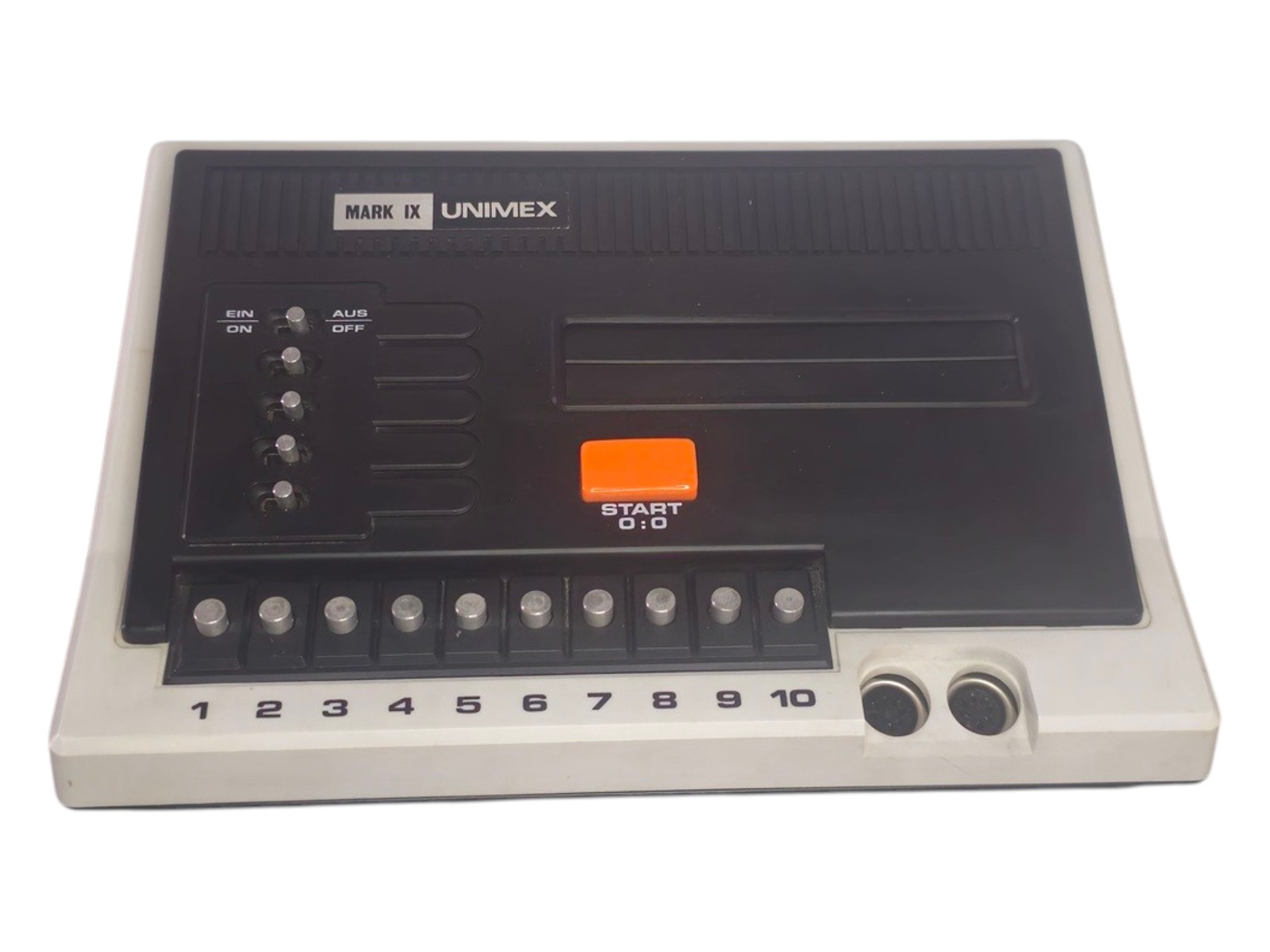
The Unimex Mark IX is a rare and historically fascinating cartridge-based television game console from the late 1970s. Marketed in West Germany by Unimex / Unicom Consumer Electronics, the system represents an important transitional stage between the earliest dedicated Pong consoles and the later programmable home video game systems that would dominate the industry.
Unlike conventional Pong consoles with a fixed selection of built-in games, the Unimex Mark IX used interchangeable electronic cartridges, frequently described as Video-Cassetten.
These cartridges were fundamentally different from modern ROM game cartridges. Instead of merely storing software, they contained dedicated electronic circuits that generated the actual games.
Its distinctive design featured ten numbered game-selection buttons, four configuration switches, two detachable joystick controllers, an RF television connection, and the ability to operate from batteries or an external power adapter.
The system was associated with a family of closely related consoles sold under several European brands, including Conic, Sanwa, Mustang, Poppy, Nicole, and Sheen.
Although relatively obscure today, the Unimex Mark IX provides an excellent example of the technological experimentation that characterised the first generation of home video gaming.
It represents a period when manufacturers were beginning to recognise that consumers wanted to expand their gaming libraries without replacing the entire console.
📘 Introduction
The Unimex Mark IX, also known through the Unimex TV-10 Color naming, appeared in the German consumer electronics market around 1978.
Some historical catalogues associate the model with 1979, reflecting the limited surviving documentation of these early European gaming systems.
The console was marketed under the Unimex name by Unicom Consumer Electronics, a company based in Wiesbaden, West Germany.
Its hardware belongs to a family of Asian-manufactured electronic television game systems distributed internationally under different brand names.
Main Characteristics
- Cartridge-based electronic television gaming
- Pong-generation hardware architecture
- Colour graphics output
- Ten numbered game-selection buttons
- Four game-configuration switches
- Separate Start/Reset button
- Two detachable joystick controllers
- Seven-pin DIN controller connections
- Built-in audio speaker
- RF television output
- External 9V DC power capability
- Battery operation using six 1.5V cells
- Dedicated game-generation integrated circuits inside cartridges
The Mark IX was considerably more flexible than ordinary fixed-game Pong machines.
Its interchangeable cartridges could introduce new types of games using different dedicated electronic circuits.
However, it was not a programmable console in the modern sense.
The games were primarily implemented through special-purpose hardware rather than software executed by a conventional microprocessor.
This distinction makes the Mark IX a particularly interesting milestone in gaming history.
🏭 Unimex & the West German Consumer Electronics Market
During the 1970s, the European consumer electronics industry experienced rapid growth.
Televisions, electronic calculators, cassette recorders, and other household devices became increasingly affordable.
Video games represented a new and exciting market.
The Rise of Pong Systems
Following the commercial success of Atari’s arcade Pong in 1972 and the emergence of dedicated home television games, numerous companies began selling similar systems.
Many were designed around dedicated game-generation integrated circuits.
These devices could be manufactured at relatively low cost and sold under different brands.
Unicom Consumer Electronics
The Unimex brand was associated with Unicom Consumer Electronics, based in Wiesbaden, West Germany.
The company marketed various electronic gaming products during the late 1970s.
The Mark Series
Known Unimex television game models included:
- Unimex Mark III
- Unimex Mark IV
- Unimex Mark V
- Unimex Mark V-B
- Unimex Mark V-C
- Unimex Mark VI
- Unimex Mark VII
- Unimex Mark VIII
- Unimex Mark IX
- Unimex Mark X
These systems did not all share the same hardware.
Some were conventional dedicated Pong consoles, while others introduced interchangeable game cartridges.
An Evolving Product Range
The Mark series demonstrates the rapid development of consumer gaming technology.
Within a relatively short period, manufacturers moved from fixed collections of simple ball games towards more flexible systems capable of offering different game types.
The Mark IX’s Position
The Mark IX represented the cartridge-based stage of this evolution.
It allowed consumers to access new hardware-generated games without purchasing a completely new television console.
🌏 Manufacturing & International Rebranding
One of the most interesting aspects of the Unimex Mark IX is its relationship with other Pong-era systems.
During the 1970s, numerous consumer electronics products were manufactured in Asia and distributed by European companies under local brand names.
Manufacturing Origins
Documented examples of the Mark IX hardware family have been associated with manufacturing in Hong Kong.
Unimex marketed the product in West Germany.
This distinction between manufacturing location and distributing brand was common in the consumer electronics industry.
Related Console Names
Closely related systems appeared under names including:
The degree of cosmetic and electrical similarity varied between individual versions.
An Early Example of Rebranding
The same underlying hardware concepts could appear in different countries with modified branding, colours, packaging, or accessories.
Why This Matters
The Mark IX should not be understood only as an isolated German console.
It belongs to a wider international family of cartridge-based television games.
The Importance of Regional Documentation
Different product names and cartridge labels can obscure relationships between otherwise similar systems.
For collectors, identifying the physical connector, electronic circuitry, and original cartridge family is essential.
🖥️ The Distinctive Mark IX Design
The Unimex Mark IX features a characteristic late-1970s plastic enclosure.
Its appearance combines utilitarian controls with a distinctly experimental consumer-electronics design.
Known Colour Variations
Documented versions include:
- Black upper housing with contrasting white edging
- White upper housing with contrasting black edging
The exact colour combination should be verified for each individual console.
Top-Mounted Cartridge Slot
The upper surface includes a prominent cartridge connection.
The interchangeable game cartridge forms an important part of the console’s appearance.
The Control Panel
The console provides several directly accessible controls:
- On/Off switch
- Four configuration switches
- Ten numbered game-selection buttons
- Start/Reset button
- Controller connections
German & English Labelling
Some controls use bilingual markings.
Examples include:
- EIN / ON
- AUS / OFF
- START 0:0
These labels reflect the console’s European marketing and intended accessibility.
A Design Before Modern Console Interfaces
Unlike later game systems, the Mark IX does not feature an on-screen menu controlled through software.
The player interacts directly with hardware switches and buttons.
An Important Historical Characteristic
The control panel illustrates how early home gaming relied on physical configuration rather than software-based settings.
⚙️ Technical Specifications
The Unimex Mark IX uses a dedicated game-chip architecture rather than a conventional software-driven console design.
Hardware Overview
- Brand: Unimex
- Distributor: Unicom Consumer Electronics
- Distributor location: Wiesbaden, West Germany
- Console: Mark IX
- Alternative name: TV-10 Color
- Approximate introduction: 1978
- Historical generation: First-generation / transitional cartridge-based TV game
- Original manufacturing region: Hong Kong, according to documented related hardware
- Main technology: Dedicated video-game integrated circuits
- General-purpose CPU in base console: None
- Game processing: Integrated circuits contained in interchangeable cartridges
- Typical game IC: General Instrument AY-3-8610 in the Superstar cartridge
- Graphics: Hardware-generated 2D video
- Colour: Supported
- Sound: Integrated speaker
- Controllers: Two detachable joystick controllers
- Controller connectors: Seven-pin DIN
- Game selection: Ten numbered hardware buttons
- Game settings: Four switches
- Display connection: Analogue RF television output
- Storage media: Electronic game cartridges
- External power: 9V DC, centre-positive on a documented Mark IX example
- Battery power: Six 1.5V C-size cells
- Standard cartridge family: Unimex electronic Video-Cassetten
- Optional game types: Ball games, racing, combat, and target-based games
The precise electrical details of an individual unit should be confirmed using its original label and internal hardware.
This is especially important for power supplies and cartridge compatibility.
🧠 A Console Without a Conventional CPU
The Mark IX uses a fundamentally different approach from modern gaming consoles.
Today, a console normally contains a central processor, graphics hardware, memory, and software stored on a game cartridge or disc.
The Mark IX operates differently.
Dedicated Game Electronics
The game-generation circuitry is located primarily inside the cartridge.
For example, the Superstar cartridge contains a specialised integrated circuit capable of generating multiple Pong-style games.
No General-Purpose Software Execution
The base console does not have a conventional programmable CPU executing a game stored in ROM.
Instead, dedicated electronics generate the game’s:
- Moving objects
- Scoring
- Ball behaviour
- Collision responses
- Control signals
- Sound effects
What the Base Console Provides
The main console supplies functions such as:
- Electrical power
- Controller connections
- Game-selection inputs
- Configuration switches
- Television output
- Audio reproduction
Why the Cartridge Matters So Much
The cartridge is not simply a container for game data.
It is a significant part of the actual game hardware.
An Important Technological Distinction
This places the Mark IX between conventional dedicated Pong machines and later software-based cartridge consoles.
It demonstrates an alternative approach to expanding a home gaming system.
💾 The Electronic Video-Cassette System
The Mark IX uses interchangeable game cartridges commonly described as Video-Cassetten.
Despite the name, these devices are not magnetic videotapes.
They are electronic modules containing dedicated integrated circuits.
How a Cartridge Works
A cartridge connects to the console through a multi-contact electrical connector.
The console provides power and connects the cartridge circuitry to the controllers and television-output electronics.
The Cartridge-Based Concept
Different cartridges can provide different game hardware.
A single cartridge may contain multiple game variations.
A Significant Improvement Over Fixed Games
In many early Pong consoles, the available games were permanently built into the device.
With the Mark IX, consumers could purchase additional cartridges.
Important Limitations
These cartridges are not comparable to modern program ROMs.
They do not ordinarily contain independently programmable software executed by the main console.
Connector Differences
The Mark IX cartridge connector is documented as having 22 contacts on each side.
This is particularly important when comparing cartridges from other manufacturers.
Why Compatibility Cannot Be Assumed
Cartridges with similar games or related integrated circuits may use physically different connectors.
Using an incompatible cartridge can damage the connector or electronics.
For preservation purposes, compatibility should be verified electrically and physically rather than inferred from appearance alone.
🧩 General Instrument: The Technology Behind Early Pong Consoles
The American semiconductor company General Instrument played an important role in the development of dedicated home video game systems.
Its integrated circuits allowed manufacturers to produce electronic games without developing all the underlying circuitry independently.
The AY-3-8500 Family
One of General Instrument’s best-known products was the AY-3-8500, a dedicated Pong-style game chip.
It appeared in numerous consoles during the 1970s.
The Evolution of Game Chips
Later chips introduced different gameplay types and capabilities.
These included circuits for:
- Ball-and-paddle games
- Motorcycle racing
- Car racing
- Tank battles
- Submarine games
- Breakout-style games
- Shooting games
A Modular Industry
Manufacturers could use General Instrument technology to create different television games.
The Mark IX Approach
The Mark IX’s cartridges made this modular concept especially visible.
Instead of hiding all game-generation hardware permanently inside the console, different electronic game circuits could be supplied through replaceable modules.
A Significant Historical Example
The system demonstrates how semiconductor manufacturers influenced the early video game industry.
Dedicated integrated circuits helped make home television games affordable and commercially practical.
🏓 The Superstar Cartridge: Ten Games in One Module
One of the most important cartridges associated with the Unimex Mark IX is:
Unimex Cassette 901 – Superstar / Olympische Ball Spiele
This cartridge was supplied with documented original retail packages.
It uses the General Instrument AY-3-8610 integrated circuit.
The AY-3-8610
The AY-3-8610 is a dedicated electronic game chip capable of producing ten selectable game variations.
These games concentrate on ball-and-paddle competition and target-based activities.
The Ten Games
Documented cartridge labels identify:
- Tennis
- Hockey
- Squash
- Practice
- Soccer
- Basketball
- Basketball Practice
- Gridball
- Target 1
- Target 2
Selecting a Game
The player presses one of the console’s ten numbered buttons.
The cartridge circuitry generates the selected game.
More Than Simple Tennis
Although the graphics are primitive by modern standards, the games offer different rules and arrangements.
These include variations in:
- Paddle positioning
- Ball movement
- Scoring
- Goals
- Target behaviour
- Single-player and multiplayer activities
A Compact Gaming Collection
One electronic cartridge offered ten related games.
This was an attractive concept during the late 1970s, when even simple electronic entertainment devices could be relatively expensive.
🎛️ Game Selection & Difficulty Controls
The Mark IX provides an unusually extensive physical control panel for an early Pong-era system.
Ten Selection Buttons
Buttons numbered 1 through 10 allow players to select games or variations supported by the inserted cartridge.
The available functions depend on the cartridge.
Four Configuration Switches
The Superstar cartridge uses switches associated with settings such as:
- Ball speed
- Left paddle size
- Right paddle size
- Automatic or manual service
Ball Speed
The speed control changes how the game behaves.
Different settings can make certain games easier or more challenging.
Paddle Size
Players can select larger or smaller paddle sizes.
Smaller paddles generally require more precise movement.
Automatic vs. Manual Service
The service switch controls how play begins or resumes.
In manual mode, a player may use the controller button to initiate an action.
Start/Reset
The marked START 0:0 button provides a way to begin again with the score reset.
A Hardware-Based User Interface
Every setting is controlled through physical switches.
The Mark IX therefore provides an excellent example of user-interface design before graphical menus became common in home gaming.
🕹️ The Two Joystick Controllers
The original Unimex Mark IX system was designed for two detachable joystick controllers.
These are different from the rotating paddle controllers used by many early Pong consoles.
Controller Features
- Separate handheld enclosure
- Multi-directional joystick
- Red action button
- Wired connection
- Seven-pin DIN connector
Analogue-Style Movement
The joysticks provide positional control through an analogue-style mechanism.
This allows the player to move the on-screen object according to the requirements of the game.
The Action Button
The button can be used for:
- Manual service
- Firing
- Starting certain actions
- Other cartridge-specific functions
A More Flexible Controller
The multi-directional joystick is useful for games beyond traditional vertical paddle movement.
The Importance of Detachable Controllers
Separate controllers allow players to sit at a convenient distance from the television.
Preservation Significance
Original controllers are important components of a complete Mark IX system.
Their electrical connections and mechanical construction should be preserved carefully.
🎮 Other Game Cartridges
The Mark IX belonged to a wider family of electronic cartridge systems offering several game types.
Contemporary packaging and collector documentation identify cartridges covering activities such as:
- Motorcycle racing
- Car racing
- Tank battles
- Submarine combat
- Breakout-style games
- Shooting-gallery games
- Ball-and-paddle variations
Motorcycle Racing
Motorcycle cartridges use dedicated circuitry to simulate racing and obstacle-based gameplay.
Car Racing
Car-racing modules provide driving-related challenges using simple electronic graphics.
Tank Battle
Tank games introduce direct combat between player-controlled vehicles.
Submarine Games
Submarine cartridges involve naval-themed action and target gameplay.
Wipeout
Wipeout-style electronic games are related to the Breakout concept.
Players attempt to remove objects or targets by controlling the movement of a ball.
Shooting Gallery
Shooting-gallery cartridges introduce target-based gameplay and can be associated with specialised shooting accessories.
An Archival Limitation
Historical documentation contains incomplete or inconsistent cartridge-number listings.
Different brands also used different names and numbering systems.
Therefore, a complete numbered Unimex cartridge catalogue should not be treated as definitively established without further original packaging or manual evidence.
🔫 Shooting Games & Light-Gun Accessories
The cartridge family associated with the Mark IX included target-based games.
Certain related systems supported compatible optical shooting accessories.
The Light-Gun Concept
Early light guns were designed for use with CRT televisions.
They detected light from specific screen targets or timing events.
A Simple but Innovative Technology
This allowed players to interact with television games by aiming at the screen.
Shooting-Game Variations
Possible activities included:
- Target shooting
- Skeet-style games
- Arcade shooting challenges
Controller-Based Target Games
The Superstar cartridge also contains Target 1 and Target 2 games.
These use the controller-based interaction supported by the cartridge circuitry.
Compatibility Considerations
Not every light gun designed for a similar Pong system is electrically compatible with the Mark IX.
The connector and specific game cartridge must be checked.
Modern Display Limitations
Traditional light-gun accessories generally depend on CRT display characteristics.
They are not automatically compatible with modern LCD or OLED televisions.
Historical Importance
These accessories demonstrate how manufacturers were experimenting with alternative control methods long before modern motion controllers and camera-based gaming.
🔌 Power Supply & Battery Operation
The Unimex Mark IX was designed for flexible home use.
Documented examples support both battery operation and an external power supply.
Battery Operation
The console can operate using:
6 × 1.5V C-size batteries
This provides a nominal total of 9V.
External Power Supply
A documented Mark IX configuration uses:
9V DC — centre-positive
Important Safety Consideration
Power connector polarity is critical.
Many vintage electronic devices use similar-looking connectors with different electrical requirements.
A physically compatible connector does not guarantee that the adapter is safe to use.
Checking the Original Hardware
Before applying external power, the following should be verified:
- Voltage
- AC or DC output
- Polarity
- Current capacity
- Connector dimensions
- Condition of the power socket
Battery Compartment
The battery compartment is located beneath the console.
Old batteries should be removed during storage.
Historical Significance
Battery operation reflects the design philosophy of many early consumer electronics products.
The ability to use the system without an external mains adapter provided additional flexibility.
📺 RF Television Connection & the CRT Experience
The Mark IX was developed for analogue television equipment.
It uses an RF television output rather than modern video connections.
RF Video
The video signal is modulated onto a television frequency.
The television receives it through its analogue tuner.
The Original Setup
A typical user would:
- Connect the console to the television’s antenna input
- Select or tune the appropriate television channel
- Insert a compatible game cartridge
- Switch on the console
- Select a game
- Begin playing
Simple Electronic Graphics
The Mark IX produces basic two-dimensional game images.
Typical visual elements include:
- Lines
- Paddles
- Balls
- Targets
- Scores
- Simple vehicles
Colour Output
The console’s associated cartridge architecture supports coloured game graphics.
These colours are far simpler than those used by later programmable consoles.
Modern Television Compatibility
Most modern televisions do not provide the same analogue tuner capabilities as period CRT equipment.
A suitable analogue television or compatible RF demodulation equipment may be necessary.
The Ideal Museum Display
A functioning late-1970s or early-1980s CRT television can provide an authentic demonstration.
It also helps visitors understand the visual limitations and technological achievements of early home gaming.
🔊 The Built-In Speaker
Unlike consoles that reproduce sound through a television’s audio input, documented Mark IX systems include an internal speaker.
Sound Generation
The dedicated game chip can generate simple electronic sound signals.
These are converted into audible effects through the console’s internal speaker.
Typical Sounds
Depending on the cartridge, sounds may accompany:
- Ball collisions
- Paddle impacts
- Scoring
- Target hits
- Game events
Simple Electronic Audio
The system does not feature complex music synthesis comparable with later programmable consoles.
Its sounds are basic electronic effects.
An Important Part of the Experience
The distinctive beeps and tones of early television games became strongly associated with the Pong era.
Preservation
The internal speaker, wiring, and related electronics should be inspected during restoration.
Retaining the original sound characteristics is an important part of preserving the historical gaming experience.
🔄 Mark IX vs. Traditional Dedicated Pong Consoles
The Unimex Mark IX represents a significant variation on the conventional Pong design.
Traditional Pong Systems
Many early Pong consoles featured:
- Permanently built-in games
- Dedicated game circuitry
- Two simple controllers
- Limited graphics
- Limited sound
- No interchangeable game media
Unimex Mark IX
The Mark IX offers:
- Interchangeable game cartridges
- Dedicated game chips inside cartridges
- Ten numbered selection buttons
- Multiple game-configuration switches
- Two detachable joysticks
- Additional game categories
- Hardware expansion through alternative cartridges
The Main Difference
A fixed-game Pong console cannot normally change its game circuitry.
The Mark IX can use another dedicated game cartridge.
The Importance of Expansion
Consumers could add game types without replacing the complete system.
A Transitional Design
This made the Mark IX an important step towards the idea of an expandable home gaming platform.
It did not provide the software flexibility of later ROM-based systems, but it introduced a modular approach.
🔄 Mark IX vs. Radofin & Soundic Programmable Systems
The Mark IX is frequently associated with a wider group of late-1970s cartridge-based television game consoles.
These include systems marketed by:
Shared Technical Concepts
Several of these systems used dedicated game chips from General Instrument.
They also offered similar game categories.
The PC-50x Family
The PC-50x cartridge series included game concepts such as:
- Supersportic
- Motorcycle
- Tank Battle
- Car Racing
- Submarine
- Wipeout
- Shooting Gallery
- Fundamental
Similar Technology, Different Connectors
The Mark IX hardware family uses related electronic design ideas.
However, its cartridge connector differs from standard PC-50x systems.
Not Directly Interchangeable
This means that a cartridge intended for a Soundic or Radofin console should not automatically be inserted into the Mark IX.
Collector Significance
This distinction is important because similar-looking cartridges may contain closely related game circuitry but use incompatible physical connections.
An Important Preservation Lesson
Identifying the game chip is not enough.
The connector pinout and power arrangement must also be compatible.
🔄 Unimex Mark IX vs. Unimex Mark X
The later Unimex Mark X represented another development in the company’s television-game range.
Mark IX
- Introduced around 1978
- Dedicated chip-based cartridges
- Two joystick controllers
- Hardware game-selection buttons
- Related to the Conic 4A8 / 9015 hardware family
Mark X
- Associated with 1979
- Part of a different interchangeable-cartridge system family
- Related to the 1292 Advanced Programmable Video System ecosystem
- Uses a different hardware architecture
Why the Distinction Matters
Despite sharing the Unimex brand and similar naming, the two consoles are not simply successive revisions of identical hardware.
Different Cartridge Ecosystems
Cartridge compatibility cannot be assumed between the Mark IX and Mark X.
A Rapidly Changing Market
The differences between these systems illustrate the speed at which electronic gaming technology developed during the late 1970s.
🕰️ The First Generation of Home Video Gaming
The Mark IX belongs to a historically important period before programmable consoles became dominant.
The First Home Video Game Era
Early systems included dedicated electronic games such as:
- Magnavox Odyssey
- Atari Home Pong
- Numerous General Instrument-based Pong consoles
- European television sports systems
Simple Rules
Typical games involved moving a paddle, hitting a ball, or targeting basic objects.
The Importance of Television
The television served as the display, while the game hardware generated the images.
The Transition to Cartridges
As consumers demanded more game variety, manufacturers investigated modular systems.
Some used cartridges containing dedicated game circuits.
Others, such as the Atari VCS, adopted software stored in ROM.
A Crucial Difference
The Atari VCS used a programmable processor capable of executing different software.
The Mark IX instead relied on dedicated game electronics inside its cartridges.
Historical Importance
Both approaches were part of the evolution towards expandable gaming systems.
The Mark IX illustrates a branch of that evolution that eventually became obsolete as programmable consoles grew more powerful and affordable.
🌍 European Distribution & Cultural Context
The late 1970s were a period of rapid change in European household entertainment.
Colour televisions were becoming increasingly widespread.
Electronic games were marketed as modern technological novelties.
A Growing Market
Many companies imported or distributed television game systems under local names.
West Germany
The German consumer electronics market was particularly important.
Companies such as Unimex, Universum, Interton, and others offered a wide variety of electronic entertainment products.
The Mark IX’s Market Position
The system was more flexible than many fixed-game Pong consoles.
However, it faced competition from increasingly sophisticated programmable consoles.
An Expensive Form of Entertainment
Electronic games were still relatively expensive consumer products.
Purchasing a television game system was often a significant household decision.
The Decline of Dedicated Game Chips
As programmable systems became more affordable, dedicated-chip cartridge systems lost much of their commercial appeal.
The Mark IX therefore represents a relatively brief technological period.
🇬🇷 Early Television Gaming in Greece
The late 1970s were an important period for the introduction of electronic video games into Greek households.
Imported Pong-style television consoles appeared in the Greek market through specialist retailers and other distribution channels.
The Early Greek Gaming Experience
These systems offered new ways to interact with an ordinary household television.
Instead of watching a broadcast, players could control moving objects on the screen.
A Family Activity
Simple sports and racing games made early television consoles suitable for family entertainment.
The Cost of Technology
Specialist historical documentation records a Greek-market price of approximately 10,000 drachmas in 1979 for the Mark IX.
This figure is useful as a historical indication, although the original retail advertisement or price list would be required to verify the exact commercial circumstances.
A Rare Survivor
Early imported television games were often replaced by newer systems.
Many original units were discarded, damaged, or separated from their accessories.
The Importance of Preservation
A surviving Unimex Mark IX helps document the beginning of interactive home entertainment in Greece and Europe.
It is a valuable contrast to the programmable systems that became popular during the 1980s.
🔧 Maintenance & Common Hardware Problems
The Unimex Mark IX is now a vintage electronic device approaching fifty years of age.
Its simple architecture is an advantage for preservation, but individual components may have deteriorated.
Common Maintenance Areas
- Cartridge connector
- Controller sockets
- Controller cables
- Joystick mechanisms
- Configuration switches
- Game-selection buttons
- Start/Reset button
- Battery contacts
- Power socket
- Internal speaker
- RF connection
- Capacitors
- Internal solder joints
Cartridge Contact Problems
Dirty or oxidised connectors can prevent the cartridge circuitry from operating correctly.
Symptoms may include:
- No video
- Missing game graphics
- Incorrect game selection
- Intermittent operation
Controller Problems
Old joystick mechanisms may develop unreliable movement or button contacts.
Battery Corrosion
The six-cell battery compartment is a potential source of corrosion.
Leaking batteries can damage contacts and nearby wiring.
RF Tuning Problems
Incorrect television tuning can make a working console appear defective.
The output should be tested with suitable analogue equipment.
Power Problems
The power connection should be checked carefully before use.
A wrong-polarity adapter can damage the system.
Careful Restoration
When restoring vintage Pong-era electronics, preserving original integrated circuits and connectors is particularly important.
Many of these components are no longer produced.
🛠️ Preserving Original Game Cartridges
The Mark IX’s cartridges are among the most historically important parts of the system.
They contain specialised electronic hardware rather than ordinary software storage alone.
Why This Matters
A damaged original cartridge may be difficult to replace.
The dedicated integrated circuits used in these systems are obsolete.
Important Preservation Areas
- Cartridge shell
- Original labels
- Electrical contacts
- Internal printed circuit board
- Dedicated game chip
- Supporting components
- Mechanical connector
Avoiding Damage
Cartridges should not be forced into incompatible systems.
The correct orientation and electrical pinout must be verified.
Original Labels
Labels may identify:
- Cartridge number
- Game title
- Available game variations
- Switch functions
- Manufacturer branding
Historical Documentation
Photographs of the cartridge exterior and internal circuit board can provide valuable technical evidence.
Long-Term Storage
Cartridges should be stored in a clean, dry environment away from excessive heat and sunlight.
The Importance of Authenticity
Because the games depend on their original electronic circuits, complete surviving cartridges are particularly valuable for demonstrating the technology of the period.
🏛️ Collectability & Historical Preservation
The Unimex Mark IX is an important collectible because it represents a relatively obscure stage in video game history.
Its design and technology differ substantially from later cartridge-based consoles.
Important Collecting Factors
- Original Unimex Mark IX console
- Correct factory enclosure
- Original manufacturer and distributor labels
- Functional cartridge connector
- Original detachable controllers
- Original game cartridges
- Correct external power supply
- Battery compartment condition
- Original documentation
- Original retail packaging
- Cartridge instruction manuals
- Warranty documents
Colour Variations
The black-and-white and white-and-black enclosure variations are important details.
The exact finish should be recorded for the individual unit.
Original Controllers
The two joystick controllers are central to the intended gaming experience.
Their correct connector type is particularly important.
The Superstar Cartridge
The Unimex Cassette 901 is an important reference cartridge because it documents the AY-3-8610 game hardware.
The Importance of Packaging
Original boxes and manuals may provide information unavailable from modern databases.
These can include:
- Product names
- Distributor addresses
- Game catalogues
- Cartridge numbering
- Retail presentation
- Technical instructions
A Valuable Museum Exhibit
The Mark IX provides a practical demonstration of how early electronic video games worked before conventional software-driven consoles became dominant.
⭐ Why the Unimex Mark IX Still Matters
The Unimex Mark IX remains historically significant for several reasons:
- It represents late-1970s European television gaming
- It used interchangeable electronic game cartridges
- It placed dedicated game-generation circuitry inside the cartridges
- It featured ten hardware game-selection buttons
- It supported multiple game categories
- It used detachable multi-directional joysticks
- It offered colour graphics
- It included an internal speaker
- It supported battery-powered operation
- It belonged to an internationally rebranded hardware family
- It illustrates the difference between dedicated-chip and programmable consoles
- It documents the experimental period before ROM-based consoles became dominant
A Missing Link in Console History
The Mark IX connects two important ideas.
The first is the dedicated Pong console with permanently installed games.
The second is the expandable cartridge system.
A Different Kind of Cartridge
The most fascinating detail is that the cartridge contains the hardware responsible for generating the game.
This makes the Mark IX fundamentally different from later Nintendo, Atari, and Sega consoles.
A European Gaming Artefact
The system provides a valuable example of the lesser-known manufacturers and distributors that helped introduce video gaming to European households.
A Rare Technological Approach
Dedicated-chip cartridge systems became obsolete relatively quickly.
Their surviving hardware is therefore especially valuable for historical research.
📦 Items Included in This Collection Entry
Approximate release year: 1978
Distribution: Unimex / Unicom Consumer Electronics, West Germany
System type: Cartridge-based dedicated electronic TV game
Hardware family: Conic 4A8 / 9015-related system
Individual enclosure variation: To be verified
Original cartridge and accessories: To be documented separately
🏁 Conclusion
The Unimex Mark IX represents a fascinating stage in the evolution of home video gaming.
Introduced around 1978, it combined the simplicity of early Pong consoles with the flexibility of interchangeable electronic cartridges.
Unlike the software-based cartridge systems that later became standard, the Mark IX relied on dedicated game-generation integrated circuits located inside individual cartridges.
Its distinctive design, ten game-selection buttons, configurable gameplay settings, detachable joysticks, and colour television output reflected the experimental character of the late-1970s electronics industry.
The Unimex Cassette 901, built around General Instrument’s AY-3-8610, provided ten ball-and-paddle and target-based games.
Additional cartridge types expanded the concept to racing, combat, and shooting activities.
The system also formed part of a larger international family of related hardware marketed under names such as Conic, Sanwa, Mustang, Nicole, and Poppy.
Its relationship with these other consoles illustrates how consumer electronics designs were manufactured, distributed, and rebranded across different international markets.
Although programmable consoles eventually replaced dedicated-chip cartridge systems, the Unimex Mark IX remains historically important.
It demonstrates how manufacturers experimented with expanding the capabilities of early television games before the modern game-console architecture became established.
Today, surviving Mark IX consoles and cartridges are valuable artefacts of the first generation of interactive home entertainment.
A remarkable Pong-era cartridge console, an uncommon example of hardware-based game expansion, and an important survivor from the earliest years of European video gaming.
