

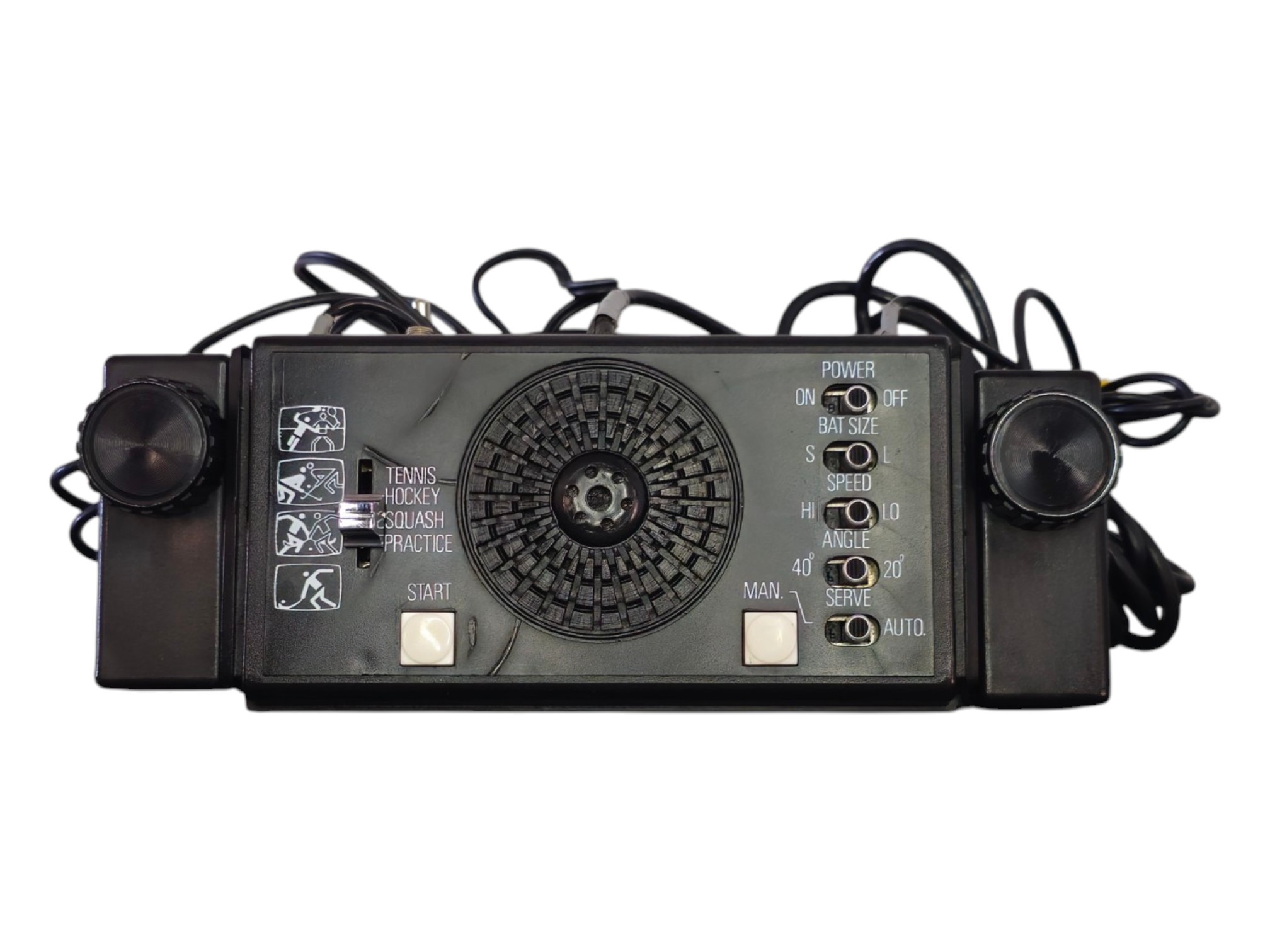
The Temco TV Game T-800 is a classic first-generation home video game console from the late 1970s, representing the period when simple electronic television games were beginning to introduce interactive entertainment into ordinary households.
Built around the famous General Instrument AY-3-8500, one of the most widely used dedicated video game integrated circuits of its era, the T-800 offered four variations of Pong-style entertainment: Tennis, Hockey, Squash, and Practice.
Its compact enclosure, two wired rotary controllers, central speaker grille, physical game-selection switch, and numerous difficulty adjustments reflect the characteristic design of early consumer video game systems.
Unlike later consoles from Atari, Nintendo, and Sega, the T-800 did not use interchangeable game cartridges, a conventional programmable CPU, or software loaded from external media. Its games were permanently implemented in a dedicated electronic chip.
The console was marketed under the Temco brand and belonged to a wider family of related television games distributed internationally under different names, including Ajax, Regina, Zeon, and other regional brands.
Today, the Temco T-800 is an important historical artefact illustrating the development of affordable home gaming before programmable cartridge consoles became the industry standard.
📘 Introduction
The Temco T-800 appeared during the late 1970s, when home video gaming was still a relatively new consumer technology.
Available historical sources associate the T-800 hardware family with 1977, while some catalogues date the Temco-branded model to 1979.
The exact introduction date of every regional version is not securely established.
The console belongs to the first generation of home video game systems, commonly known as the Pong generation.
Its central purpose was simple: allow one or two people to interact with moving objects displayed on an ordinary television.
Main Characteristics
- First-generation dedicated television game console
- Four built-in Pong-style games
- General Instrument AY-3-8500 integrated circuit
- Monochrome video output
- Two wired paddle controllers
- On-screen scoring
- Adjustable ball speed
- Adjustable paddle size
- Adjustable rebound angles
- Automatic or manual serve
- Internal sound generation
- Built-in speaker
- RF television connection
- Battery or external power operation
The T-800 belongs to an era before programmable gaming systems became commonplace.
Its simplicity makes it especially valuable for understanding how early home video games worked.
🏭 The Birth of Home Video Gaming
The Temco T-800 belongs to the first major wave of home electronic entertainment.
Before the 1970s, most televisions were passive devices used to receive broadcast programmes.
Interactive gaming introduced an entirely different relationship between people and their television sets.
The Magnavox Odyssey (1972)
The Magnavox Odyssey, designed through the pioneering work of Ralph H. Baer and his collaborators, was the first commercially released home video game console.
It introduced the concept of controlling electronic objects on a domestic television.
Atari Pong (1972)
Atari’s Pong became a major arcade success.
Its simple tennis-like gameplay helped demonstrate the commercial potential of electronic games.
Atari Home Pong (1975)
The home version of Pong brought the experience directly into living rooms.
It encouraged numerous companies to develop competing television-game systems.
The Dedicated Pong Market
By the middle of the decade, manufacturers were introducing many variations of electronic sports consoles.
Most offered relatively simple games involving:
- Paddles
- Balls
- Scoring
- Walls
- Goals
- Targets
The Temco T-800
The T-800 appeared within this rapidly growing market.
It offered several Pong variations in a relatively small and affordable electronic device.
Its architecture was made practical by the availability of specialised integrated circuits.
🌍 Temco & International Consumer Electronics Distribution
During the late 1970s, numerous television gaming devices were manufactured in Asia and distributed in Europe under different brands.
The Temco T-800 belongs to this international consumer electronics environment.
The Temco Brand
Collector documentation associates Temco television-game distribution with the Netherlands and European markets.
Historical listings also identify Temco-branded releases in the United Kingdom.
The available documentation does not establish a complete corporate history for the brand.
Manufacturing
Surviving Temco T-800 packaging identifies Hong Kong as the manufacturing location.
This reflects the growing importance of Hong Kong’s electronics manufacturing industry during the 1970s.
International Rebranding
Manufacturers frequently supplied similar hardware to different companies.
These distributors could sell the devices under their own brand names.
Related Brands
Closely related AY-3-8500 television-game systems appeared under names such as:
- Ajax
- Regina
- Zeon
- Riva
- Hanimex
- Audiosonic
- Tenko
- Grandstand
- Other regional brands
These products shared an underlying technical concept, although their enclosure design and precise circuitry could differ.
Why This Matters
The T-800 is an example of a period when hardware designs travelled internationally while branding changed according to the market.
This practice played an important role in making early video games widely available.
🖥️ The Compact Temco T-800 Design
The T-800 features an unusually compact enclosure for a late-1970s home gaming console.
The main unit has a rectangular body with rounded elements and a prominent circular speaker grille.
Exterior Features
- Compact plastic enclosure
- Central circular speaker grille
- Game-selection switch
- Power switch
- Game adjustment switches
- Start button
- Manual serve button
- Two wired rotary controllers
- Controller holders at the sides
- RF television cable
- External power connector
- Battery compartment
Controller Storage
The two paddle controllers can be placed in holders at either side of the main console.
This makes the device relatively compact when not in use.
Known Colour Variations
Surviving examples of the hardware family feature different enclosure colours, including black and orange-toned versions.
The exact colour of an individual console should be documented from the physical unit.
A Central Speaker Grille
One of the most distinctive visual features is the large circular grille positioned near the centre.
It provides an outlet for the simple electronic sound effects.
A Physical User Interface
Every important function is controlled through switches, buttons, or rotary controls.
There are no software menus, graphical settings screens, or external game-loading mechanisms.
The design reflects the straightforward nature of the first generation of consumer gaming.
⚙️ Technical Specifications
The Temco T-800 uses a dedicated electronic game circuit rather than a conventional computer architecture.
Hardware Overview
- Brand: Temco
- Product: TV Game
- Model: T-800
- Approximate period: 1977–1979
- Generation: First-generation home video game console
- System type: Dedicated Pong console
- Main integrated circuit: General Instrument AY-3-8500
- CPU architecture: Dedicated game logic; no conventional programmable CPU
- Graphics: Hardware-generated monochrome video
- Games: Four built-in
- Game selection: Physical slide switch
- Scoring: Automatic on-screen score display
- Audio: Electronic sound effects
- Speaker: Built-in
- Player controls: Two wired rotary paddle controllers
- Difficulty settings: Ball speed, paddle size, rebound angle
- Serve modes: Automatic and manual
- Television connection: Analogue RF
- Battery power: Six 1.5V AA batteries
- External supply: 9V DC on documented examples
- Power polarity: Centre-positive on a documented T-800 unit
- Cartridge slot: None
- Internal software storage: Not applicable
- Original manufacturing region: Hong Kong, according to surviving packaging
The exact video-channel arrangement and power requirements should be verified on the individual unit before operation.
🧠 General Instrument AY-3-8500: Pong on a Chip
The most important electronic component inside the Temco T-800 is the General Instrument AY-3-8500.
Introduced in 1976, the AY-3-8500 became one of the most influential integrated circuits in the early home video game industry.
An Entire Game System in One Chip
Instead of using a conventional CPU and external software, the chip contains dedicated circuitry for producing Pong-style games.
Its functions include:
- Ball movement
- Paddle positions
- Game rules
- Collision detection
- Score generation
- Sound signals
- Television synchronisation
Why It Was Revolutionary
Earlier electronic games could require numerous individual components to perform similar operations.
The AY-3-8500 integrated the essential game functions into one compact semiconductor package.
The 28-Pin Package
The chip uses a 28-pin dual in-line package.
This was a common integrated-circuit format during the 1970s.
The 625-Line Version
The AY-3-8500 was designed for 625-line television systems used in PAL territories.
A related version, the AY-3-8500-1, supported 525-line television systems.
A Foundational Gaming Component
The AY-3-8500 helped manufacturers produce affordable electronic television games.
It appeared in numerous devices from different companies.
Its commercial success contributed significantly to the rapid expansion of home gaming.
💻 Why the Temco T-800 Has No Conventional CPU
The Temco T-800 is fundamentally different from a later programmable video game console.
A modern console operates by executing software instructions through a processor.
The T-800 uses dedicated electronic circuits.
Hardwired Game Logic
Its gameplay behaviour is defined by the internal construction of the AY-3-8500.
The chip contains logic responsible for implementing the rules and behaviour of each game.
No Software Cartridges
The T-800 does not have a slot for interchangeable ROM cartridges.
Its games cannot be replaced by inserting different software.
No General-Purpose Operating System
The console does not boot into an operating system.
There is no software-based dashboard or file system.
Immediate Operation
Once connected and powered, the device generates its game display directly.
The Importance of Dedicated Electronics
The absence of a conventional CPU does not mean the system is technologically insignificant.
The AY-3-8500 was an important example of large-scale integration making consumer electronics simpler and less expensive.
A Different Computing Philosophy
The T-800 is best understood as an electronic game appliance rather than a general-purpose computer.
It provides a useful demonstration of how interactive entertainment existed before software-driven architectures became dominant.
🎮 The Four Built-In Games
The Temco T-800 offers four games selected through a physical switch.
These are:
- Tennis
- Hockey
- Squash
- Practice
All four are generated by the AY-3-8500.
A Shared Technical Foundation
The games use similar basic elements:
- Rectangular paddles
- Moving ball
- Boundary lines
- Scoring
- Player-controlled movement
Different Rules
Although the underlying graphics are similar, the games vary in their use of walls, goals, players, and gameplay objectives.
Why Four Games?
The AY-3-8500 is capable of supporting additional shooting-game modes.
However, the standard T-800 provides access to four ball-and-paddle variations.
The availability of features inside an integrated circuit does not mean every console using it exposes all those features.
A Characteristic First-Generation Experience
The games may appear simple today.
During the 1970s, however, controlling an object on a television was still an exciting experience for many households.
🎾 Tennis: The Classic Pong Experience
Tennis is the most recognisable game offered by the T-800.
Two players control vertical paddles positioned at opposite sides of the television screen.
Gameplay
The players attempt to return a moving ball.
If one player misses, the opponent receives a point.
Controls
Each player rotates their paddle controller to change the vertical position of their on-screen paddle.
Adjustable Difficulty
The system allows changes to:
- Ball speed
- Paddle size
- Rebound angle
- Serve behaviour
The Importance of Tennis
This type of game became synonymous with the entire Pong generation.
Its simple rules made it easy to understand.
A Social Experience
Tennis encouraged direct competition between two people sitting together in front of the television.
This became one of the earliest forms of popular local multiplayer entertainment.
🏒 Hockey: An Alternative Pong Game
Hockey introduces a different arrangement of the familiar ball-and-paddle concept.
Gameplay
Players attempt to direct the ball into the opponent’s scoring area.
The arrangement differs from conventional Tennis.
The Role of the AY-3-8500
The chip generates the additional player and goal elements required by the game.
A More Complex Screen
Hockey demonstrates how simple digital circuits could produce different gameplay arrangements without changing the core hardware.
A Familiar Sporting Theme
Sports were natural subjects for early video games.
They required relatively simple rules and could be represented using basic geometric shapes.
Historical Importance
Hockey illustrates how manufacturers expanded their catalogues of games while working within the capabilities of dedicated integrated circuits.
🏓 Squash: Playing Against a Wall
Squash is another variation of ball-and-paddle gaming.
Gameplay
Instead of ordinary head-to-head Tennis, the game uses a wall-based playing arrangement.
The ball rebounds from a boundary and returns towards the player’s paddle.
The Main Challenge
The player must anticipate the ball’s movement and position the paddle correctly.
Game Speed
The speed setting can increase the difficulty.
Paddle Size
Smaller paddles require more accurate positioning.
An Early Arcade Mechanic
Wall-based paddle games influenced numerous later electronic games.
The underlying principles can also be seen in games involving ball reflection and target destruction.
🧍 Practice: Single-Player Entertainment
Practice provides a way to play without requiring a second human opponent.
The Solo Concept
The player controls a paddle while the game provides a simplified environment for returning the moving ball.
Learning the Controls
Practice can be used to become familiar with the rotary controller and the behaviour of the ball.
Increasing Difficulty
Players can change the speed and paddle settings.
An Important Feature
During the earliest years of home video gaming, many games were designed primarily for two people.
A single-player mode increased the usefulness of the console.
A Step Towards Independent Gaming
Practice demonstrates how manufacturers began introducing game modes intended for one player rather than requiring constant head-to-head competition.
🎛️ Game Selection & Difficulty Controls
The T-800 offers a surprisingly large number of gameplay adjustments for such a simple console.
Game Selection
A sliding switch allows the user to choose between Tennis, Hockey, Squash, and Practice.
Bat Size
The Bat Size switch changes the height of the paddle.
A larger paddle makes returning the ball easier.
A smaller paddle increases the challenge.
Speed
The Speed switch changes how quickly the ball moves.
Angle
The Angle setting changes the available rebound angles.
This makes ball movement more or less varied.
Serve
The Serve switch determines whether service is automatic or manual.
Start Button
The Start button begins or resets the game.
Manual Serve Button
The manual serve button allows the player to initiate play when the appropriate mode is selected.
An Analogue-Era Interface
Every setting changes the behaviour of the hardware directly.
There is no need to navigate through menus or pause the game to adjust software settings.
This physical interface is one of the system’s most interesting historical characteristics.
🕹️ Two Wired Rotary Paddle Controllers
The T-800 uses two paddle-style controllers.
Each controller has a rotary mechanism used to move the corresponding on-screen paddle.
Controller Design
- Compact handheld enclosure
- Rotary control
- Wired connection
- Side storage holder
- Direct electrical input
How Movement Works
Turning the control changes an electrical value, normally through a potentiometer-based circuit.
The game chip uses this input to determine the paddle’s vertical position.
Analogue Position Control
Although the game image is produced electronically, player movement is controlled through analogue electrical input.
This is an important characteristic of early Pong systems.
Wired Connections
The controllers are permanently wired to the main console in documented T-800 examples.
They can be removed from their storage holders but are not necessarily detachable electrically.
A Different Experience from Modern Gamepads
The rotary paddles provide a very different physical sensation from directional pads and analogue thumbsticks.
They are specifically suited to paddle-and-ball games.
Historical Significance
These controllers represent one of the earliest widespread forms of home video game input.
Their basic design reflects the simple yet effective interaction model of the Pong generation.
📺 Monochrome Television Graphics
The standard Temco T-800 produces a monochrome video image.
Its graphics consist of simple geometric shapes generated directly by the dedicated game chip.
Typical Screen Elements
- Vertical paddles
- Small rectangular ball
- Boundary lines
- Scoring numbers
- Playing field
- Basic goal or wall objects
No Conventional Framebuffer
The T-800 does not render elaborate images into a general-purpose video memory system.
Its dedicated logic generates the required video signals.
Why the Graphics Are Simple
The AY-3-8500 was designed for inexpensive electronic sports games.
It prioritised reliable gameplay generation over complex graphics.
The Importance of Timing
The chip produces the synchronisation information required for the television display.
Black-and-White Output
The standard T-800 displays its games in monochrome.
This distinguishes it from the T-800C colour version.
An Authentic First-Generation Picture
The image is simple by modern standards, but it captures the essential interactive experience that helped launch the home video game industry.
📡 RF Output & Analogue Television Connection
The Temco T-800 was designed for connection to an ordinary analogue television.
It uses an RF video signal.
How RF Works
The game circuitry produces video information.
An RF modulator converts the signal into a form that can be received by a television tuner.
Original Television Setup
A typical installation involves:
- Connecting the RF cable
- Selecting or tuning the appropriate television channel
- Powering the console
- Selecting a game
- Adjusting the controls
- Starting play
VHF Connection
A documented T-800 example uses VHF channel 4.
However, regional or manufacturing variations should be checked individually.
The Importance of CRT Televisions
The console was designed during the era of analogue CRT televisions.
Its picture is best understood in that original environment.
Modern Television Compatibility
Many modern televisions no longer support the relevant analogue broadcasting standards.
A compatible analogue tuner, RF demodulator, or period-correct CRT may be necessary.
Museum Presentation
Displaying the console with a functioning CRT can help visitors experience the technology as it was originally intended.
🔊 Built-In Electronic Sound
The AY-3-8500 contains sound-generation circuitry.
The Temco T-800 reproduces these simple electronic effects through its internal speaker.
Typical Audio Events
- Ball hitting a paddle
- Ball reflecting from a boundary
- A player scoring
Simple Electronic Tones
Unlike later consoles, the T-800 does not feature a programmable music synthesiser or stored sound samples.
Its audio consists of short electronic tones.
The AY-3-8500’s Sound Output
The chip generates different signals for events such as a hit, rebound, or score.
The Internal Speaker
The circular speaker grille occupies a prominent position on the console.
Historical Importance
These simple sounds became closely associated with the earliest era of video gaming.
They demonstrate how audio feedback helped make electronic games more engaging.
🔋 Battery Operation & Power Supply
The Temco T-800 was designed to be powered either by batteries or a suitable external adapter.
Battery Power
Documented units use:
6 × 1.5V AA batteries
This provides a nominal 9V supply.
External Adapter
A documented T-800 uses:
9V DC, centre-positive
An Important Safety Detail
The correct polarity must be verified before connecting an external power supply.
Many vintage gaming devices use similar connectors but different electrical arrangements.
Battery Compartment
The battery compartment is located on the underside of the enclosure.
Portable Convenience
Battery operation allowed the console to be moved between rooms without requiring a dedicated mains adapter.
A television connection was still required.
Long-Term Preservation
Old batteries should not be left inside the console during storage.
Leaking batteries can damage the metal contacts and internal electronics.
Electrical Verification
For an individual collector unit, power voltage and polarity should always be checked against original markings or the actual circuit before testing.
🌈 Temco T-800 vs. Temco T-800C
The Temco product family included a colour version of the T-800.
Temco T-800
- Monochrome graphics
- Four built-in Pong games
- AY-3-8500 game circuitry
- Rotary controllers
- RF television output
- Compact enclosure
Temco T-800C
- Colour-capable Pong system
- Four built-in games
- Related game-generation technology
- Similar control concept
- Colour video circuitry
The Main Difference
The standard T-800 produces a black-and-white picture.
The T-800C adds colour capability through additional circuitry.
The Core Gameplay
Both systems belong to the same dedicated Pong tradition.
Not the Same Hardware Revision
The T-800C should not simply be described as a colour setting available on the standard T-800.
It represents a separate product configuration.
Collecting Significance
The monochrome and colour systems provide an interesting comparison showing how consumer Pong hardware evolved during the late 1970s.
🧩 Other Temco Television Game Models
Historical collector records identify several other Temco gaming products.
Temco T-802
A related monochrome television game system with a different enclosure arrangement.
Temco T-802C
A colour version within the compact television-game family.
Temco T-900
A smaller all-in-one-style Pong gaming device.
Temco T-106C
A colour television game system associated with a larger selection of games and shooting-game capabilities.
Different Enclosures
Some of these models use substantially different case designs.
Shared Game Technology
Several relied on General Instrument’s dedicated-game integrated circuits.
An Evolving Product Family
The range shows how manufacturers introduced numerous variations of similar technologies to appeal to different markets.
The Importance of Exact Model Identification
The T-800, T-800C, T-802, and T-802C should be documented separately.
Their similar names do not make them identical products.
🔄 Temco T-800 vs. Unimex Mark IX
The Temco T-800 and Unimex Mark IX belong to the same broad historical period but use different approaches to electronic gaming.
Temco T-800
- Four permanently built-in games
- Dedicated AY-3-8500 game chip
- No cartridge slot
- Two rotary paddle controllers
- Monochrome video
- Compact enclosure
Unimex Mark IX
- Interchangeable electronic game cartridges
- Game-generation circuitry inside cartridges
- Multiple game families
- Joystick-style controllers
- Colour-capable output
- Cartridge-dependent gameplay
The Fundamental Difference
The Temco T-800 is a dedicated fixed-game console.
The Unimex Mark IX uses interchangeable hardware cartridges.
Two Approaches to Home Gaming
Both demonstrate the early development of consumer video games.
However, the Mark IX attempted to expand the available games through hardware modules.
The T-800 concentrated on offering a simple and affordable self-contained gaming system.
Museum Significance
Displaying both systems helps explain the transition from fixed-game electronic devices towards expandable console platforms.
🆚 Temco T-800 vs. Atari Home Pong
Atari Home Pong and the Temco T-800 share a similar basic gaming concept.
Atari Home Pong
- Introduced in 1975
- Dedicated Pong gameplay
- Rotary paddle controls
- Television display
- Simple electronic audio
Temco T-800
- Late-1970s dedicated console
- Four game variations
- Two rotary paddle controls
- Adjustable game settings
- Integrated General Instrument game chip
The Importance of Competition
Following Pong’s commercial success, numerous manufacturers attempted to offer similar experiences.
Some introduced more games or additional control options.
An Affordable Electronics Revolution
The availability of integrated Pong chips helped make this competition possible.
Historical Importance
The T-800 reflects the rapid spread of electronic gaming technology beyond its earliest pioneering manufacturers.
🕰️ The Transition to Programmable Consoles
The Temco T-800 appeared during a crucial period in home gaming history.
The Dedicated-Game Era
Early systems relied on hardware designed for a fixed set of games.
This approach made the devices relatively simple.
The Cartridge Revolution
More sophisticated systems introduced interchangeable game media.
Fairchild Channel F (1976)
The Fairchild Channel F became an important early programmable cartridge-based home console.
It used software stored in interchangeable cartridges.
Atari VCS / Atari 2600 (1977)
The Atari VCS helped establish the long-term commercial importance of programmable cartridge consoles.
A Major Technological Change
Instead of requiring a different dedicated game circuit for every set of games, programmable systems could execute different software.
The Decline of Pong-Only Hardware
As programmable consoles became more attractive and affordable, dedicated Pong systems gradually lost their commercial appeal.
The T-800’s Historical Position
The Temco T-800 represents the maturity of the dedicated electronic television-game concept shortly before the programmable model became dominant.
🌍 European Gaming Culture in the Late 1970s
During the late 1970s, television gaming was becoming increasingly familiar to European households.
A New Form of Entertainment
Consumers could use their existing televisions for interactive activities.
An International Market
Companies imported and distributed electronic games across Europe.
The same basic hardware could appear under different brand names.
Pong as a Common Language
Tennis and Hockey games required little explanation.
Their simple rules helped make electronic entertainment accessible.
Two-Player Competition
Many families experienced video gaming for the first time through two-player Pong systems.
A Brief Technological Generation
The dedicated Pong era was commercially important but relatively short.
Within a few years, programmable consoles and more sophisticated arcade games changed consumer expectations.
The Importance of Preserved Hardware
Systems such as the T-800 provide tangible evidence of this transition.
🇬🇷 Pong Consoles & Early Electronic Gaming in Greece
Greece encountered the first generation of home video gaming through imported consumer electronics.
During the late 1970s, television games were part of a growing international market.
The Early Experience
The concept of controlling a moving object on a television was new to many households.
A Social Activity
Pong consoles encouraged people to play together in front of the same screen.
Imported Hardware
European and Asian-manufactured systems appeared under numerous brand names.
The Temco T-800
The T-800 provides an excellent representative example of this generation.
Its presence in a modern Greek collection documents the broader international spread of Pong technology.
Specific original Greek retail distribution for the Temco-branded T-800 has not been conclusively established.
Historical Importance
Preserving such devices helps explain the origins of home video gaming before the widespread arrival of Atari, Sega, Nintendo, and home computers.
🔧 Maintenance & Common Hardware Problems
The Temco T-800 is now a vintage electronic device approaching fifty years of age.
Its simple construction can make maintenance relatively straightforward, but its original components are becoming increasingly difficult to replace.
Common Maintenance Areas
- Battery contacts
- Power connector
- RF cable
- Paddle controllers
- Rotary potentiometers
- Game-selection switch
- Difficulty switches
- Start and manual-serve buttons
- Internal speaker
- Capacitors
- PCB solder joints
- AY-3-8500 integrated circuit
Controller Problems
Worn or oxidised potentiometers can cause unstable paddle movement.
Switch Problems
Old switches may develop poor electrical contact.
Battery Corrosion
Leaking batteries can cause significant damage.
RF Output Problems
A working console may appear defective if the television is not compatible with its RF signal or is tuned incorrectly.
Power Problems
Incorrect supply polarity or voltage can damage the console.
Integrated Circuit Preservation
The AY-3-8500 is a historically important obsolete component.
Replacement may be possible using suitable vintage parts, but original hardware should be protected whenever practical.
🛠️ Restoration & Testing
Restoring a Temco T-800 requires attention to its age and original electrical design.
Initial Inspection
Before connecting power, examine:
- Enclosure condition
- Battery compartment
- Power connector
- Switches
- Controller wiring
- RF cable
Checking the Power Supply
Confirm the required voltage and polarity.
Do not rely on the connector shape alone.
Testing the Controllers
Each rotary controller should move its corresponding paddle smoothly.
Erratic movement may indicate worn or contaminated potentiometers.
Testing the Display
A suitable analogue television or RF conversion setup is required.
Testing the Games
All four game modes should be selected individually.
Testing Difficulty Controls
The following adjustments should be checked:
- Bat Size
- Speed
- Angle
- Serve
Testing Audio
The internal speaker should reproduce simple electronic effects.
Preservation Philosophy
The original integrated circuit, enclosure, labels, and controller mechanisms should be retained whenever possible.
Unnecessary modifications can reduce the authenticity of a historic electronic device.
🏛️ Collectability & Historical Preservation
The Temco T-800 is an interesting collectible because it represents a lesser-known European-market Pong console.
Important Collecting Factors
- Original Temco T-800 console
- Original enclosure colour
- Original rotary controllers
- Functional game-selection switch
- Functional difficulty switches
- Original AY-3-8500 chip
- Working RF output
- Original internal speaker
- Intact battery compartment
- Original manufacturer markings
- Original packaging, if present
- Instruction manual, if present
- Correct power adapter, if present
The Importance of the Original Controllers
The controllers are an essential part of the system’s design.
Their distinctive rotary movement represents the original Pong experience.
Original Packaging
Surviving boxes provide useful information concerning:
- Product branding
- Model identification
- Manufacturing location
- Game selection
- Retail presentation
Colour Variations
Different housing finishes can be documented as separate collection variations.
Distinguishing the T-800C
A colour T-800C should not be confused with the monochrome T-800.
Historic Electronics Value
The T-800 is not valuable solely because of its commercial success.
Its importance comes from its contribution to the history of affordable electronic home gaming.
⭐ Why the Temco T-800 Still Matters
The Temco TV Game T-800 remains historically important for several reasons:
- It belongs to the first generation of home consoles
- It represents the Pong era
- It uses the influential General Instrument AY-3-8500
- It features four dedicated built-in games
- It provides two-player interaction
- It uses analogue paddle controllers
- It includes adjustable gameplay settings
- It produces video without a general-purpose CPU
- It supports ordinary analogue televisions
- It operates using batteries or a suitable external power supply
- It belongs to an international family of rebranded television games
- It documents the period before programmable consoles became dominant
A Simple but Important Technology
The T-800 demonstrates that meaningful interactive entertainment does not require sophisticated computing hardware.
The Rise of Integrated Circuits
Its AY-3-8500 chip illustrates how semiconductor integration helped make home gaming affordable.
The Origins of Multiplayer Gaming
Two-player Pong competition was one of the earliest popular home multiplayer experiences.
An International Consumer Product
The T-800 also illustrates the role of international manufacturing and distribution in the spread of electronic entertainment.
📦 Items Included in This Collection Entry
Approximate production period: Late 1970s
Generation: First-generation home video game console
Game technology: General Instrument AY-3-8500
Built-in games: Tennis, Hockey, Squash, Practice
Video: Monochrome RF
Original controller design: Two wired rotary paddles
Individual enclosure colour and additional accessories: To be verified against the physical collection item
🏁 Conclusion
The Temco TV Game T-800 represents an important stage in the early evolution of home video gaming.
Introduced during the late 1970s, it offered four electronic sports games using the General Instrument AY-3-8500 integrated circuit.
Its compact design, two rotary controllers, adjustable gameplay settings, and simple television connection made it a characteristic example of the first generation of consumer gaming systems.
Unlike later programmable consoles, the T-800 did not rely on software cartridges or a conventional CPU.
Instead, its dedicated electronic circuitry generated the games directly.
This architecture demonstrates how early semiconductor technology made interactive home entertainment practical and affordable.
The console also belonged to a wider international family of similar television games sold under different brand names.
Its history therefore reflects not only the development of gaming technology but also the global expansion of consumer electronics during the 1970s.
Although the games are extremely simple compared with modern entertainment software, they introduced fundamental ideas that continue to define gaming: player control, scoring, competition, difficulty adjustment, and interactive visual feedback.
Today, the Temco T-800 remains a valuable historical artefact documenting the origins of television gaming.
A classic first-generation Pong console, an excellent example of dedicated game-chip technology, and an important survivor from the earliest era of home video entertainment.
