

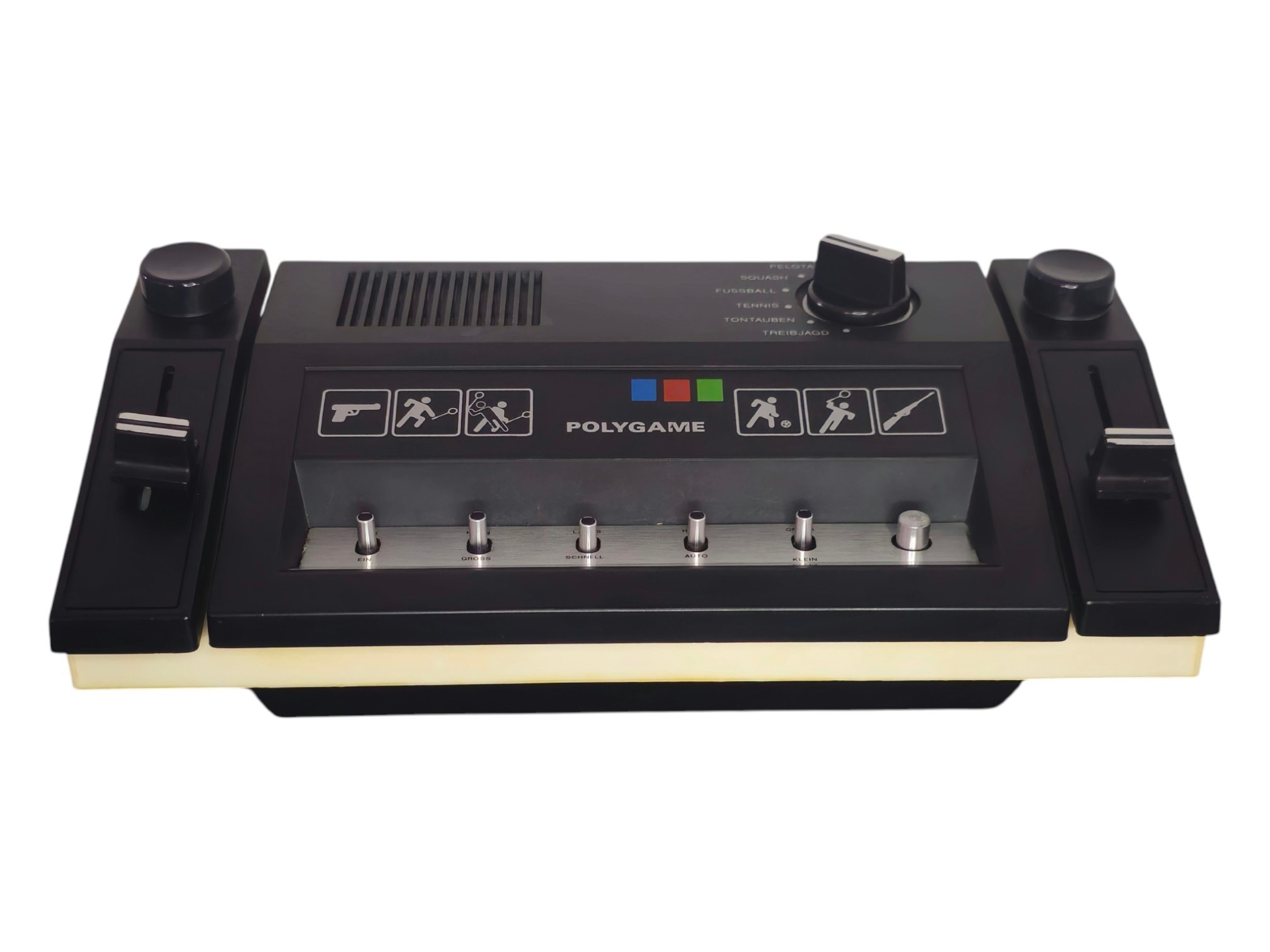
The Polygame 6 is a remarkable first-generation home video game console from 1977, representing the era when electronic television games were evolving beyond simple Pong-style sports into more varied forms of interactive entertainment.
Associated with the European Polygame Tele-Match family and closely related to contemporary Palladium Tele-Match systems, the console offered six built-in games, including four electronic sports activities and two light-gun shooting games.
Its distinctive black enclosure, physical game-selection controls, separate wired paddle controllers, and compatibility with a modular photoelectric shooting accessory make it an especially interesting example of late-1970s gaming technology.
One of the system’s most unusual features is its transformable light gun. With compatible attachments, the controller can be configured as a compact pistol or as a longer rifle-style accessory using a separate shoulder stock and interchangeable barrel sections.
Unlike later consoles from Atari, Nintendo, and Sega, the Polygame 6 does not rely on interchangeable software cartridges or a conventional programmable processor. Instead, its games are generated by specialised electronic circuitry.
The six-game configuration reflects the technology associated with General Instrument’s influential AY-3-8500 family of integrated circuits, which played a fundamental role in the rapid expansion of home video gaming during the 1970s.
Today, the Polygame 6 is a fascinating survivor of the first console generation, preserving both the simplicity of early Pong gameplay and the creativity of manufacturers experimenting with new types of electronic controllers.
📘 Introduction
The Polygame 6 belongs to the pioneering generation of dedicated television gaming systems introduced during the 1970s.
Contemporary records place the Polygame Tele-Match in 1977, with documented distribution in the Austrian and German-speaking European market.
The system appeared during a period of intense competition between manufacturers of electronic television games.
Following the success of Atari’s Pong and Magnavox’s earlier Odyssey, companies began introducing increasingly sophisticated consumer products.
The Polygame 6 combined familiar sports games with two target-shooting activities.
Principal Features
- Six permanently installed games
- Four Pong-style sports games
- Two shooting games
- Dedicated electronic game circuitry
- Colour-capable video on documented Tele-Match configurations
- Two wired player controllers
- Photoelectric light-gun support
- Interchangeable shooting-accessory components
- Physical game-selection controls
- Adjustable gameplay settings
- Automatic electronic scoring
- Analogue RF television output
- Traditional CRT television compatibility
The console is particularly notable because of its combination of different gameplay styles.
Players could compete using conventional paddle controls or switch to shooting games requiring an entirely different input device.
This made the Polygame 6 more versatile than many early systems offering only Tennis and Hockey.
🏭 Polygame & the European Pong Market
The Polygame name is associated with a small group of early television gaming systems marketed in Europe during the late 1970s.
Historical catalogues identify machines such as the Polygame MK4 and Polygame Tele-Match.
The surviving documentation is considerably more limited than that available for major manufacturers such as Atari, Magnavox, or Nintendo.
An Emerging Consumer Industry
During the mid-1970s, electronic games were a new product category.
The industry had not yet developed the standardised console architecture familiar today.
Manufacturers experimented with different:
- Enclosure designs
- Controller arrangements
- Game-selection mechanisms
- Electronic chips
- Video systems
- Retail brands
International Manufacturing
Many electronic television games sold in Europe were manufactured by third-party electronics companies.
Similar internal designs could be distributed through several independent brands.
The Polygame Brand
Polygame belongs to this environment of regional gaming products.
The name appears in historical records associated with Austrian distribution.
The Palladium Connection
The Polygame Tele-Match is also closely associated with the broader Palladium Tele-Match group, marketed in Germany.
These products share technical concepts and, in some cases, closely related hardware designs.
An Important Distinction
The commercial relationship between Polygame and Palladium should not automatically be interpreted as proof that every model was manufactured by the same company.
The exact original manufacturer of an individual console requires evidence from its labels or internal electronics.
Historical Significance
The Polygame 6 documents a period when European consumers could purchase electronic games from numerous brands that have since largely disappeared from the market.
📺 The Rise of Home Video Gaming
The development of the Polygame 6 can be understood through the rapid evolution of electronic entertainment during the 1970s.
Magnavox Odyssey (1972)
The Magnavox Odyssey became the first commercially released home video game console.
Its development was based on pioneering work by Ralph H. Baer and his collaborators.
It demonstrated that electronic objects could be controlled directly on a domestic television.
Atari Pong (1972)
Atari introduced Pong as an arcade game.
Its simple sports gameplay became internationally successful.
Atari Home Pong (1975)
The home version helped establish electronic gaming as a consumer entertainment product.
The Pong Boom
Many manufacturers began producing dedicated television games.
These typically included variations of:
- Tennis
- Hockey
- Squash
- Practice
- Football
- Shooting
Integrated Game Chips
Dedicated semiconductor technology made it possible to produce these games using relatively inexpensive electronic circuits.
The Polygame 6
The system appeared during the mature phase of this first-generation market.
It combined established sports games with more unusual shooting-game features.
🖥️ The Distinctive Black Console Design
The Polygame Tele-Match design is characterised by its black plastic enclosure and extensive physical controls.
Compared with later consoles, the appearance is strongly influenced by traditional consumer electronics equipment.
Exterior Features
Documented examples feature:
- Black plastic enclosure
- Central control panel
- Polygame branding
- Game-selection control
- Illustrated game symbols
- Physical gameplay switches
- Speaker grille
- Wired player controllers
- Analogue television connection
- Shooting-controller support
The Polygame Branding
The name appears prominently on the front panel.
The design also uses coloured rectangular decorations.
Game Symbols
Illustrations identify the different categories of games.
These include sports and shooting activities.
A Functional Appearance
Most of the enclosure is dedicated to controls rather than decorative elements.
A Product of Its Era
The black plastic, printed labels, mechanical switches, and separate controllers reflect the industrial design of the late 1970s.
Historical Importance
The console demonstrates how manufacturers were still experimenting with the appearance of home gaming systems.
The familiar modern arrangement of a main console, two gamepads, and software menus had not yet become established.
⚙️ Technical Specifications
The Polygame 6 belongs to the dedicated electronic gaming generation.
Hardware Overview
- Brand: Polygame
- Collection model designation: Polygame 6
- Related commercial designation: Polygame Tele-Match
- Documented period: 1977
- Generation: First-generation home console
- System type: Dedicated electronic television game
- Original market: European / German-speaking region
- Known regional association: Austria and Germany
- Games: Six built-in
- Sports games: Four
- Shooting games: Two
- Game architecture: Dedicated electronic logic
- Related chip family: General Instrument AY-3-8500
- Conventional programmable CPU: None
- Software cartridges: Not supported
- Graphics: Simple two-dimensional electronic video
- Video capability: Colour on documented Tele-Match models
- Television connection: Analogue RF
- Player controllers: Two wired paddle-style controls
- Additional controller: Photoelectric light gun
- Shooting accessories: Optional modular stock and barrel components
- Game selection: Physical selector
- Difficulty adjustments: Hardware controls
- Scoring: Electronic on-screen display
- Sound: Basic electronic effects
- Display type: Analogue television, ideally CRT
The individual motherboard revision, exact integrated-circuit marking, electrical supply requirements, and manufacturing origin require confirmation from the original hardware.
🧠 General Instrument & the Pong-on-a-Chip Revolution
One of the most influential companies behind the first generation of home video gaming was General Instrument.
The company developed dedicated integrated circuits capable of generating complete electronic television games.
The AY-3-8500
Introduced in 1976, the AY-3-8500 became one of the most widely used game chips of its era.
Dedicated Game Functions
The chip provides circuitry associated with:
- Ball movement
- Paddle positioning
- Collision detection
- Scoring
- Video synchronisation
- Game selection
- Sound effects
- Shooting-game functions
Six Supported Games
The AY-3-8500 architecture provides four ball-and-paddle games and two rifle-game functions.
A Related Polygame Architecture
The Polygame Tele-Match belongs to a group of systems closely associated with this technology.
The exact chip fitted to an individual Polygame 6 should be confirmed through inspection.
Why the Technology Mattered
Before highly integrated circuits became common, electronic gaming could require numerous individual components.
General Instrument’s chips simplified the design considerably.
Lower Manufacturing Costs
Manufacturers could produce different consoles around the same basic semiconductor technology.
An International Influence
These circuits appeared in products sold throughout Europe, North America, and other markets.
Historical Significance
The dedicated game chip was one of the most important technologies behind the rapid growth of Pong consoles.
💻 A Console Without a Conventional CPU
The Polygame 6 differs fundamentally from modern gaming hardware.
A contemporary console normally contains a programmable CPU that executes software stored in memory.
The Polygame 6 uses dedicated electronic circuits.
Hardwired Game Logic
The rules of the games are implemented directly in the electronic hardware.
No Software Cartridge Slot
The console does not load different games from removable ROM cartridges.
No Operating System
There is no graphical dashboard, file system, or bootable software environment.
No Conventional Save System
The games do not support modern save files, player profiles, or memory cards.
Immediate Gameplay
After the correct power and television connections are established, the game circuitry generates the video display directly.
A Different Computing Philosophy
The console is best understood as a specialised electronic entertainment device.
Historical Value
This architecture is especially useful for explaining how home video games existed before software-driven systems became dominant.
🎮 The Six Built-In Games
The Polygame Tele-Match family provides six electronic games.
Documented German-language selections include:
| Original name | English description |
|---|---|
| Tennis | Two-player paddle tennis |
| Fußball | Football / Soccer |
| Squash | Wall-based paddle game |
| Pelota | Ball-and-wall sports variation |
| Tontauben | Clay Pigeon Shooting |
| Treibjagd | Driven Hunt Shooting |
The precise printed spelling and selection order may vary between related regional versions.
Four Sports Games
The first four modes use the wired paddle controllers.
Two Shooting Games
The final two modes use a compatible photoelectric shooting accessory.
The Importance of Variety
Six games offered a broader experience than basic single-game Pong devices.
No Additional Software
All six modes are implemented within the console’s original electronic architecture.
🎾 Tennis: The Original Pong Experience
Tennis provides the classic electronic ball-and-paddle experience.
Gameplay
Two players control paddles positioned at opposite sides of the television screen.
A moving ball travels between them.
Player Objective
Each player must return the ball towards the opponent.
Scoring
A point is awarded when an opponent fails to return the ball.
The Controllers
Rotary or sliding paddle inputs determine the position of the player’s on-screen object.
A Simple but Effective Design
The game requires reaction time, coordination, and accurate movement.
Historical Importance
Tennis was one of the defining games of the first console generation.
It helped introduce interactive electronic entertainment to millions of consumers.
⚽ Fußball: Electronic Football
The Fußball mode offers another sports variation.
Gameplay
The game uses a modified playing field with electronic paddles and a moving ball.
A Different Arrangement
The objective is based on scoring against the opposing player.
Simplified Graphics
The game uses rectangular objects rather than detailed player animations.
Shared Hardware
The same dedicated game circuitry generates the necessary objects.
Historical Importance
Football was a popular subject for early television games because its basic structure could be represented using simple electronic graphics.
🏓 Squash: Playing Against a Wall
Squash introduces a modified ball-and-paddle arrangement.
Gameplay
The player attempts to return a moving ball while responding to its rebounds from a boundary.
Skill
Accurate timing and paddle positioning are essential.
Difficulty
The console’s hardware controls can change relevant gameplay characteristics.
A Familiar Pong Variation
Squash appeared in numerous first-generation gaming systems.
Historical Significance
It demonstrates how dedicated game circuits could generate several different activities without requiring interchangeable software.
🏐 Pelota: Another Ball-and-Wall Game
Pelota provides a related sports activity.
The name is associated with ball games involving a court or wall.
A Modified Playing Field
The electronic version uses simple geometric objects.
The Player’s Objective
Players must control the movement of the ball according to the game’s particular rules.
A Different Challenge
The court arrangement and rebound behaviour create an alternative experience to conventional Tennis.
The Importance of Game Variations
Early manufacturers frequently offered several related ball games because these could share much of the same electronic circuitry.
Historical Significance
Pelota illustrates the variety of sports terminology used in European Pong systems.
🎯 Tontauben: Clay Pigeon Shooting
The first shooting game is Tontauben, the German word for clay pigeons.
The Concept
The player aims at an electronic target displayed on the television.
The Light Gun
A photoelectric pistol detects light associated with the target.
The Main Challenge
Successful play depends on accurate aiming and appropriate timing.
A New Kind of Input
Unlike Pong games, which use paddle controls, Tontauben allows the player to interact directly with the television picture.
A Sporting Inspiration
The game takes its basic concept from clay-target shooting.
Historical Importance
Tontauben demonstrates the early development of electronic shooting games as a distinct category of home entertainment.
🔫 Treibjagd: The Hunting Game
The second shooting mode is called Treibjagd, a German term referring to driven hunting.
Gameplay Concept
The player attempts to shoot targets appearing on the television screen.
A Different Challenge
The shooting arrangement differs from Tontauben, providing an alternative target-based activity.
The Photoelectric Controller
The game requires a compatible light-sensitive shooting accessory.
A Familiar 1970s Theme
Hunting and target shooting were common themes in early electronic gaming.
Simple Visual Presentation
The game uses electronic shapes and limited graphics.
Historical Significance
The mode reflects an era when manufacturers were experimenting with converting familiar recreational activities into electronic games.
🔫 The Transformable Polygame Light Gun
One of the most interesting aspects of the Polygame 6 is its modular light-gun accessory.
Unlike simple pistol-shaped controllers, the surviving accessory configuration allows the physical controller to be assembled in different forms.
The Basic Light Gun
The principal component contains the photoelectric detection system and trigger mechanism.
The Short Barrel
A shorter front section creates a compact pistol-style arrangement.
The Long Barrel
The longer barrel changes the physical appearance and handling of the accessory.
The Shoulder Stock
The separate stock allows the controller to be assembled in a longer, rifle-style configuration.
A Modular Design
The combination of detachable components creates several possible arrangements without requiring a completely different electronic controller.
Historical Significance
This reflects the experimental nature of first-generation console accessories.
Manufacturers were exploring ways to make electronic gaming feel more immersive through physical devices.
An Important Collecting Feature
Because the modular components are separate, they can easily become lost over time.
Preserving the original light gun, stock, and barrel sections together provides a much more complete picture of the intended accessory design.
🎯 How Photoelectric Light Guns Work
Early light-gun systems use a fundamentally different technology from modern motion controllers.
The Photoelectric Sensor
A light-sensitive component detects illumination from the television screen.
The Trigger
Pressing the trigger initiates the shooting action.
The Television Signal
The electronic game circuitry determines whether the detected signal corresponds to a successful hit.
Why CRT Televisions Matter
Traditional CRT televisions produce images through a scanning electron beam.
Many early shooting systems rely on the timing and brightness characteristics of this technology.
Modern LCD and OLED Displays
Modern flat-panel televisions use fundamentally different methods of generating images.
As a result, the original photoelectric gun may not operate correctly even when the game picture is visible.
RF Conversion Is Not Always Enough
A video converter can make the console’s picture appear on a modern television.
However, it does not necessarily reproduce the timing conditions required for light-gun operation.
Museum Demonstration
A compatible CRT television is the preferred way to demonstrate the original shooting games.
🕹️ The Two Wired Controllers
The Polygame 6 uses two separate wired player controllers for its sports games.
Controller Design
Documented Tele-Match examples feature controls that use a sliding paddle mechanism.
Analogue Input
The player changes the position of the on-screen paddle through an analogue control.
Two-Player Operation
The system allows direct local competition.
Simple Controls
The paddles are designed primarily for sports games requiring movement along one axis.
A Different Experience from Modern Gamepads
The original controls do not use modern directional pads or analogue thumbsticks.
Historical Importance
These input devices represent the earliest widespread forms of home video game control.
Preservation
Original controller housings, cables, and electrical mechanisms are important parts of the console’s historical identity.
🎛️ The Physical Game Controls
The Polygame Tele-Match family uses mechanical controls for game selection and difficulty settings.
Game Selection
A selector allows the player to choose between the six games.
Power Control
The system includes an electrical On/Off control.
Gameplay Adjustments
Documented controls in the related hardware family modify characteristics such as:
- Ball speed
- Paddle size
- Ball behaviour
- Serve mode
- Shooting settings
- Difficulty
Manual and Automatic Serving
Certain sports modes allow the player to choose how a new round begins.
Reset and Scoring Functions
The electronic logic provides the necessary gameplay and score-management functions.
A Hardware-Based Interface
Unlike modern consoles, the Polygame does not display software menus.
Historical Importance
Its control panel demonstrates how first-generation gaming systems communicated directly with users through physical switches.
🌈 Colour Graphics & the Early Television Experience
Documented Polygame Tele-Match systems support colour television graphics.
Electronic Video Generation
The game circuitry creates simple graphical objects.
Typical On-Screen Elements
- Paddles
- Ball
- Playing fields
- Lines
- Goals
- Scoring digits
- Shooting targets
Colour as a Selling Point
Colour video was an important differentiating feature during the late 1970s.
Many earlier Pong systems used exclusively black-and-white graphics.
Limited Graphical Complexity
The system does not use a programmable GPU or conventional digital framebuffer.
A Dedicated Display Architecture
Electronic timing circuits create the video signal directly.
The Importance of Regional Variations
Colour output and precise television characteristics can differ between related models.
The original PAL configuration of an individual console should be confirmed from its electronics.
The CRT Experience
A period-correct television helps reproduce the picture as consumers originally saw it.
📡 Analogue RF Television Connection
The Polygame 6 uses a traditional analogue television connection.
RF Output
The console’s video information is transmitted as a radio-frequency television signal.
The Original Installation
A typical setup involved connecting the RF cable to a television’s antenna input.
Channel Tuning
The television would be tuned to the console’s output channel.
European Television Standards
European systems generally used 625-line television configurations.
Modern Compatibility
Contemporary digital televisions may not support the original analogue output.
RF Converters
Suitable external equipment can sometimes convert the signal for modern displays.
Important Light-Gun Limitation
Even if conversion produces a visible image, the shooting accessory may still require a CRT.
Historical Significance
The RF connection demonstrates how early consoles were designed to work with ordinary televisions before dedicated composite and HDMI connections became standard.
🔊 Electronic Sound Effects
The Polygame 6 produces simple electronic audio associated with gameplay.
Typical Sounds
- Paddle collisions
- Ball rebounds
- Scoring
- Shooting actions
- Successful target hits
Dedicated Sound Generation
The sound is created by electronic circuitry rather than recorded audio samples.
No Digital Music System
The console does not have a modern audio processor or music library.
An Important Form of Feedback
Electronic sounds help players recognise gameplay events.
The Pong-Era Sound
Simple beeps and tones became one of the defining characteristics of early video gaming.
Preservation
Original sound circuitry and speaker arrangements should be retained wherever practical.
🔌 Power Supply & Electrical Safety
The Polygame 6 is a vintage electronic device that must be tested carefully.
Different Regional Arrangements
First-generation Pong consoles frequently used external low-voltage power supplies, batteries, or both.
The Importance of the Original Label
The exact power arrangement of an individual Polygame 6 should be verified from its physical markings.
Before Connecting Power
Confirm:
- Required voltage
- AC or DC operation
- Connector polarity
- Current capacity
- Connector dimensions
Why This Matters
Many vintage consoles use similar-looking connectors with different electrical requirements.
The Risk of Incorrect Power
An unsuitable adapter can damage original semiconductor components.
Age-Related Problems
Old capacitors, oxidised switches, and damaged wiring can cause faults.
Museum Preservation
Testing should begin only after the console’s electrical condition has been inspected.
🔄 Polygame 6 vs. Polygame MK4
The Polygame name is associated with more than one first-generation console.
Polygame MK4
The MK4 belongs to the earlier four-game Pong tradition.
It uses a simpler sports-game configuration.
Polygame 6
The six-game system expands the gaming experience through shooting activities.
The Main Differences
- Four games versus six
- Sports-only gameplay versus sports and shooting
- Different control requirements
- Different accessory configurations
An Important Collecting Distinction
The two systems should not automatically be treated as identical models.
Museum Documentation
Separate articles are appropriate when the hardware or game capabilities differ substantially.
Historical Significance
The evolution from simpler four-game systems to six-game light-gun models reflects the rapid development of electronic entertainment during the 1970s.
🔄 Polygame 6 vs. Palladium Tele-Match
The Polygame Tele-Match has strong historical connections with the German Palladium television-game family.
Related Palladium Models
These include:
- Tele-Match 4000
- Tele-Match 6000
- Tele-Match 825-series models
- Tele-Match Color variants
- Tele-Multiplay variants
Shared Characteristics
Certain models feature:
- Dedicated sports games
- Shooting activities
- Light-gun compatibility
- Similar electronic game technology
- RF television output
Different Model Numbers
The Palladium family contains several models with different technical features.
Not Every Tele-Match Is Identical
Some offer four games.
Others provide six or more.
Certain versions use colour graphics, while others are monochrome.
The Polygame’s Position
The Polygame Tele-Match belongs to this wider commercial and technological environment.
Historical Importance
The relationship provides useful evidence of the international distribution and rebranding practices of the era.
🔄 Polygame 6 vs. Magnavox Wonder Wizard Bulls Eye
The Magnavox Wonder Wizard Bulls Eye is another first-generation system combining sports and shooting games.
Polygame 6
- European-market console
- Six built-in games
- Dedicated electronic game circuitry
- Wired paddle controllers
- Photoelectric shooting accessory
- Modular light-gun configuration
Wonder Wizard Bulls Eye
- American-market console
- Six built-in games
- General Instrument AY-3-8500
- Paddle-based sports games
- Photoelectric pistol
- Compact metal enclosure
Shared Technology
Both systems belong to the Pong-chip era.
Different Industrial Designs
The Bulls Eye uses a particularly compact metal housing.
The Polygame uses a larger plastic enclosure.
The Importance of Accessories
The modular shooting components associated with the Polygame offer an interesting contrast with more conventional pistol-shaped controllers.
Museum Value
Displaying both machines demonstrates different approaches to early light-gun entertainment.
🔄 Polygame 6 vs. Conic Color TV Sports 406
The Conic Color TV Sports 406 provides another useful comparison.
Conic 406
- Introduced in 1977
- Manufactured in Hong Kong
- Six built-in games
- General Instrument AY-3-8500
- Four sports games
- Two shooting games
- Colour-capable graphics
Polygame 6
- Documented in 1977
- European distribution
- Six built-in games
- Four sports games
- Two shooting games
- Dedicated electronic game architecture
- Modular light-gun accessories
Similar Entertainment Concepts
Both systems expand the basic Pong formula through electronic shooting games.
Different Enclosures
Their physical designs and controller arrangements differ.
Historical Significance
The comparison illustrates how manufacturers used related technological concepts to create distinct consumer products.
🔄 Polygame 6 vs. Unimex Mark IX
The Polygame 6 and Unimex Mark IX represent different approaches to early electronic gaming.
Polygame 6
- Six permanently installed games
- Dedicated console-based game circuitry
- No interchangeable game cartridges
- Sports and shooting modes
- Photoelectric light-gun support
Unimex Mark IX
- Interchangeable electronic game cartridges
- Dedicated game circuitry contained in cartridges
- Cartridge-dependent game selection
- Expandable game categories
- Different controller and connector design
The Fundamental Difference
The Polygame 6 provides a fixed library of games.
The Unimex Mark IX can change its game-generation hardware through interchangeable modules.
Two Different Evolutionary Paths
Both belong to the experimental period before software-based consoles became dominant.
Museum Significance
These machines demonstrate the diversity of early console architectures.
🕰️ The End of the Dedicated Pong Era
By 1977, video game technology was changing rapidly.
Dedicated Consoles
First-generation machines offered games implemented through electronic circuitry.
Hardware Expansion
Some systems introduced interchangeable electronic game modules.
Programmable Consoles
The Fairchild Channel F, released in 1976, demonstrated the advantages of software stored in ROM cartridges.
Atari VCS (1977)
Atari’s Video Computer System helped establish programmable cartridges as a major commercial format.
A Fundamental Change
With a programmable CPU, developers could create entirely new games without replacing the console’s main game logic hardware.
The Decline of Fixed-Game Consoles
Dedicated Pong systems became less attractive as software-based platforms offered larger and more varied game libraries.
The Polygame’s Historical Position
The Polygame 6 represents the mature stage of dedicated electronic gaming.
It combines the established Pong concept with alternative controllers and shooting games.
🌍 European Gaming Culture in 1977
During the late 1970s, home video gaming was still a novelty in many European countries.
The Household Television
Electronic games made it possible to interact directly with the television screen.
A Shared Experience
Two-player sports games encouraged family competition.
New Forms of Entertainment
Light-gun games introduced a more physically interactive experience.
International Electronics Distribution
Manufacturers and distributors supplied similar devices under different regional brands.
The German-Speaking Market
Austria and West Germany were important markets for early electronic consumer products.
An Experimental Industry
The appearance and functionality of consoles varied considerably.
Historical Significance
The Polygame 6 reflects the creativity and rapid experimentation that characterised European television gaming during this period.
🇬🇷 Historical Context for Greece
The late 1970s marked an important period in the introduction of electronic gaming to European households, including those in Greece.
Early Television Games
Many consumers first encountered video games through dedicated Pong-style systems.
Imported Consumer Electronics
Gaming products arrived through international distributors and electronics retailers.
A Familiar Television
Early consoles used the television that a household already owned.
Two-Player Entertainment
Sports games encouraged direct social interaction.
The Shooting Accessory
An electronic pistol or rifle represented a particularly unusual form of domestic entertainment.
The Polygame 6
Specific original Greek commercial distribution for this exact model has not been conclusively documented.
Museum Importance
Its preservation in a Greek technology collection provides a valuable example of the international origins of home video gaming.
🔧 Common Hardware Problems
The Polygame 6 is now an electronic device approaching fifty years of age.
Its original components may require maintenance.
Common Maintenance Areas
- Power connection
- RF output
- Game selector
- Gameplay switches
- Paddle controller mechanisms
- Controller cables
- Light-gun connection
- Photoelectric sensor
- Trigger contacts
- Modular accessory fittings
- Internal electronic components
- Capacitors
- Solder connections
Controller Problems
Oxidised or worn controls can cause unstable paddle movement.
Switch Problems
Mechanical contacts may become unreliable.
Light-Gun Problems
The photoelectric accessory may fail because of sensor deterioration, cable damage, or incompatible display equipment.
RF Problems
A working console may produce no visible picture when connected to an unsuitable television tuner.
Power Problems
Incorrect voltage or polarity can damage vintage electronic components.
Preserving Original Parts
Original integrated circuits and accessory components are important historical materials.
🛠️ Restoration & Authentic Operation
Restoring a Polygame 6 should begin with careful visual inspection.
Inspecting the Console
Check:
- Enclosure condition
- Manufacturer labels
- Game selector
- Gameplay switches
- RF cable
- Power connector
- Controller connections
Testing the Controllers
Verify that both wired controllers operate correctly.
Testing the Games
Select each of the six modes individually.
Testing the Shooting Accessory
The light gun should be tested only with compatible display equipment.
Checking the Modular Components
The stock and barrel attachments should fit correctly without excessive force.
Preserving the Original Finish
Aggressive cleaning and chemical treatments may damage old plastics.
Documenting Repairs
Any replacement components or internal modifications should be recorded.
The Importance of a CRT
A suitable CRT television provides the most authentic experience, particularly for the light-gun functions.
🏛️ Collectability & Historical Preservation
The Polygame 6 is an interesting collector’s item because it combines dedicated electronic gaming with an unusually elaborate shooting accessory.
Important Collecting Factors
- Original Polygame console
- Correct manufacturer and model labels
- Original wired controllers
- Functional game selector
- Working gameplay switches
- Original RF cable
- Original light gun
- Original light-gun stock
- Original short barrel
- Original long barrel
- Original power accessories, if present
- Original packaging, if present
- Instruction manual, if present
The Importance of the Light-Gun Assembly
The modular shooting controller is one of the most distinctive features of the system.
Separate Components
The original stock and barrel sections are important because they are easily separated from the main controller.
A Complete Historical Representation
Preserving the accessory configuration helps document how manufacturers attempted to create immersive home gaming experiences.
Regional Branding
Original markings may provide useful evidence about the console’s intended market and manufacturer.
A Rarely Documented System
Because the Polygame brand is relatively obscure, surviving physical examples are particularly useful for historical research.
⭐ Why the Polygame 6 Still Matters
The Polygame 6 remains historically significant for several reasons:
- It belongs to the first generation of home video game consoles
- It dates to the important year 1977
- It represents the European Pong market
- It provides six dedicated electronic games
- It combines sports and shooting gameplay
- It uses two wired player controllers
- It supports a photoelectric shooting accessory
- Its light gun can be configured with modular attachments
- It uses physical gameplay controls
- It connects through analogue RF
- It belongs to the dedicated-chip generation
- It illustrates the international distribution of early gaming hardware
- It documents the transition towards more sophisticated home entertainment systems
More Than a Pong Console
Although it belongs to the Pong era, the Polygame 6 provides more than conventional paddle-and-ball games.
An Unusual Controller Design
Its transformable shooting accessory makes it particularly interesting.
A Link Between Technologies
The system combines simple electronic game circuits with alternative player-input technology.
A Valuable Historical Survivor
Today, the Polygame 6 offers an important perspective on the experimental years before the modern console industry became established.
📦 Items Included in This Collection Entry
This collection entry documents the following hardware and original accessories:
- Polygame 6 dedicated television game console
- Left player controller
- Right player controller
- RF television connection cable
- Original photoelectric light gun
- Original light-gun shoulder stock
- Original short barrel attachment
- Original long barrel attachment
Documented period: 1977
Region: European PAL configuration
Generation: First-generation home console
Built-in games: Six
Game categories: Electronic sports and shooting
Original control system: Two wired paddle controllers
Additional input: Modular photoelectric light gun
Internal integrated circuit and exact board revision: Not yet verified
🏁 Conclusion
The Polygame 6 represents a fascinating stage in the early evolution of home video gaming.
Introduced during the first-generation Pong era in 1977, it combined six dedicated electronic games with two different forms of player interaction.
The conventional sports games used familiar wired paddle controllers, while the shooting games introduced a photoelectric light gun.
Its modular shooting accessory, featuring a separate shoulder stock and interchangeable barrel sections, is particularly remarkable.
This physical design demonstrates how manufacturers were experimenting with ways to make electronic entertainment more immersive, long before motion controllers, camera-based gaming, and modern interactive accessories.
The console’s architecture also reflects the importance of dedicated game-generation integrated circuits during the 1970s.
Unlike later programmable platforms, the Polygame 6 did not execute interchangeable software stored on cartridges.
Its games were permanently implemented through specialised electronic logic.
The relationship between the Polygame Tele-Match and contemporary Palladium systems provides additional evidence of the international distribution and branding practices that characterised the European gaming market.
Although programmable cartridge consoles eventually replaced dedicated Pong systems, machines such as the Polygame 6 remain important.
They document a period when the fundamental ideas of home video gaming were still being developed.
For a technology museum, the Polygame 6 is especially valuable because its original accessories demonstrate the importance of controller innovation even during the earliest years of electronic entertainment.
A distinctive six-game Pong console, an early example of modular light-gun technology, and an important survivor from the pioneering years of European video gaming.
