

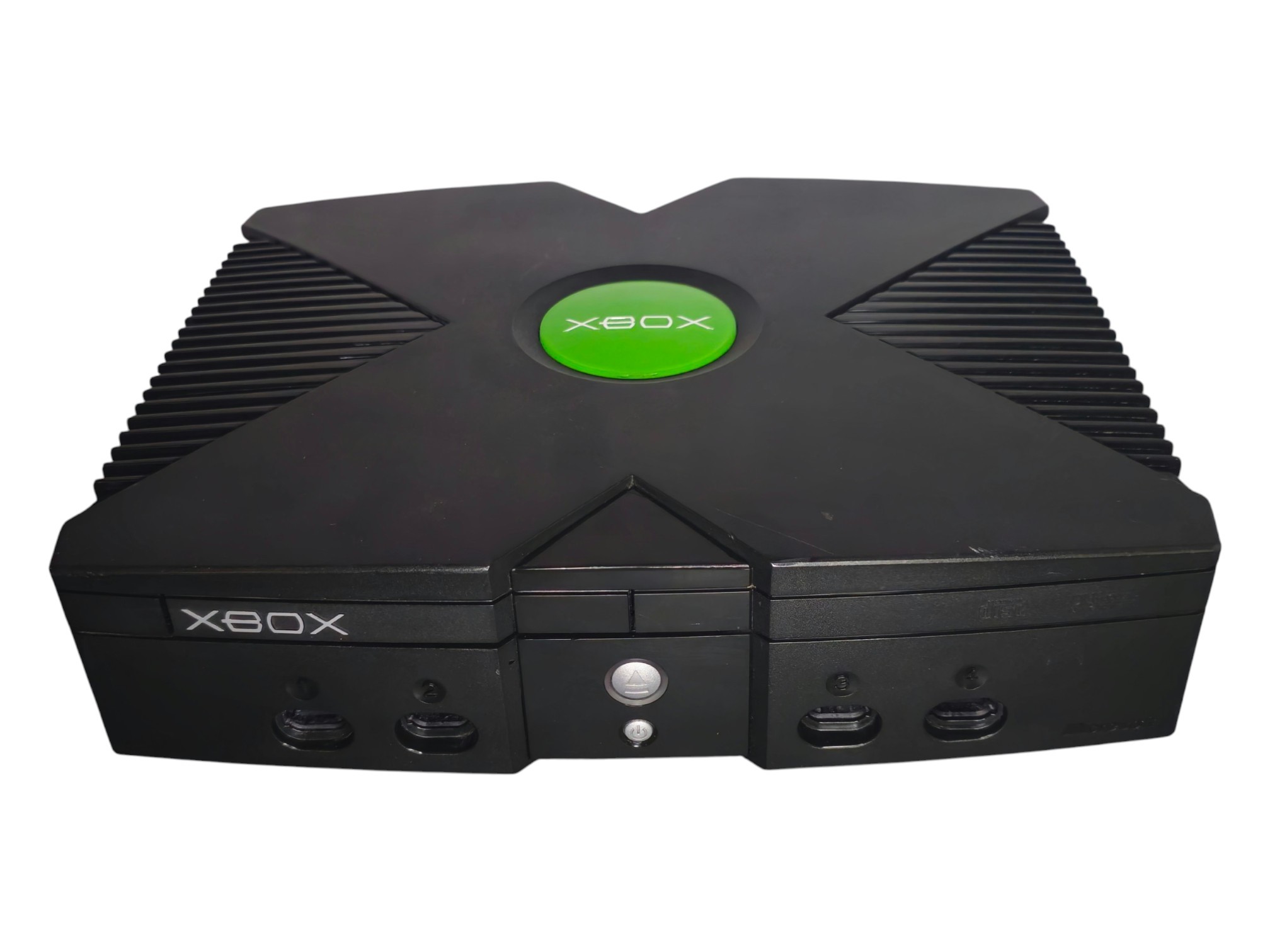
The Microsoft Xbox, commonly known as the Original Xbox, is one of the most important home video game consoles of the early twenty-first century. Released in North America on November 15, 2001, it marked Microsoft’s entry into the dedicated gaming hardware market and established the foundations of the Xbox brand.
Unlike previous generations of consoles built around highly specialised architectures, the original Xbox adopted a design closely related to contemporary personal computers. It combined a custom Intel x86 processor, advanced NVIDIA graphics technology, unified system memory, an internal hard disk drive, a DVD-ROM drive, and integrated Ethernet networking.
Its distinctive black enclosure, oversized X-shaped top surface, and bright green Xbox emblem became immediately recognisable symbols of Microsoft’s new gaming platform.
The Xbox competed directly with the Sony PlayStation 2 and Nintendo GameCube during the sixth generation of video game consoles.
Its powerful hardware enabled ambitious games including Halo: Combat Evolved, Halo 2, Fable, Forza Motorsport, Project Gotham Racing, Ninja Gaiden, Star Wars: Knights of the Old Republic, and The Elder Scrolls III: Morrowind.
The system also helped popularise integrated hard-drive storage, downloadable content, broadband multiplayer, and console-based online services through the introduction of Xbox Live in 2002.
The example represented in this collection belongs to the early 2002 production period and is associated with Hungarian manufacturing. Its factory and production identifiers strongly indicate the original Xbox motherboard revision 1.0, making it an especially interesting example of Microsoft’s earliest console hardware.
Today, the original Xbox remains historically significant not only for its games but also for the influence it had on console architecture, online gaming, and the development of the modern Xbox ecosystem.
📘 Introduction
The Microsoft Xbox was developed to challenge the growing dominance of dedicated gaming consoles, particularly Sony’s PlayStation platform.
Microsoft was already an established leader in personal computer operating systems and software development.
The Xbox represented an attempt to bring technologies associated with Windows PCs into a dedicated living-room gaming device.
Original Release Dates
- North America: November 15, 2001
- Japan: February 22, 2002
- Europe: March 14, 2002
- Australia: March 14, 2002
The console arrived in Europe approximately four months after its American launch.
Major Features
- 733 MHz Intel x86 processor
- NVIDIA NV2A graphics processor
- 64 MB unified DDR memory
- Built-in 8–10 GB-class hard disk drive
- DVD-ROM optical drive
- Four controller ports
- Integrated 10/100 Ethernet
- Advanced 3D graphics
- Hardware-supported positional audio
- Dolby Digital 5.1 support
- Broadband online gaming through Xbox Live
- System Link multiplayer
- Internal game-save storage
- Custom music soundtracks
- DVD movie playback with an optional accessory
The Xbox brought several features commonly associated with personal computers into a mainstream gaming console.
Its design significantly influenced the development of later gaming platforms.
🏭 Microsoft’s Entry into the Console Industry
The Xbox originated from Microsoft’s growing involvement in computer gaming during the 1990s.
Microsoft had already developed technologies important to PC games, including Windows, DirectX, and various software development tools.
The Rise of DirectX
DirectX was introduced in the 1990s to simplify multimedia and game development on Windows computers.
It provided standardised programming interfaces for graphics, audio, and input devices.
The DirectX Box Concept
The original Xbox project emerged from the idea of developing a game console closely related to Microsoft’s PC technologies.
The informal name DirectX Box eventually evolved into Xbox.
The Development Team
Important figures associated with the creation of Xbox included:
- Seamus Blackley
- Kevin Bachus
- Otto Berkes
- Ted Hase
Microsoft’s Xbox organisation subsequently expanded under executives including Robbie Bach.
The Official Reveal
Bill Gates presented the Xbox at the Consumer Electronics Show in January 2001.
The Strategic Objective
Microsoft wanted to create a powerful console capable of attracting:
- PC game developers
- Console developers
- Third-party publishers
- Multiplayer gaming communities
An Important Corporate Decision
Entering the console market required Microsoft to compete directly with established entertainment hardware manufacturers.
The result was a new gaming platform that would eventually become one of the industry’s major brands.
🖥️ The Distinctive Black X-Shaped Design
The original Xbox has one of the most recognisable physical designs of its generation.
Its large black enclosure incorporates a prominent X-shaped upper surface.
Exterior Features
- Matte black plastic housing
- Large X-shaped top design
- Circular green Xbox emblem
- Front-loading DVD drive
- Four controller ports
- Power button
- Disc Eject button
- Rear ventilation grille
- Internal cooling fan
- Ethernet connector
- AV Multi Out connector
- AC power inlet
The Green Xbox Logo
The central green emblem became the visual identity of the platform.
A Large Console
The original Xbox is considerably larger than many competing game systems.
Its dimensions reflect the use of PC-derived hardware, an internal hard disk, and a full-size optical drive.
Approximate Dimensions
- Width: 320 mm
- Depth: 260 mm
- Height: 100 mm
- Weight: Approximately 3.4 kg
The Importance of Ventilation
The Xbox generates significant heat during operation.
It requires sufficient airflow around the enclosure.
An Iconic Industrial Design
The black-and-green appearance became closely associated with Microsoft’s gaming identity.
Later Xbox consoles retained variations of the brand’s distinctive visual language.
⚙️ Technical Specifications
The original Xbox was one of the most powerful gaming consoles available at its introduction.
Hardware Overview
- Manufacturer: Microsoft
- Console: Xbox
- Common name: Original Xbox
- North American release: November 15, 2001
- European release: March 14, 2002
- Generation: Sixth
- CPU: Custom Intel Pentium III-derived processor
- CPU architecture: 32-bit x86
- CPU frequency: 733 MHz
- GPU: NVIDIA NV2A
- GPU frequency: Approximately 233 MHz
- System memory: 64 MB DDR SDRAM
- Memory architecture: Unified
- Memory bandwidth: Approximately 6.4 GB/s
- Internal storage: 8–10 GB-class IDE hard drive
- Optical storage: DVD-ROM
- Disc formats: Xbox game discs, supported CDs and DVDs
- Controllers: Four proprietary wired controller ports
- Network: Integrated 10/100 Mbps Ethernet
- Graphics: Direct3D-based 3D rendering
- Standard video output: Analogue composite and other formats through compatible cables
- Enhanced video: Component video and supported high-definition modes on compatible regional configurations
- Audio: Multichannel digital audio engine
- Surround support: Dolby Digital 5.1
- DVD movie playback: Requires compatible DVD Playback Kit
- Operating system: Custom Xbox system software
- Internal cooling: Fan-assisted
- Colour: Original Black
- Early hardware revision: v1.0 on documented matching production units
The early 2002 collection example is strongly associated with the first Xbox motherboard generation.
Its precise internal component configuration should nevertheless be verified through physical inspection.
🧠 Intel’s 733 MHz x86 Processor
The original Xbox uses a custom Intel processor derived from Pentium III-era technology.
The x86 Architecture
Unlike the specialised processors used in several competing consoles, the Xbox adopted the x86 instruction-set architecture familiar from personal computers.
CPU Frequency
The processor operates at 733 MHz.
Processor Responsibilities
It handles:
- Game logic
- Artificial intelligence
- Physics calculations
- Character movement
- Input processing
- Operating-system functions
- Game scripting
- Network communication
- General application execution
The PC Connection
The use of x86 technology made the Xbox architecturally closer to a Windows gaming PC than many earlier consoles.
Not an Ordinary Desktop Processor
Although derived from contemporary Intel technology, the Xbox processor was part of a custom console design.
It was not intended to be replaced or upgraded like a normal desktop CPU.
Historical Importance
The original Xbox helped demonstrate the viability of PC-derived hardware inside a successful home gaming console.
This became increasingly influential in later console generations.
🎨 NVIDIA NV2A Graphics Architecture
One of the Xbox’s greatest technological strengths was its graphics processor.
Microsoft collaborated with NVIDIA to develop the NV2A.
Graphics Capabilities
- Hardware-accelerated 3D rendering
- Programmable vertex shading
- Programmable pixel shading
- Texture filtering
- Advanced lighting effects
- Multitexturing
- Environment mapping
- Full-scene antialiasing capabilities
- Depth-buffer processing
- High-quality character and environment rendering
DirectX Technology
The Xbox graphics architecture was designed around technologies related to DirectX 8.
Programmable Shaders
Programmable shaders allowed developers to produce more sophisticated visual effects.
These included:
- Dynamic lighting
- Water effects
- Reflective surfaces
- Detailed textures
- Atmospheric effects
The GeForce Connection
The NV2A is technologically related to NVIDIA’s GeForce 3 generation.
However, it was customised specifically for Microsoft’s console.
A Powerful Gaming Platform
The GPU helped the Xbox deliver impressive graphics in games such as Halo, RalliSport Challenge, Ninja Gaiden, and Project Gotham Racing.
Historical Importance
The Xbox demonstrated the growing importance of advanced programmable graphics hardware in console gaming.
💾 64 MB Unified DDR Memory
The original Xbox contains 64 MB of DDR SDRAM.
The memory is shared between the processor and graphics system.
Unified Memory Architecture
Instead of using completely separate memory pools for CPU and GPU tasks, the Xbox uses a unified arrangement.
The Advantages
This allows developers to manage memory resources according to the needs of their games.
Memory Bandwidth
The system provides approximately 6.4 GB/s of memory bandwidth.
Memory Uses
Memory stores:
- Game code
- Graphics textures
- Geometry data
- Audio information
- Animation data
- Game-state information
- System software
Comparison with Competing Consoles
The PlayStation 2 has 32 MB of main system RAM.
The GameCube has 24 MB of main 1T-SRAM, with additional auxiliary memory.
The Xbox contains 64 MB of unified main memory.
The Importance of Memory
Its architecture helped support large game worlds and sophisticated graphics for the period.
💽 The Built-In Hard Drive Revolution
One of the Xbox’s most important innovations was the inclusion of an internal hard disk drive as standard equipment.
Most competing consoles still relied primarily on removable memory cards for game saves.
The Xbox Hard Drive
Retail units commonly used 3.5-inch IDE hard drives with physical capacities of approximately 8 GB or 10 GB.
The available space was managed through the console’s own partitions and file system.
What the Hard Drive Enabled
- Game saves
- Downloadable content
- Xbox Live-related data
- Music storage
- Custom soundtracks
- Game caching
- Faster loading in supported titles
- System configuration storage
An Important Convenience
Players did not need a separate memory card for ordinary game-save storage.
Music Ripping
The Xbox could copy compatible audio CDs to its internal hard disk.
Custom Soundtracks
Certain games allowed players to use music stored on the console.
A Major Design Decision
The hard drive increased manufacturing cost but provided valuable features.
Historical Significance
The internal hard drive became an increasingly important component of later console designs.
The Xbox helped establish expectations for local storage in gaming systems.
💿 DVD-ROM Optical Drive
The original Xbox uses a front-loading DVD-ROM drive.
Disc-Based Games
Commercial Xbox games were distributed primarily on DVD-based optical media.
The Advantages of DVD
Compared with CD-ROM, DVD provided substantially greater storage capacity.
This allowed developers to include:
- Larger environments
- More audio
- Video sequences
- Higher-resolution textures
- More complex game content
Disc Drive Manufacturers
Original Xbox consoles used DVD drives from several manufacturers, including:
- Thomson
- Philips
- Samsung
- Hitachi-LG
Early Hungarian Production
Early Hungarian-manufactured Xbox v1.0 consoles were commonly equipped with Thomson DVD drives.
However, the actual drive in an individual surviving console must be inspected because replacements are possible.
The Importance of Optical Media
The DVD format played a central role in the sixth generation of game consoles.
A Preservation Challenge
After more than two decades, original DVD drives may experience mechanical and optical failures.
🎬 DVD Movie Playback
The Xbox could also function as a DVD movie player.
However, this feature required an additional accessory.
The Xbox DVD Movie Playback Kit
The kit includes:
- Infrared receiver
- Remote control
The Receiver
The receiver connects to one of the console’s controller ports.
The Remote Control
It provides conventional movie playback functions.
Why an Accessory Was Required
Microsoft separated DVD movie playback functionality from the standard console configuration.
Regional DVD Restrictions
DVD movie playback was subject to DVD region controls.
These are distinct from the regional restrictions applied to Xbox game discs.
Historical Importance
DVD functionality helped the Xbox participate in the growing market for multimedia entertainment devices.
🎵 Audio & Dolby Digital 5.1
The Xbox includes a sophisticated audio-processing architecture for its generation.
Audio Capabilities
- Multichannel audio processing
- Positional sound
- Three-dimensional audio effects
- Hardware-assisted audio mixing
- Dolby Digital 5.1 support
- Digital audio through compatible accessories
Surround Sound
The Xbox was notable for its ability to provide Dolby Digital 5.1 audio in compatible games.
A More Immersive Experience
Surround sound allowed players to hear effects positioned around them.
Halo
Halo used sound effects and music to create atmospheric environments.
Project Gotham Racing
Racing games benefited from vehicle sounds and environmental effects.
Digital Output
A suitable advanced AV accessory could provide optical digital audio output.
Historical Significance
The Xbox helped make sophisticated home-theatre audio a practical feature of console gaming.
🔌 Video Output & Regional Differences
The original Xbox uses a proprietary AV Multi Out connector.
Different accessories provide different video connections.
Common Video Formats
- Composite video
- RGB SCART on compatible regional systems
- S-Video through supported accessories
- Component video
- High-definition analogue video modes on supported configurations
North American High-Definition Modes
Compatible NTSC-configured Xbox systems can support video modes including:
- 480p
- 720p
- 1080i
Actual support depends on the game and settings.
European PAL Systems
Standard PAL Xbox firmware normally does not expose the same high-definition configuration options.
PAL 50 & PAL 60
European systems can support different television refresh modes according to their software and settings.
An Important Regional Distinction
The capabilities of the hardware should not be confused with the video modes exposed by a particular regional dashboard.
No Native HDMI
The original Xbox does not contain an HDMI connector.
Modern displays require compatible analogue inputs or appropriate conversion equipment.
🕹️ The Original Xbox Controller: The Duke
The original Xbox launched with a large wired controller nicknamed The Duke.
It became one of the most recognisable accessories of the console’s first generation.
Controller Features
- Two analogue thumbsticks
- Directional pad
- A, B, X and Y buttons
- Two analogue triggers
- Black and White auxiliary buttons
- Start and Back buttons
- Vibration feedback
- Two accessory slots
- Breakaway cable connection
A Large Design
The Duke was substantially larger than many competing console controllers.
The Button Layout
Its control arrangement became a foundation for later Xbox controllers.
Dual Analogue Sticks
The controller was especially suited to three-dimensional games.
Halo
Halo’s control design helped demonstrate the advantages of dual analogue sticks for first-person shooters.
Breakaway Cable
The cable incorporated a detachable section intended to reduce the risk of the console being pulled from its position if someone tripped over the cable.
Historical Significance
The Duke remains an iconic example of early Xbox industrial design.
🎮 The Smaller Controller S
Microsoft subsequently introduced a smaller controller, commonly called Controller S.
It originated with the Japanese market and later became the standard controller in other regions.
Main Differences
- Smaller enclosure
- Modified button layout
- Improved ergonomics for many users
- Different positioning of Start and Back
- Revised analogue controls
The Controller S Legacy
Its design more closely resembles the general layout used by later Xbox controllers.
Compatibility
Both Duke and Controller S are compatible with the original Xbox.
Collector Significance
The controller supplied with an individual Xbox can help document the original retail package.
However, a surviving controller should not automatically be assumed to be the one originally sold with the console.
🔗 Four Controller Ports & Local Multiplayer
The original Xbox includes four controller ports on the front panel.
Four-Player Gaming
Compatible games support local multiplayer for up to four players without requiring a separate multitap accessory.
Popular Multiplayer Games
- Halo: Combat Evolved
- Halo 2
- Fusion Frenzy
- Project Gotham Racing
- TimeSplitters 2
- Star Wars Battlefront
The Controller Connections
The Xbox ports use a proprietary connector based on USB-related technology.
Additional Accessories
The controller ecosystem included:
- Memory units
- Arcade controllers
- Steering wheels
- Specialist game controllers
Historical Importance
Built-in four-player support made the Xbox well suited to shared living-room entertainment.
🌐 Ethernet Networking & System Link
A defining hardware feature of the original Xbox was its integrated Ethernet port.
Networking Specification
The console provides 10/100 Mbps Ethernet.
System Link
System Link allows compatible games to communicate between multiple consoles connected through a local network.
LAN Multiplayer
Players can connect several Xbox consoles using suitable networking equipment.
Halo LAN Parties
Halo became particularly famous for local multiplayer gatherings.
A New Social Experience
Players could organise multiplayer sessions across multiple televisions.
No Built-In Wi-Fi
The original Xbox does not contain integrated wireless networking.
Historical Importance
Ethernet networking became increasingly important in later console generations.
The Xbox helped make networking an expected part of gaming hardware.
🌐 Xbox Live: The Beginning of a Major Online Platform
Microsoft introduced Xbox Live on November 15, 2002, one year after the North American Xbox launch.
The service was designed around broadband internet connectivity.
Important Features
- Online multiplayer
- Xbox gamertags
- Friends lists
- Voice communication
- Matchmaking
- Online game services
- Downloadable content
The Gamertag
Xbox Live provided a persistent online identity for players.
Voice Chat
Voice communication became a defining feature of the service.
Broadband Networking
The original Xbox was designed around Ethernet rather than an ordinary telephone-line dial-up modem.
Halo 2
Released in 2004, Halo 2 became one of the most influential early Xbox Live games.
The Original Service Shutdown
Microsoft discontinued the original Xbox Live service for first-generation Xbox games on April 15, 2010.
What Remains Possible
Local multiplayer, compatible offline games, and System Link do not depend on the original Xbox Live service.
Historical Significance
Xbox Live established many of the connected gaming features that became standard in later generations.
🎮 The Original Xbox Game Library
The original Xbox developed an extensive software catalogue covering many different genres.
Important Games
- Halo: Combat Evolved
- Halo 2
- Fable
- Fable: The Lost Chapters
- Forza Motorsport
- Project Gotham Racing
- Project Gotham Racing 2
- Ninja Gaiden
- Ninja Gaiden Black
- Star Wars: Knights of the Old Republic
- Star Wars: Knights of the Old Republic II
- Jade Empire
- The Elder Scrolls III: Morrowind
- The Elder Scrolls III: Morrowind – Game of the Year Edition
- Crimson Skies: High Road to Revenge
- Panzer Dragoon Orta
- Jet Set Radio Future
- Blinx: The Time Sweeper
- Dead or Alive 3
- Dead or Alive Ultimate
- RalliSport Challenge
- RalliSport Challenge 2
- MechAssault
- MechAssault 2: Lone Wolf
- Steel Battalion
- Steel Battalion: Line of Contact
- The Chronicles of Riddick: Escape from Butcher Bay
- Splinter Cell
- Splinter Cell: Pandora Tomorrow
- Splinter Cell: Chaos Theory
- Burnout 3: Takedown
- Burnout Revenge
- Doom 3
- Half-Life 2
- Grand Theft Auto: Vice City
- Grand Theft Auto: San Andreas
- Psychonauts
- Conker: Live & Reloaded
- Fuzion Frenzy
- Oddworld: Munch’s Oddysee
- Oddworld: Stranger’s Wrath
The Xbox became particularly well known for action games, racing titles, first-person shooters, and role-playing games.
👽 Halo: Combat Evolved
Halo: Combat Evolved, developed by Bungie, was released alongside the Xbox in North America in November 2001.
It became the console’s defining launch title.
The Story
Players control Master Chief, a supersoldier fighting against the alien Covenant.
Gameplay Features
- First-person combat
- Large environments
- Vehicle gameplay
- Science-fiction storytelling
- Cooperative campaign
- Multiplayer combat
The Importance of Controls
Halo demonstrated that a sophisticated first-person shooter could work effectively with a console controller.
LAN Multiplayer
System Link support contributed to the popularity of Halo multiplayer gatherings.
A New Microsoft Franchise
Halo became one of the most important properties associated with Xbox.
Historical Significance
Its success played a major role in establishing Microsoft’s credibility in the console market.
👽 Halo 2 & the Rise of Online Multiplayer
Released in November 2004, Halo 2 became one of the most influential online console games of its generation.
Major Features
- Expanded campaign
- Dual-wielding weapons
- New multiplayer maps
- Online matchmaking
- Xbox Live integration
- Competitive multiplayer
The Importance of Xbox Live
Halo 2 helped demonstrate the potential of organised broadband multiplayer on consoles.
A Major Community
Players developed strong online communities around the game.
Historical Impact
Halo 2 established expectations for online console shooters that would influence the industry for years.
🏎️ Forza Motorsport & Project Gotham Racing
Racing games were another major strength of the Xbox.
Project Gotham Racing
Released in 2001, Project Gotham Racing combined high-performance cars with a distinctive driving-score system.
Project Gotham Racing 2
The sequel expanded the experience with additional vehicles, cities, and Xbox Live functionality.
Forza Motorsport
Released in 2005, Forza Motorsport introduced Microsoft’s major racing simulation franchise.
Technical Achievements
These games demonstrated:
- Detailed vehicle models
- Sophisticated environments
- Advanced lighting
- Realistic handling
- High-quality audio
Historical Significance
The original Xbox established two important racing franchises that would remain associated with Microsoft’s gaming platforms.
🐉 Fable, Morrowind & Western Role-Playing Games
The Xbox became an important platform for complex role-playing games.
Fable
Developed by Lionhead Studios and released in 2004, Fable combined fantasy adventure with character development and player choices.
The Elder Scrolls III: Morrowind
Released for Xbox in 2002, Morrowind brought an expansive open-world role-playing experience to a console audience.
Star Wars: Knights of the Old Republic
Released in 2003, Knights of the Old Republic became one of the platform’s most celebrated role-playing games.
Jade Empire
Released in 2005, Jade Empire introduced an original fantasy setting inspired by martial arts and mythological themes.
The Hardware Advantage
The Xbox’s internal hard drive, memory arrangement, and processing power helped support ambitious role-playing experiences.
Historical Significance
The platform played an important role in expanding the audience for Western-style role-playing games.
🥷 Ninja Gaiden & Advanced Action Gaming
Ninja Gaiden, developed by Team Ninja, became one of the Xbox’s most respected action games.
Gameplay
Players control Ryu Hayabusa through demanding combat sequences.
Technical Features
- Detailed character models
- Fast animation
- Sophisticated combat mechanics
- Large environments
- Advanced visual effects
Ninja Gaiden Black
The later enhanced release expanded the original experience.
A Technical Showcase
The series demonstrated the console’s ability to handle fast, technically demanding three-dimensional action.
🔄 Xbox vs. PlayStation 2 vs. GameCube
The sixth console generation was one of the most competitive periods in gaming history.
Sony PlayStation 2
- Released in 2000
- Emotion Engine processor
- DVD-ROM media
- Memory Card storage
- Enormous software library
- PlayStation backward compatibility
Nintendo GameCube
- Released in 2001
- IBM PowerPC-based processor
- ATI-developed graphics technology
- Nintendo optical discs
- Compact enclosure
- Four controller ports
Microsoft Xbox
- Released in 2001
- Intel x86 processor
- NVIDIA graphics processor
- DVD-ROM media
- Built-in hard drive
- Four controller ports
- Integrated Ethernet
- Xbox Live online service
The Xbox Advantage
The Xbox emphasised hardware performance, integrated storage, networking, and advanced graphics.
The PlayStation 2 Advantage
Sony benefited from its enormous software catalogue and established PlayStation audience.
The GameCube Advantage
Nintendo focused on distinctive first-party software, compact hardware, and familiar franchises.
Historical Significance
The competition between these platforms helped define the future of home gaming.
🧩 Original Xbox Hardware Revisions
Microsoft introduced several internal revisions during the Xbox’s commercial lifetime.
These changes improved manufacturing efficiency, component integration, and reliability.
Revision 1.0
The original production architecture.
Notable characteristics include:
- Dedicated GPU cooling fan
- Separate controller interface daughterboard
- Conexant video encoder
- Early motherboard layout
- Large original BIOS flash configuration
Revision 1.1
Introduced hardware refinements including changes to the cooling arrangement and controller electronics.
Revisions 1.2–1.3
Featured further motherboard redesigns and component changes.
Revision 1.4
Introduced changes including a different video encoder.
Revisions 1.6 / 1.6b
Later redesigns changed several internal components, including video circuitry and BIOS architecture.
Collector Identification
Motherboard revisions can be estimated using:
- Manufacturing period
- Factory information
- Serial-number structure
- Video encoder
- Cooling arrangement
- Controller daughterboard
- Main PCB markings
The Importance of Direct Inspection
External markings provide strong evidence but cannot prove that internal hardware has never been replaced.
🏭 The Early Hungarian Xbox Production
The collection example represented here is associated with Xbox manufacturing in Hungary during April 2002.
This is historically interesting because European Xbox production was concentrated in specific international factories.
The Hungarian Factory
Microsoft used manufacturing facilities in Hungary for early Xbox production.
The European Launch
The Xbox arrived in Europe on March 14, 2002.
Early Production
Hungarian-made systems from spring 2002 were among the early-generation units distributed during the European launch period.
Hardware Revision 1.0
Contemporary production documentation associates Hungarian manufacturing with original Xbox hardware revision 1.0.
Typical Components
These systems commonly used:
- Original v1.0 motherboard architecture
- Dedicated GPU cooling fan
- Conexant video circuitry
- Thomson optical drive
Not Every Component Is Guaranteed
Individual parts may have been replaced during the console’s lifetime.
A Valuable Historical Detail
A surviving early Hungarian-produced Xbox provides a direct connection with Microsoft’s first European console launch.
🔧 The Clock Capacitor: An Important Preservation Issue
One of the best-known problems affecting the original Xbox is the ageing clock capacitor.
Early motherboard revisions contain a small supercapacitor designed to retain the system clock for a limited period when power is disconnected.
The Clock Capacitor
Its purpose is to support temporary retention of the clock state.
The Problem
Certain original capacitors are prone to leaking electrolyte as they age.
Potential Damage
Leaked electrolyte can cause:
- Corroded PCB traces
- Damaged solder connections
- Unreliable power operation
- Faulty front-panel controls
- Motherboard failure
Early Xbox Revisions
The problem is particularly important on original motherboard revisions 1.0 through 1.4.
Revision 1.0
The early 2002 hardware associated with this collection entry belongs to the high-priority inspection group.
Preservation Practice
A qualified repairer can inspect the motherboard, assess the clock capacitor, remove or replace it when appropriate, and clean any affected areas.
An Important Revision Difference
Later revision 1.6 systems use a different clock-capacitor arrangement and should not be treated identically.
Museum Significance
Preventive maintenance is especially important for preserving early Xbox consoles in working condition.
🛠️ Other Common Hardware Problems
The original Xbox is now a vintage computer-based gaming system.
After more than twenty years, several components may require attention.
DVD Drive Problems
The optical drive may experience:
- Disc-reading failures
- Slow recognition
- Tray problems
- Mechanical wear
- Laser deterioration
Hard Drive Failure
Original IDE hard drives contain moving mechanical parts.
Their failure can prevent the Xbox from starting normally.
Capacitor Ageing
Electrolytic capacitors in the power and motherboard circuits can deteriorate.
Cooling Fan Wear
Fans can become noisy or fail.
Power Supply Problems
Original power supplies may develop ageing-related electrical faults.
Connector Damage
The AV, Ethernet, and controller connectors may develop mechanical or electrical problems.
Important Safety Precaution
The Xbox contains an internal mains-powered power supply.
Electrical repairs should be performed only by someone qualified to work safely with mains-powered electronics.
Preservation
Original components should be documented before replacement.
💾 Hard Drive Preservation & Software Archiving
The original Xbox hard drive is an important part of the system.
Unlike consoles using only removable memory cards, the Xbox depends heavily on its internal storage.
Stored Information
The hard drive may contain:
- Game saves
- System files
- Downloaded content
- Music collections
- Xbox Live-related files
- User settings
The ATA Security System
Original Xbox hard drives normally use a locking arrangement associated with the console’s configuration.
Why Replacement Requires Care
A replacement hard drive cannot always be installed as if it were an ordinary PC storage device.
The Importance of Backups
A working hard drive may contain valuable historical information.
Preserving the Original Drive
For a museum, it can be useful to retain the original disk even if a replacement is fitted for everyday operation.
Documenting Modifications
Changes to firmware, storage, or dashboard software should be recorded.
A Digital Preservation Challenge
The original Xbox demonstrates that conserving modern gaming systems increasingly involves preservation of both hardware and stored digital information.
🌍 Worldwide Commercial Impact
The original Xbox established Microsoft as a significant participant in the console industry.
Although it did not match the PlayStation 2’s enormous lifetime sales, it built a substantial player community.
Global Sales
Industry estimates commonly place original Xbox lifetime sales at approximately 24 million consoles worldwide.
This should be understood as an approximate historical total rather than an exact independently verified final Microsoft figure.
North America
The Xbox was particularly successful in the United States.
Europe
Microsoft invested heavily in European distribution and marketing.
Japan
The console faced considerable commercial challenges in Japan despite efforts to attract local developers.
The Importance of Halo
Halo became the defining exclusive franchise of the platform.
The Online Advantage
Xbox Live helped differentiate Microsoft from competitors.
A Long-Term Investment
The original Xbox established the foundation for the Xbox 360, Xbox One, Xbox Series, and the wider Xbox gaming ecosystem.
🇬🇷 The Original Xbox in Greece
The Xbox reached the European market on March 14, 2002.
During this period, Sony’s PlayStation 2 already had a strong presence in Greece.
A New Competitor
Microsoft introduced an alternative gaming platform with advanced graphics, internal storage, and broadband networking.
Popular Games
Greek players encountered well-known titles such as:
- Halo
- Halo 2
- Fable
- Project Gotham Racing
- Ninja Gaiden
- Star Wars: Knights of the Old Republic
- Splinter Cell
- Forza Motorsport
The Importance of PAL Hardware
European Xbox models were commonly configured for PAL television systems.
Networking
Ethernet connectivity provided opportunities for local multiplayer and compatible network gaming.
A Different Gaming Experience
The Xbox emphasised Western-developed games, shooters, racing games, and PC-style role-playing experiences.
Museum Significance
A surviving early European Xbox helps document the development of gaming in Greece at the beginning of the twenty-first century.
It represents Microsoft’s entrance into a market previously dominated by established console manufacturers.
🏛️ Collectability & Historical Preservation
The original Xbox has become an important collectible, particularly for enthusiasts of sixth-generation consoles.
Important Collecting Factors
- Original Microsoft Xbox console
- Authentic black enclosure
- Original green Xbox emblem
- Intact manufacturer label
- Original motherboard
- Original DVD drive
- Original hard drive
- Original BIOS and dashboard
- Functional controller ports
- Correct regional power supply
- Original controllers, if present
- Original AV cable, if present
- Original power cable, if present
- Original packaging, if present
- Instruction manual, if present
Early Revision Interest
The first-generation v1.0 hardware is particularly interesting because it preserves Microsoft’s earliest commercial Xbox architecture.
The GPU Fan
The separate GPU cooling fan is a useful identification feature.
The Controller Daughterboard
The first hardware revision also includes a separate controller interface board.
Original Storage
The internal hard drive is an important part of the original design.
The Importance of Condition
Cosmetic originality and safe electronic operation are both important for museum preservation.
A Complete Historical Representation
Original hardware and accessories help demonstrate the Xbox as consumers experienced it during the early 2000s.
⭐ Why the Original Xbox Still Matters
The original Xbox is historically important for numerous reasons:
- It was Microsoft’s first dedicated gaming console
- It introduced a major new competitor to the industry
- It used PC-derived x86 processing technology
- It incorporated advanced NVIDIA graphics
- It included 64 MB of unified memory
- It featured a standard internal hard drive
- It supported DVD-based gaming
- It included four controller ports
- It provided integrated Ethernet connectivity
- It supported System Link multiplayer
- It introduced Xbox Live
- It helped popularise broadband console gaming
- It supported custom soundtracks
- It offered advanced digital surround sound
- It established Halo as a major gaming franchise
- It laid the foundations for later Xbox platforms
A PC-Inspired Console
The Xbox brought several computer technologies into a dedicated gaming device.
A New Online Future
Xbox Live changed expectations for online multiplayer on consoles.
A Distinctive Hardware Design
The black X-shaped enclosure became one of the most recognisable console designs of its era.
An Important First Generation
Early production examples preserve the original technological architecture Microsoft used to enter the market.
📦 Items Included in This Collection Entry
Original platform launch: November 15, 2001
European platform launch: March 14, 2002
Individual production period: April 2002, according to factory and production identifiers
Manufacturing location: Hungary, based on factory identification
Hardware generation: Sixth-generation home console
Probable motherboard revision: Xbox v1.0
Processor: Intel x86, 733 MHz
Graphics: NVIDIA NV2A
Memory: 64 MB DDR SDRAM
Storage: Internal IDE hard drive
Optical media: DVD-ROM
Regional video configuration: To be verified from the individual unit
Original internal component configuration: Not yet physically verified
Controllers, cables, packaging, and other accessories: To be documented separately where physically present
🏁 Conclusion
The Microsoft Xbox Original represents one of the most significant developments in modern console gaming.
Introduced in North America in November 2001 and Europe in March 2002, it established Microsoft as a major participant in the video game hardware industry.
Its custom Intel x86 processor, NVIDIA NV2A graphics architecture, 64 MB unified memory, DVD-ROM drive, internal hard disk, and integrated Ethernet networking created a powerful and distinctive gaming platform.
The Xbox also introduced important consumer features, including local hard-drive storage, custom music soundtracks, System Link networking, and the groundbreaking Xbox Live service.
Its software catalogue produced numerous influential titles, particularly Halo, Halo 2, Fable, Ninja Gaiden, Project Gotham Racing, Forza Motorsport, and Star Wars: Knights of the Old Republic.
The early 2002 Hungarian-produced hardware represented in this collection is especially interesting because it is strongly associated with the original v1.0 motherboard architecture.
This first hardware revision preserves the earliest commercial Xbox engineering approach, including its distinctive cooling and internal controller arrangements.
Although the system faces modern preservation challenges involving ageing capacitors, optical drives, and internal hard disks, these very components make it a valuable historical artefact.
For a technology museum, the original Xbox represents the meeting point between personal computer hardware and dedicated home gaming.
It also documents the beginning of Microsoft’s long-lasting influence on console design, online multiplayer, and digital entertainment.
The console that launched Xbox, transformed Microsoft’s relationship with gaming, and helped define the future of connected home entertainment.
