

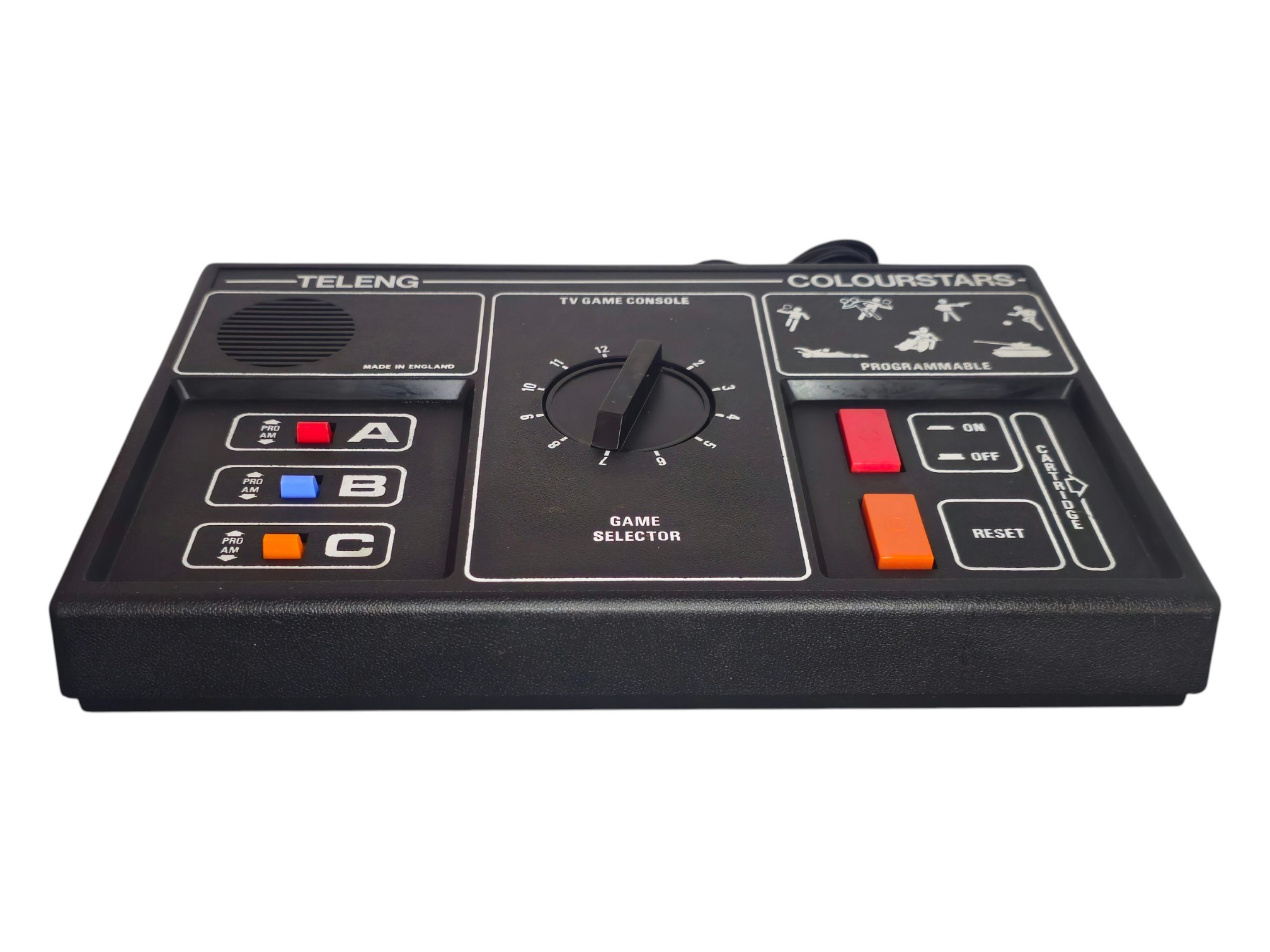
The Teleng Colourstars Programmable is a fascinating British home video game console from the late 1970s, representing an important transitional period between the earliest dedicated Pong machines and the programmable cartridge-based systems that would eventually dominate the industry.
Developed and marketed by Teleng, a British electronics company based in Essex, the Colourstars introduced interchangeable electronic game cartridges, colour television graphics, analogue joystick controllers, and a distinctive twelve-position rotary game selector.
Unlike conventional Pong consoles with a fixed selection of games, the Colourstars Programmable could offer different types of entertainment through separate cartridges. These included traditional ball-and-paddle sports, motorcycle and automobile racing, tank battles, submarine games, and other electronic challenges.
Its most unusual feature was the technology inside its cartridges. Rather than containing ordinary software stored in ROM, the cartridges housed dedicated General Instrument game-generation integrated circuits.
These specialised chips generated the gameplay directly, making the Colourstars a fascinating intermediate step in the evolution of home gaming.
The original Cartridge No. 1 – Ball/Paddle used the General Instrument AY-3-8610, providing ten selectable games through the console’s large twelve-position rotary dial.
The console’s black enclosure, prominent central game selector, three PRO/AM difficulty controls, large red and orange buttons, and side-mounted cartridge connection create one of the more distinctive designs of the late-1970s British gaming market.
Today, the Teleng Colourstars Programmable is an important collectible demonstrating the diversity of early video game hardware and the role of British electronics companies in the development of home entertainment.
📘 Introduction
The Teleng Colourstars Programmable appeared during the late 1970s, when home video gaming was evolving rapidly.
Historical catalogues associate the Colourstars family with 1977, while contemporary advertising confirms the availability of cartridge-based Colourstars products by 1978.
The Centre for Computing History dates its documented Colourstars console and Cartridge No. 1 examples to 1979.
For this reason, 1978–1979 is a useful conservative description of the documented commercial period of the programmable configuration.
Main Features
- British-designed and marketed home gaming system
- Interchangeable electronic game cartridges
- Colour-capable television graphics
- Twelve-position rotary game selector
- Three PRO/AM difficulty controls
- Dedicated power switch
- Large Game Reset button
- Two external wired joystick controllers
- Analogue directional control
- Cartridge-dependent gameplay
- General Instrument integrated circuits inside cartridges
- RF television output
- Internal electronic sound
- Battery and external power operation
- Side-mounted cartridge connection
- Expandable selection of games
The Colourstars was developed at a time when manufacturers were experimenting with several different ways of expanding a console’s game library.
Although advertised as programmable, its operating principle differed from later consoles such as the Atari 2600.
Instead of executing software stored on a cartridge, the Colourstars relied on specialised electronic circuitry contained inside the removable game module.
This makes it a particularly valuable example of early gaming technology.
🏭 Teleng: A British Electronics Company
The Colourstars was associated with Teleng Ltd., a British electronics company with roots in television engineering.
Teleng was established during the 1950s and was connected with the Telefusion engineering business.
The Company’s Origins
Teleng’s activities originally centred on television and radio-frequency technology.
Its products included equipment related to:
- Television reception
- Signal distribution
- Aerial systems
- Television testing
- Electronic measurement
- Consumer electronics
Essex, England
Historical company records associate Teleng with locations in Essex, including Harold Wood and South Ockendon.
The latter was home to facilities associated with the company’s later television-game activities.
Expansion into Electronic Gaming
During the 1970s, electronic television games became a promising consumer market.
Companies already familiar with television technology were well positioned to participate.
Teleng’s Gaming Products
Teleng marketed several gaming systems, including:
- Teleng Telestars
- Teleng Colourstars TV Games
- Teleng Colourstars Programmable
- Teleng Television Computer System
These products represented different levels of technical sophistication.
A British Connection to Early Gaming
The Colourstars demonstrates that the development of early gaming technology was not restricted to American companies.
British manufacturers and distributors also contributed to the growing home entertainment market.
🇬🇧 Made in England
One of the most interesting details of the Colourstars Programmable is its British identity.
Documented consoles and related Teleplay variants feature Made in England markings.
British Consumer Electronics
During the 1970s, the United Kingdom had an established electronics industry.
Companies manufactured television equipment, radios, calculators, and other electronic products.
The Home Gaming Opportunity
The success of Pong created demand for products that could connect directly to domestic televisions.
The Colourstars Design
Teleng combined dedicated semiconductor technology with an enclosure and control system suitable for British and European consumers.
A Distinctive Origin
Many inexpensive Pong consoles were manufactured in Hong Kong or other Asian electronics centres.
The Colourstars is particularly interesting because documented configurations were produced in England.
The Importance of Factory Markings
Original manufacturing labels can help establish the origin of a surviving unit.
They should be preserved wherever possible.
Museum Significance
The Colourstars provides an excellent example of British consumer gaming hardware developed shortly before the country’s famous home-computer expansion of the early 1980s.
🖥️ The Distinctive Black Console Design
The Teleng Colourstars Programmable features a wide, low-profile black plastic enclosure.
Its appearance is unusual compared with many contemporary Pong machines.
Exterior Characteristics
- Black rectangular housing
- Teleng branding
- Colourstars nameplate
- Large central rotary selector
- Twelve numbered game positions
- Three difficulty buttons
- Power switch
- Game Reset button
- Integrated speaker grille
- Cartridge connector on the right side
- Rear controller and television connections
A Prominent Central Dial
The game selector occupies a large portion of the upper surface.
It is surrounded by numbers from 1 to 12.
A Professional Appearance
The extensive use of black plastic and white printed markings gives the machine an appearance similar to other electronic equipment of its period.
Colour-Coded Buttons
Large red and orange controls provide visual contrast.
The Unusual Cartridge Location
Instead of placing the cartridge slot in the centre or rear of the machine, the Colourstars uses a connection positioned at the side.
A Recognisable Design
This layout makes the console visually distinctive among early cartridge-based Pong systems.
⚙️ Technical Specifications
The Colourstars Programmable uses an electronic architecture based on removable dedicated game circuitry.
Hardware Overview
- Manufacturer / Brand: Teleng
- Console: Colourstars Programmable
- Product type: Cartridge-based television game console
- Documented commercial period: 1978–1979
- Historical generation: First-generation / transitional cartridge system
- Country of origin: United Kingdom
- Manufacturing: England on documented versions
- Base console architecture: Dedicated electronic interface circuitry
- General-purpose CPU: None
- Game circuitry: Located inside interchangeable cartridges
- Game-chip family: General Instrument AY-3-8xxx
- Standard Ball/Paddle cartridge chip: AY-3-8610
- Game selector: Twelve-position rotary dial
- Difficulty controls: Three PRO/AM settings
- Reset: Dedicated button
- Video: Hardware-generated colour television graphics
- Television connection: Analogue RF
- Regional display configuration: PAL on documented UK hardware
- Controllers: Two external wired joystick controllers in original retail configurations
- Audio: Internal electronic sound output
- Storage medium: Electronic game cartridges
- Cartridge connector: Specialised multi-contact connection
- External power on documented related versions: 9V DC, centre-positive
- Battery operation on documented related versions: Six 1.5V C-size cells
- Operating system: None
- Conventional game RAM: Not applicable in the modern sense
The precise internal revision and electrical details of an individual console should be verified directly from its original hardware.
🧠 A Console with No Conventional CPU
The most important technological distinction of the Colourstars is its unconventional architecture.
Modern game consoles contain processors capable of executing different software programs.
The Colourstars operates differently.
Dedicated Game Hardware
Each cartridge contains an integrated circuit specifically designed to generate particular games.
The Role of the Main Console
The base system provides:
- Electrical power
- Controller connections
- Game selection
- Difficulty settings
- Video output
- Audio output
- Cartridge interface circuitry
The Role of the Cartridge
The cartridge contains much of the electronic logic responsible for implementing the games.
No Conventional Software Execution
The machine does not load programs from ROM into a general-purpose processor.
No Operating System
There is no software dashboard or boot environment.
Why This Matters
The Colourstars is neither a simple fixed-game Pong console nor a programmable computer in the conventional sense.
It belongs to an intermediate generation of electronic gaming systems.
Historical Importance
This architecture demonstrates that the development of expandable gaming followed more than one technological path.
💾 Electronic Cartridges: Hardware Instead of Software
The Colourstars uses a form of cartridge very different from those associated with later Nintendo, Sega, or Atari systems.
Modern ROM Cartridges
A conventional software cartridge stores program instructions and data.
The console’s CPU executes those instructions.
Colourstars Cartridges
A Colourstars cartridge contains specialised integrated circuitry that generates its games.
The Importance of the Game Chip
Different cartridges can use different General Instrument chips.
Changing the Gameplay
Replacing the cartridge allows the base console to support a different game family.
The Main Advantage
Players can expand their entertainment options without purchasing a new console.
The Main Limitation
Developing new games generally requires dedicated electronic hardware rather than merely writing a new software program.
A Transitional Technology
Hardware cartridges appeared during the short period between fixed-game Pong consoles and widely successful ROM-based programmable systems.
Preservation Value
Because the cartridges contain obsolete semiconductor components, original examples are important technical artefacts in their own right.
🧩 General Instrument & the AY-3-8xxx Game Chips
The American semiconductor manufacturer General Instrument played a major role in the development of early home video games.
The company produced integrated circuits capable of generating complete electronic games.
The AY-3-8500
Introduced commercially during the Pong boom, the AY-3-8500 became one of the most influential dedicated game chips.
The Expanding Chip Family
General Instrument subsequently developed other specialised circuits for:
- Electronic sports
- Motorcycle racing
- Automobile racing
- Tank battles
- Submarine games
- Shooting games
- Breakout-style games
The Colourstars Concept
Different integrated circuits could be installed inside interchangeable cartridges.
An Economical Approach
The base console could be reused for multiple types of electronic games.
A Different Industry Model
The manufacturer could expand its library by producing additional electronic cartridges.
Historical Significance
General Instrument’s technology helped establish the cartridge-based Pong market before software-driven consoles became dominant.
🏓 Cartridge No. 1 – Ball/Paddle
The most important cartridge associated with the Teleng Colourstars is Cartridge No. 1 – Ball/Paddle.
This was the standard introductory cartridge supplied with documented retail configurations.
The Integrated Circuit
The cartridge uses the General Instrument AY-3-8610.
Ten Games
The chip provides ten ball-and-paddle and target-based games.
The Twelve-Position Dial
The console’s rotary selector has twelve positions.
Two positions are not assigned to games on this cartridge.
Why Twelve Positions?
The control layout was designed to support cartridge-dependent selections.
The number of positions on the console does not establish the number of games contained in any particular cartridge.
The Importance of Cartridge No. 1
This cartridge provides an excellent example of how the system operates.
A Complete Game-Generation Module
The electronic circuitry necessary for producing the games is contained within the removable cartridge.
Historical Value
The Ball/Paddle cartridge is central to understanding the Colourstars architecture.
🎮 The Ten Games on Cartridge No. 1
The original Cartridge No. 1 provides the following documented selection arrangement:
| Dial position | Game |
|---|---|
| 1 | Solo Squash |
| 2 | Unassigned |
| 3 | Gridball |
| 4 | Solo Basketball |
| 5 | Unassigned |
| 6 | Target |
| 7 | Solo Target |
| 8 | Squash |
| 9 | Hockey |
| 10 | Tennis |
| 11 | Basketball |
| 12 | Football |
Not Twelve Games
The console has a twelve-position selector, but Cartridge No. 1 offers ten games.
Sports Variations
Several games use different arrangements of paddles, goals, and playing-field boundaries.
Target Games
The cartridge also contains two target-based modes.
Hardware Selection
The player turns the central selector to the appropriate numbered position.
An Important Design Detail
Unlike later consoles with graphical menus, the Colourstars relies entirely on physical hardware controls for selecting games.
🎾 Tennis, Squash & Hockey
The Ball/Paddle cartridge contains several traditional Pong-style sports games.
Tennis
Two players control paddles at opposite sides of the screen.
The objective is to return the moving ball and prevent the opponent from scoring.
Squash
A modified court arrangement introduces wall-based gameplay.
Players must anticipate rebounds and position their controls accurately.
Hockey
Hockey provides a different playing-field layout involving goals and electronic player objects.
Shared Electronic Technology
All three games use related graphical building blocks.
The Importance of Simple Rules
These activities were particularly suitable for early home gaming because they required very little explanation.
Historical Significance
They demonstrate how the Pong concept was adapted into multiple electronic sports games during the 1970s.
🏀 Basketball & Solo Basketball
The AY-3-8610 also provides basketball-themed electronic games.
Basketball
The game uses simple electronic objects to simulate a ball-and-goal competition.
Solo Basketball
The single-player variation provides an alternative arrangement suitable for individual play.
A Different Sporting Concept
Although the graphics remain simple, basketball introduces another form of scoring challenge.
The Role of the Game Chip
The AY-3-8610 generates the gameplay directly.
A Wider Sports Library
The inclusion of basketball helped distinguish the cartridge from earlier Pong systems offering only four traditional games.
Historical Importance
These variations demonstrate the effort to expand the entertainment value of dedicated game chips.
⚽ Football & Gridball
The Ball/Paddle cartridge includes Football and Gridball.
Football
The game uses electronic paddles and goals to create a simplified football-inspired activity.
Gridball
Gridball introduces an alternative playing-field arrangement and gameplay pattern.
A Different Challenge
The player must respond to the ball according to the rules of the selected mode.
Simple Graphics
The games use basic geometric objects rather than animated players.
The Importance of Variety
Offering different sports variations made the cartridge more attractive as a complete entertainment package.
Historical Significance
These games belong to the experimental period when manufacturers were discovering how much variety could be produced using dedicated electronic circuits.
🎯 Target & Solo Target
The Ball/Paddle cartridge also includes two target-based game modes.
Target
A competitive electronic target game.
Solo Target
A variation designed around individual play.
A Different Type of Gameplay
These modes move beyond the familiar sporting arrangement of two paddles exchanging a ball.
Controller Requirements
The original controls and any compatible shooting accessories should be checked against the specific cartridge instructions before attempting operation.
The Importance of Period Hardware
Some shooting-game technologies of the era depended on the timing and brightness behaviour of CRT televisions.
Historical Significance
Target games demonstrate the growing variety of activities available in early electronic gaming systems.
🏍️ Stunt Cycle & Motorcycle Games
Additional Colourstars-family cartridges offered motorcycle-themed gameplay.
Stunt Cycle
A dedicated electronic game inspired by motorcycle jumping and stunt challenges.
A Different Genre
Instead of traditional Pong gameplay, players control a vehicle-related activity.
Specialised Integrated Circuit
The cartridge uses game circuitry suited to its particular gameplay.
The Importance of Hardware Expansion
A different cartridge could transform the type of entertainment offered by the system.
A Popular 1970s Theme
Motorcycle stunt games were part of the broader electronic arcade culture of the period.
Historical Value
The cartridge demonstrates how manufacturers adapted new gaming concepts to dedicated electronic hardware.
🏎️ Road Race & Car Racing
Another cartridge category involved automobile racing.
Road Race
The game introduces driving-related challenges.
Documented Game Technology
Related racing cartridges used specialised General Instrument chips such as the AY-3-8603.
Different Game Variations
The dedicated hardware could support more than one racing mode.
A Change from Pong
Racing games require different movement and collision rules.
The Advantage of Cartridges
A separate module makes these alternative game mechanics possible without redesigning the base console.
Historical Significance
Car racing was an important early expansion beyond traditional electronic sports games.
🪖 Tank Battle
The Colourstars cartridge family also included a tank-combat concept.
Tank Combat
Players control military vehicles in a simplified electronic battlefield.
Different Control Requirements
The gameplay may use directional movement and firing functions.
A More Complex Game Type
Tank battles introduce combat mechanics distinct from simple paddle-and-ball games.
Dedicated Hardware
Related cartridge systems used specialised chips for vehicle-based combat.
Collector Interest
Original tank-game cartridges are important examples of early gaming expansion.
Historical Importance
Tank Battle demonstrates how early home gaming moved beyond sports into action and combat genres.
🚢 Submarine & Space War
The Colourstars-related cartridge catalogue also included more ambitious game concepts.
Submarine
Submarine-themed games involve naval environments, moving objects, and targeting.
Space War
Space-themed games introduce electronic combat concepts inspired by science-fiction entertainment.
Simple Visuals
The hardware produces basic shapes rather than complex illustrations.
New Game Categories
These cartridges helped expand the appeal of electronic gaming.
Availability
Contemporary advertising and collector documentation identify these titles within the broader planned or marketed cartridge range.
The exact production and distribution history of every cartridge is not equally well documented.
Historical Significance
The variety of advertised games shows that manufacturers were already thinking in terms of expanding libraries rather than selling one permanent set of games.
🧱 Wipeout: The Breakout-Style Game
Another documented cartridge title is Wipeout.
The Basic Concept
Wipeout is associated with the Breakout style of electronic gameplay.
Gameplay
A player attempts to reflect a ball towards targets or blocks.
The Arcade Connection
Atari’s Breakout, introduced in 1976, became an influential design.
A Familiar Mechanic
The player uses precise movement and timing to control the ball’s trajectory.
Dedicated Electronics
The cartridge contains circuitry designed for the selected game type.
Historical Importance
Wipeout demonstrates how early cartridge systems could provide genres different from the original Pong formula.
🎛️ The Twelve-Position Game Selector
The central rotary selector is one of the most distinctive features of the Teleng Colourstars.
Positions 1–12
The player turns the dial to select a game or cartridge-defined mode.
The Ball/Paddle Arrangement
Cartridge No. 1 uses ten of the twelve available positions.
Unassigned Positions
Positions 2 and 5 are unassigned in the documented Ball/Paddle selection list.
Different Cartridges
Other game cartridges may use the selector differently.
A Hardware Interface
There is no on-screen software menu.
An Unusual Design
The large mechanical dial makes the console look quite different from later programmable systems.
Historical Importance
It represents one of the many experimental approaches to game selection used during the early console era.
🎚️ The Three PRO/AM Difficulty Controls
The Colourstars features three adjustable difficulty controls marked:
- A
- B
- C
Each offers PRO and AM settings.
Professional Mode
The PRO setting generally selects a more demanding configuration.
Amateur Mode
The AM setting provides an easier alternative.
Cartridge-Dependent Behaviour
The actual effect depends on how the inserted cartridge uses the control signals.
Possible Adjustments
Depending on the game, difficulty settings can affect:
- Player control characteristics
- Game speed
- Movement behaviour
- Challenge level
A Flexible Arrangement
Three independent controls provide multiple combinations.
Historical Importance
The controls demonstrate how manufacturers offered configurable gameplay through relatively simple physical hardware.
🔄 Power & Game Reset Controls
The Colourstars includes large, easily identifiable controls for everyday operation.
ON/OFF
The red power switch controls the console’s electrical supply.
RESET
The orange Game Reset button returns the current game to its starting state.
An Immediate Response
The player does not need to navigate through a software menu.
Cartridge Behaviour
The exact reset behaviour depends on the circuitry contained in the inserted game module.
A Characteristic Feature
The prominent coloured buttons contribute strongly to the console’s visual identity.
Historical Significance
This simple mechanical interface illustrates how early gaming systems were operated before software-driven dashboards became standard.
🕹️ The External Joystick Controllers
Original Colourstars retail configurations included two wired controllers.
These were designed for the different games available through the cartridge system.
Controller Features
Documented examples include:
- Handheld plastic enclosure
- Analogue directional joystick
- Action button
- Wired connection
- Five-pin DIN connector
A More Versatile Input Device
Unlike rotary paddle controls, a joystick can support several directions of movement.
Different Game Types
This is useful for:
- Ball-and-paddle activities
- Racing games
- Tank battles
- Other cartridge-based games
The Action Button
Depending on the cartridge, the button may be used for firing or another gameplay action.
Historical Importance
The use of joysticks reflects the transition towards more flexible game controllers.
Collecting Significance
Original compatible controllers are valuable accessories because not all contemporary Pong joysticks use the same electrical arrangement.
📺 Colour Television Graphics
The Colourstars Programmable supported colour television output.
Simple Electronic Images
The actual graphics depend on the inserted cartridge.
Typical elements include:
- Paddles
- Balls
- Vehicles
- Targets
- Projectiles
- Scoring numbers
- Playing-field boundaries
The Importance of Colour
Many earlier Pong consoles offered black-and-white images.
Colour graphics were an attractive feature during the late 1970s.
Dedicated Video Generation
The system does not use a programmable GPU.
Its image is generated through specialised electronic game circuitry and supporting video hardware.
PAL Television
Documented British models are associated with PAL television operation.
Modern Display Limitations
A compatible analogue television or suitable RF conversion equipment may be required.
The Authentic Experience
A period-correct CRT television is particularly useful for demonstrating the original image characteristics.
🔊 Electronic Sound & the Internal Speaker
The Colourstars provides basic electronic sound effects.
Cartridge-Generated Events
The dedicated game circuitry produces sound signals associated with gameplay.
Typical Effects
- Ball collisions
- Scoring
- Shooting
- Vehicle actions
- Other game events
Internal Audio
Documented related hardware uses an internal speaker.
No Digital Soundtrack
The system does not reproduce recorded music or digital audio samples.
A Familiar Retro Sound
Short electronic beeps were a defining characteristic of first-generation video gaming.
Historical Importance
Even simple sound effects made early games more interactive and entertaining.
🔌 RF Television Connection
The Colourstars was designed for use with conventional analogue televisions.
RF Output
The video signal is transmitted through a radio-frequency connection.
The Original Setup
A typical user would:
- Connect the console to the television.
- Select the appropriate analogue channel.
- Connect the controllers.
- Insert a compatible cartridge.
- Power on the console.
- Select a game using the rotary dial.
- Adjust the difficulty controls.
- Begin playing.
No Modern Video Output
The original console does not provide HDMI or USB video.
Analogue Compatibility
Modern televisions may require additional equipment to receive the original signal.
Preservation
Original RF cables and connectors should be retained whenever practical.
🔋 Power Supply & Battery Operation
Documented Colourstars-related hardware could operate using batteries or an external adapter.
Battery Configuration
A documented compatible design uses:
Six 1.5V C-size batteries
This provides a nominal 9V supply.
External Adapter
A documented related configuration uses:
9V DC — centre-positive
Important Safety Consideration
The electrical requirements of an individual console must be checked before connecting any external power supply.
The Risk of Incorrect Polarity
Vintage electronics can be damaged by an unsuitable adapter.
Battery Corrosion
Old batteries can leak and damage metal contacts.
Long-Term Storage
Batteries should be removed when the device is not in use.
Historical Value
Battery operation reflects the design philosophy of many early consumer electronics products.
🔄 Colourstars Programmable vs. Colourstars TV Games
An important distinction exists between two Teleng systems carrying similar Colourstars names.
Teleng Colourstars TV Games
The earlier dedicated design is associated with:
- Six built-in games
- General Instrument AY-3-8500
- Four sports games
- Two shooting games
- No conventional interchangeable game-cartridge system
- Different controls and enclosure arrangement
Teleng Colourstars Programmable
The cartridge-based design provides:
- Interchangeable electronic game cartridges
- General Instrument game chips inside cartridges
- Twelve-position rotary selector
- Three PRO/AM controls
- Side-mounted cartridge connector
- Expandable game selection
- External joystick controllers
The Fundamental Difference
The dedicated version contains its game-generation chip inside the main console.
The Programmable version uses separate electronic game modules.
Why the Names Cause Confusion
Both products belong to the Teleng Colourstars family and were marketed during the same general period.
An Important Museum Distinction
They should be documented as different hardware configurations rather than treated as one console.
🔄 Colourstars vs. Teleng Telestars
The Teleng Telestars was an earlier dedicated Pong system associated with 1977.
Telestars
- Fixed electronic games
- Traditional Pong gameplay
- Two-player controls
- No interchangeable game cartridge library
- Simpler system architecture
Colourstars Programmable
- Cartridge-based electronic gaming
- Expandable game categories
- Dedicated circuitry inside cartridges
- More elaborate selection controls
- Support for different electronic game chips
A Significant Evolution
The Colourstars introduced flexibility that was absent from ordinary fixed-game machines.
Historical Importance
The progression illustrates how Teleng responded to growing consumer demand for different types of electronic games.
🔄 Colourstars vs. Soundic & Radofin Systems
The Colourstars belongs to a wider technological ecosystem of dedicated-chip cartridge consoles.
Related Systems
These include products associated with:
- Soundic
- Radofin
- Grandstand
- Teleplay
- Mercury
- Sovereign
Shared Semiconductor Technology
Several systems used General Instrument game chips.
The PC-50x Connection
The Soundic PC-50x cartridge series used dedicated game electronics in removable modules.
The Colourstars Cartridge Format
Teleng used its own cartridge connector arrangement.
Not Automatically Compatible
A cartridge containing the same General Instrument chip may still have a different connector or electrical pinout.
Why This Matters
Cartridge compatibility should never be inferred solely from similar game titles or semiconductor technology.
A Collector’s Challenge
Understanding these differences is important for safely operating and preserving early cartridge-based systems.
🔄 Colourstars vs. Atari 2600
The Colourstars and Atari Video Computer System appeared during the same transitional period.
However, their architectures were fundamentally different.
Teleng Colourstars
- Dedicated game chips in cartridges
- No conventional general-purpose CPU
- Hardware-controlled game selection
- Limited cartridge-specific gameplay
- Early colour electronic graphics
Atari VCS / Atari 2600
- MOS Technology 6507 processor
- Software stored in ROM cartridges
- Programmable game logic
- Dedicated TIA video and audio hardware
- Expanding software library
The Main Difference
The Atari runs different software programs.
The Colourstars changes specialised game-generation hardware.
The Commercial Result
Software-based cartridges offered far greater flexibility for developers.
Historical Significance
The comparison demonstrates why programmable consoles eventually replaced most dedicated-chip gaming architectures.
🕰️ The Transition Between Console Generations
The Colourstars represents a fascinating transitional stage in gaming history.
First-Generation Consoles
The earliest systems used dedicated electronic circuits.
Fixed-Game Pong Machines
Most offered permanently installed Tennis, Hockey, or Squash variations.
Electronic Cartridge Systems
The Colourstars allowed users to replace the game-generation module.
Programmable ROM-Based Consoles
Systems such as the Fairchild Channel F and Atari VCS introduced software-controlled games.
A Fundamental Technological Shift
Once the same general-purpose processor could run many different programs, dedicated game chips became increasingly unnecessary.
A Brief Experimental Period
Electronic-chip cartridges remained commercially relevant for only a relatively short time.
The Colourstars’ Historical Role
The machine preserves evidence of an alternative evolutionary route that is rarely represented in mainstream gaming history.
🌍 The British Home Gaming Market
The United Kingdom developed an important consumer electronics market during the 1970s.
The Growth of Television Gaming
Electronic games became increasingly affordable.
Regional Manufacturers
British companies marketed both locally produced and imported gaming systems.
The Importance of Colour
Colour television graphics became an attractive feature as colour televisions grew more common.
The Attraction of Cartridges
Interchangeable game modules offered the prospect of new entertainment without purchasing another console.
Contemporary Advertising
British electronics magazines advertised Colourstars-related cartridge systems in the late 1970s.
Certain products were offered as kits as well as assembled machines.
An Interesting Marketing Approach
Electronics hobbyists could obtain a gaming system while also participating in its assembly.
Historical Significance
The Colourstars reflects the overlap between consumer entertainment and hobby electronics that characterised the British technology market before the home-computer boom.
🇬🇷 Historical Context for Greece
The Teleng Colourstars was associated primarily with the British and European consumer market.
The Arrival of Home Video Gaming
During the late 1970s, electronic television games became increasingly familiar to European consumers.
The Greek Market
Imported Pong consoles introduced many Greek households to interactive electronic entertainment.
Television Compatibility
British PAL equipment shared important television-system characteristics with Greek PAL television equipment.
However, compatibility with individual televisions and RF channels still required verification.
The Importance of Game Cartridges
Expandable systems demonstrated that consumers could purchase additional games for an existing machine.
Regional Distribution
Specific original Greek retail distribution of the Teleng Colourstars Programmable has not been conclusively documented.
Museum Significance
Its preservation in Greece provides an important example of British gaming technology from the period immediately before the rise of home computers.
🔧 Common Hardware Problems
The Colourstars is now a vintage electronic system approaching fifty years of age.
Important Maintenance Areas
- Cartridge connector
- Rotary game selector
- Difficulty switches
- Power switch
- Reset button
- Controller DIN sockets
- Controller cables
- Internal speaker
- Battery contacts
- External power socket
- RF output
- Capacitors
- PCB solder connections
Cartridge Connector Wear
Dirty or oxidised contacts may prevent the system from recognising the inserted electronic module.
Game Selection Problems
The rotary dial contains mechanical contacts that may become unreliable.
Controller Problems
Original joysticks may develop faults because of damaged cables or worn internal components.
Power Problems
The wrong adapter can damage the console.
Ageing Components
Capacitors and solder joints may deteriorate with time.
Preservation
Original components should be retained whenever practical, particularly obsolete integrated circuits and cartridge connectors.
🛠️ Restoration & Authentic Operation
A careful restoration should begin with a physical examination.
Initial Inspection
Check:
- Enclosure condition
- Manufacturer labels
- Cartridge slot
- Power socket
- Battery compartment
- Game selector
- Difficulty controls
- Controller sockets
- RF cable
Identifying the Cartridge
Confirm the cartridge type and connector arrangement.
Avoiding Incompatible Cartridges
Never force a cartridge into the slot.
Testing the Game Module
A compatible cartridge is required for normal gameplay.
Testing the Selector
Verify the numbered positions supported by the inserted cartridge.
Testing the Controllers
Check directional movement and action buttons.
Testing the Television Output
Use suitable analogue television equipment.
Documenting Internal Hardware
Photographs of the motherboard and cartridge circuitry can provide useful identification evidence.
Historical Preservation
Any repairs or modifications should be documented as part of the collection’s technical record.
🏛️ Collectability & Historical Preservation
The Teleng Colourstars Programmable is particularly interesting because of its British origin and unusual cartridge technology.
Important Collecting Factors
- Original Teleng Colourstars console
- Authentic black enclosure
- Original game-selection dial
- Original PRO/AM difficulty controls
- Original power and reset buttons
- Manufacturer identification labels
- Functional cartridge connector
- Original compatible cartridges
- Original controllers, if present
- Correct power accessories, if present
- Original RF cable, if present
- Retail packaging, if present
- Original instruction manual, if present
The Importance of Cartridge No. 1
The Ball/Paddle cartridge documents the system’s standard initial game-generation technology.
The Value of Original Game Chips
Specialised General Instrument chips are obsolete semiconductor components.
Preserving Original Labels
Cartridge labels may contain important details about game selection and compatibility.
British Manufacturing Identity
Original Made in England markings are valuable historical evidence.
The Importance of Hardware Completeness
A base console, compatible cartridge, and correct controllers are all useful for demonstrating the intended gaming experience.
A Significant Educational Exhibit
The Colourstars can explain the distinction between electronic hardware cartridges and software-based game cartridges more effectively than many better-known consoles.
⭐ Why the Teleng Colourstars Still Matters
The Teleng Colourstars Programmable remains historically important for several reasons:
- It represents late-1970s British gaming hardware
- It belongs to the transitional cartridge-based Pong generation
- It uses interchangeable game-generation modules
- It places dedicated integrated circuits inside cartridges
- It supports multiple game categories
- It features a twelve-position rotary game selector
- It provides three difficulty settings
- It uses external analogue joystick controllers
- It supports colour television graphics
- It reflects British electronics manufacturing
- It illustrates the international dedicated-game-chip industry
- It documents an alternative to conventional software-based console design
- It represents the period immediately before programmable cartridges became dominant
An Unusual Cartridge Architecture
The Colourstars’ greatest technological distinction is its use of complete game-generation hardware inside removable cartridges.
An Important British Console
Its connection with Teleng makes it part of the broader history of British electronics.
A Distinctive Design
The large rotary selector and side-mounted cartridge connection set it apart from more conventional systems.
A Missing Link in Gaming History
The machine provides valuable evidence of an experimental technological approach that did not survive into later generations.
📦 Items Included in This Collection Entry
This collection entry documents:
- Teleng Colourstars Programmable television game console unit
- Teleng Cartridge No. 1 – Ball/Paddle, separate original electronic game cartridge
Collection console reference: 140000
Collection cartridge reference: 140001
Documented commercial period: 1978–1979
Manufacturer / Brand: Teleng
Country: United Kingdom
Console architecture: Dedicated-chip cartridge system
Cartridge No. 1 integrated circuit: General Instrument AY-3-8610
Games on Cartridge No. 1: Ten
Game selector: Twelve positions
Video: Colour-capable analogue RF
Original controller type: Two wired analogue joysticks
Controllers physically included with this collection entry: Not confirmed
Original box, manual, and power accessories: Not confirmed
Exact motherboard revision: Not yet verified
🏁 Conclusion
The Teleng Colourstars Programmable represents one of the most fascinating experimental stages in the early history of home video gaming.
Introduced during the late 1970s, it combined British electronics design, colour television graphics, analogue joystick controls, and interchangeable electronic game cartridges.
Its distinctive twelve-position game selector and three PRO/AM difficulty settings illustrate an era when manufacturers were still developing the most practical ways for players to interact with electronic gaming hardware.
The Colourstars’ most historically important feature is its cartridge architecture.
Unlike later programmable consoles, its game cartridges contained dedicated integrated circuits that generated the actual gameplay rather than ordinary software stored in ROM.
The original Ball/Paddle cartridge, based on the General Instrument AY-3-8610, provided ten game variations covering sports and target-based entertainment.
Additional cartridge concepts introduced motorcycle racing, automobile racing, tank battles, submarine games, and other electronic challenges.
This expanding library demonstrated that consumers wanted greater variety than traditional fixed-game Pong consoles could provide.
However, the Colourstars also illustrates why fully programmable consoles eventually became dominant.
Software-based cartridges allowed developers to create fundamentally new games without producing a different dedicated game-generation chip for each type of entertainment.
The Colourstars therefore occupies an important position between two technological generations.
Its British heritage, distinctive industrial design, specialised semiconductor technology, and unusual cartridge ecosystem make it a valuable collector’s item.
For a technology museum, the Teleng Colourstars Programmable provides an excellent opportunity to explain how early home gaming evolved from fixed electronic circuits towards the flexible software-driven systems that transformed the industry.
A remarkable British cartridge-based television game console, an unusual example of hardware-driven game expansion, and an important survivor from the experimental beginnings of home video gaming.
