

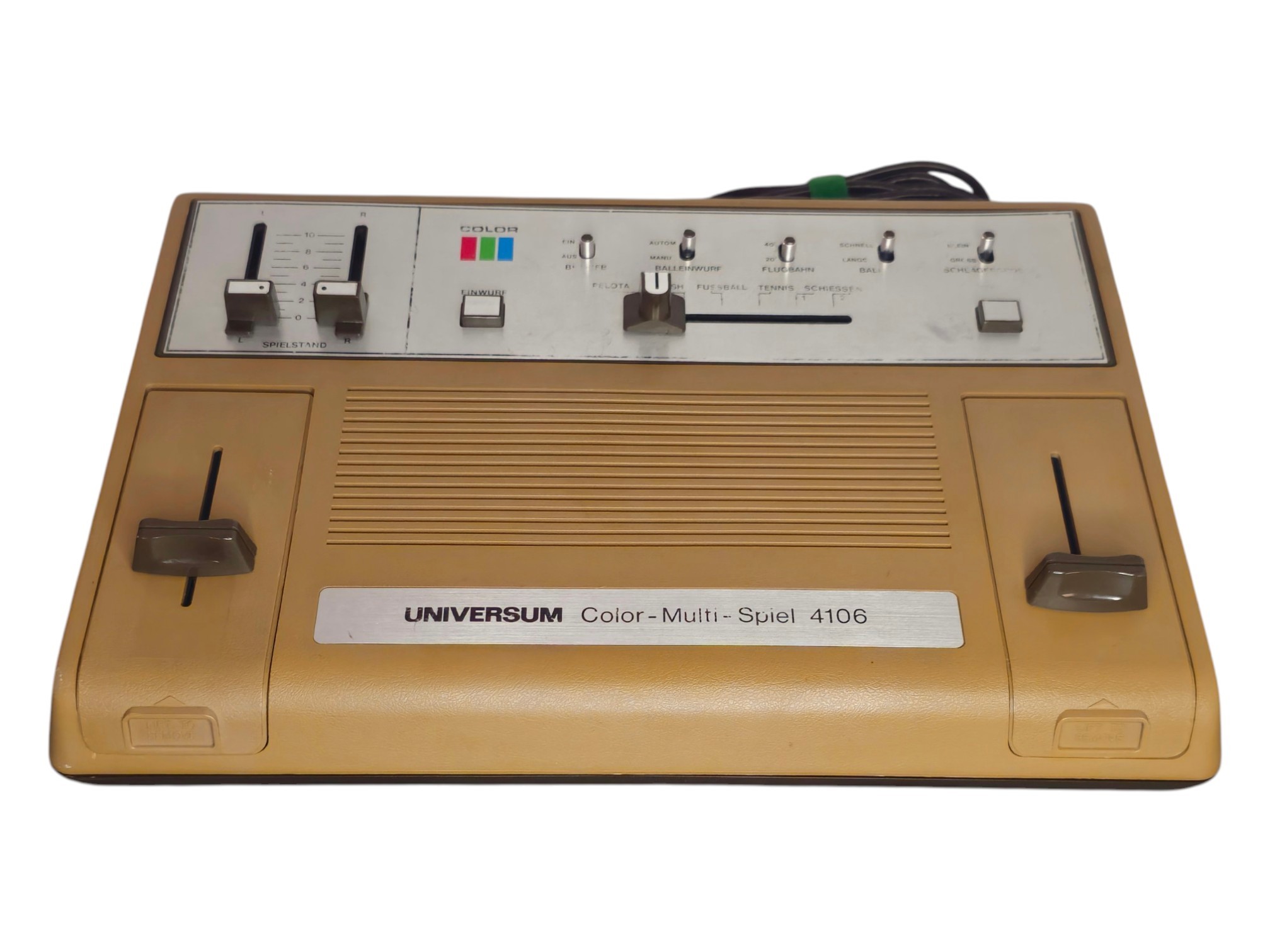
The Universum Color Multi-Spiel 4106A is a classic first-generation home video game console from the late 1970s and early 1980s, representing the period when electronic television gaming was becoming a familiar form of entertainment in European households.
Marketed under the Universum brand associated with the German mail-order company Quelle, the console offered six built-in games combining traditional Pong-style sports with two electronic shooting activities.
Powered by the influential General Instrument AY-3-8500 game chip, the Color Multi-Spiel uses dedicated electronic circuitry rather than a programmable CPU or interchangeable software cartridges.
Its distinctive beige-brown enclosure, metallic-looking control panel, detachable sliding paddle controllers, adjustable gameplay switches, and compatibility with a photoelectric shooting accessory make it a fascinating example of early European gaming hardware.
The console was particularly interesting because it offered colour television graphics at a time when many comparable Pong machines still produced only black-and-white images.
Like several contemporary systems, the Color Multi-Spiel relied on a specialised colour-encoding circuit to transform the dedicated game chip’s video signals into a television-compatible colour picture.
The wider 4106 family is documented with manufacturing and commercial dates ranging from 1977 to 1981. Its exact introduction chronology remains uncertain, and the specific 4106A designation should be distinguished from later or alternative production configurations only when supported by the physical unit.
Today, the Universum Color Multi-Spiel 4106A is an important historical artefact illustrating the international Pong phenomenon, the development of inexpensive semiconductor-based games, and the role of European catalogue retailers in bringing electronic entertainment to the public.
📘 Introduction
The Universum Color Multi-Spiel 4106A belongs to the first generation of home video game consoles.
During this period, electronic gaming systems were relatively simple devices designed primarily to connect directly to an ordinary household television.
Unlike modern consoles, which execute software stored on discs, cartridges, or internal storage, the 4106 family generates its games through dedicated electronic circuits.
Principal Features
- Six permanently installed electronic games
- Four Pong-style sports games
- Two electronic shooting games
- General Instrument AY-3-8500 game chip
- Colour television graphics
- Additional PAL colour-encoding circuitry
- Two wired sliding paddle controllers
- Integrated controller storage compartments
- Adjustable ball speed
- Adjustable paddle size
- Adjustable rebound angle
- Manual and automatic serving
- Electronic score display
- Built-in sound effects
- RF television output
- Battery operation
- Optional external power supply
- Photoelectric light-gun compatibility
The system offers a particularly good example of how manufacturers attempted to differentiate their Pong consoles through additional games, colour output, and alternative controllers.
Its design also reflects the close relationship between early gaming systems and the television equipment already present in households.
🏭 Universum & the German Quelle Company
The history of the Color Multi-Spiel is closely connected with Quelle, one of West Germany’s most influential mail-order retail companies.
The Quelle Business
Quelle developed an extensive catalogue retail operation, selling a wide range of household and consumer products.
Customers could order goods through printed catalogues rather than purchasing them directly from conventional stores.
The Universum Brand
Universum was a retail brand used by Quelle for consumer electronics.
Products carrying the Universum name included:
- Televisions
- Radios
- Audio equipment
- Cassette recorders
- Home entertainment products
- Electronic games
- Video game consoles
A Retail Brand Rather Than a Single Factory
The Universum name did not necessarily identify the original manufacturing company.
Quelle sourced various consumer electronics from external suppliers and marketed them under its own brand.
The International Supply Chain
Documented Color Multi-Spiel 4106 examples are associated with manufacturing in Taiwan.
Other Universum products could have different manufacturing origins.
The precise factory responsible for the 4106A variation requires confirmation from original labels or production documentation.
An Important German Distribution Channel
Quelle’s catalogue network helped introduce new consumer technologies to customers throughout West Germany.
Historical Significance
The Universum Color Multi-Spiel illustrates how retailers participated in the early home gaming industry without necessarily developing every electronic component themselves.
🕰️ Historical Dating: 1977 or 1981?
The Color Multi-Spiel 4106 has an unusually inconsistent release history in surviving collector documentation.
The 1977 Attribution
Several historical console catalogues identify the Universum Color Multi-Spiel 4106 as a 1977 system.
This places it firmly within the commercial expansion of first-generation Pong consoles.
The 1981 Attribution
Other collector records describe the same model family as a 1981 release.
Surviving boxed examples and detailed technical examinations are associated with this later date.
The 4106A Designation
The collection unit is identified as model 4106A.
However, reliable documentation distinguishing every 4106A, 4106B, and other possible production variant is limited.
What Can Be Established
The 4106 belongs to the technological period when colour Pong consoles were marketed in Europe using dedicated game chips.
A Conservative Historical Classification
Until an original dated catalogue, manufacturing code, or model-specific technical document establishes the precise chronology, it is safest to describe the machine as a late-1970s to early-1980s first-generation console.
Why This Matters
Accurate museum documentation should distinguish between verified manufacturing dates, catalogue dates, and later collector estimates.
📺 The Rise of Home Television Gaming
The Color Multi-Spiel emerged from the rapid development of home video gaming during the 1970s.
Magnavox Odyssey (1972)
The Magnavox Odyssey became the first commercially released home video game console.
It demonstrated that players could interact with electronic objects displayed on domestic televisions.
Atari Pong (1972)
Atari’s arcade Pong helped popularise electronic sports games.
Atari Home Pong (1975)
Home Pong introduced a similar experience to consumers at home.
The Pong Boom
Numerous companies began producing television game machines.
These systems commonly offered combinations of:
- Tennis
- Football
- Hockey
- Squash
- Practice
- Target shooting
The Integrated-Circuit Revolution
Dedicated game chips enabled manufacturers to produce consoles with fewer components and lower manufacturing costs.
Universum’s Participation
Through the Quelle retail network, Universum introduced several television-game products for European consumers.
Historical Importance
The 4106 represents the mature stage of the Pong generation, when colour graphics and shooting-game accessories had become marketable features.
🖥️ The Distinctive Beige-Brown Enclosure
The Universum Color Multi-Spiel 4106 is recognisable for its broad, low-profile plastic housing.
Documented examples feature a warm beige or brown enclosure with a silver-toned control panel.
Exterior Characteristics
- Rectangular plastic housing
- Beige-brown finish
- Silver-coloured control panel
- Universum branding
- Color Multi-Spiel identification
- Two removable sliding paddle controllers
- Dedicated controller storage spaces
- Central speaker grille
- Mechanical switches
- Sliding game selector
- Score display or score-setting controls
- Manual serve button
- Game reset button
The Central Speaker Grille
The broad grille occupies a prominent position beneath the main control panel.
Two Controller Compartments
The left and right controllers are stored within recesses in the main enclosure.
They can be lifted out for gameplay.
A Practical Design
The integrated storage arrangement keeps the equipment relatively compact when not in use.
The Metallic Control Panel
The control section provides a strong visual contrast with the brown plastic body.
A Characteristic Late-1970s Appearance
The machine’s mechanical switches, printed labels, and neutral colours reflect the industrial design of the period.
⚙️ Technical Specifications
The Universum Color Multi-Spiel 4106A uses dedicated electronic gaming technology.
Hardware Overview
- Brand: Universum
- Retail organisation: Quelle
- Model: Color Multi-Spiel 4106A
- Hardware family: Color Multi-Spiel 4106
- Market: West Germany / European distribution
- Historical period: Late 1970s–early 1980s
- Console generation: First
- System type: Dedicated television game
- Main game chip: General Instrument AY-3-8500
- Conventional programmable CPU: None
- Games: Six built-in
- Sports games: Four
- Shooting games: Two
- Video: Hardware-generated colour graphics
- Colour standard: PAL on documented European examples
- Graphics architecture: Dedicated video logic
- Scoring: On-screen electronic scoring
- Audio: Simple electronic sound effects
- Speaker: Built-in
- Controllers: Two wired sliding paddles
- Additional input: Compatible photoelectric light gun
- Difficulty adjustments: Speed, angle, paddle size
- Serving: Manual or automatic
- Television connection: Analogue RF
- Battery supply: Six 1.5V C-size batteries on documented 4106 examples
- External power: 9V DC on documented examples
- Cartridge support: None
- Operating system: None
- Game storage: Permanent electronic logic
Some electrical and mechanical details can differ between production versions.
The exact manufacturing revision and power connector requirements should be confirmed from the individual 4106A unit.
🧠 General Instrument AY-3-8500: The Pong-on-a-Chip Technology
The main electronic component of the Color Multi-Spiel is the General Instrument AY-3-8500.
Introduced in 1976, this integrated circuit became one of the defining technologies of the first home console generation.
A Dedicated Game Generator
The AY-3-8500 implements electronic functions for:
- Ball movement
- Paddle positions
- Collision detection
- Scoring
- Game selection
- Video synchronisation
- Sound generation
- Shooting-game operation
No Conventional Processor
The chip does not execute software programs like a modern CPU.
Its game rules are implemented directly in electronic logic.
A Major Semiconductor Innovation
Earlier gaming circuits could require large numbers of individual electronic components.
The AY-3-8500 integrated many of these functions into one compact package.
The Six-Game Architecture
The chip supports four paddle-based sports modes and two shooting modes.
An International Standard
Similar dedicated chips appeared in numerous television games sold throughout Europe, North America, and Asia.
Historical Importance
The AY-3-8500 helped make electronic home gaming affordable and technically practical.
🎨 How the Universum Produced Colour Graphics
One of the 4106 family’s most interesting technological features is its colour video system.
The AY-3-8500 produces electronic game signals that can be combined with additional circuitry to create colour output.
The Original Game Signals
The chip generates separate signals representing game elements such as:
- Left player
- Right player
- Ball
- Playing field
- Scoring information
The Additional Colour Encoder
A documented 4106 motherboard includes electronic logic that converts the game’s video signals into PAL-compatible colour information.
The PAL Colour Carrier
The PAL system uses a colour subcarrier frequency of approximately 4.43 MHz.
Additional Logic Components
A documented board uses common digital logic circuits, including:
- 7404 inverters
- 7400 NAND gates
- 7408 AND gates
A Simple but Effective Design
These components help generate the colour phases needed to represent different game objects.
Documented Colours
A technically examined 4106 displays:
- Blue for the left player
- Red for the right player
- Green for the scoring information
The Importance of Colour
Colour was a valuable marketing feature when many early Pong systems remained monochrome.
A Fascinating Technical Achievement
The colour encoder demonstrates how relatively simple supporting circuits could extend the capabilities of a dedicated television-game chip.
🎮 The Six Built-In Games
The Universum Color Multi-Spiel 4106 provides six built-in games.
The German-language game selections are:
| German game name | English description |
|---|---|
| Tennis | Electronic paddle tennis |
| Fußball | Football / Soccer |
| Squash | Wall-based paddle game |
| Pelota | Ball-and-wall sports variation |
| Treibjagd / Schießen I | Driven Hunt / Shooting |
| Tontaubenschießen / Schießen II | Clay Pigeon Shooting |
The exact printed wording and selection order can vary between documented packaging and control-panel versions.
Four Sports Games
The first four activities use conventional paddle controls.
Two Shooting Games
The other two modes are intended for a compatible photoelectric shooting accessory.
No Additional Cartridges
All six games are permanently provided by the electronic circuitry.
A Broad Selection for the Era
Six games offered considerably more variety than the earliest single-game Pong consoles.
🎾 Tennis: The Classic Pong Experience
Tennis is the most familiar game provided by the system.
Gameplay
Two players control vertical paddles positioned on opposite sides of the television screen.
A ball moves between them.
The Objective
Each player attempts to return the ball without missing.
Scoring
The electronic circuit automatically updates the score.
Player Controls
The sliding paddles adjust the vertical position of the on-screen players.
Difficulty
Higher ball speed and smaller paddles increase the challenge.
Historical Importance
Electronic Tennis was one of the foundational experiences of home gaming.
It helped demonstrate that a television could become an interactive entertainment device.
⚽ Fußball: Electronic Football
The Fußball mode offers a football-inspired Pong variation.
Gameplay
The game uses electronic paddles and a moving ball.
A Different Playing Field
The arrangement includes scoring areas and a modified court.
Simple Visual Elements
The system represents the action using geometric shapes.
Shared Controllers
Players use the same sliding paddle devices.
Historical Importance
Football became a common subject for early television games because its basic scoring concept could be reproduced with simple electronic circuitry.
🏓 Squash: A Wall-Based Challenge
Squash introduces an alternative paddle-and-ball arrangement.
Gameplay
The player attempts to return a ball that rebounds from a wall or boundary.
The Main Challenge
Timing and accurate paddle movement are essential.
Adjustable Settings
Ball speed, paddle size, and rebound angle affect the difficulty.
An Early Solo-Oriented Concept
Wall-based games could provide entertainment without requiring the same style of direct two-player competition as Tennis.
Historical Significance
Squash demonstrates how a fixed-purpose game chip could support several different gameplay arrangements.
🏐 Pelota: Electronic Ball-and-Wall Gaming
Pelota is another sports variation.
The name is associated with traditional ball games played against walls or within enclosed courts.
Electronic Gameplay
The machine uses paddles, a ball, and boundaries to reproduce a simplified sporting challenge.
Different Movement Patterns
The court arrangement changes the way players respond to the ball.
A European Game Name
Pelota appeared frequently in European television-game products.
Historical Importance
The game reflects the regional terminology used to market similar electronic sports activities.
🎯 Treibjagd: The Hunting Game
Treibjagd is one of the 4106’s shooting-game modes.
The German term refers to driven hunting.
The Basic Concept
The player attempts to hit a target represented electronically on the television screen.
The Shooting Controller
The game is designed for a compatible light-sensitive gun.
A Different Input Method
Instead of moving a paddle, the player aims directly at the display.
The Role of the Game Chip
The AY-3-8500 contains circuitry supporting shooting-game functions.
Historical Importance
Treibjagd illustrates how early electronic gaming expanded beyond simple ball-and-paddle sports.
🔫 Tontaubenschießen: Clay Pigeon Shooting
The second shooting game is Tontaubenschießen, or clay pigeon shooting.
Gameplay
Players attempt to hit an electronic target using the compatible shooting accessory.
The Challenge
Successful play depends on aiming and timing.
A Familiar Sporting Theme
The game is based on the idea of clay-target shooting.
Specialised Gameplay
It uses the same television display but a different type of controller.
Historical Significance
The inclusion of shooting games made the 4106 more versatile than ordinary four-game Pong consoles.
🔫 The Optional Electronic Pistol / Rifle
The Universum Color Multi-Spiel 4106 supports a compatible photoelectric shooting accessory.
Historical Quelle documentation identifies electronic pistol and rifle accessories for the television-game range.
The Photoelectric Principle
A light-sensitive detector is used to identify light from the television picture.
Aiming at the Display
The player aims the accessory towards the electronic target.
The Importance of CRT Televisions
Traditional photoelectric light guns depend on characteristics of analogue CRT displays.
Modern Television Limitations
LCD and OLED televisions do not reproduce the same scanning behaviour.
Consequently, an original light gun may not operate correctly even when a converted game image is visible.
A Distinctive Peripheral
The pistol/rifle accessory is historically important because it demonstrates an alternative form of player interaction.
Collection Documentation
The shooting accessory should be listed as part of an individual collection entry only when physically present.
🕹️ The Two Sliding Paddle Controllers
The 4106 family uses two wired sliding controllers.
These are among the console’s most recognisable features.
Controller Design
Each controller features a slider moving along a vertical track.
Direct Paddle Positioning
Moving the slider changes the position of the player’s paddle on the television.
Integrated Storage
The controllers can be placed into recesses within the main console enclosure.
Wired Operation
The controllers communicate with the main system through cables.
Analogue Input
The paddle position is determined through analogue electrical control.
A Different Experience
Sliding controllers feel substantially different from conventional rotary paddles or modern gamepads.
Historical Importance
These devices demonstrate the diversity of early analogue gaming controllers.
🎛️ The Physical Control Panel
The Universum 4106 provides a range of mechanical controls.
BETRIEB EIN / AUS
The power switch turns the console on or off.
BALLTEMPO
Adjusts the speed of the ball.
SCHNELL / LANGSAM
Selects faster or slower gameplay.
FLUGBAHN
Controls the rebound angle.
Documented settings include:
- 20°
- 40°
SCHLÄGERGRÖSSE
Adjusts the paddle size.
BALLEINWURF
Selects automatic or manual serving.
EINWURF
Starts a manual serve.
GAME RESET / 0:0
Resets the game or scoring state.
SPIELSTAND
The score-related controls and markings are part of the console’s physical interface.
A Hardware-Based User Interface
Every setting is changed mechanically.
There is no software menu or digital dashboard.
Historical Significance
The control panel preserves the way consumer electronics were operated before graphical interfaces became standard.
🔢 Electronic Scoring
The Color Multi-Spiel displays scores directly on the television.
On-Screen Numbers
The game circuit produces numerical indicators.
Automatic Updates
The score changes according to gameplay events.
A Familiar Arcade Feature
Electronic scoring made the games resemble arcade machines.
A Basic but Important Innovation
Players did not need to track points manually.
Historical Importance
Automatic scoring became a fundamental element of competitive video gaming.
🔊 Electronic Sound Effects
The Universum produces simple electronic sounds.
Typical Effects
- Paddle impacts
- Ball rebounds
- Scoring events
The AY-3-8500 Sound Output
The game chip generates short electronic signals corresponding to these events.
The Internal Speaker
A speaker inside the console reproduces the audio.
No Digital Sound Samples
The system does not use recorded music or sophisticated audio software.
The Characteristic Pong Sound
Short tones became immediately recognisable features of early electronic games.
Historical Significance
Simple audio feedback helped make these games more engaging and responsive.
📡 RF Output & Analogue Television
The 4106 was designed to connect to a conventional television through an RF signal.
The Original Connection
The console uses a television antenna-style connection.
RF Modulation
The game signal is converted into a form compatible with analogue television tuning.
Regional Differences
Surviving documentation contains references to different RF channels and television configurations within the wider family.
Therefore, the exact output channel should be confirmed from the individual 4106A.
PAL Colour
Documented European examples use PAL colour encoding.
No Native HDMI
The original console does not contain a digital video output.
Modern Television Compatibility
A suitable analogue tuner or RF conversion device may be necessary.
Authentic Presentation
A compatible CRT television provides the most historically accurate display.
It is especially important when demonstrating the shooting games.
🔋 Battery Operation & Power Supply
The Universum Color Multi-Spiel can operate from batteries or a suitable external power adapter.
Battery Configuration
Documented 4106 hardware uses:
6 × 1.5V C-size batteries (R14 / LR14)
This provides a nominal 9V battery supply.
External Supply
Documented versions support an external 9V DC power connection.
Important Electrical Warning
The exact connector polarity must be verified from the physical 4106A unit.
It should not be assumed from the voltage alone.
Why This Matters
Different vintage gaming devices can use similar connectors with different polarities.
Battery Corrosion
Leaking batteries may damage contacts and internal electronics.
Long-Term Storage
Batteries should be removed when the console is not in use.
Preservation
The battery compartment, original markings, and power connector should be inspected before testing.
🔧 The Internal Electronics
The 4106 is a relatively simple system compared with later programmable consoles.
Nevertheless, its internal electronics are historically interesting.
Main Components
A documented motherboard contains:
- General Instrument AY-3-8500
- Game clock oscillator
- PAL colour-encoding circuitry
- Logic integrated circuits
- RF modulator
- Voltage regulation components
- Audio amplifier
- Controller input circuits
The Game Clock
A documented 4106 board uses an oscillator operating around 2 MHz.
The PAL Colour Oscillator
A separate oscillator produces the PAL colour-subcarrier timing around 4.43 MHz.
The RF Modulator
The completed video information is transmitted to the television.
A Real Restoration Example
A documented 4106 repair involved failure of its game-clock crystal.
Replacing the defective oscillator component was necessary to restore operation.
Why This Matters
A console that produces no picture is not necessarily suffering from a failed game chip.
Peripheral timing or power circuitry may be responsible.
Historical Importance
The electronics provide an excellent demonstration of practical video-generation technology before modern graphics processors.
🔄 Universum 4106A vs. 4106B
Surviving collector records refer to variants identified as 4106A and 4106B.
The Shared Model Family
Both names are associated with the Color Multi-Spiel 4106 design.
Documented Common Characteristics
- AY-3-8500-based architecture
- Six built-in games
- Colour television output
- Sliding paddle controls
- Shooting-game support
- RF connection
- Similar enclosure design
What Remains Uncertain
The available documentation does not establish a definitive, comprehensive list of differences between all A and B units.
Possible Production Changes
Manufacturers could revise internal circuit boards, component suppliers, RF modulators, or markings without changing the consumer-facing product.
However, such changes must be confirmed through actual technical evidence.
A Museum Documentation Recommendation
The suffix A should be preserved in the collection title.
The exact motherboard and factory revision should remain unverified until the original hardware is inspected.
🔄 Universum 4106 vs. TV-Multi-Spiel 2006
The Universum TV-Multi-Spiel 2006 is another related console.
TV-Multi-Spiel 2006
- Dedicated Pong architecture
- General Instrument AY-3-8500
- Six-game capability
- Monochrome video
- Sliding paddle controllers
- Light-gun support
Color Multi-Spiel 4106
- Dedicated Pong architecture
- General Instrument AY-3-8500
- Six-game capability
- Colour video
- Sliding paddle controllers
- Light-gun support
The Principal Difference
Colour output is an important distinguishing feature of the 4106.
The Shared Technology
Both belong to the same dedicated game-chip tradition.
Historical Significance
The comparison demonstrates how manufacturers expanded their products by introducing colour graphics while retaining familiar gameplay.
🔄 Universum 4106 vs. Color Multi-Spiel 4004 & 4006
The Universum range contained several closely related models.
Color Multi-Spiel 4004
Associated with four built-in Pong-style games.
Color Multi-Spiel 4006
A six-game configuration with shooting-game functionality.
Color Multi-Spiel 4106
A six-game configuration with colour output and characteristic sliding controls.
Why These Models Are Confusing
Similar names and technologies make identification difficult.
The Importance of the Exact Label
The full model number should be preserved in collection records.
Historical Significance
These variations reflect how quickly Pong manufacturers changed their products to compete in the growing consumer electronics market.
🔄 Universum 4106 vs. Color Multi-Spiel 4010
The Universum Color Multi-Spiel 4010 is a more advanced relative within the product range.
Color Multi-Spiel 4106
- AY-3-8500 game chip
- Six built-in games
- Primarily sports and shooting
- Vertical paddle movement
- Colour graphics
Color Multi-Spiel 4010
- AY-3-8610 game chip
- Ten game variations
- Additional sports and target modes
- More flexible game-generation circuitry
- Colour-capable design
The Main Difference
The 4010 offers more game variations through a more advanced dedicated integrated circuit.
An Evolving Product Family
This demonstrates how semiconductor improvements expanded the possibilities of dedicated gaming.
Historical Importance
The comparison shows that the Pong generation continued evolving technologically even as programmable consoles were becoming more common.
🔄 Universum 4106 vs. TV-Multi-Spiel 4014
The Universum 4014 belongs to another stage in the development of the product family.
The 4014 Architecture
Documented examples use General Instrument game chips associated with:
- AY-3-8610
- AY-3-8760-family motorcycle game technology
A Larger Game Selection
The 4014 offered fourteen games.
Additional Gameplay Types
These included activities beyond the traditional four sports games.
The 4106’s Position
The 4106 remained a simpler six-game design.
Historical Importance
The two machines demonstrate the increasing variety offered by dedicated game circuitry before fully programmable consoles replaced this approach.
🔄 Universum 4106 vs. Polygame 6
The Polygame 6 is another European Pong console offering six games.
Shared Features
Both systems belong to the first generation and support:
- Four sports games
- Two shooting games
- Analogue controllers
- Photoelectric light-gun technology
- RF television output
Different Designs
The Universum uses its own beige-brown enclosure and sliding paddle arrangement.
The Polygame has a different control layout and accessory design.
The Modular Light Gun
Certain Polygame shooting accessories feature interchangeable barrel and stock components.
Historical Significance
The comparison shows how different European brands offered similar entertainment concepts through distinct physical designs.
🔄 Universum 4106 vs. Conic Color TV Sports 406
The Conic Color TV Sports 406 offers another interesting comparison.
Conic 406
- Hong Kong-associated manufacturing
- Six built-in games
- AY-3-8500
- Colour sports graphics
- Photoelectric shooting support
- Different controller design
Universum 4106
- German Quelle retail branding
- Six built-in games
- AY-3-8500
- Colour PAL output
- Photoelectric shooting support
- Sliding paddle controllers
The Shared Semiconductor
Both products demonstrate the influence of the AY-3-8500.
Different Regional Designs
Although the consoles offer similar gameplay, their enclosures and supporting electronics differ.
Museum Significance
Displaying the machines together helps explain how one integrated circuit supported a global market of competing products.
🕰️ The Transition to Programmable Consoles
The Color Multi-Spiel belongs to a generation that was gradually replaced by programmable gaming systems.
Dedicated Consoles
Early machines contained a fixed number of games implemented through electronic circuits.
The Limitation
Consumers could not add completely new software titles.
Fairchild Channel F (1976)
The Channel F demonstrated the advantages of interchangeable ROM cartridges and a programmable CPU.
Atari VCS (1977)
The Atari VCS helped popularise software-driven cartridge gaming.
The Technological Difference
A programmable console can execute many different game programs using the same processor.
The Commercial Impact
Programmable systems offered much greater potential for expanding game libraries.
The End of an Era
Fixed-game Pong consoles became less attractive as more sophisticated systems became available.
The Universum’s Historical Position
The 4106 represents the mature dedicated Pong architecture, enhanced through colour graphics and shooting-game functionality.
🇩🇪 Home Gaming in West Germany
West Germany was an important European market for electronic entertainment during the 1970s and early 1980s.
The Role of Catalogue Retailers
Mail-order catalogues allowed consumers to purchase new technologies from home.
The Quelle Network
Quelle offered many consumer products under its Universum brand.
A Familiar Television
Most households already owned a television, making dedicated video game devices relatively easy to introduce.
An Affordable Entertainment Product
Pong consoles allowed families to enjoy electronic games without purchasing a full computer.
Colour Television
As colour television became increasingly common, colour gaming equipment became more appealing.
A Brief Commercial Generation
Dedicated gaming systems eventually faced competition from Atari consoles and home computers.
Historical Importance
The Color Multi-Spiel illustrates the development of consumer video gaming in German-speaking Europe.
🇬🇷 Historical Context for Greece
The Universum Color Multi-Spiel was associated primarily with the German and wider European electronics market.
Early Home Video Gaming
During the late 1970s, Pong-style consoles began appearing in households across Europe.
Imported Technology
Many devices reached consumers through electronics distributors and international retailers.
The Greek Market
Greece encountered similar electronic television games before the widespread adoption of home computers and later console generations.
European Television Systems
A PAL-compatible Universum console could be technologically closer to European television equipment than an American NTSC Pong console.
However, RF channel compatibility and power requirements still require verification.
A Valuable Museum Exhibit
The Universum 4106A provides an example of German catalogue retailing and international consumer electronics manufacturing.
An Important Comparison
It can be displayed alongside British, American, and Asian Pong consoles to illustrate the international spread of early gaming.
🔧 Maintenance & Common Problems
The Universum Color Multi-Spiel is now several decades old.
Its original electronic and mechanical components may require inspection.
Common Maintenance Areas
- Power connector
- Battery compartment
- On/Off switch
- Game-selection slider
- Difficulty switches
- Paddle mechanisms
- Controller cables
- Reset and serve buttons
- RF modulator
- Video encoder
- Internal speaker
- Capacitors
- Crystal oscillators
- PCB solder joints
Power Problems
Oxidised contacts and poor power connections can prevent normal operation.
Controller Problems
Worn or dirty slide potentiometers can cause unstable paddle movement.
Video Problems
Failures in the PAL colour encoder may affect colour reproduction.
Oscillator Problems
A defective clock oscillator can prevent the game chip from operating correctly.
RF Problems
An incompatible television tuner may fail to display a working console.
Battery Corrosion
Leaking batteries can damage metal contacts and internal wiring.
Preservation
Original electronics should be retained wherever practical.
🛠️ Restoration & Authentic Testing
Restoration should begin with careful inspection rather than immediately applying power.
Initial Examination
Inspect the exterior housing, labels, switches, controllers, and cables.
Power Verification
Confirm the required voltage, polarity, and connector configuration.
Battery Compartment
Check for corrosion or damaged terminals.
Controller Testing
Both paddles should move smoothly.
Game Testing
Select each of the six game modes individually.
Colour Output
Verify that the console produces an appropriate PAL colour image.
Light-Gun Testing
Use a compatible photoelectric accessory and suitable CRT television when available.
Electronics Inspection
The board’s oscillator, capacitors, video logic, and power circuits may require testing.
Preserving the Original Design
Repairs should retain the original architecture whenever practical.
Museum Documentation
Any repairs, modifications, or replacement parts should be recorded.
🏛️ Collectability & Historical Preservation
The Universum Color Multi-Spiel 4106A is an interesting collectible because of its German retail history, early colour technology, and unusual controller arrangement.
Important Collecting Factors
- Original Universum Color Multi-Spiel 4106A console
- Original beige-brown enclosure
- Original silver-toned control panel
- Manufacturer and model labels
- Functional AY-3-8500 circuitry
- Original paddle controllers, if present
- Functional game selector
- Functional difficulty controls
- Original RF cable, if present
- Compatible light-gun accessory, if present
- Correct power adapter, if present
- Original retail box, if present
- Instruction manual, if present
- Warranty papers, if present
The Importance of the Model Suffix
The 4106A designation should be preserved.
Original Packaging
Retail boxes can help document the precise product configuration and period of sale.
The Light-Gun Accessory
A compatible original pistol or rifle can help demonstrate all six games.
The Internal Circuit Board
Photographs of the motherboard are useful for identifying manufacturing variations.
A Historically Interesting Design
The slide-paddle storage arrangement and colour circuitry distinguish the 4106 from many other dedicated Pong consoles.
Museum Significance
The system provides an excellent opportunity to explain early electronic video generation and consumer television technology.
⭐ Why the Universum Color Multi-Spiel 4106A Still Matters
The Universum Color Multi-Spiel 4106A is historically significant for several reasons:
- It belongs to the first generation of home video game consoles
- It was marketed under the German Universum brand
- It reflects Quelle’s role in consumer electronics distribution
- It uses the influential General Instrument AY-3-8500
- It provides six permanently installed games
- It offers colour television graphics
- It uses additional PAL colour-encoding circuitry
- It supports two-player competition
- It features sliding analogue paddle controllers
- It offers adjustable difficulty
- It provides shooting-game functionality
- It supports a compatible photoelectric light gun
- It uses analogue RF television output
- It illustrates the global spread of dedicated Pong technology
A German Retail Story
The console demonstrates how companies such as Quelle introduced electronic gaming into ordinary households.
A Technological Achievement
Its colour encoder is a particularly interesting example of simple electronic video engineering.
A Distinctive Physical Design
The integrated controller storage and mechanical control panel make the machine immediately recognisable.
A Valuable Historical Survivor
The Universum documents a period when the home console industry was still experimenting with graphics, controls, and gameplay.
📦 Items Included in This Collection Entry
- Universum Color Multi-Spiel 4106A dedicated home television game console unit
Historical period: Late 1970s–early 1980s
Commercial brand: Universum
Distributor: Quelle, West Germany
Generation: First-generation home video game console
Main game chip: General Instrument AY-3-8500
Built-in games: Six
Graphics: PAL colour on documented hardware
Original controller arrangement: Two sliding paddle controllers
Shooting-game capability: Yes, with compatible photoelectric accessory
Exact factory, individual board revision, and production date: Not yet verified
Individual accessories, packaging, and documentation: To be confirmed from the physical collection item
🏁 Conclusion
The Universum Color Multi-Spiel 4106A represents an important stage in the evolution of early European home video gaming.
Marketed under the Universum brand associated with West Germany’s Quelle retail company, the system combined six dedicated electronic games with colour graphics, analogue paddle controllers, adjustable difficulty settings, and photoelectric shooting-game support.
Its General Instrument AY-3-8500 integrated circuit demonstrates the semiconductor technology that helped make home gaming affordable during the Pong boom.
The console’s additional PAL colour-encoding circuitry is particularly interesting because it illustrates how relatively simple electronics could transform basic dedicated game signals into a colour television picture.
Its distinctive beige-brown housing, metallic-looking control panel, sliding controllers, and extensive mechanical switches reflect a period when video game consoles were still developing their familiar form.
The 4106 family also provides a valuable example of the international consumer electronics industry, combining specialist semiconductor technology, overseas manufacturing, and German catalogue retail distribution.
Although the precise dating of the 4106A remains uncertain, the machine clearly belongs to the era when dedicated Pong systems reached their mature technological form.
Within a relatively short period, programmable cartridge consoles would introduce much greater gameplay variety and gradually replace fixed-game systems.
Nevertheless, consoles such as the Universum Color Multi-Spiel established many of the essential concepts of home gaming: interactive television graphics, player-controlled objects, scoring, difficulty adjustment, competitive multiplayer, and specialised accessories.
For a technology museum, the 4106A provides an excellent opportunity to demonstrate both the international spread of gaming and the engineering principles behind early colour television consoles.
A distinctive European colour Pong system, an important example of AY-3-8500 technology, and a fascinating survivor from the pioneering era of home electronic entertainment.
