

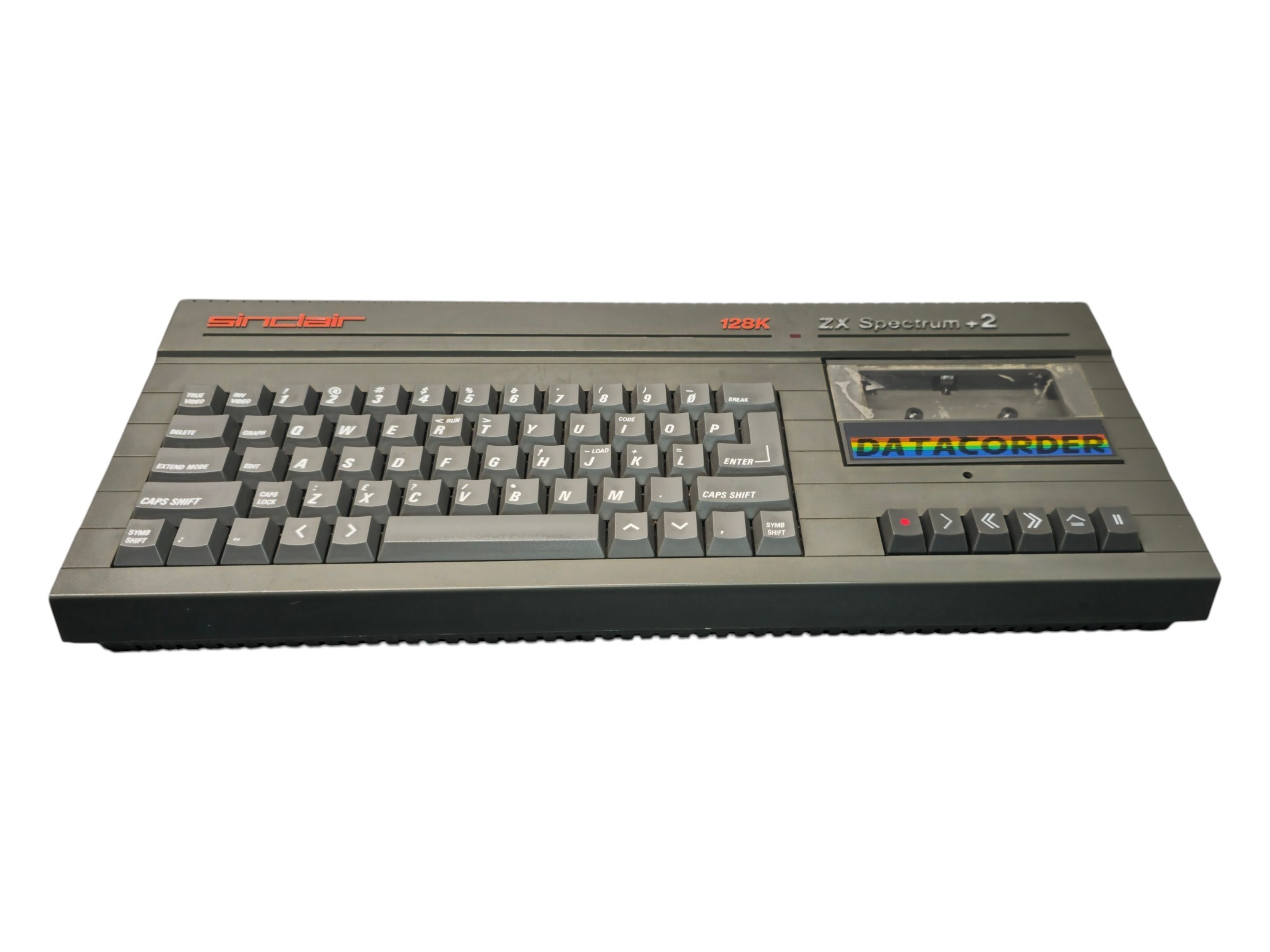
The Sinclair ZX Spectrum +2 128K is one of the most recognisable home computers of the 1980s and an important milestone in British computing history. Combining the legendary ZX Spectrum architecture with 128 KB of memory, improved sound, a full-size keyboard, and a built-in cassette recorder, it brought a new level of convenience to one of the world’s most beloved 8-bit platforms.
Released in 1986, the Spectrum +2 represented a major turning point for the Sinclair brand, marking the beginning of the Amstrad era while preserving the gaming heritage that had made the original ZX Spectrum a cultural phenomenon.
📘 Introduction
Introduced in 1986, the Sinclair ZX Spectrum +2 was the first Spectrum model released under Amstrad’s ownership, following the company’s acquisition of Sinclair’s computer business earlier that year.
The machine combined the technology of the earlier ZX Spectrum 128K with a completely redesigned exterior, incorporating several features inspired by Amstrad’s successful CPC range.
Its philosophy was simple: make the ZX Spectrum more accessible, more convenient, and more appealing to families looking for an affordable home computer.
Unlike earlier Spectrum models, which required an external cassette recorder to load software, the +2 offered a complete system with integrated storage and a considerably improved keyboard.
The result was a computer that maintained the spirit of Sir Clive Sinclair’s original creation while introducing a distinctly Amstrad approach to design and usability.
🏭 The Amstrad Takeover: A New Era for Sinclair
The story of the Spectrum +2 is closely connected to one of the most significant events in British home computing.
In April 1986, Amstrad, led by Alan Sugar, acquired Sinclair’s computer business and the rights to the ZX Spectrum brand.
Sinclair Research had revolutionised affordable computing with machines such as the ZX80, ZX81, and ZX Spectrum, but increasing financial difficulties and fierce competition had placed the company under considerable pressure.
Amstrad saw an opportunity to continue the Spectrum’s commercial success while applying its own expertise in manufacturing, distribution, and integrated computer systems.
The Spectrum +2 was the first major result of this transition.
Although the machine retained the Sinclair name, its construction and overall design clearly reflected Amstrad’s philosophy.
Interestingly, the +2 shared many visual similarities with the Amstrad CPC 464, particularly its integrated cassette recorder and full-travel keyboard.
It was a fascinating combination of two influential British computing brands.
🖥️ A Completely Redesigned ZX Spectrum
One of the most noticeable changes introduced with the Spectrum +2 was its distinctive grey enclosure, a major departure from the compact black design of earlier Spectrum computers.
The redesigned system included:
- A full-size, spring-loaded keyboard
- A built-in cassette recorder called the Datacorder
- Two integrated joystick ports
- 128 KB of RAM
- Improved three-channel sound
- RGB monitor and television connectivity
- Compatibility with much of the existing Spectrum software library
The improved keyboard was particularly important.
Earlier Spectrum models, especially the original rubber-key 48K, were famous for their unconventional typing experience.
The +2 introduced a more comfortable keyboard that made extended programming sessions and general computing significantly easier.
Its larger enclosure also gave the machine a more substantial appearance, making it feel closer to a conventional personal computer than its predecessors.
📼 The Built-In Datacorder: A Major Improvement
Perhaps the most distinctive feature of the Spectrum +2 was its integrated cassette recorder, officially known as the Datacorder.
Earlier ZX Spectrum owners generally needed a separate tape recorder connected through audio cables, frequently dealing with volume adjustments, unreliable connections, and loading errors.
The +2 simplified the entire process.
Datacorder Features
- Integrated cassette tape mechanism
- Dedicated Play, Stop, Rewind, and Fast Forward controls
- Direct connection to the computer’s internal circuitry
- Support for standard Spectrum cassette software
- Ability to load and save BASIC programs
This integration offered several advantages:
- No separate cassette player required
- Fewer external cables
- Easier software loading
- More convenient program saving
- A cleaner and more organised setup
However, cassette loading remained relatively slow compared with floppy disk systems.
The characteristic loading sounds, flashing screen borders, and colourful loading screens became unforgettable elements of the Spectrum experience.
For an entire generation of gamers, waiting several minutes for a game to load was simply part of the adventure.
🧠 128 KB RAM: More Memory, More Possibilities
The Spectrum +2 inherited the expanded memory architecture of the earlier ZX Spectrum 128K.
Compared with the original 48K model, its 128 KB RAM represented a significant improvement.
Memory Specifications
- RAM: 128 KB
- ROM: 32 KB
- Memory organisation: Eight 16 KB RAM banks
- Memory management: Bank switching
- Processor addressing: 64 KB address space
Because the Zilog Z80A processor could address only 64 KB at a time, the computer used bank switching to access different sections of memory.
The additional RAM allowed software developers to create more ambitious programs and improve existing games.
Advantages included:
- Larger game worlds and levels
- Additional graphics and animation data
- More sophisticated soundtracks
- Reduced need for repeated cassette loading in some games
- Greater flexibility for programmers
- Enhanced versions of selected 48K titles
Although the computer remained fundamentally an 8-bit machine, the additional memory extended the capabilities of the Spectrum platform considerably.
⚙️ Technical Specifications
Despite its redesigned exterior, the Spectrum +2 remained closely related to the earlier 128K Spectrum architecture.
Hardware Overview
- Manufacturer: Amstrad
- Brand: Sinclair
- Model: ZX Spectrum +2
- Release year: 1986
- Country of origin: United Kingdom
- CPU: Zilog Z80A
- Clock speed: Approximately 3.5 MHz
- RAM: 128 KB
- ROM: 32 KB
- Graphics resolution: 256×192 pixels
- Colour palette: 15 displayable colours, including brightness variations
- Sound: AY-3-8912, three channels, plus traditional Spectrum beeper
- Storage: Built-in cassette Datacorder
- Keyboard: Full-travel, 58 keys
- Operating environment: Sinclair BASIC
- Video output: RF television and RGB
- Joystick ports: Two Sinclair-compatible ports
The computer also featured an expansion connector and interfaces supporting additional peripherals.
Its design balanced affordability with compatibility, allowing existing Spectrum users to retain access to a substantial proportion of their software collection.
🎨 Graphics & Sound
The Spectrum +2 retained the classic graphics architecture that had defined the ZX Spectrum since 1982.
Although its graphics capabilities were more limited than those of certain competitors, developers achieved remarkable results through creative programming techniques.
Graphics
The computer offered:
- Resolution: 256×192 pixels
- Text display: 32 columns × 24 rows
- Colours: Eight basic colours with normal and bright variations
- Screen attributes: Two colours per 8×8 pixel character cell
One of the Spectrum’s most famous characteristics was attribute clash, commonly known as colour clash.
Because each 8×8 pixel area could use only one foreground and one background colour, moving objects could produce unusual colour effects when passing over different backgrounds.
Rather than preventing commercial success, this limitation became part of the Spectrum’s distinctive visual identity.
Many developers designed games specifically around these restrictions, producing visually impressive results despite the hardware’s limitations.
Sound
One of the major benefits of the 128K architecture was the inclusion of the AY-3-8912 programmable sound generator.
The chip provided:
- Three independent sound channels
- Programmable tones and noise effects
- More complex background music
- Improved arcade-style audio
- Multi-channel chiptune compositions
The machine also retained the original Spectrum’s basic beeper capabilities.
Compared with the simple sound effects of earlier 48K machines, the AY chip represented a substantial improvement.
Many 128K-compatible games featured memorable music that became closely associated with the Spectrum’s later years.
🎮 Games & Software Library
The Spectrum +2 benefited from one of the largest and most influential software libraries in 8-bit computing history.
Thanks to its compatibility with earlier models, users could enjoy a vast catalogue of games originally developed for the ZX Spectrum 48K, alongside newer titles designed to exploit the expanded capabilities of 128K machines.
Popular games associated with the Spectrum platform include:
- Manic Miner
- Jet Set Willy
- Knight Lore
- Head over Heels
- The Great Escape
- Dizzy
- Treasure Island Dizzy
- Batman: The Movie
- R-Type
- RoboCop
- Chase H.Q.
- Target: Renegade
- Rainbow Islands
- Saboteur!
- Operation Wolf
The Spectrum library covered almost every major genre of the period, including platform games, arcade conversions, racing games, adventures, puzzle games, and strategy titles.
Software publishers such as Ultimate Play the Game, Ocean Software, US Gold, Codemasters, and Imagine Software helped establish the Spectrum as one of Europe’s most important gaming platforms.
The low cost of cassette-based games also encouraged widespread software distribution.
For many households, the Spectrum +2 provided access to hundreds of games at a fraction of the cost of dedicated arcade machines.
💻 Programming & Sinclair BASIC
Beyond gaming, the Spectrum +2 remained an accessible introduction to computer programming.
Like its predecessors, it featured Sinclair BASIC, allowing users to write their own programs without purchasing additional software.
The machine supported both 48K and 128K BASIC environments.
48K BASIC Mode
This mode maintained compatibility with the familiar programming environment of earlier Spectrum models.
It supported the traditional keyword-entry system, where BASIC commands could be entered using individual key combinations.
128K BASIC Mode
The newer environment introduced a different editing experience, allowing users to type BASIC keywords letter by letter.
Programmers could experiment with:
- Graphics and animation
- Mathematical calculations
- Music and sound generation
- Memory management
- Text-based adventures
- Educational software
- Simple games and utilities
Although the Spectrum +2 was primarily marketed as an entertainment and family computer, it continued the Sinclair tradition of encouraging users to explore programming.
For countless young computer enthusiasts, writing a few lines of BASIC was their first step towards understanding how computers worked.
🕹️ Dual Joystick Ports & Connectivity
Another improvement over earlier Spectrum models was the inclusion of two built-in joystick ports.
Previously, many Spectrum owners needed separate interfaces to connect their favourite controllers.
The +2 eliminated this requirement by providing two joystick connections directly on the computer.
However, the system used Sinclair-style joystick wiring rather than the more widespread Atari-compatible standard.
This meant that some conventional nine-pin joysticks required an adapter to function correctly.
Additional connectivity included:
- RF television output
- RGB monitor output
- External expansion interface
- Audio output
- Serial and peripheral connections
- MIDI output support
These interfaces allowed users to connect additional hardware and experiment with more advanced configurations.
The combination of improved connectivity and integrated storage made the +2 considerably more convenient than the earliest Spectrum machines.
🔧 Build Quality & Longevity
The ZX Spectrum +2 is generally regarded as a durable and relatively straightforward computer to maintain.
Its full-size keyboard and integrated design offered practical advantages over some earlier models.
However, after four decades, original machines may require maintenance.
Common restoration tasks include:
- Replacing the cassette drive belt
- Cleaning the Datacorder’s read/write head
- Adjusting tape head alignment
- Inspecting the keyboard membrane
- Checking the external power supply
- Cleaning internal connectors
- Inspecting ageing electronic components
The cassette mechanism is particularly important because worn belts or incorrect head alignment can cause loading failures.
Fortunately, the Spectrum community has developed a wide range of replacement components, repair guides, and modern upgrades.
Modern storage interfaces and other expansions can also provide convenient alternatives to original cassette loading.
With suitable maintenance, a Spectrum +2 can remain a fully operational computer decades after leaving the factory.
🌍 Popularity Across Europe
The ZX Spectrum family became one of the defining home computing platforms of the 1980s, particularly in Europe.
The Spectrum +2 continued this legacy, benefiting from an established user base and an enormous catalogue of available software.
The Spectrum platform was especially influential in:
- The United Kingdom
- Spain
- Portugal
- Greece
- Several Central and Eastern European countries
In Britain, the Spectrum became synonymous with the early home computer gaming industry.
In Spain, the platform developed an especially enthusiastic following, helping support an important domestic software development scene.
The Spectrum also found its way into Greek homes during the 1980s, introducing many young users to computer games and BASIC programming.
Computer magazines, cassette compilations, local retailers, and enthusiast communities all contributed to the machine’s popularity.
Its influence extended far beyond the original hardware, inspiring generations of programmers and game developers.
⚫ The Grey +2 vs. the Black +2A
One of the most important distinctions for collectors is the difference between the original grey Spectrum +2 and the later black Spectrum +2A.
Although the machines look similar, they are not identical internally.
Original ZX Spectrum +2 (1986)
- Distinctive grey enclosure
- Based closely on the original ZX Spectrum 128K architecture
- Built-in cassette Datacorder
- 32 KB ROM
- Generally strong compatibility with earlier Spectrum software
ZX Spectrum +2A (1987)
- Black enclosure
- Redesigned internal architecture related to the Spectrum +3
- Built-in cassette Datacorder
- 64 KB ROM
- Different memory and hardware configuration
- Greater compatibility limitations with certain older software and peripherals
The original grey +2 is particularly interesting because it represents the earliest stage of Amstrad’s Spectrum production.
For collectors, distinguishing between these revisions is essential when evaluating compatibility, repairs, and historical significance.
⭐ Why the Spectrum +2 Still Matters
The Sinclair ZX Spectrum +2 remains an important part of computing history for several reasons:
- It was the first Spectrum model produced under Amstrad ownership
- It combined Sinclair’s legendary architecture with Amstrad’s integrated design philosophy
- Its built-in Datacorder simplified cassette-based computing
- Its improved keyboard made programming more comfortable
- Its 128 KB RAM supported more sophisticated software
- Its three-channel sound improved the gaming experience
- It retained compatibility with a vast library of Spectrum titles
- It represents a unique chapter in the history of British computing
The machine also occupies a special position between the original Sinclair era and the later Amstrad-designed Spectrum models.
Even today, enthusiasts continue producing new games, utilities, hardware expansions, and demonstrations for the ZX Spectrum family.
The platform’s limitations have become part of its appeal, encouraging modern developers to discover new ways of pushing 8-bit hardware beyond its original expectations.
🏛️ Collectability & Retro Computing Legacy
The Spectrum +2 is a popular choice among vintage computer collectors because of its distinctive appearance, historical importance, and practical usability.
Unlike the original rubber-key Spectrum, the +2 offers a more conventional keyboard and a built-in cassette system, making it particularly enjoyable to use with authentic software.
Collectors often look for examples that retain:
- The original grey enclosure
- A fully functional Datacorder
- The original Sinclair/Amstrad power supply
- Original packaging and protective inserts
- Manuals and accompanying documentation
- Original cassette games and software
The condition of the keyboard, cassette mechanism, and external plastics can significantly influence collectability.
Complete boxed examples are especially desirable for enthusiasts seeking to preserve the original retail experience.
Beyond monetary value, however, the +2 represents an important technological and cultural artefact.
It captures a period when home computing was rapidly evolving, when cassette tapes were still a standard software format, and when a single affordable machine could provide entertainment, education, and an introduction to programming.
📦 Items Included in This Collection Entry
🏁 Conclusion
The Sinclair ZX Spectrum +2 128K represents a fascinating turning point in the history of British home computing. By combining the innovative legacy of Sinclair with Amstrad’s practical design philosophy, it transformed the familiar ZX Spectrum into a more complete and user-friendly home computer.
Its built-in cassette recorder, improved keyboard, expanded memory, and enhanced sound capabilities made it one of the most accessible versions of the legendary Spectrum platform.
For an entire generation, the Spectrum +2 was far more than a gaming machine. It was an introduction to programming, a gateway to digital entertainment, and an important part of everyday home computing.
Four decades after its release, the Spectrum +2 continues to attract collectors, programmers, and retro gaming enthusiasts who appreciate its unique place in computing history.
A true British computing classic, a symbol of the Sinclair-Amstrad transition, and an essential part of any serious retro computer collection.
