

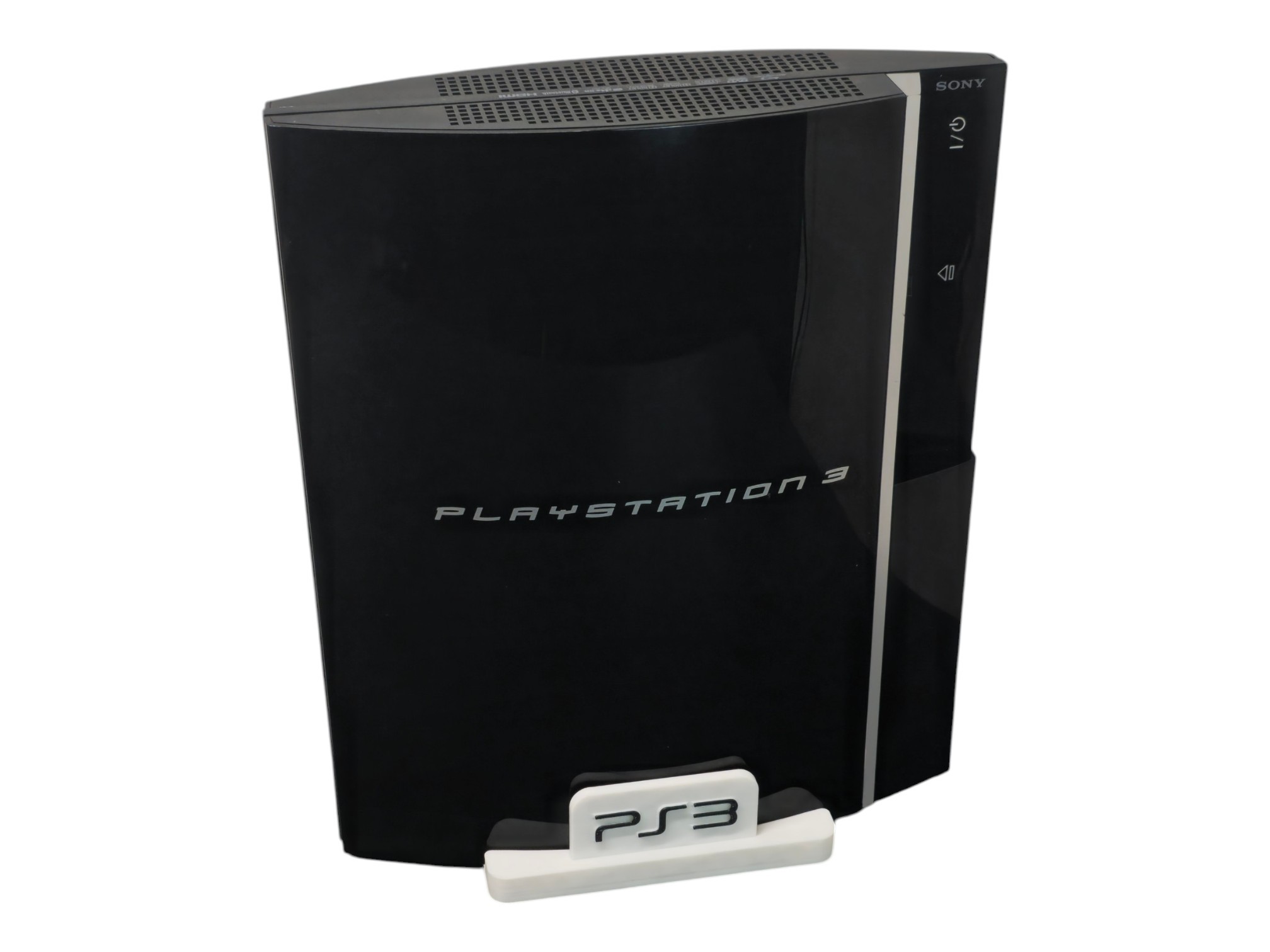
The Sony PlayStation 3 Fat is one of the most ambitious and technologically advanced video game consoles of its generation. Combining powerful multi-core processing, high-definition graphics, Blu-ray technology, and comprehensive online connectivity, it represented a major leap forward in home entertainment.
First released in 2006, the original PlayStation 3 introduced gamers to an entirely new generation of cinematic experiences, realistic graphics, sophisticated physics, and connected entertainment.
With legendary titles such as Uncharted 2: Among Thieves, Metal Gear Solid 4, God of War III, Gran Turismo 5, and The Last of Us, the PlayStation 3 helped redefine modern gaming and established many of the technologies that continue to influence video game consoles today.
Its distinctive glossy black enclosure, curved design, and advanced hardware made the original Fat model one of the most recognisable consoles in Sony’s history.
📘 Introduction
Introduced in Japan on November 11, 2006, the Sony PlayStation 3 was the successor to the enormously successful PlayStation 2.
The console launched in North America on November 17, 2006, before reaching European markets on March 23, 2007.
Developed during a period of rapid technological advancement, the PlayStation 3 was designed to offer considerably more than conventional gaming.
Sony envisioned a comprehensive digital entertainment system capable of delivering high-definition games, Blu-ray movies, online multiplayer, digital downloads, and multimedia playback.
The console introduced several important technologies to the PlayStation family, including:
- The Cell Broadband Engine processor
- High-definition graphics through the RSX processor
- Blu-ray Disc technology
- HDMI digital video output
- Integrated hard disk storage
- Wireless controllers
- PlayStation Network connectivity
- Built-in Ethernet and Wi-Fi on most models
The PlayStation 3 competed directly with Microsoft’s Xbox 360 and Nintendo’s Wii during the seventh generation of video game consoles.
Although its high launch price and complex hardware initially created challenges, the system gradually developed into one of the most influential entertainment platforms of the 2000s and early 2010s.
🏭 The Evolution of Sony PlayStation
The PlayStation 3 represented the next stage in Sony’s transformation from a newcomer in the video game industry into one of its dominant manufacturers.
The original Sony PlayStation, launched in Japan in 1994, helped popularise CD-ROM gaming and advanced three-dimensional graphics.
Its successor, the PlayStation 2, introduced DVD playback, improved processing capabilities, and one of the largest game libraries in entertainment history.
By the mid-2000s, Sony wanted to create a system that would push console technology even further.
The PlayStation 3 introduced several revolutionary concepts:
- Multi-core processing architecture
- High-definition gaming
- Large-capacity optical media
- Integrated online services
- Wireless motion-sensitive controllers
- Digital game distribution
- Advanced multimedia functionality
However, Sony’s ambitions also resulted in an unusually expensive and technically complicated machine.
The PlayStation 3 was originally positioned not merely as a gaming console, but as a powerful computing and multimedia platform for the living room.
This philosophy influenced nearly every aspect of its design.
🖥️ The Iconic Original Fat Design
The original PlayStation 3 featured one of the most distinctive designs in console history.
Unlike the relatively angular PlayStation 2, the PS3 adopted a large, curved enclosure with a glossy black finish and prominent PlayStation branding.
Its substantial dimensions gave the machine a premium appearance, reflecting Sony’s ambition to position it as a sophisticated entertainment system.
Design Features
- Large, curved black enclosure
- Glossy piano-black finish
- Chrome or silver-coloured trim, depending on model
- Slot-loading Blu-ray disc drive
- Touch-sensitive Power and Eject controls
- Integrated internal power supply
- Front USB connections
- Rear HDMI, AV, and digital audio connections
- Horizontal and vertical placement support
- Internal cooling system with a large fan
The original launch model measured approximately 325 × 98 × 274 mm and weighed around 5 kg.
This made it substantially larger and heavier than the later Slim and Super Slim revisions.
The Famous Spider-Man Font
One unusual detail of the original PlayStation 3 was its distinctive PLAYSTATION 3 logo, which closely resembled the typography used in Sony’s Spider-Man films of the period.
The unusual branding helped distinguish the original model from both its predecessors and later PlayStation consoles.
In 2009, Sony introduced a revised PS3 logo alongside the Slim redesign, making the original branding a recognisable feature of the Fat generation.
Today, the large glossy enclosure and original typography contribute significantly to the model’s nostalgic and collectible appeal.
⚙️ Technical Specifications
The PlayStation 3 Fat introduced one of the most technically ambitious hardware architectures of its generation.
Hardware Overview
- Manufacturer: Sony Computer Entertainment
- Model: PlayStation 3 Fat
- Original release: 2006
- European release: March 23, 2007
- Generation: Seventh-generation video game console
- CPU: Cell Broadband Engine
- CPU clock speed: 3.2 GHz
- GPU: NVIDIA/Sony RSX Reality Synthesizer
- GPU clock speed: Approximately 550 MHz
- Main RAM: 256 MB XDR DRAM
- Video RAM: 256 MB GDDR3
- Optical drive: Blu-ray Disc, DVD and CD
- Internal storage: 20 GB, 40 GB, 60 GB, 80 GB or 160 GB, depending on revision and market
- Hard drive interface: 2.5-inch SATA
- Maximum video output: 1080p
- HDMI: HDMI 1.3-class output
- USB: Two or four USB 2.0 ports, depending on revision
- Ethernet: Gigabit Ethernet
- Wi-Fi: IEEE 802.11b/g on most models
- Bluetooth: Bluetooth 2.0 with EDR
- Digital audio: Optical S/PDIF
- Controller: SIXAXIS or DualShock 3
- Backward compatibility: Original PlayStation games and, on selected early models, PlayStation 2 games
The PS3’s hardware specifications were impressive at launch, particularly its custom Cell processor and ability to reproduce high-definition content.
However, the unusual memory architecture and specialised processing system required developers to adapt their programming techniques.
🧠 The Cell Broadband Engine: A Revolutionary Processor
One of the most important technological features of the PlayStation 3 was its Cell Broadband Engine.
Developed through a collaboration involving Sony, Toshiba, and IBM, the Cell processor represented a radically different approach to high-performance computing.
Rather than relying entirely on conventional processor cores, Cell combined a general-purpose PowerPC-based processing element with several specialised processing units.
Cell Processor Architecture
The processor included:
- One PowerPC-based Processing Element
- Eight physically implemented Synergistic Processing Elements
- Seven enabled SPEs in production PS3 processors
- Dedicated high-speed local memory for individual SPEs
- High-bandwidth communication between processing elements
- A clock speed of 3.2 GHz
Of the seven enabled SPEs, one was generally reserved for system-related functions, leaving six primarily available to game developers.
Why Cell Was Different
The architecture allowed certain calculations to be performed in parallel.
This was particularly useful for:
- Physics simulations
- Character animation
- Artificial intelligence
- Audio processing
- Mathematical calculations
- Graphics-related workloads
- Complex environmental effects
However, the processor was notoriously difficult to program efficiently.
Developers had to carefully distribute tasks across the specialised processing elements to exploit the available performance.
Games developed specifically around the Cell architecture eventually demonstrated the console’s remarkable capabilities.
Titles such as Uncharted 3, God of War III, and The Last of Us showed how dramatically software optimisation could improve results over the machine’s lifespan.
The Cell processor remains one of the most fascinating experiments in console hardware design.
🎨 RSX Graphics & High-Definition Gaming
The PlayStation 3 featured a custom graphics processor called the RSX Reality Synthesizer, developed through a collaboration between Sony and NVIDIA.
The RSX worked alongside the Cell processor to deliver complex 3D graphics and high-definition gaming experiences.
Graphics Capabilities
- Hardware-accelerated 3D rendering
- Programmable vertex and pixel shaders
- Advanced lighting effects
- High-resolution textures
- Realistic reflections
- Complex particle systems
- High-definition video output
- Support for selected 1080p games
The console supported output resolutions including:
- 576i / 576p for PAL-compatible displays
- 720p
- 1080i
- 1080p
Although the system could output video at 1080p, many graphically demanding PlayStation 3 games rendered internally at 720p or lower resolutions.
This distinction is important because the console’s maximum supported video output did not mean every game rendered natively at Full HD.
The Transition to HD Gaming
The PlayStation 3 arrived during the transition from traditional CRT televisions to modern high-definition flat-panel displays.
Compared with the PlayStation 2 generation, HD gaming offered:
- Sharper images
- More detailed environments
- Improved texture quality
- More sophisticated lighting
- Greater visual realism
- Cinematic presentation
The PlayStation 3 helped establish high-definition graphics as a standard expectation for home consoles.
💿 Blu-ray Disc: A Major Technological Milestone
One of the PlayStation 3’s most significant innovations was its built-in Blu-ray Disc drive.
At the time, optical media technology was undergoing an important transition.
DVDs had become the dominant home entertainment format, but high-definition video required considerably more storage capacity.
Sony supported Blu-ray as the next major optical format.
Blu-ray Advantages
A standard Blu-ray Disc could provide:
- 25 GB of storage on a single-layer disc
- 50 GB on a dual-layer disc
- High-definition video playback
- High-capacity game storage
- Support for advanced audio formats
Compared with standard DVDs, Blu-ray offered significantly more room for game assets, cinematic sequences, high-quality audio, and additional content.
A Console and a Blu-ray Player
The PlayStation 3 was also a fully functional Blu-ray movie player.
At launch, standalone Blu-ray players were expensive, making the PS3 an attractive option for consumers interested in high-definition home entertainment.
The console supported:
- Blu-ray movies
- DVD movies
- Audio CDs
- PlayStation 3 game discs
- Compatible original PlayStation discs
- PlayStation 2 discs on selected early models
The inclusion of Blu-ray technology helped establish the format as a major successor to DVD.
It also made the PlayStation 3 one of the most versatile entertainment devices available during its early years.
🎮 Games & Software Library
The PlayStation 3 developed an extraordinary software library throughout its commercial lifespan.
Its catalogue included cinematic action adventures, racing simulations, role-playing games, fighting games, first-person shooters, and innovative independent productions.
Some of the most celebrated PlayStation 3 games include:
- Uncharted: Drake’s Fortune
- Uncharted 2: Among Thieves
- Uncharted 3: Drake’s Deception
- The Last of Us
- Metal Gear Solid 4: Guns of the Patriots
- God of War III
- God of War: Ascension
- Gran Turismo 5
- Gran Turismo 6
- LittleBigPlanet
- LittleBigPlanet 2
- Killzone 2
- Killzone 3
- Resistance: Fall of Man
- Resistance 2
- MotorStorm
- MotorStorm: Pacific Rift
- inFAMOUS
- inFAMOUS 2
- Heavy Rain
- Beyond: Two Souls
- Demon’s Souls
- Journey
- Ni no Kuni: Wrath of the White Witch
- Red Dead Redemption
- Grand Theft Auto IV
- Grand Theft Auto V
- Batman: Arkham City
- BioShock
- Assassin’s Creed II
- Call of Duty: Modern Warfare 2
- Dark Souls
- Portal 2
The console became particularly famous for its cinematic single-player experiences.
Sony’s first-party studios produced games that combined storytelling, sophisticated animation, realistic character performances, and advanced graphics.
The PlayStation 3 also benefited from strong third-party support, allowing it to compete with the Xbox 360 across most major gaming genres.
Many of its most celebrated games were released several years after the console’s introduction, demonstrating how developers gradually mastered its difficult architecture.
🧭 Uncharted: A New Standard for Cinematic Adventure
One of the most influential franchises introduced during the PlayStation 3 generation was Uncharted.
Developed by Naughty Dog, the series followed treasure hunter Nathan Drake through dangerous expeditions, ancient mysteries, and spectacular action sequences.
The first game, Uncharted: Drake’s Fortune, arrived in 2007.
Its sequel, Uncharted 2: Among Thieves, released in 2009, became one of the most critically acclaimed games of its generation.
The series featured:
- Cinematic storytelling
- Detailed character animations
- Large-scale action sequences
- Environmental puzzles
- Platforming and exploration
- Advanced graphics
- Memorable characters and dialogue
Uncharted demonstrated how video games could combine interactive gameplay with the presentation and pacing of Hollywood adventure films.
The franchise also helped establish Naughty Dog as one of Sony’s most important development studios.
Its success influenced the design of numerous action-adventure games released in subsequent years.
🧟 The Last of Us: Pushing the Hardware to Its Limits
Released in 2013, The Last of Us became one of the defining achievements of the PlayStation 3 generation.
Developed by Naughty Dog, the game combined survival mechanics, stealth gameplay, and emotionally complex storytelling.
Set in a post-apocalyptic world, it followed Joel and Ellie as they travelled through a devastated United States.
The game featured:
- Detailed environmental design
- Advanced character animation
- Sophisticated artificial intelligence
- Cinematic storytelling
- Atmospheric lighting
- Realistic voice acting
- Carefully designed survival gameplay
The Last of Us arrived near the end of the PlayStation 3’s main commercial generation.
Its technical presentation demonstrated how effectively experienced developers could use the Cell processor and RSX graphics hardware.
The game became one of the most influential releases of the 2010s and remains a landmark in interactive storytelling.
🔄 Backward Compatibility: PS1, PS2 & PS3
One of the most interesting features of the original PlayStation 3 Fat was its backward compatibility.
Sony initially wanted the PS3 to function as a unified PlayStation entertainment system capable of playing games from multiple console generations.
However, compatibility varied significantly between hardware revisions.
Original PlayStation Compatibility
Retail PlayStation 3 consoles support the playback of compatible original PlayStation game discs.
This allows users to revisit classics such as:
- Metal Gear Solid
- Final Fantasy VII
- Final Fantasy VIII
- Resident Evil 2
- Crash Bandicoot
- Spyro the Dragon
- Tekken 3
- Gran Turismo 2
Some titles may have compatibility issues, and original disc region restrictions still apply.
PlayStation 2 Compatibility
The situation with PS2 software is considerably more complicated.
Only selected early PlayStation 3 Fat models can play original PlayStation 2 game discs.
CECHA / CECHB Models
Certain Japanese and North American launch models included substantial PlayStation 2 hardware internally.
These models provided the most extensive PS2 compatibility among retail PlayStation 3 systems.
CECHC Models — European Launch
The original European 60 GB PlayStation 3 used a combination of hardware and software emulation.
Sony retained the PlayStation 2 Graphics Synthesizer but removed its Emotion Engine processor, replacing some functions with software emulation.
As a result, compatibility with PS2 games was more limited than on the earliest Japanese and North American models.
Later Fat Models
Many later PS3 Fat models removed PlayStation 2 disc compatibility entirely.
These systems could still play compatible original PlayStation games and their own PlayStation 3 software.
Why Backward Compatibility Matters
For collectors, early backward-compatible Fat models are especially desirable.
They can provide access to multiple generations of PlayStation software through a single console.
However, it is essential to identify the exact model number before assuming that a particular PlayStation 3 can play PS2 discs.
🧩 PlayStation 3 Fat Models & Revisions
The original PlayStation 3 was produced in several configurations with different storage capacities, internal components, and hardware features.
20 GB — CECHB Series
- One of the original launch configurations
- Released in Japan and North America
- PlayStation 2 hardware compatibility
- Four USB ports
- No built-in Wi-Fi
- No integrated memory card reader
- Black trim rather than the chrome finish of the 60 GB model
60 GB — CECHA Series
- Early Japanese and North American launch configuration
- Extensive PlayStation 2 hardware compatibility
- Four USB ports
- Integrated Wi-Fi
- Integrated memory card reader
- Chrome-coloured trim
- Super Audio CD support
60 GB — CECHC Series (Europe)
- Original European launch configuration
- Introduced in March 2007
- Partial PlayStation 2 compatibility
- Hybrid hardware and software emulation
- Four USB ports
- Integrated Wi-Fi
- Memory Stick, SD and CompactFlash card readers
- Super Audio CD support
40 GB Models
- Introduced during 2007
- Lower-cost configuration
- Two USB ports
- No integrated memory card reader
- No original PS2 disc compatibility
- Simplified internal architecture
80 GB Models
- Released in multiple regional revisions
- Some early CECHE models retained partial PS2 compatibility
- Later 80 GB revisions removed PS2 disc compatibility
- Internal hardware and connectivity varied by model
160 GB Models
- Introduced during the later Fat generation
- Larger original hard drive capacity
- Revised motherboard and internal components
- No original PS2 disc compatibility
- Continued support for PS3 and compatible PS1 discs
Because Sony introduced multiple revisions under similar commercial storage descriptions, the CECH model number is more reliable than hard drive capacity when identifying a particular console.
This distinction is especially important when evaluating collectability and backward compatibility.
🌐 PlayStation Network & Online Gaming
The PlayStation 3 introduced a significantly expanded online experience to Sony’s console ecosystem.
Through the PlayStation Network (PSN), players could connect with friends, download digital content, and participate in online multiplayer games.
The system introduced features such as:
- PlayStation Network accounts
- Online multiplayer
- Friends lists
- Messaging
- PlayStation Store
- Downloadable games
- Game demonstrations
- Downloadable content
- System software updates
- Trophies, introduced in 2008
Unlike the original Xbox Live Gold model, online multiplayer for most PS3 games did not require a paid PlayStation Plus subscription.
PlayStation Store
The PlayStation Store became an important platform for digital game distribution.
It offered:
- Downloadable games
- Game demos
- Additional game content
- Classic PlayStation titles
- Themes and avatars
- Selected multimedia content
Digital distribution allowed smaller developers to reach console audiences without relying exclusively on physical retail releases.
Online Multiplayer
Popular online PlayStation 3 games included:
- Call of Duty: Modern Warfare
- Call of Duty: Modern Warfare 2
- Battlefield: Bad Company 2
- Resistance 2
- Killzone 2
- Gran Turismo 5
- LittleBigPlanet
- Grand Theft Auto IV
- Red Dead Redemption
Online connectivity became a central part of the PlayStation experience during this generation.
Although many original game servers have since closed, the PlayStation 3 remains an important milestone in the development of modern console networking.
🎛️ The XrossMediaBar Interface
The PlayStation 3 introduced many users to Sony’s distinctive XrossMediaBar (XMB) interface.
Originally developed for Sony multimedia devices and also used on the PlayStation Portable, the XMB offered a clean and organised way to navigate content.
Its interface featured horizontal categories and vertical lists of available options.
Users could access:
- Games
- Video content
- Music
- Photos
- System settings
- Network functions
- Friends and messages
- PlayStation Network features
The XMB became one of the most recognisable software interfaces of the PlayStation 3 generation.
Its minimalist appearance and animated background gave the console a premium multimedia identity.
The interface was also closely associated with the PlayStation Portable, creating a consistent design language across Sony’s gaming devices.
🕹️ SIXAXIS & DualShock 3 Controllers
The PlayStation 3 originally launched with the SIXAXIS wireless controller.
Although its shape closely resembled the DualShock 2, the new controller introduced important changes.
SIXAXIS Features
- Bluetooth wireless connectivity
- Motion-sensitive controls
- Six-axis motion sensing
- Two analogue sticks
- Directional pad
- Four face buttons
- Redesigned L2 and R2 triggers
- Integrated rechargeable battery
- USB charging and wired connectivity
The original SIXAXIS did not include vibration motors.
This made it lighter than the earlier DualShock 2 but also removed a familiar feature from PlayStation gaming.
DualShock 3
Sony later introduced the DualShock 3, combining SIXAXIS motion controls with traditional vibration feedback.
The controller provided:
- Wireless Bluetooth connectivity
- Motion sensing
- Dual vibration motors
- Rechargeable battery
- Familiar PlayStation button layout
The DualShock 3 became the standard PlayStation 3 controller for much of the console’s commercial lifespan.
It also remained compatible with many games originally designed around SIXAXIS functionality.
🎯 PlayStation Move & New Ways to Play
In 2010, Sony introduced PlayStation Move, a motion-based control system designed to provide new forms of interactive gameplay.
The system used motion-sensitive controllers in combination with a compatible PlayStation camera.
Its most recognisable feature was the illuminated sphere at the top of the motion controller.
The camera tracked the coloured sphere while internal sensors detected movement and orientation.
PlayStation Move Features
- Motion tracking
- Accelerometer and gyroscope sensors
- Camera-based position detection
- Wireless connectivity
- Vibration feedback
- Interactive gameplay applications
Popular PlayStation Move titles included:
- Sports Champions
- The Fight: Lights Out
- Start the Party!
- The Shoot
- Sorcery
- Heavy Rain (Move-compatible edition)
- Killzone 3 (Move support)
The PlayStation Move represented Sony’s response to the increasing popularity of motion-controlled gaming.
It also became an important technological step towards later motion-tracking and virtual reality applications.
🐧 OtherOS: The PlayStation 3 as a Computer
One of the most unusual features of early PlayStation 3 consoles was their ability to install an alternative operating system.
This functionality, known as OtherOS, allowed users to install compatible Linux distributions alongside the standard PlayStation 3 operating environment.
The feature reflected Sony’s original vision of the PS3 as a powerful computing platform rather than simply a gaming device.
OtherOS Capabilities
- Installation of compatible Linux systems
- Access to programming environments
- Experimental software development
- Research and educational applications
- Certain scientific computing workloads
The Cell processor attracted interest from researchers because of its parallel processing capabilities.
Groups of PlayStation 3 systems were even used for specialised computing projects.
However, OtherOS did not provide unrestricted access to the entire console hardware.
Removal of OtherOS
In April 2010, Sony released system software version 3.21, which removed the ability to install and use OtherOS on updated consoles.
The decision was associated with security concerns and became controversial among enthusiasts who valued the console’s computing capabilities.
Today, the original OtherOS functionality remains an interesting part of the PlayStation 3’s technological history.
🔥 Yellow Light of Death: A Famous Hardware Problem
One of the best-known problems associated with early PlayStation 3 Fat consoles is the Yellow Light of Death (YLOD).
The term refers to a hardware failure condition commonly identified by a brief yellow indicator light followed by a flashing red light and system shutdown.
YLOD is not a single specific defect.
It is a general symptom that can be associated with several hardware failures.
Possible Causes
- RSX graphics processor failure
- Internal processor connection problems
- Faulty power regulation components
- Failed capacitors
- Other motherboard faults
- Thermal management problems
Certain early consoles with 90 nm RSX graphics processors are particularly associated with serious long-term reliability concerns.
Why Early Fat Models Need Attention
The first PS3 models contained relatively large processors and produced considerable heat.
As components age, accumulated thermal stress can contribute to hardware deterioration.
However, overheating is not the only cause of YLOD, and simply replacing thermal paste cannot repair every affected console.
Likewise, improvised heating techniques may provide only temporary results or cause additional damage.
Preservation & Maintenance
Collectors preserving original PS3 Fat hardware should consider:
- Regular internal cleaning
- Proper ventilation
- Inspecting the cooling system
- Replacing deteriorated thermal paste when appropriate
- Monitoring fan behaviour and operating temperatures
- Diagnosing hardware faults before attempting repairs
- Consulting specialists for processor or motherboard failures
For serious hardware faults, professional diagnosis is essential.
With proper care and suitable repairs, many original PlayStation 3 consoles can continue operating decades after their original release.
💾 Hard Drive Storage & Expandability
The PlayStation 3 was one of the major consoles of its generation to include an internal hard drive as standard.
Unlike earlier consoles that often relied on memory cards, the PS3 used a conventional hard disk for storing games, updates, and multimedia content.
Its storage system supported:
- Game save files
- Downloaded games
- Installed game data
- System updates
- Music
- Photos
- Videos
- Downloadable game content
Upgradeable Storage
The PS3 used a standard 2.5-inch SATA hard drive format.
This allowed users to replace the original drive with a compatible larger-capacity model.
Compatible solid-state drives can also be used, although the console’s older SATA interface limits the performance advantages compared with modern systems.
Storage upgrades can be useful for preserving a large library of digital games and installed content.
However, replacing the drive generally requires preparing compatible system software and may involve reinstallation or restoration procedures.
The internal hard drive represented an important transition towards the storage architecture used in modern consoles.
📺 HDMI, Blu-ray & Multimedia Entertainment
The PlayStation 3 was one of Sony’s most important products during the transition to high-definition home entertainment.
Its multimedia features included:
- HDMI digital output
- Blu-ray movie playback
- DVD playback
- Audio CD support
- Digital music playback
- Photo viewing
- Video playback
- Network media functionality
The console supported high-definition video output and could connect directly to modern flat-panel televisions.
Audio Capabilities
The PlayStation 3 supported several advanced audio formats, including:
- Dolby Digital
- DTS
- Linear PCM
- Multi-channel audio output
- Optical digital audio
The system was therefore suitable for use with compatible home cinema equipment.
Modern Display Compatibility
The PS3 remains relatively convenient to use with modern televisions because it includes native HDMI output.
Unlike many earlier consoles, it generally does not require an analogue-to-HDMI converter.
However, display compatibility, available resolutions, and image quality still depend on the connected television and software.
The PlayStation 3 helped establish HDMI and digital multimedia functionality as standard features in home gaming systems.
🌍 Worldwide Success & Cultural Impact
Despite its difficult commercial beginning, the PlayStation 3 eventually became a major success.
Sony reported more than 87.4 million PlayStation 3 consoles shipped worldwide by March 31, 2017.
This figure includes the original Fat model and subsequent hardware revisions.
The PlayStation 3 developed particularly strong communities across:
- Japan
- North America
- The United Kingdom
- France
- Germany
- Spain
- Italy
- Greece and Cyprus
- Australia
- Other international markets
The console played an important role in popularising:
- High-definition gaming
- Digital game distribution
- Online multiplayer
- Downloadable content
- Wireless controllers
- Console multimedia services
- Persistent user accounts
- Achievement and trophy systems
The PlayStation 3 in Greece
In Greece, the PlayStation 3 became one of the most recognisable gaming systems of the late 2000s and early 2010s.
Its arrival coincided with the rapid adoption of high-definition televisions and broadband internet connections.
Popular titles such as Pro Evolution Soccer, FIFA, Gran Turismo, Call of Duty, Uncharted, and Grand Theft Auto attracted a wide range of players.
The original Fat model was initially considered an expensive, premium entertainment system.
Later price reductions and redesigned hardware helped make the PlayStation 3 accessible to a broader audience.
For many Greek gamers, the PS3 represented the transition from traditional offline console gaming to modern online entertainment.
🔄 PlayStation 3 Fat vs. Slim vs. Super Slim
Throughout its lifespan, Sony introduced three major physical designs of the PlayStation 3.
Although all three shared the same core gaming platform, they differed considerably in size, construction, power consumption, and certain hardware capabilities.
PlayStation 3 Fat (2006)
- Original large, curved enclosure
- Glossy piano-black design
- Touch-sensitive controls
- Internal power supply
- Slot-loading Blu-ray drive
- Higher power consumption in many revisions
- PS2 disc compatibility on selected early models
- OtherOS support on compatible early firmware
- Two or four USB ports, depending on revision
PlayStation 3 Slim (2009)
- Smaller and lighter enclosure
- Redesigned matte finish
- Lower power consumption
- Revised internal components
- Slot-loading Blu-ray drive
- No original PS2 disc backward compatibility
- No official OtherOS support
- Improved efficiency
PlayStation 3 Super Slim (2012)
- Further reduced size and weight
- Sliding top-loading disc cover
- Revised cooling and internal architecture
- Lower-cost manufacturing design
- No original PS2 disc compatibility
- Continued support for PS3 and compatible PS1 discs
- Additional storage configurations
Which Version Is Most Collectible?
The original Fat model holds special historical significance because it represents Sony’s initial PlayStation 3 design philosophy.
Early backward-compatible configurations are especially interesting because of their additional hardware capabilities.
Later Slim and Super Slim models are generally more practical for everyday use due to their improved efficiency and reduced complexity.
Each design represents a different stage in the evolution of Sony’s seventh-generation console.
⭐ Why the PlayStation 3 Fat Still Matters
The Sony PlayStation 3 Fat remains an important part of computing and gaming history for several reasons:
- It introduced the powerful Cell Broadband Engine
- It helped popularise Blu-ray technology
- It established high-definition gaming within the PlayStation ecosystem
- It introduced integrated PlayStation Network services
- Its original design remains instantly recognisable
- Selected early models support PlayStation 2 discs
- It was one of the most ambitious multimedia consoles ever released
- It supported alternative operating systems in its early history
- Its game library includes some of the most influential titles of its generation
- It represents a major turning point in the development of modern gaming
The PlayStation 3 also demonstrated how software optimisation could dramatically extend the capabilities of console hardware.
Its difficult programming environment initially challenged developers, but the platform eventually produced some of the most technically impressive games of the seventh generation.
The original Fat model remains particularly significant because it captures Sony’s most ambitious vision for the PlayStation 3.
🏛️ Collectability & Retro Gaming Legacy
The original PlayStation 3 Fat has become increasingly interesting to collectors seeking to preserve the evolution of modern gaming hardware.
Its distinctive design, unusual architecture, and early hardware features make it a valuable historical artefact.
Collectors often look for examples that retain:
- The original PlayStation 3 Fat console
- Original SIXAXIS or DualShock 3 controller
- Original power cable
- Original AV or HDMI accessories
- Original packaging and protective inserts
- Instruction manuals and documentation
- Authentic PlayStation 3 game discs
- Fully functional Blu-ray drive
- Unmodified original exterior components
Backward-Compatible Models
Early models capable of playing original PS2 discs are particularly desirable.
Collectors frequently pay attention to the following model families:
- CECHA
- CECHB
- CECHC
- CECHE
These models differ in their approach to backward compatibility and were not all sold in the same regions.
Condition & Preservation
The condition of an original PS3 Fat can significantly influence its collectability.
Important considerations include:
- Cosmetic condition
- Original labels and serial information
- Functional optical drive
- Controller and USB port operation
- Cooling system condition
- Evidence of previous repairs
- Motherboard revision
- Original firmware and hardware features
Well-preserved, fully working early models are especially interesting from a historical preservation perspective.
However, their long-term reliability must also be considered.
Beyond its monetary value, the PlayStation 3 Fat represents an extraordinary experiment in advanced consumer electronics design.
It combines the ambition of early multi-core computing, the arrival of Blu-ray technology, and the transformation of video game consoles into network-connected multimedia systems.
📦 Items Included in This Collection Entry
- Sony PlayStation 3 Fat console unit (PAL / European region)
🏁 Conclusion
The Sony PlayStation 3 Fat represents one of the most ambitious chapters in the history of home video gaming. Combining the revolutionary Cell Broadband Engine, advanced RSX graphics, Blu-ray technology, and integrated online services, Sony created a console that pushed the boundaries of interactive entertainment.
Its distinctive design, powerful architecture, and multimedia capabilities reflected a bold vision of what a gaming console could become.
Although its initial commercial journey was challenging, the PlayStation 3 gradually established itself through an extraordinary library of games, improved software development techniques, and an expanding online ecosystem.
From the cinematic adventures of Uncharted to the technical achievements of God of War III and the emotional storytelling of The Last of Us, the PS3 generation delivered experiences that remain influential today.
Two decades after its introduction, the original Fat model continues to fascinate collectors, hardware enthusiasts, and retro gaming fans around the world.
A true seventh-generation legend, an extraordinary achievement in console engineering, and an essential part of any serious video game hardware collection.
