
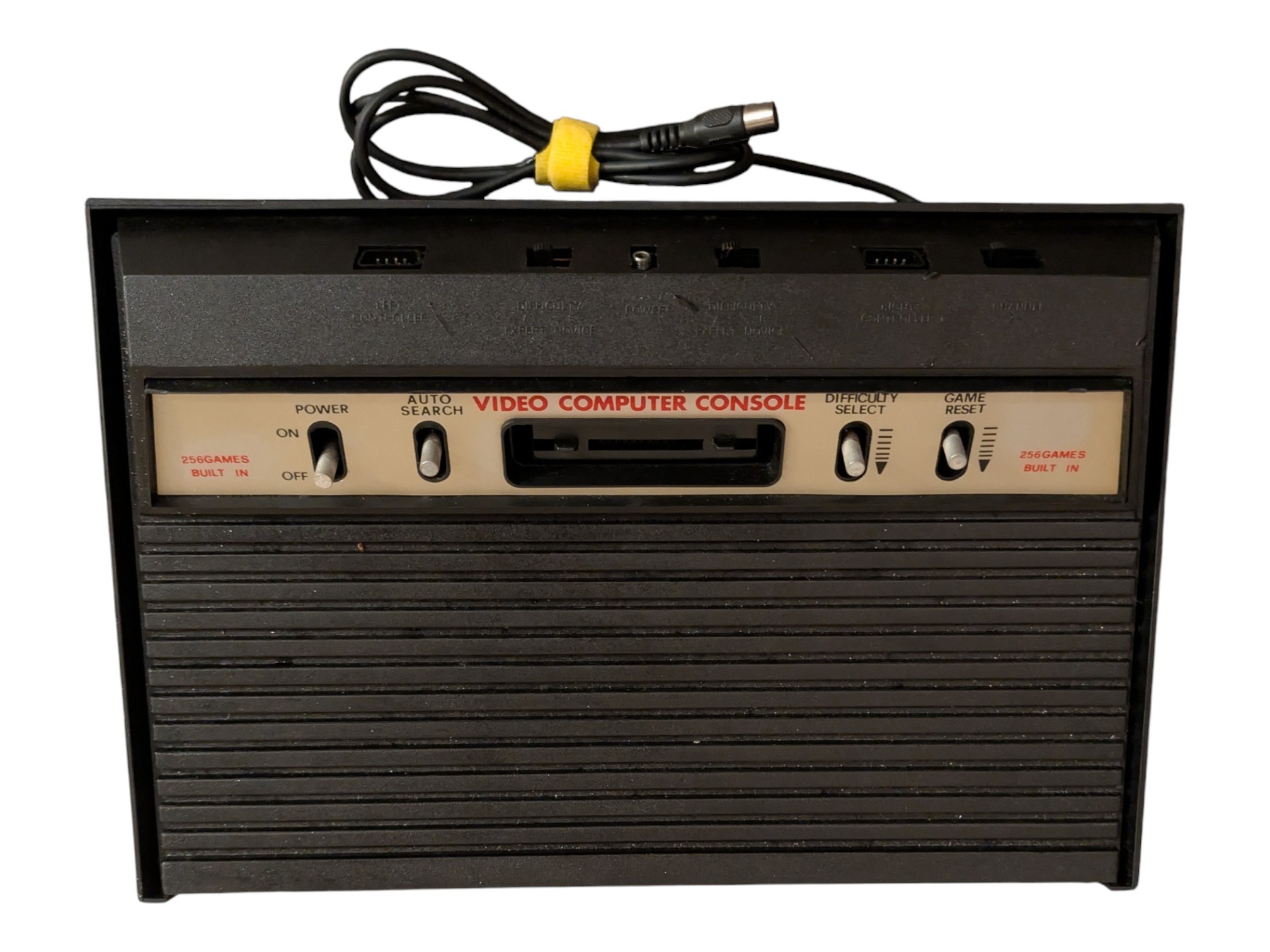
The Atari 2600 Clone – 256 Games represents a fascinating chapter in the history of home video gaming. Inspired by one of the most influential consoles ever created, this Atari 2600-compatible system belongs to a generation of unofficial and third-party machines that helped keep classic 8-bit gaming accessible long after the original Atari Video Computer System had revolutionised the entertainment industry.
Marketed around an impressive collection of 256 games, this type of console reflects a period when affordable hardware, multi-game collections, and simplified television connectivity introduced classic video gaming to new audiences.
Although these machines were not manufactured by Atari, they preserved important elements of the original gaming experience, including simple joystick controls, colourful television graphics, electronic sound effects, and the distinctive gameplay of the early cartridge-console era.
Today, Atari-compatible clones are interesting historical artefacts that reveal how popular console technology spread beyond its original manufacturer and became part of an international market for affordable home entertainment.
📘 Introduction
The history of the Atari 2600 Clone – 256 Games begins with the original Atari Video Computer System, introduced in North America in September 1977.
Later renamed the Atari 2600, the console transformed home video gaming through its use of interchangeable ROM cartridges.
Unlike earlier dedicated systems, which typically contained a fixed selection of games, the Atari VCS allowed consumers to expand their collections by purchasing additional software.
Its success helped establish the basic commercial model followed by many later console manufacturers.
As the Atari 2600 became increasingly popular, other companies began developing compatible hardware, alternative cartridges, and inexpensive systems inspired by Atari’s architecture.
Some of these products reproduced the appearance of original Atari consoles, while others introduced completely different designs.
The 256 Games configuration represents this broader tradition of affordable, multi-game gaming systems.
Rather than being an official Atari model, it belongs to the aftermarket ecosystem that grew around one of gaming’s most influential platforms.
🏭 The Origins of the Atari 2600
The original Atari VCS was introduced in 1977, during the early development of the home video game industry.
Atari had already achieved considerable success through arcade machines and dedicated home gaming products.
However, its engineers recognised that interchangeable cartridges could fundamentally change the market.
Instead of purchasing a completely new console to enjoy different games, consumers could use one system with multiple cartridges.
The Atari Video Computer System
The original machine introduced several important concepts:
- Interchangeable ROM cartridges
- Programmable video game hardware
- Joystick-based controls
- Television connectivity
- Multiple game variations
- A growing software catalogue
The console was initially marketed as the Atari Video Computer System, commonly abbreviated to VCS.
The Atari 2600 name became established in the early 1980s.
A Gaming Revolution
The platform became especially successful following the release of popular home adaptations of arcade games.
Titles such as Space Invaders helped demonstrate the appeal of bringing arcade-style entertainment into the living room.
Atari’s success encouraged numerous competing manufacturers and software publishers to enter the market.
The console eventually became one of the defining consumer electronics products of the late 1970s and early 1980s.
Its popularity also created the conditions for the development of compatible and cloned hardware.
🧩 The Rise of Atari-Compatible Clones
During the 1980s and subsequent years, numerous manufacturers developed consoles inspired by or compatible with the Atari 2600.
These machines are commonly described as Atari clones.
Some were designed to reproduce the original console’s operation, while others combined Atari-compatible technology with built-in game collections or redesigned hardware.
Why Atari Clones Appeared
Several factors contributed to their development:
- The enormous popularity of Atari games
- Strong demand for affordable home entertainment
- The relatively mature 2600 hardware architecture
- The availability of compatible electronic components
- Established cartridge and controller designs
- Consumer interest in inexpensive multi-game systems
Third-party manufacturing became particularly important as electronic component production expanded internationally.
Different companies introduced their own variations, often with little connection to the official Atari brand.
A Diverse Market
Atari-compatible systems appeared in numerous forms.
Some resembled the original woodgrain Atari 2600.
Others copied the smaller Atari 2600 Jr. design or adopted entirely different enclosures.
Certain consoles offered conventional cartridge slots, while others provided games through internal memory or bundled multi-game cartridges.
This diversity makes the history of Atari cloning particularly interesting.
Unlike official consoles, which generally followed identifiable production families, clones often appeared under multiple names and with substantial differences between versions.
🎮 256 Games: The Appeal of Multi-Game Collections
The most distinctive characteristic of the Atari 2600 Clone – 256 Games is its advertised multi-game collection.
During the early home console era, individual games were normally distributed on separate cartridges.
Consumers needed to purchase additional cartridges to expand their software library.
Multi-game systems offered a different approach.
By combining numerous games or selectable game entries within one product, manufacturers could advertise a much larger library at an accessible price.
The 256 Games Concept
The advertised collection could be implemented through:
- Internal ROM storage
- A dedicated multi-game cartridge
- A selectable game bank
- Alternative programme variants
- Different game configurations
The exact implementation depends on the specific console and cartridge hardware.
Are There Really 256 Different Games?
One important characteristic of vintage multi-game products is that the advertised number does not always represent the same number of completely unique titles.
Some collections contain:
- Distinct games
- Alternative versions of existing games
- Different difficulty configurations
- Gameplay variations
- Repeated titles
- Modified software
Therefore, 256 Games should be understood as the advertised collection size unless the complete software library has been independently verified.
This distinction is important when documenting original hardware.
The numerical claim itself is part of the product’s historical identity, reflecting the marketing practices of the period.
🖥️ Design & Construction
Atari 2600-compatible clones were manufactured in numerous external configurations.
Their designs often attempted to reproduce the functionality of the original system while reducing production costs.
Common characteristics across the wider family included:
- Plastic console enclosures
- Simple Power and Reset controls
- Television video connections
- External power supplies
- Joystick-compatible controller interfaces
- Game-selection mechanisms
- Cartridge connectors on certain models
The exact appearance and functionality varied significantly between manufacturers.
Simplified Manufacturing
Many clone manufacturers focused on reducing the number of components required to reproduce Atari-compatible functionality.
Rather than duplicating every original Atari circuit exactly, some designs used more highly integrated electronic components.
This made the consoles cheaper to manufacture and easier to distribute.
A Different Design Philosophy
Official Atari consoles were developed as branded consumer products with established packaging, documentation, and accessory ecosystems.
Clones were often produced with a greater emphasis on affordability.
This could result in differences in:
- Plastic quality
- Internal circuitry
- Controller construction
- Video output quality
- Power supply design
- Packaging and documentation
These variations now make individual clone models interesting objects of study for retro hardware collectors.
⚙️ Technical Specifications
The technical foundation of Atari 2600-compatible consoles comes from the original Atari VCS architecture.
However, clone hardware may reproduce this architecture using different electronic components.
Original Atari 2600 Hardware Architecture
- Original manufacturer: Atari, Inc.
- Original console release: 1977
- Generation: Second-generation video game console
- CPU: MOS Technology 6507
- Processor architecture: 8-bit, derived from the MOS 6502
- CPU clock speed: Approximately 1.19 MHz on NTSC systems
- Main RAM: 128 bytes
- Graphics and audio: Television Interface Adaptor (TIA)
- Maximum nominal NTSC display width: Approximately 160 pixels
- Common NTSC display height: 192 active lines
- NTSC colour palette: 128 possible colour values
- Sound: Two-channel monaural audio
- Original game storage: ROM cartridges
- Controller interface: Atari-compatible nine-pin connectors
- Original video output: Analogue RF television signal
The 256 Games Clone Configuration
- System type: Atari 2600-compatible clone
- Manufacturer: Unidentified
- Model designation: 256 Games
- Official Atari product: No
- Advertised software collection: 256 games or selectable entries
- Processor implementation: Model-dependent
- Graphics implementation: Atari-compatible or functionally equivalent hardware
- Game storage arrangement: Model-dependent
- Video standard: Requires verification of the specific unit
- Controller configuration: Requires verification of the specific unit
- Production date: Not established
The original Atari specifications provide the architectural reference for understanding these systems.
They should not automatically be interpreted as confirmed component specifications for every compatible clone.
Some machines used different chips while reproducing much of the original console’s behaviour.
🧠 The MOS 6507: The Foundation of Atari Gaming
The original Atari 2600 was built around the MOS Technology 6507, a simplified version of the influential MOS 6502 processor.
The processor operated at approximately 1.19 MHz in NTSC systems.
Although extremely modest by modern standards, it provided sufficient processing capability for the relatively simple games of the late 1970s.
Processor Responsibilities
- Executing game instructions
- Reading controller inputs
- Updating game logic
- Coordinating graphics
- Controlling sound
- Managing memory
- Handling gameplay timing
Only 128 Bytes of RAM
One of the most remarkable aspects of the original Atari 2600 was its extremely limited memory.
The system contained just 128 bytes of RAM.
This was used for essential game information, temporary calculations, object positions, and other programme data.
Developers had to work within extraordinary restrictions.
The Challenge of Atari Programming
Creating games for the Atari 2600 required highly efficient programming.
Developers frequently used assembly language and carefully timed instructions.
The limited memory encouraged innovative techniques for reusing data and manipulating the graphics hardware.
Atari-compatible clones inherited the software expectations of this architecture, even when their internal components differed from those used in official consoles.
🎨 Graphics: The Television Interface Adaptor
The original Atari 2600 used a custom chip called the Television Interface Adaptor, commonly abbreviated to TIA.
This chip handled video generation, sound, and certain controller-related functions.
Unlike later video game consoles, the Atari 2600 did not contain a conventional frame buffer capable of storing a complete image.
Instead, the processor and TIA worked closely together to generate the television picture.
Graphics Capabilities
The original NTSC architecture supported:
- A nominal graphics width of up to 160 pixels
- A commonly used display height of 192 active lines
- A palette of 128 possible colour values
- Two player graphics objects
- Two missile objects
- One ball object
- A programmable background playfield
The number of colours simultaneously visible within a particular region was restricted by the hardware design.
However, programmers could change colours and display settings during screen generation.
Racing the Beam
One of the most famous Atari programming techniques is known as racing the beam.
Because the system generated the image in real time, developers had to coordinate program execution with the television’s scanning process.
This required extremely precise timing.
Programmers could manipulate visual elements as the screen was drawn, producing effects beyond what the limited hardware might initially suggest.
Graphics on Clone Hardware
Atari-compatible clones attempted to reproduce these graphical behaviours.
However, not every clone implemented the original timing and video circuitry identically.
Differences could result in:
- Altered colours
- Screen positioning variations
- Incorrect graphical effects
- Timing problems
- Compatibility issues with certain games
These differences are useful when examining how closely a clone reproduces original Atari hardware.
🎵 Classic Atari Sound
The Atari 2600 introduced a distinctive electronic sound that became closely associated with early video gaming.
Its TIA chip included two audio channels capable of generating simple tones and noise.
Audio Capabilities
- Two sound channels
- Programmable frequencies
- Noise-based sound effects
- Adjustable volume
- Simple electronic melodies
- Arcade-style sound generation
Although the audio system was limited compared with later consoles, developers created memorable effects.
Classic Atari sounds included:
- Laser fire
- Explosions
- Vehicle engines
- Electronic alarms
- Collision effects
- Simple musical sequences
The Sound of Early Video Gaming
The limited audio hardware contributed to the distinctive identity of the second console generation.
Instead of sophisticated music and recorded sound, games relied on short electronic effects to communicate actions and events.
These sounds became an essential part of the early video game experience.
Compatible clones attempted to reproduce the same general audio characteristics, although sound quality and timing could vary between hardware implementations.
🕹️ Joysticks & Classic Controls
One of the most recognisable aspects of Atari 2600 gaming is its simple controller design.
The original Atari CX40 joystick featured a directional stick and a single action button.
This straightforward arrangement became one of the defining control systems of early home gaming.
The Classic Atari Joystick
Its main features included:
- Four-direction digital movement
- Single action button
- Compact square base
- Simple internal switching mechanism
- Nine-pin connector
The controller was particularly suitable for early arcade-style games.
Third-Party Controllers
Numerous manufacturers developed compatible joystick alternatives.
Some offered additional features such as:
- Autofire
- Alternative handle designs
- Different button arrangements
- Larger bases
- Improved grip
Controllers on Clone Systems
Many Atari-compatible clones retained the familiar controller connection standard.
However, connector wiring and compatibility should be verified for each particular machine.
Some clones used modified or non-standard interfaces despite their Atari-inspired appearance.
For collectors, original controllers and compatible third-party alternatives are important parts of the hardware ecosystem.
🎮 The Atari 2600 Gaming Legacy
The Atari 2600 developed one of the most influential software libraries of the early home console era.
Its catalogue included arcade conversions, action games, shooters, sports titles, racing games, and innovative original productions.
Some of the most celebrated Atari 2600 games include:
- Combat
- Space Invaders
- Asteroids
- Missile Command
- Adventure
- Pitfall!
- Pitfall II: Lost Caverns
- River Raid
- Enduro
- Yars’ Revenge
- Breakout
- Super Breakout
- Berzerk
- Defender
- Centipede
- Millipede
- Frogger
- Pac-Man
- Ms. Pac-Man
- Kaboom!
- H.E.R.O.
- Keystone Kapers
- Seaquest
- Atlantis
- Demon Attack
- Phoenix
- Solaris
- Pole Position
- Jungle Hunt
- Barnstorming
- Freeway
- Boxing
- Tennis
- Basketball
These games demonstrate the creativity of developers working with extremely limited hardware.
Many introduced gameplay concepts that remain familiar today.
Important Collection Distinction
The titles above represent the wider Atari 2600 software library.
They should not be interpreted as a confirmed list of games included in this particular 256 Games clone.
The exact software selection depends on the unit’s internal ROM or multi-game cartridge.
👾 Space Invaders: Atari’s Breakthrough
One of the most important games in Atari’s history was Space Invaders.
Originally developed by Taito for arcades in 1978, the game became an international sensation.
Atari released its home adaptation for the VCS in 1980.
Why Space Invaders Mattered
The game introduced many households to the appeal of arcade-style action gaming at home.
Its features included:
- Descending alien formations
- Player-controlled laser cannon
- Increasing difficulty
- Destructible defensive barriers
- High-score challenges
- Numerous gameplay variations
The success of Space Invaders helped transform the Atari VCS into a major commercial product.
It demonstrated that a dedicated home console could offer games people previously associated with arcade machines.
The title became one of the most significant early examples of software driving hardware sales.
🌴 Pitfall! & the Birth of the Platform Adventure
Released by Activision in 1982, Pitfall! became one of the Atari 2600’s most influential games.
Players controlled Pitfall Harry as he explored a jungle filled with obstacles and hidden treasures.
The game featured:
- Side-view platform action
- Running and jumping
- Dangerous pits
- Moving logs
- Crocodiles
- Underground passages
- Collectible treasures
- Time-limited gameplay
A Major Step Forward
Pitfall! demonstrated how imaginative level design could create a sense of exploration on extremely limited hardware.
Its large interconnected environment was especially impressive for the time.
The game influenced the development of later platform and action-adventure titles.
Activision’s Contribution
Pitfall! also reflected the growing importance of independent software publishers.
Activision became one of the earliest major third-party console game developers.
Its success helped establish the idea that software development could become a substantial business independently of the console manufacturer.
🚁 River Raid: Fast-Paced Arcade Action
Another important Atari 2600 title was River Raid, developed by Carol Shaw and published by Activision in 1982.
The game placed players in control of an aircraft travelling along a scrolling river.
Its gameplay involved:
- Avoiding obstacles
- Destroying enemy vehicles
- Collecting fuel
- Navigating narrow passages
- Surviving increasingly difficult environments
Technical Innovation
River Raid became famous for its smoothly scrolling environments and efficient procedural level generation.
These techniques allowed the game to create the appearance of a much larger world than could otherwise fit into the console’s limited memory.
A Lasting Legacy
River Raid became one of the most recognisable games of the Atari generation.
Its gameplay remains remarkably accessible.
The title also represents the contributions of pioneering developers who achieved impressive technical results within severe hardware limitations.
💾 Built-In Games vs. Multi-Game Cartridges
One important distinction among Atari-compatible clones concerns how their game collections are stored.
Different systems used different arrangements.
Built-In ROM Collections
Some clone consoles contained multiple games within internal ROM memory.
Users could select different titles through built-in controls or a menu.
Advantages included:
- No need for individual game cartridges
- Immediate access to multiple titles
- Simplified operation
- Lower cost per advertised game
- Reduced dependence on external software
Multi-Game Cartridges
Other systems used cartridges containing several games.
These cartridges could be selected through physical switches, menus, or other hardware mechanisms.
Historically, Atari-compatible multi-game cartridges appeared in various configurations, including collections advertised with 32, 64, 128, 160, 192, or 256 games.
Why This Matters for Collectors
The distinction affects how a machine should be catalogued.
A console containing a built-in collection is not technically identical to a conventional Atari-compatible system supplied with a 256-in-1 cartridge.
The exact configuration should be verified by examining the console, its cartridge slot, and any accompanying documentation.
Both arrangements form part of the broader history of multi-game entertainment systems.
📺 RF Television Connectivity & the CRT Experience
The original Atari 2600 was designed for connection to analogue televisions.
Its standard video output used an RF signal that could be tuned through a television’s antenna system.
Many Atari-compatible clones followed this approach, although some later designs offered additional connection options.
The Original Atari Video Experience
RF connections were common during the late 1970s and 1980s.
Their advantages included:
- Compatibility with many household televisions
- Relatively inexpensive hardware
- Simple cabling
- No need for specialised computer monitors
However, RF signals could be affected by interference and picture-quality limitations.
PAL & NTSC Differences
Atari 2600 hardware existed in different regional video configurations.
The principal television standards included:
- NTSC: Common in North America and Japan
- PAL: Common throughout much of Europe
- SECAM: Used in certain other markets
These standards differed in video timing, colour encoding, and display behaviour.
Atari-compatible clone manufacturers sometimes produced regional versions designed for local television systems.
Using a Clone Today
Depending on its actual output configuration, a vintage Atari-compatible console may be connected through:
- A compatible CRT television
- An analogue antenna input
- Appropriate RF adapters
- Video conversion equipment
- Model-specific composite video solutions
Modern televisions may not support the required analogue signals directly.
For historical demonstrations, a compatible CRT television remains one of the most authentic ways to experience original Atari-era graphics.
The exact video output of an individual clone should be confirmed before selecting cables or adapters.
🏪 Affordable Gaming & the Unofficial Console Market
Atari-compatible clones represent an important part of the international market for affordable home electronics.
Not every household could afford an official console together with a large collection of separate games.
Clone manufacturers attempted to address this demand through lower-cost hardware and multi-game packages.
Why Consumers Bought Clones
- Lower purchase prices
- Large advertised game collections
- Simple television operation
- Familiar arcade-style gameplay
- Easy access to entertainment
- Reduced need for additional software purchases
A Different Retail Environment
Unlike official Atari products, clone systems were often sold through smaller electronics retailers, local distributors, and general merchandise shops.
Brand names and packaging could vary between countries.
Some products appeared with generic names such as:
- TV Game
- Video Game System
- 2600 Compatible
- Multi Game
- Family Game
- Hundreds of Games
These generic descriptions make exact historical identification difficult.
The Importance of Packaging
Original boxes, labels, and printed game lists are particularly valuable because they can reveal information not visible on the hardware itself.
For an otherwise unidentified clone, the packaging may provide clues about:
- Manufacturer
- Distributor
- Country of manufacture
- Intended market
- Advertised game count
- Power requirements
- Controller compatibility
- Video standard
These details help distinguish one clone configuration from another.
🔄 Original Atari 2600 vs. Atari-Compatible Clone
Although clones were designed to reproduce some or much of the original Atari gaming experience, they were not necessarily identical to official hardware.
Original Atari 2600
- Official Atari-manufactured console
- Introduced in 1977 as the Atari VCS
- MOS 6507-based architecture
- Atari TIA graphics and sound
- Official cartridge interface
- Established hardware revisions
- Documented production history
- Recognisable Atari branding
Atari 2600-Compatible Clone
- Manufactured by a third party
- Potentially different internal components
- Alternative circuit-board design
- Atari-compatible functionality
- Variable cartridge support
- Variable controller compatibility
- Different exterior designs
- Model-dependent video output
- Potential built-in or bundled game collections
Compatibility Is Not Always Perfect
A clone may reproduce most original Atari games successfully while having difficulty with certain software.
Differences can involve:
- Graphics timing
- Sound generation
- Cartridge bank switching
- Controller behaviour
- Unusual programming techniques
- Regional video compatibility
For collectors, these differences reveal how the original Atari architecture was interpreted and reproduced by other manufacturers.
🔧 Build Quality & Longevity
Atari-compatible clones vary considerably in construction quality.
Some were built using relatively robust components, while others were designed to minimise manufacturing costs.
As a result, their long-term reliability depends heavily on the specific model and its internal hardware.
Common Maintenance Tasks
- Cleaning exterior plastics
- Inspecting the motherboard
- Checking solder joints
- Cleaning controller connectors
- Inspecting the power connection
- Testing video output
- Checking game-selection controls
- Cleaning cartridge connectors, if present
- Inspecting ageing capacitors
- Checking cables and accessories
Power Supply Compatibility
One of the most important precautions involves the external power supply.
Different Atari-compatible clones may require different voltages, connector dimensions, or polarity arrangements.
The original Atari 2600 power adapter should not automatically be assumed compatible with an unidentified clone.
Before connecting a power supply, the device’s electrical requirements should be verified.
Ageing Electronic Components
Like other vintage electronics, clones may suffer from:
- Oxidised connectors
- Dry solder joints
- Damaged switches
- Ageing capacitors
- Corroded metal contacts
- Deteriorated cables
Many problems can be addressed through careful inspection and suitable repairs.
Long-Term Preservation
Proper storage is particularly important for inexpensive vintage electronic equipment.
Recommended practices include:
- Maintaining a dry environment
- Avoiding extreme temperatures
- Protecting the console from direct sunlight
- Preventing dust accumulation
- Storing cables without excessive strain
- Keeping accessories together
- Retaining original packaging and documentation
With suitable care, Atari-compatible systems can remain useful historical demonstrations of early home video gaming.
🌍 Atari Clones Around the World
The original Atari 2600 achieved international recognition, encouraging the development of compatible hardware and software outside its original market.
Third-party console manufacturing became particularly visible in regions where affordability and local distribution were important factors.
Atari-compatible hardware and software appeared across various markets, including:
- Europe
- South America
- Asia
- Parts of the Middle East
- Other regional consumer electronics markets
The Role of Asian Electronics Manufacturing
Manufacturers in Taiwan, Hong Kong, and other Asian electronics markets contributed to the production of Atari-compatible cartridges and hardware.
Many multi-game cartridges documented by collectors are associated with Taiwanese production.
These products sometimes appeared under generic or changing brand names.
Their labels, packaging, and game combinations reflected a highly fragmented aftermarket.
Atari Compatibility in Brazil
Brazil became an important market for Atari-compatible systems and locally manufactured gaming products.
Various companies produced consoles, cartridges, and accessories associated with the Atari ecosystem.
Brazilian gaming history provides a particularly interesting example of how international technology could develop a distinct local identity.
The European Experience
Throughout Europe, affordable console hardware competed with popular home computers such as the ZX Spectrum, Commodore 64, and Amstrad CPC.
Atari-compatible clones offered a straightforward alternative for consumers primarily interested in gaming.
Their simple operation and relatively low cost helped keep older console technology accessible even as newer systems became available.
🇬🇷 Atari-Compatible Gaming in Greece
The history of Atari-compatible consoles is also relevant to the development of home gaming in Greece.
During the 1980s and early 1990s, Greek consumers encountered a wide variety of electronic entertainment products.
These included:
- Dedicated Pong-style consoles
- Atari-compatible video game systems
- Home computers
- Imported cartridge consoles
- Generic multi-game machines
The Appeal of Affordable Consoles
Generic gaming systems could offer an accessible alternative to branded hardware.
For families interested primarily in simple entertainment, a console advertised with dozens or hundreds of games could appear particularly attractive.
The ability to connect a device to an ordinary television was another important advantage.
A Distinctive Retail Culture
Generic consoles were often distributed differently from official branded systems.
Retail packaging, local importers, and hardware specifications could vary considerably.
This makes surviving consoles, boxes, game lists, and instruction sheets valuable sources of information.
Preserving a Forgotten Market
While major manufacturers such as Atari, Nintendo, and Sega are extensively documented, many smaller clone manufacturers remain poorly researched.
Preserving these machines helps document a less visible part of Greek and European gaming culture.
They represent the experiences of consumers who discovered video gaming through inexpensive alternative hardware rather than official consoles.
🏛️ Collectability & Historical Significance
Atari-compatible clones occupy a distinctive category within retro gaming collections.
They are not official Atari consoles, but they remain historically interesting because they document the spread and adaptation of early video game technology.
What Collectors Look For
Important features can include:
- Original console enclosure
- Manufacturer markings
- Model labels
- Original controller ports
- Compatible joysticks
- Original power adapter
- Game-selection system
- Cartridge slot, if present
- Original retail packaging
- Printed game lists
- Instruction manuals
- Distributor information
The Importance of the 256 Games Label
The advertised number of games is a useful identifier.
It can help distinguish different clone versions or software configurations.
However, two products advertised with the same game count may contain different software libraries or internal hardware.
Originality & Condition
Collectors should consider:
- Cosmetic condition
- Original labels
- Unmodified circuit boards
- Functionality
- Completeness
- Original accessories
- Packaging condition
- Hardware revision
Unlike official Atari products, generic clones can be difficult to identify precisely.
For this reason, photographs of the motherboard, external labels, and retail packaging can be particularly valuable.
A Different Kind of Gaming History
The importance of clone consoles extends beyond monetary value.
They reveal how technology was copied, adapted, distributed, and marketed to audiences beyond the original manufacturer’s intended customer base.
Each surviving example contributes to documenting this lesser-known part of electronic entertainment history.
⭐ Why the Atari 2600 Clone – 256 Games Still Matters
The Atari 2600 Clone – 256 Games represents an important aspect of retro gaming history for several reasons:
- It reflects the extraordinary influence of the original Atari 2600
- It demonstrates the international spread of compatible gaming hardware
- It illustrates the popularity of multi-game collections
- It represents affordable home entertainment outside official console ecosystems
- It preserves the experience of early joystick-controlled gaming
- It documents alternative electronics manufacturing
- It provides insight into historical software distribution practices
- It highlights the variety of unofficial console designs
- It helps preserve a lesser-documented part of gaming culture
The console also demonstrates the commercial longevity of successful technology.
Even as newer generations introduced more advanced processors, colourful graphics, and sophisticated sound systems, the basic Atari gaming experience continued to attract consumers.
For many players, simple arcade-style gameplay remained enjoyable regardless of technological progress.
📦 Items Included in This Collection Entry
🏁 Conclusion
The Atari 2600 Clone – 256 Games represents a fascinating extension of one of the most influential platforms in video game history.
Inspired by the original Atari Video Computer System, compatible consoles helped bring classic gaming experiences to audiences through affordable hardware, alternative manufacturing, and large advertised game collections.
Although these machines were not official Atari products, they illustrate the extraordinary reach of the Atari 2600 architecture and the lasting appeal of early home video games.
Their simple controls, characteristic electronic sounds, and arcade-inspired gameplay connect them directly to the origins of cartridge-based home entertainment.
The advertised 256-game collection also reflects an era when multi-game products became an important marketing concept in the affordable electronics industry.
Today, surviving Atari-compatible clones are valuable historical artefacts that document the diversity of the early console market.
They tell a story not only about the success of Atari, but also about the manufacturers, distributors, and consumers who contributed to the worldwide expansion of video gaming.
A fascinating example of unofficial console history, a tribute to the enduring legacy of the Atari 2600, and an important addition to any comprehensive retro video game collection.
