

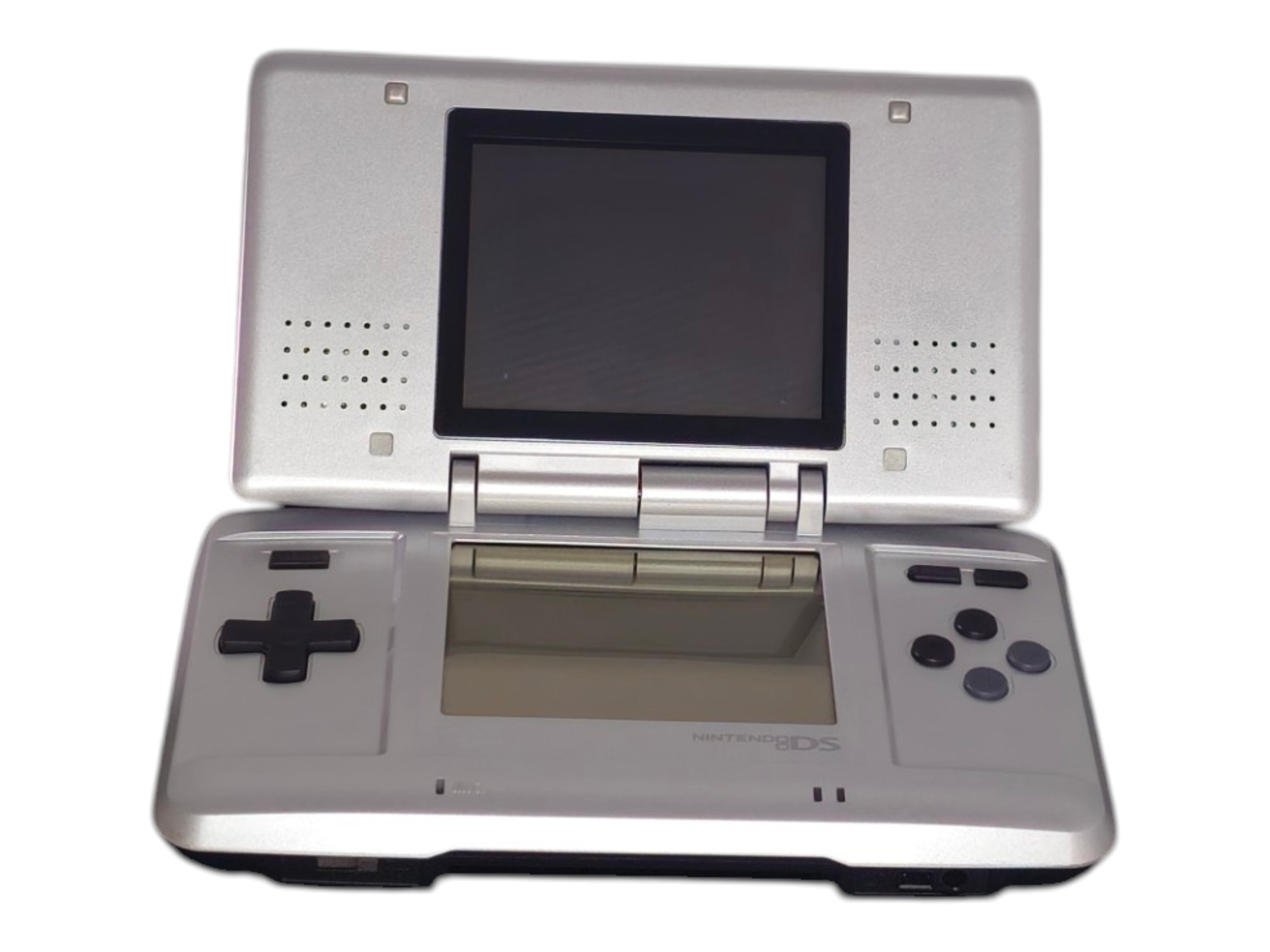
The Nintendo DS Silver, also known as the original Nintendo DS NTR-001 or Platinum Silver, is one of the most influential handheld gaming consoles ever created. Introduced in 2004, it revolutionised portable entertainment through an innovative combination of two screens, touchscreen controls, wireless communication, a built-in microphone, and backward compatibility with Game Boy Advance software.
Its distinctive silver-and-black clamshell design represented a radical departure from Nintendo’s earlier Game Boy family. Rather than concentrating exclusively on faster processors and improved graphics, Nintendo introduced completely new ways for players to interact with video games.
With legendary titles such as Mario Kart DS, New Super Mario Bros., Nintendogs, Brain Age, Pokémon Diamond and Pearl, Animal Crossing: Wild World, and The Legend of Zelda: Phantom Hourglass, the Nintendo DS helped transform handheld gaming into a mainstream activity enjoyed by players of all ages.
The original Silver edition is particularly important because it represents the first design of a platform that would eventually become one of the most commercially successful gaming systems in history.
📘 Introduction
The Nintendo DS was first released in North America on November 21, 2004, followed by Japan on December 2, 2004, and Europe on March 11, 2005.
Its original model designation was NTR-001.
The Silver, or Platinum Silver, finish was one of the console’s original launch colour configurations.
At first glance, the Nintendo DS appeared to be an unusual successor to the Game Boy Advance.
Instead of one display, it featured two.
Instead of relying exclusively on conventional buttons, it introduced a touchscreen and stylus.
Instead of requiring a physical link cable for multiplayer gaming, it included wireless communication.
Its major innovations included:
- Two 3-inch colour LCD screens
- A touch-sensitive lower display
- Integrated microphone
- Dual ARM processors
- Wireless multiplayer communication
- Nintendo DS Download Play
- PictoChat messaging
- Backward compatibility with Game Boy Advance games
- Rechargeable lithium-ion battery
- Compact folding enclosure
These features represented an important change in Nintendo’s approach to handheld entertainment.
The Nintendo DS demonstrated that innovative interaction could be just as important as conventional hardware performance.
🏭 Nintendo’s Handheld Gaming Heritage
The Nintendo DS emerged from a long history of portable electronic entertainment.
Nintendo had already achieved remarkable success through several generations of handheld systems.
Game & Watch (1980)
The Game & Watch series introduced millions of consumers to Nintendo’s portable gaming philosophy.
These compact devices featured simple electronic games built around LCD technology.
Several Game & Watch models also introduced folding designs with dual screens.
This design tradition would later influence the Nintendo DS.
Game Boy (1989)
The original Game Boy became one of the most influential handheld consoles in history.
Designed under the leadership of Gunpei Yokoi, it combined durable hardware, affordable manufacturing, efficient battery consumption, and interchangeable game cartridges.
Game Boy Color (1998)
The Game Boy Color introduced colour graphics while maintaining compatibility with much of the earlier Game Boy software library.
Game Boy Advance (2001)
The Game Boy Advance represented a significant improvement in processing power and graphics capabilities.
Its 32-bit ARM processor enabled more sophisticated portable games.
Game Boy Advance SP (2003)
The Game Boy Advance SP introduced a folding design, illuminated screen, and rechargeable battery.
It demonstrated the advantages of a more compact and protective handheld form factor.
Nintendo DS (2004)
The Nintendo DS combined elements of earlier Nintendo handhelds with new interaction technologies.
Its dual screens, touchscreen, microphone, and wireless capabilities represented a fundamental change in portable game design.
Rather than simply replacing the Game Boy Advance with a faster version, Nintendo introduced an entirely new gameplay concept.
🧠 Nintendo’s Third Pillar Strategy
When Nintendo originally announced the DS, the company described it as a third pillar of its gaming business.
At the time, Nintendo’s major hardware lines were:
The DS was initially positioned as a separate gaming concept rather than a conventional Game Boy successor.
Why Nintendo Took This Approach
The company believed that simply increasing graphical performance would eventually become insufficient to attract new audiences.
Instead, Nintendo wanted to develop hardware that could support unfamiliar gaming experiences.
Its strategy focused on:
- Innovative controls
- Accessible gameplay
- New audiences
- Social interaction
- Creative software design
- Alternative forms of entertainment
A Different Direction
While competitors concentrated on powerful multimedia hardware, Nintendo emphasised how players interacted with games.
The DS’s touchscreen, microphone, and wireless communication provided developers with new design possibilities.
The Result
The DS became an enormous commercial success.
Its popularity established an approach that later influenced other Nintendo products, including the Wii and subsequent handheld systems.
The idea that gameplay innovation could be more important than raw graphical power became one of Nintendo’s defining strategies.
🖥️ The Original Silver Clamshell Design
The Nintendo DS NTR-001 features a distinctive folding enclosure.
Its design is noticeably different from the slimmer DS Lite introduced in 2006.
The original Silver edition combines a metallic-looking upper surface with darker lower sections and accents.
Exterior Features
- Silver upper enclosure
- Dark-coloured lower housing
- Two colour LCD screens
- Folding clamshell construction
- Directional pad
- A, B, X, and Y buttons
- L and R shoulder buttons
- Start and Select buttons
- Built-in stereo speakers
- Integrated microphone
- Stylus storage
- Game Card slot
- Game Boy Advance cartridge slot
- Headphone connection
- Rechargeable battery
The Folding Design
The clamshell construction protects the two displays when the console is closed.
This makes the handheld easier to transport without exposing the screens directly.
A Substantial Handheld
Compared with later DS revisions, the original model is relatively large and thick.
Its weight and physical construction give it a more substantial appearance.
The Silver Finish
The Silver edition became closely associated with the original DS launch.
Its appearance now provides an immediate visual distinction from the later DS Lite, DSi, and 3DS families.
For collectors, the original NTR-001 design represents the first generation of Nintendo’s dual-screen handheld technology.
⚙️ Technical Specifications
The original Nintendo DS combines two ARM processors, dedicated graphics hardware, wireless communication, and dual LCD displays.
Hardware Overview
- Manufacturer: Nintendo
- Model: Nintendo DS NTR-001
- Colour: Silver / Platinum Silver
- Generation: Seventh-generation handheld console
- North American release: November 21, 2004
- Japanese release: December 2, 2004
- European release: March 11, 2005
- Main CPU: ARM946E-S, approximately 67 MHz
- Secondary CPU: ARM7TDMI, approximately 33 MHz
- Main RAM: 4 MB
- Video RAM: 656 KB
- Top screen: 3-inch TFT colour LCD
- Bottom screen: 3-inch TFT colour touchscreen
- Resolution: 256×192 pixels per screen
- Display colour capability: Approximately 262,144 colours
- Graphics: Dedicated 2D and 3D hardware
- Audio: Stereo speakers
- Microphone: Built-in
- Wireless: IEEE 802.11-compatible and proprietary Nintendo wireless communication
- Game storage: Nintendo DS Game Cards
- Backward compatibility: Game Boy Advance Game Paks
- Battery: Rechargeable lithium-ion
- Original battery life: Approximately 6–10 hours
- Original charging time: Approximately 4 hours
- Dimensions: 148.7 × 84.7 × 28.9 mm when closed
- Weight: Approximately 275 g including battery and stylus
- Built-in software: PictoChat and DS system settings
The original DS was a considerable technological improvement over the Game Boy Advance.
However, its greatest innovation was the combination of two independent screens with multiple input methods.
🧠 Dual ARM Processors: ARM9 & ARM7
One of the Nintendo DS’s most important architectural features is its use of two processors.
Unlike earlier handhelds built around a single primary CPU, the DS uses separate ARM9 and ARM7 processing cores.
ARM946E-S
The main ARM9 processor operates at approximately 67 MHz.
It is responsible for important aspects of Nintendo DS software execution, including:
- Main game logic
- Graphics coordination
- Three-dimensional processing
- Memory operations
- Application execution
ARM7TDMI
The secondary ARM7 processor operates at approximately 33 MHz.
It supports functions such as:
- Audio processing
- Wireless communication
- Input/output operations
- System services
- Game Boy Advance compatibility
Why Two Processors?
The dual-processor design allows the system to distribute responsibilities across different processing components.
This makes the architecture more flexible than a simple single-processor arrangement.
The ARM Connection
The use of ARM technology also connects the Nintendo DS to an important family of processors.
ARM architectures have become extremely influential in portable electronics, embedded devices, smartphones, and tablets.
The Nintendo DS demonstrates how ARM processing technology could support sophisticated handheld entertainment while maintaining relatively efficient power consumption.
🎨 Graphics: Two Screens & Dedicated 3D Hardware
The Nintendo DS introduced a substantially more advanced graphical architecture than earlier Game Boy systems.
Its graphics hardware supports both traditional two-dimensional rendering and three-dimensional environments.
2D Graphics
The DS includes dedicated 2D graphics engines capable of handling:
- Background layers
- Sprites
- Tile-based graphics
- Scrolling
- Transparency effects
- Character animation
These capabilities were particularly suitable for classic Nintendo gameplay styles.
3D Graphics
The system also introduced dedicated three-dimensional graphics hardware.
This supported:
- Polygon-based environments
- Textured objects
- Depth effects
- Lighting
- Three-dimensional character models
- Perspective rendering
Different Uses for the Two Screens
Developers could use the screens in several ways.
Examples included:
- Main gameplay on the upper screen
- Maps on the lower screen
- Inventory management
- Touchscreen puzzles
- Dual-perspective environments
- Expanded vertical gameplay areas
The Importance of Dual Displays
The two screens were not simply a novelty.
They gave developers a way to separate gameplay information from the main action.
This influenced the design of numerous games throughout the DS’s commercial lifespan.
✍️ The Touchscreen Revolution
The lower Nintendo DS display includes a resistive touchscreen.
This technology detects physical pressure applied to the display surface.
It was designed to work with the included stylus or other suitable touch input.
Touchscreen Applications
- Menu navigation
- Object selection
- Drawing
- Writing
- Puzzle solving
- Character interaction
- Inventory management
- Direct manipulation of game elements
The Stylus
The stylus provided more precise control than a finger.
This was especially useful for games requiring accurate drawing or selecting small objects.
A Major Change in Game Design
Before the Nintendo DS, most mainstream handheld gaming relied on directional controls and physical buttons.
The touchscreen introduced a fundamentally different method of interaction.
Developers could build games around touching, dragging, tracing, or tapping objects.
An Accessible Interface
Touchscreen controls also helped attract players who were unfamiliar with traditional controllers.
A person could interact with the game simply by touching the desired object.
This accessibility played an important role in the commercial success of the DS.
🎤 The Built-In Microphone
The Nintendo DS also included a microphone.
Although small and relatively simple, it gave software developers an additional input method.
Microphone Applications
Compatible games could use audio input for:
- Voice recognition
- Spoken commands
- Whistling
- Blowing
- Sound-triggered actions
- Interactive activities
Nintendogs
One of the most famous microphone-based games was Nintendogs.
Players could speak to their virtual puppies and teach them to recognise voice commands.
This created a more personal relationship between player and game.
WarioWare: Touched!
WarioWare: Touched! demonstrated creative uses of the touchscreen and microphone.
Some minigames required unusual physical interactions rather than conventional button inputs.
A New Form of Gameplay
The microphone demonstrated Nintendo’s willingness to experiment with alternative game controls.
Together with the touchscreen, it helped make the DS feel substantially different from earlier handheld consoles.
🎵 Stereo Sound & Audio Capabilities
The Nintendo DS features integrated stereo speakers positioned around the upper display.
Its audio hardware was a significant improvement over earlier Game Boy systems.
Audio Features
- Built-in stereo speakers
- Multi-channel sampled audio
- Digital sound effects
- Music playback
- Programmable audio processing
- Headphone output
- Microphone input
Game Soundtracks
The improved audio capabilities supported more elaborate game music and sound design.
Titles could feature:
- Rich instrumental arrangements
- Digitised voices
- Environmental sound effects
- Stereo positioning
- Complex musical compositions
The Importance of Sound
The DS’s speakers allowed players to enjoy stereo audio without connecting headphones.
This made the portable experience more immersive.
A Distinctive Nintendo Sound
Games such as Mario Kart DS, Pokémon Diamond and Pearl, and The Legend of Zelda: Phantom Hourglass used memorable music to complement their gameplay.
The DS continued Nintendo’s tradition of combining technical efficiency with strong audio design.
💾 Nintendo DS Game Cards
The Nintendo DS introduced a new proprietary cartridge format known as the Nintendo DS Game Card.
Compared with traditional Game Boy Advance cartridges, DS Game Cards were smaller and more compact.
Game Card Characteristics
- Small plastic cartridges
- Solid-state ROM storage
- No optical drive
- No moving components
- Fast software access
- Compact dimensions
- Support for game-specific save storage
Why Nintendo Continued Using Cartridges
During the mid-2000s, Sony introduced the PlayStation Portable with an optical UMD format.
Nintendo chose to continue using solid-state media.
This offered several advantages:
- Compact game distribution
- Reduced power requirements
- Better resistance to movement
- No spinning disc
- Convenient portability
- Relatively fast access to game data
Game Data & Save Files
Nintendo DS games used different storage and save arrangements depending on the software.
Most commercial titles contained appropriate memory for preserving game progress.
A Format That Supported a Huge Library
The DS Game Card format supported thousands of commercial releases over the system’s lifespan.
Its compact design became an important part of the console’s identity.
🔄 Backward Compatibility with Game Boy Advance
One of the original Nintendo DS’s most useful features was its ability to run Game Boy Advance games.
The console includes a dedicated cartridge slot commonly called Slot-2.
Supported Software
The original DS supports:
Important Limitations
The Nintendo DS cannot natively play:
It also lacks the Game Boy Advance Link Cable port.
Consequently, conventional GBA multiplayer functions requiring a link cable or wireless adapter are not supported.
GBA Gameplay on the DS
Compatible Game Boy Advance games run using the system’s backward compatibility hardware.
Because GBA games were designed for a single screen, they are displayed on one DS screen.
The user can select which display is used through the system settings.
Why Backward Compatibility Mattered
This allowed existing Game Boy Advance owners to continue enjoying their software libraries.
It also helped the Nintendo DS transition into the market without immediately abandoning Nintendo’s previous handheld platform.
A Valuable Collector Feature
For retro gaming enthusiasts, the original DS is useful because it supports two generations of Nintendo software.
This gives it a broader historical role than a handheld restricted to a single game format.
📡 Wireless Multiplayer Gaming
The Nintendo DS introduced wireless communication as a standard feature.
Earlier Game Boy systems often relied on physical cables for multiplayer functionality.
The DS removed much of this inconvenience.
Wireless Features
- Local wireless multiplayer
- Compatible game-data exchange
- Wireless communication between nearby systems
- Nintendo DS Download Play
- Online functionality in supported games
Local Multiplayer
Players could connect compatible Nintendo DS systems without a cable.
This made multiplayer gaming easier and more convenient.
A Social Gaming Experience
Wireless multiplayer encouraged groups of players to meet and play together.
Games such as Mario Kart DS became especially popular in social environments.
No Link Cable Required
This represented an important change from the Game Boy Advance era.
The DS was designed around wireless interaction rather than conventional physical multiplayer connections.
🎮 Nintendo DS Download Play
One of the system’s most innovative features was DS Download Play.
Certain multiplayer games allowed multiple players to participate using only one physical Game Card.
How Download Play Works
A player with a compatible game starts a multiplayer session.
Other Nintendo DS users can join through the built-in Download Play interface.
The host system transfers the necessary software to the participating handhelds.
Advantages
- Fewer game cartridges required
- Easier local multiplayer
- Convenient demonstrations
- Short downloadable game sessions
- Greater accessibility
A Popular Multiplayer Feature
Games such as Mario Kart DS used Download Play to allow players to race together.
The exact number of players and available game modes depended on the software.
Historical Importance
Download Play anticipated later forms of temporary software sharing and local multiplayer distribution.
It was an especially practical feature at a time when portable gaming was frequently enjoyed with friends.
💬 PictoChat: Wireless Messaging Before Smartphones
The Nintendo DS included a built-in application called PictoChat.
This allowed nearby DS users to communicate through a wireless messaging interface.
PictoChat Features
- Local wireless messaging
- Text entry
- Handwritten messages
- Stylus drawing
- Multiple chat rooms
- Up to 16 users in a room
A Simple Communication System
Users could write messages using the touchscreen.
They could also draw pictures or create handwritten notes.
No Internet Required
PictoChat used local wireless communication.
It did not require an internet connection.
An Early Social Feature
Today, messaging applications are standard smartphone features.
In 2004, however, an integrated messaging program in a handheld gaming console was an unusual and memorable addition.
Preservation Value
PictoChat remains useful for demonstrating the original DS’s local wireless capabilities.
It also provides a distinctive example of how Nintendo experimented with social interaction before modern mobile messaging became universal.
🌐 Nintendo Wi-Fi Connection
The Nintendo DS was one of Nintendo’s first major handheld platforms designed to support internet-based multiplayer gaming.
Nintendo introduced Nintendo Wi-Fi Connection in 2005.
The service allowed compatible games to connect to other players through the internet.
Supported Features
Depending on the game, Nintendo Wi-Fi Connection could provide:
- Online multiplayer
- Matchmaking
- Leaderboards
- Downloadable content
- Game-data exchange
- Online trading
- Special events
Popular Online Games
Important examples included:
- Mario Kart DS
- Animal Crossing: Wild World
- Pokémon Diamond and Pearl
- Metroid Prime Hunters
A Major Step Forward
Internet gaming became an important part of the Nintendo DS experience.
Players were no longer limited to competing with people physically nearby.
Service Discontinuation
Nintendo officially discontinued the original Nintendo Wi-Fi Connection service on May 20, 2014.
As a result, its original online matchmaking and related services are no longer available.
Local Wireless Still Works
The discontinuation of Nintendo Wi-Fi Connection did not remove the console’s basic local wireless functionality.
Compatible systems can still communicate directly for supported offline multiplayer features.
For collectors, this distinction is important when testing original DS hardware.
🏎️ Mario Kart DS: A Handheld Racing Revolution
Released in 2005, Mario Kart DS became one of the most influential games on the platform.
It successfully adapted Nintendo’s famous kart-racing series to a portable dual-screen environment.
Gameplay Features
- Three-dimensional racing tracks
- Familiar Nintendo characters
- Multiple vehicles
- Competitive racing
- Battle modes
- Wireless multiplayer
- Online racing through the original Wi-Fi service
Dual-Screen Gameplay
The upper screen displays the main racing action.
The lower screen can show useful race information and a map.
Download Play
Mario Kart DS became particularly popular because compatible local multiplayer sessions could be played using Download Play.
An Important Milestone
The game demonstrated that a portable system could offer a sophisticated multiplayer experience.
It also became one of the defining releases of the Nintendo DS generation.
🐶 Nintendogs: Reaching New Audiences
One of the most commercially important Nintendo DS games was Nintendogs, released in 2005.
Developed by Nintendo, the game allowed players to care for virtual puppies.
Gameplay Features
- Virtual-pet interaction
- Touchscreen petting
- Voice commands
- Training activities
- Competitions
- Pet customisation
- Daily care
Touchscreen Innovation
Players used the stylus to interact directly with their pets.
This created a more natural interface than conventional button controls.
Microphone Integration
The built-in microphone allowed players to teach their dogs voice commands.
This became one of the game’s most memorable features.
A Different Audience
Nintendogs helped attract players who were not primarily interested in traditional action or competitive games.
It demonstrated the DS’s potential for accessible, family-friendly entertainment.
Historical Importance
The game became one of the clearest examples of Nintendo’s strategy of expanding the gaming audience through new interaction methods.
🧠 Brain Age: Gaming Beyond Traditional Entertainment
Another important Nintendo DS success was Brain Age, known in Europe as Dr. Kawashima’s Brain Training.
The game introduced a series of short mental exercises presented through the handheld’s touchscreen interface.
Activities Included
- Arithmetic
- Memory challenges
- Reading exercises
- Numerical puzzles
- Reaction tasks
- Writing and recognition activities
The Book-Like Orientation
Some exercises were designed to be played while holding the Nintendo DS vertically.
This made the system resemble a small electronic book.
Touchscreen & Microphone
The game used input methods such as handwritten numbers and spoken answers.
A Broader Market
Brain Age attracted adults and older players who might not ordinarily purchase a gaming console.
Its success helped establish the DS as a device for everyday entertainment and casual activities.
The game’s exercises should be understood as entertainment and practice rather than proven medical treatment or a guarantee of improved cognitive health.
A New Commercial Direction
Brain Age became closely associated with Nintendo’s effort to reach audiences beyond traditional video game players.
🍄 New Super Mario Bros.: Classic Platforming Returns
Released in 2006, New Super Mario Bros. brought traditional side-scrolling Mario gameplay to the Nintendo DS.
The game combined familiar platforming mechanics with modern graphical presentation.
Gameplay Features
- Side-scrolling platform action
- Three-dimensional character models
- Classic power-ups
- New abilities
- Hidden exits
- Secret levels
- Multiplayer minigames
A Return to Mario’s Roots
The game revisited the fundamental design of classic titles such as Super Mario Bros. and Super Mario World.
Modern Presentation
Its combination of three-dimensional character models with traditional two-dimensional level design made it visually distinctive.
The DS Advantage
The lower screen provided additional information and supported supplementary gameplay functions.
A Commercial Success
New Super Mario Bros. became one of the most successful games in the Nintendo DS library.
It helped demonstrate that classic gameplay could remain enormously popular when presented on new hardware.
🐾 Pokémon Diamond & Pearl
The Nintendo DS became a major platform for the Pokémon franchise.
Pokémon Diamond and Pearl, released in Japan in 2006, introduced the fourth generation of Pokémon games.
Gameplay Features
- New Pokémon species
- Sinnoh region
- Turn-based battles
- Pokémon collection
- Local trading
- Online connectivity
- Touchscreen menus
A New Generation
The games expanded the established Pokémon formula while introducing new graphical and communication capabilities.
Wireless Trading
The DS’s wireless features made local interaction more convenient than on earlier handhelds.
The original online services also allowed certain forms of internet-based Pokémon interaction.
Additional Pokémon Titles
The Nintendo DS family later received important games including:
- Pokémon Platinum
- Pokémon HeartGold
- Pokémon SoulSilver
- Pokémon Black
- Pokémon White
- Pokémon Black 2
- Pokémon White 2
A Major Part of DS History
The Pokémon franchise contributed significantly to the DS’s popularity and longevity.
These games remain among the most recognisable releases of the platform.
🌳 Animal Crossing: Wild World
Released in 2005, Animal Crossing: Wild World brought Nintendo’s life-simulation series to a portable handheld.
Gameplay Features
- Village exploration
- Character relationships
- Collecting objects
- Decorating homes
- Fishing
- Bug catching
- Seasonal events
- Local and online multiplayer
A Persistent Virtual World
The game uses the Nintendo DS’s clock and calendar functions to create a world that changes over time.
The Role of the Touchscreen
Players can use touch input for certain menus and interactions.
Social Gaming
The game was designed around communication and visiting other players’ towns.
Historical Importance
Wild World helped establish portable life-simulation gaming as a major category.
Its success also demonstrated the appeal of slower, more personal gaming experiences.
🗡️ The Legend of Zelda: Phantom Hourglass
Released in 2007, The Legend of Zelda: Phantom Hourglass made extensive use of the DS’s touchscreen.
The game adopted a distinctive visual style inspired by The Legend of Zelda: The Wind Waker.
Gameplay Features
- Touchscreen character control
- Stylus-based puzzles
- Exploration
- Dungeon challenges
- Drawing routes
- Map annotations
- Adventure storytelling
Touchscreen Gameplay
Instead of controlling every action exclusively through buttons, players used the stylus to move Link and interact with the environment.
Dual-Screen Design
The second display provided additional information and map functionality.
Creative Puzzle Design
The game’s puzzles encouraged players to interact physically with the handheld.
A Defining DS Experience
Phantom Hourglass demonstrated how a major Nintendo franchise could be redesigned around the distinctive capabilities of the DS.
🎮 The Nintendo DS Software Library
The Nintendo DS developed an exceptionally large and varied software catalogue.
Its library includes platformers, racing games, role-playing games, puzzle titles, strategy games, adventure games, and experimental touchscreen experiences.
Notable Nintendo DS Games
- Super Mario 64 DS
- New Super Mario Bros.
- Mario Kart DS
- Mario & Luigi: Partners in Time
- Mario & Luigi: Bowser’s Inside Story
- Nintendogs
- Brain Age
- Brain Age 2
- Animal Crossing: Wild World
- Pokémon Diamond
- Pokémon Pearl
- Pokémon Platinum
- Pokémon HeartGold
- Pokémon SoulSilver
- Pokémon Black and White
- The Legend of Zelda: Phantom Hourglass
- The Legend of Zelda: Spirit Tracks
- Metroid Prime Hunters
- Kirby: Canvas Curse
- Kirby Super Star Ultra
- Professor Layton and the Curious Village
- Professor Layton and the Diabolical Box
- Phoenix Wright: Ace Attorney
- Advance Wars: Dual Strike
- Advance Wars: Days of Ruin
- Castlevania: Dawn of Sorrow
- Castlevania: Portrait of Ruin
- Castlevania: Order of Ecclesia
- Chrono Trigger
- Dragon Quest IX
- The World Ends with You
- Elite Beat Agents
- Rhythm Heaven
- Ghost Trick: Phantom Detective
- Grand Theft Auto: Chinatown Wars
- 999: Nine Hours, Nine Persons, Nine Doors
A Library of Different Experiences
The range of software was one of the console’s greatest strengths.
Traditional gamers could enjoy sophisticated adventures and role-playing games.
Casual players could explore touchscreen activities, puzzles, and life simulations.
A Major Creative Platform
The DS encouraged developers to experiment with forms of interaction that were difficult to reproduce on conventional single-screen systems.
This creativity contributed significantly to its lasting legacy.
🔄 Nintendo DS vs. Game Boy Advance SP
The original Nintendo DS represented a substantial technological improvement over the Game Boy Advance SP.
Game Boy Advance SP (2003)
- Single colour display
- ARM7-based processing
- Traditional button controls
- Game Boy Advance cartridges
- Folding enclosure
- Rechargeable battery
- Link Cable multiplayer support
Nintendo DS NTR-001 (2004)
- Two colour displays
- ARM9 and ARM7 processors
- Touch-sensitive lower screen
- Integrated microphone
- Wireless multiplayer
- Nintendo DS Game Cards
- Game Boy Advance compatibility
- PictoChat
- More advanced 3D graphics
The Most Important Difference
The DS introduced an entirely new software and interaction architecture.
Its innovation went beyond simply providing faster processing.
Backward Compatibility
The inclusion of a dedicated Game Boy Advance cartridge slot also made the transition easier for existing Nintendo handheld owners.
🔄 Nintendo DS Original vs. Nintendo DS Lite
In 2006, Nintendo introduced the Nintendo DS Lite, a redesigned version of the original console.
The Lite retained the same core gaming platform while making several physical improvements.
Original Nintendo DS NTR-001 (2004)
- Larger enclosure
- More angular design
- Approximately 275 g
- Two 3-inch screens
- Original screen illumination system
- Game Boy Advance cartridge slot
- Distinctive Silver launch finish
Nintendo DS Lite USG-001 (2006)
- Slimmer enclosure
- More rounded styling
- Approximately 218 g
- Two 3-inch screens
- Brighter displays
- Four screen brightness settings
- Improved battery efficiency
- Game Boy Advance cartridge slot
The Main Difference
The DS Lite was not a new console generation.
It was a hardware redesign intended to improve portability, appearance, and screen visibility.
Why the Original Matters
The NTR-001 remains historically important because it introduced the DS concept.
Its larger enclosure and original controls preserve the physical experience of Nintendo’s first dual-screen handheld.
For collectors, the original Silver model represents the beginning of the entire DS family.
🔄 Nintendo DS vs. Sony PSP
The Nintendo DS entered the market shortly before Sony’s PlayStation Portable, commonly known as the PSP.
Both systems became major competitors during the mid-2000s.
However, they followed substantially different design philosophies.
Nintendo DS
- Dual screens
- Touchscreen input
- Integrated microphone
- Nintendo DS Game Cards
- Game Boy Advance compatibility
- Wireless multiplayer
- Emphasis on innovative interaction
Sony PSP
- Single widescreen display
- More powerful graphics hardware
- UMD optical disc format
- Multimedia playback
- Wi-Fi connectivity
- Emphasis on sophisticated portable graphics
Different Strengths
The PSP offered more advanced graphical capabilities and multimedia functions.
The DS concentrated on accessibility and creative gameplay.
A Historic Rivalry
The competition demonstrated that technological performance was not the only factor determining console success.
The Nintendo DS became extraordinarily successful through its combination of distinctive hardware and an extensive software library.
📈 Worldwide Popularity & Sales
The Nintendo DS became one of the most commercially successful gaming platforms ever produced.
Its dual-screen concept appealed to both established gamers and entirely new audiences.
A Global Phenomenon
The DS became popular across:
- Japan
- North America
- Europe
- Australia
- Other international markets
Lifetime Sales
Nintendo’s official lifetime figures record approximately 154.02 million Nintendo DS family systems sold worldwide.
This total includes the original DS and its later hardware revisions.
It does not represent the original Silver edition alone.
Major Reasons for Success
- Innovative hardware
- Strong Nintendo franchises
- Large third-party software library
- Accessible controls
- Local multiplayer
- Broad age appeal
- Portable design
- Continued hardware revisions
Beyond Traditional Gaming Audiences
Software such as Nintendogs and Brain Age attracted users who had not previously been interested in conventional games.
This expansion of the gaming audience became one of the most important developments of the Nintendo DS era.
🇬🇷 The Nintendo DS in Greece
The Nintendo DS arrived in Europe on March 11, 2005, entering a market where portable gaming already had an established audience.
In Greece, Nintendo handhelds were familiar through the Game Boy and Game Boy Advance families.
The DS introduced a new type of portable entertainment.
Popular Gaming Experiences
Greek players could enjoy familiar Nintendo franchises such as:
- Mario
- Pokémon
- The Legend of Zelda
- Mario Kart
- Animal Crossing
The Touchscreen Difference
For many consumers, the DS was their first experience with a touchscreen gaming console.
The use of a stylus made the device immediately distinctive.
Wireless Multiplayer
Local wireless gaming offered new possibilities for playing with friends.
The Importance of the Silver Edition
The original Silver NTR-001 represents the European launch generation.
Its design captures the appearance of the Nintendo DS before the slimmer DS Lite became widespread.
For a technology museum, the original model illustrates a major change in how handheld gaming devices were designed and used.
🔧 Maintenance & Long-Term Reliability
The Nintendo DS NTR-001 is now a vintage handheld console.
After more than two decades, its original components may require maintenance.
Common Maintenance Areas
- Rechargeable battery
- Screen hinges
- Upper LCD
- Lower touchscreen
- Touchscreen digitiser
- Stylus storage
- A, B, X, and Y buttons
- Directional pad
- Shoulder buttons
- DS Game Card connector
- GBA cartridge connector
- Charging port
- Speakers
- Microphone
Hinge Damage
One of the most recognisable mechanical problems affecting DS systems is damage around the screen hinge.
Repeated opening and closing can place stress on the plastic enclosure.
Cracks or looseness may develop over time.
Touchscreen Wear
The resistive touchscreen can develop scratches or calibration problems.
Heavy stylus pressure may damage the surface.
Display Ageing
Older LCD panels may suffer from:
- Yellowing
- Uneven illumination
- Dead pixels
- Reduced brightness
- Display ribbon cable problems
Battery Condition
The rechargeable lithium-ion battery can lose capacity with age.
A swollen or damaged battery should not be charged or used.
Cartridge Contacts
Dirty contacts can cause games to fail to load.
Careful inspection and suitable cleaning can help restore reliable operation.
🛠️ Restoration & Preservation
The original Nintendo DS remains a relatively accessible platform for retro hardware restoration.
Replacement components and donor consoles can help repair damaged units.
Common Restoration Projects
- Battery replacement
- Shell replacement
- Hinge repair
- Screen replacement
- Touchscreen digitiser replacement
- Button cleaning
- Speaker repair
- Charging connector repair
- Cartridge connector maintenance
Preserving Originality
For collectors, retaining the original factory shell is especially desirable when practical.
The Silver finish identifies the early NTR-001 generation.
Replacement shells may restore appearance but should be documented as modern components.
Software Preservation
Original Nintendo DS Game Cards are an important part of the system’s history.
Their labels, packaging, manuals, and regional information provide valuable evidence about software distribution during the mid-2000s.
Wireless Preservation
Local wireless features can still be demonstrated with compatible consoles and games.
However, the original Nintendo Wi-Fi Connection infrastructure is no longer available.
A Living Retro Platform
The DS continues to attract interest from enthusiasts experimenting with original hardware, homebrew software, and modern preservation tools.
Its architecture remains an important subject for handheld gaming historians.
🏛️ Collectability & Historical Significance
The original Silver Nintendo DS is a significant collectible because it represents the first hardware design of Nintendo’s dual-screen family.
Although later DS models introduced improvements, the NTR-001 remains historically distinctive.
Important Collecting Factors
- Original Nintendo DS NTR-001 console
- Silver factory enclosure
- Original upper and lower LCD screens
- Functional touchscreen
- Original stylus
- Working buttons
- Intact screen hinges
- Original rechargeable battery, if safely usable
- Correct charging adapter
- Original packaging
- Instruction manuals
- Nintendo DS Game Cards
- Game Boy Advance compatibility
Identifying the Original Model
The most important model code is NTR-001.
This distinguishes the original Nintendo DS from later systems such as:
- DS Lite — USG-001
- DSi — TWL-001
- DSi XL — UTL-001
Original Silver Finish
The Silver edition is particularly recognisable because of its connection to the original launch period.
Its colour scheme and enclosure design are important parts of its identity.
Condition & Completeness
Collectors often pay attention to:
- Screen condition
- Hinge stability
- Battery compartment
- Original labels
- Serial number
- Stylus presence
- Cartridge slot condition
- Original accessories
- Packaging completeness
Why Original Hardware Matters
Later Nintendo DS models can run much of the same software.
However, they do not reproduce the original NTR-001’s physical design exactly.
The Silver launch model therefore provides a distinct historical experience.
⭐ Why the Nintendo DS Silver Still Matters
The Nintendo DS Silver remains one of the most important handheld systems in gaming history.
Its significance includes:
- Introducing Nintendo’s dual-screen gaming concept
- Popularising touchscreen gameplay
- Combining conventional controls with stylus input
- Using a dual ARM processor architecture
- Introducing standard wireless multiplayer
- Supporting Download Play
- Providing built-in PictoChat communication
- Maintaining Game Boy Advance compatibility
- Attracting new gaming audiences
- Establishing one of Nintendo’s most successful hardware families
A New Definition of Portable Gaming
The Nintendo DS changed expectations about what a handheld console could do.
Its success demonstrated that interaction, accessibility, and creative software could be more important than graphical performance alone.
An Influential Hardware Design
The dual-screen concept influenced the later Nintendo 3DS family.
Touchscreen interaction also became increasingly important across the consumer electronics industry.
A Historic Launch Model
The original Silver NTR-001 represents the beginning of this transformation.
It is the hardware design that introduced millions of players to Nintendo’s new gaming philosophy.
📦 Items Included in This Collection Entry
🏁 Conclusion
The Nintendo DS Silver (NTR-001) represents one of the most important milestones in the history of portable video gaming.
Introduced in 2004, the original Nintendo DS challenged conventional expectations by combining two displays, touchscreen controls, a built-in microphone, wireless communication, and backward compatibility with Game Boy Advance software.
Its innovative hardware encouraged developers to explore entirely new gameplay concepts.
From the competitive racing of Mario Kart DS and the virtual companionship of Nintendogs to the adventures of Pokémon, Mario, and The Legend of Zelda, the console developed one of the richest software libraries in handheld gaming history.
The DS also played a major role in expanding the video game audience.
Accessible titles such as Brain Age and Nintendogs helped introduce millions of new users to interactive entertainment.
With lifetime family sales exceeding 154 million units, the Nintendo DS became one of the most commercially successful gaming platforms ever produced.
The original Silver edition holds particular historical importance because it preserves the design that introduced Nintendo’s dual-screen concept to the world.
More than twenty years after its release, the Nintendo DS remains a remarkable example of how creative hardware design can redefine an entire category of consumer electronics.
A true handheld gaming revolution, the beginning of Nintendo’s iconic dual-screen family, and an essential piece of portable video game history.
