

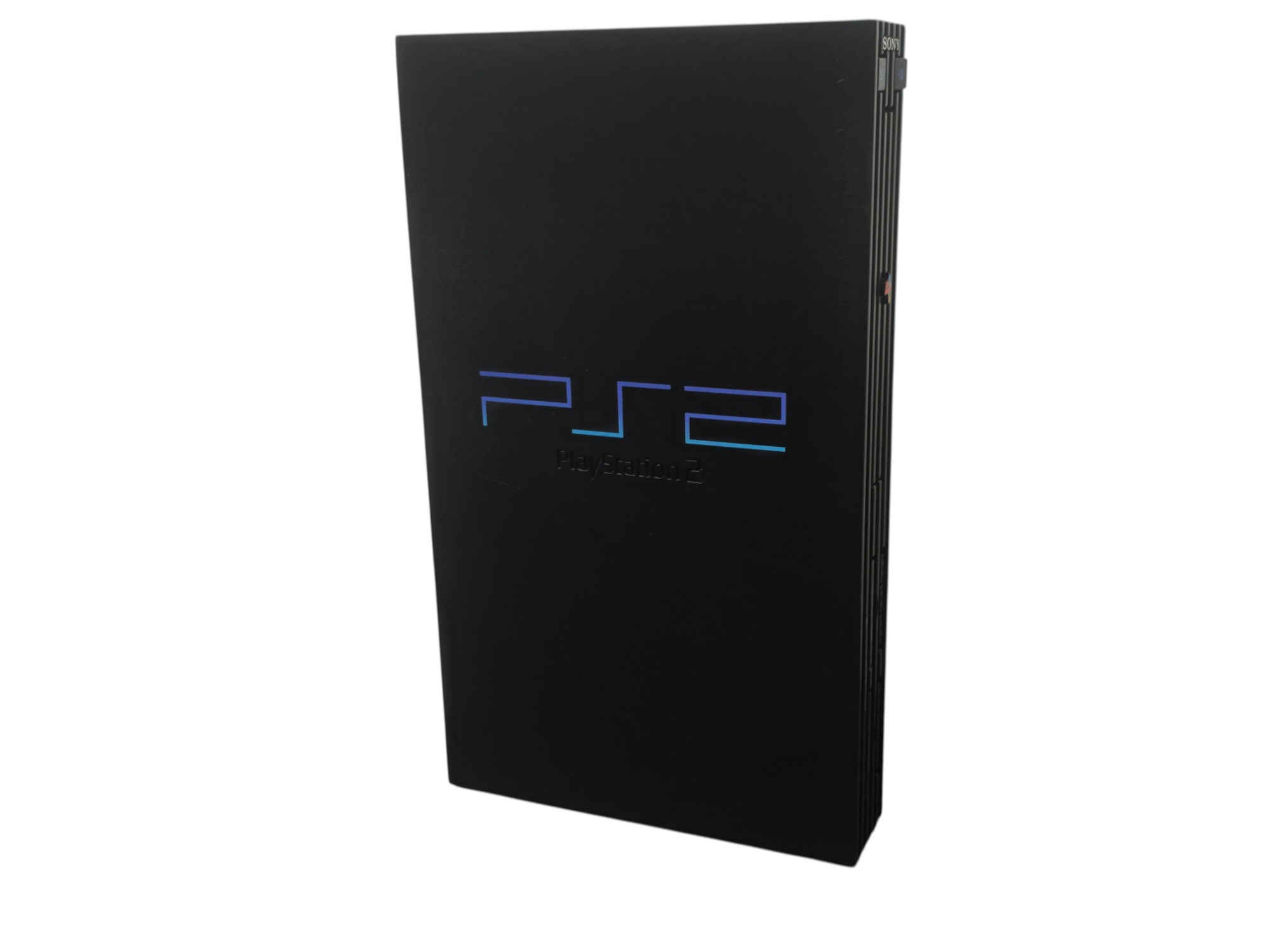
The Sony PlayStation 2 SCPH-30004 is an early European version of one of the most successful and influential home video game consoles ever created. Released as part of the original PlayStation 2 generation in 2000, it represented an extraordinary technological evolution from Sony’s first PlayStation, introducing advanced three-dimensional graphics, DVD-based gaming, DVD movie playback, and compatibility with much of the original PlayStation software library.
Featuring the iconic black vertical-ribbed enclosure, the SCPH-30004 belongs to the first generation of full-size PlayStation 2 consoles, commonly known today as the PS2 Fat.
Its advanced architecture combined the custom Emotion Engine processor, the Graphics Synthesizer, dedicated vector processing units, 32 MB of high-speed RDRAM, and a sophisticated 48-channel audio system.
With legendary games such as Grand Theft Auto: San Andreas, Metal Gear Solid 3: Snake Eater, Gran Turismo 4, God of War, Shadow of the Colossus, Final Fantasy X, Kingdom Hearts, and Silent Hill 2, the PlayStation 2 established an extraordinary legacy.
The console also introduced millions of households to DVD movie playback, expanding its appeal beyond traditional gaming.
The original European SCPH-30004 is especially significant because it represents the early development of the PlayStation 2 hardware platform, retaining connections such as i.LINK (IEEE 1394) and the rear Expansion Bay, which distinguished the first full-size models from later revisions.
Today, the PlayStation 2 remains a defining symbol of the sixth console generation and one of the most important products in the history of consumer electronics.
📘 Introduction
The Sony PlayStation 2 was launched in Japan on March 4, 2000, followed by North America on October 26, 2000, and Europe on November 24, 2000.
Developed by Sony Computer Entertainment, the PlayStation 2 succeeded the original PlayStation, which had revolutionised the gaming industry during the 1990s.
The PS2 arrived with ambitious objectives.
Sony wanted to create not only a powerful gaming console but also a multimedia entertainment system capable of becoming an essential part of the living room.
Its key features included:
- Emotion Engine processor
- Advanced vector processing hardware
- Graphics Synthesizer
- 32 MB main RDRAM
- 4 MB embedded graphics memory
- DVD-ROM optical drive
- DVD-Video playback
- Original PlayStation backward compatibility
- DualShock 2 controller
- USB connectivity
- Optical digital audio output
- Expandable storage
- Optional network connectivity
- Extensive software support
The result was a console with an exceptionally long commercial lifespan and one of the largest software libraries in gaming history.
The SCPH-30004 belongs to the early European PAL hardware family.
Its original full-size enclosure makes it particularly important for documenting the beginning of the PlayStation 2 generation.
🏭 Sony’s Journey from PlayStation to PlayStation 2
The development of the PlayStation 2 followed Sony’s remarkable success with the original PlayStation.
Sony entered the console market in December 1994, challenging established manufacturers Nintendo and Sega.
The first PlayStation established Sony as a major force in interactive entertainment.
The Original PlayStation (1994)
The original PlayStation introduced millions of consumers to:
- CD-ROM gaming
- Polygon-based three-dimensional graphics
- Cinematic storytelling
- Digitised soundtracks
- Memory Card storage
- Sophisticated racing and fighting games
Its success changed the gaming industry.
The Need for a Successor
By the late 1990s, three-dimensional gaming had become increasingly sophisticated.
Developers wanted hardware capable of supporting:
- Larger environments
- More detailed characters
- Advanced animation
- Complex physics
- Improved lighting
- Greater storage capacity
Sony responded with an ambitious new architecture.
The Emotion Engine Project
Sony collaborated with Toshiba on the development of important PlayStation 2 semiconductor technology.
The new console introduced specialised processing components intended to support advanced real-time graphics and animation.
Ken Kutaragi’s Vision
Ken Kutaragi, widely recognised as a central figure in PlayStation’s development, supported the idea of a console designed for more than conventional gaming.
The PlayStation 2 was intended to become a comprehensive digital entertainment platform.
A New Generation
When the PlayStation 2 launched in 2000, it represented a major advance in home entertainment technology.
It became the foundation for Sony’s continued dominance during much of the sixth console generation.
🖥️ The Iconic PS2 Fat Design
The original PlayStation 2 features one of the most recognisable designs in console history.
Its large black enclosure uses a series of horizontal ridges to create a distinctive architectural appearance.
Exterior Features
- Black plastic enclosure
- Horizontally ribbed design
- Front-loading disc tray
- Power/Reset button
- Eject button
- Two controller ports
- Two Memory Card slots
- Two USB connections
- Front i.LINK S400 connection
- Rear AV Multi Out
- Rear optical digital audio output
- Rear Expansion Bay
- Integrated AC power supply
- Rear main power switch
Vertical & Horizontal Operation
The PS2 can operate in either a vertical or horizontal position.
Sony also offered an optional vertical stand for additional stability.
The Rotating PlayStation Logo
One of the console’s most memorable design details is the rotating PlayStation logo on the disc tray.
The logo can be repositioned to match the console’s orientation.
An Architectural Appearance
The PS2’s dark finish and ribbed enclosure differ considerably from the lighter grey original PlayStation.
The design communicates a more sophisticated, premium consumer electronics identity.
A Recognisable Generation
The original Fat design became an icon of early-2000s gaming.
Its appearance remains closely associated with the enormous success of Sony’s second console generation.
🇪🇺 The European SCPH-30004 Revision
The SCPH-30004 identifies an early European-market PlayStation 2.
It belongs to Sony’s original full-size hardware family.
Understanding the Model Number
The SCPH prefix identifies Sony Computer Entertainment hardware.
The numerical portion identifies the PlayStation 2 model family and regional configuration.
The final digit 4 is associated with continental European distribution.
The PAL Configuration
The console was designed for European television and software standards.
Its original regional configuration supports PAL-oriented video output and region-specific commercial software.
An Early Hardware Model
The SCPH-30004 appeared during the early commercial period of the PlayStation 2.
This makes it historically interesting because it predates several significant internal revisions.
SCPH-30004 vs. SCPH-30004R
Sony later introduced revised European systems with an additional R designation.
The SCPH-30004R incorporated updated DVD playback software and other revision-dependent hardware differences.
The original SCPH-30004 should not automatically be identified as an R model.
Motherboard Revisions
Different motherboard designs were used within the broader SCPH-30004 family.
Early European configurations include boards such as:
- GH-006
- GH-007
Additional later revisions were also produced.
The exact board installed in an individual console must be confirmed through physical inspection.
Historical Importance
The SCPH-30004 represents the original European PlayStation 2 experience, before later refinements and the eventual introduction of the compact PS2 Slim.
⚙️ Technical Specifications
The PlayStation 2 uses a sophisticated architecture built around the Emotion Engine and Graphics Synthesizer.
Hardware Overview
- Manufacturer: Sony Computer Entertainment
- Console: PlayStation 2
- Model: SCPH-30004
- Design: Original Fat
- Region: PAL / Europe
- Colour: Black
- Japanese release: March 4, 2000
- North American release: October 26, 2000
- European release: November 24, 2000
- Generation: Sixth-generation home console
- Main CPU: Sony Emotion Engine
- CPU architecture: MIPS-based RISC with 128-bit vector capabilities
- CPU frequency: 294.912 MHz
- Vector processors: VU0 and VU1
- Graphics processor: Graphics Synthesizer
- GPU frequency: 147.456 MHz
- Embedded graphics memory: 4 MB eDRAM
- Main RAM: 32 MB Direct RDRAM
- Audio processor: SPU2
- Audio channels: 48 hardware voices
- Audio RAM: 2 MB
- I/O processor: PlayStation-derived MIPS architecture
- Optical drive: CD-ROM / DVD-ROM
- DVD-ROM speed: Up to 4×
- CD-ROM speed: Up to 24×
- Controller ports: Two
- Memory Card slots: Two
- Front USB ports: Two USB 1.1
- i.LINK connection: IEEE 1394 S400
- Video output: AV Multi Out
- Digital audio: Optical S/PDIF
- Storage expansion: Rear Expansion Bay
- Networking: Optional Ethernet adapter
- Power: 220–240V AC, 50/60 Hz
- Dimensions: Approximately 301 × 78 × 182 mm
- Weight: Approximately 2.2–2.4 kg, depending on revision
The original PlayStation 2 architecture is more complex than its processor clock speed suggests.
Its specialised processing units played an essential role in achieving its graphical capabilities.
🧠 Emotion Engine: The Heart of PlayStation 2
One of the PlayStation 2’s greatest innovations was its custom processor, known as the Emotion Engine.
Developed through Sony’s collaboration with Toshiba, the processor was designed specifically for advanced gaming and multimedia applications.
Processor Architecture
The Emotion Engine combines several processing components:
- MIPS-based main CPU
- Floating-point unit
- Vector Unit 0
- Vector Unit 1
- Data transfer controllers
- Memory interfaces
- Dedicated multimedia processing features
294.912 MHz Operation
The processor operates at approximately 294.912 MHz.
Although this frequency appears modest by modern standards, the architecture contains specialised components capable of performing large numbers of mathematical operations.
The Meaning of 128-Bit
Sony promoted the Emotion Engine as a 128-bit processor.
This description reflects its wide registers, multimedia instructions, and vector-processing capabilities.
It should not be interpreted as meaning that every part of the CPU is a conventional 128-bit general-purpose processing unit.
Processor Responsibilities
The Emotion Engine handles:
- Game logic
- Artificial intelligence
- Animation
- Physics simulation
- Geometric calculations
- Character movement
- System operations
- Multimedia processing
A Major Technological Advance
The Emotion Engine represented an ambitious attempt to design a processor specifically around the requirements of real-time entertainment.
Its architecture remains one of the most unusual and interesting designs in console history.
📐 Vector Units VU0 & VU1
The Emotion Engine includes two specialised vector processing units, commonly known as VU0 and VU1.
These are essential to understanding the PlayStation 2’s technical capabilities.
What Is Vector Processing?
Three-dimensional games require extensive mathematical calculations.
These involve:
- Coordinates
- Position
- Rotation
- Transformation
- Lighting
- Animation
- Geometry
Vector processing hardware can accelerate these operations.
Vector Unit 0
VU0 can assist with mathematical calculations and other operations involving the main processor.
Vector Unit 1
VU1 is particularly important for graphics-related processing.
It can calculate and prepare geometric information for the Graphics Synthesizer.
Parallel Processing
The ability to distribute operations across specialised units was an important advantage.
However, it also increased programming complexity.
Developer Challenges
To achieve maximum performance, developers needed to understand the relationships between the Emotion Engine, vector units, graphics hardware, and memory.
A Distinctive Architecture
The PlayStation 2 did not rely exclusively on a conventional graphics processor performing every stage of 3D rendering.
Its vector units played a central role in transforming game geometry.
This architecture contributed to the console’s unusual strengths and limitations.
🎨 Graphics Synthesizer: The PS2 Graphics Processor
The PlayStation 2 includes a dedicated graphics processor called the Graphics Synthesizer, commonly abbreviated to GS.
The Graphics Synthesizer operates at approximately 147.456 MHz.
Graphics Features
- Hardware-accelerated polygon rendering
- Textured graphics
- Gouraud shading
- Alpha blending
- Z-buffering
- Mipmapping support
- High-speed pixel processing
- Multiple display modes
- Embedded graphics memory
4 MB Embedded DRAM
One of the Graphics Synthesizer’s most unusual features is its 4 MB of embedded DRAM.
This memory is integrated closely with the graphics hardware.
High Internal Bandwidth
The embedded memory provides very high bandwidth for operations involving the framebuffer and other graphics data.
The Role of the Vector Units
The Emotion Engine’s vector units calculate much of the geometry that is subsequently rendered by the Graphics Synthesizer.
A Unique Rendering Architecture
The PS2 graphics pipeline differs from conventional modern PC graphics systems.
Its processing resources were carefully designed to support the complex needs of real-time 3D games.
Technological Achievement
The Graphics Synthesizer allowed the PS2 to produce highly detailed environments, large numbers of polygons, and sophisticated visual effects.
Its capabilities helped define the visual identity of sixth-generation console gaming.
💾 32 MB RDRAM & the PS2 Memory Architecture
The PlayStation 2 includes 32 MB of Direct Rambus DRAM, commonly known as RDRAM.
At the time of the console’s introduction, this was a sophisticated high-speed memory technology.
Main RAM
The main memory stores:
- Game code
- Geometry
- Character data
- Animation information
- Physics calculations
- Audio-related information
- Temporary processing data
RDRAM Technology
Rambus memory was designed to provide high data transfer rates.
The PS2’s memory interface delivered approximately 3.2 GB/s of theoretical bandwidth.
Dedicated Graphics Memory
The Graphics Synthesizer includes an additional 4 MB of embedded DRAM.
Dedicated Sound Memory
The SPU2 audio hardware also has 2 MB of dedicated sound RAM.
Why Memory Management Mattered
Despite its advanced architecture, the PS2 had relatively limited memory by modern standards.
Developers frequently used careful optimisation and streaming techniques.
A Remarkable Result
The console’s best games demonstrate how sophisticated environments and animation could be created within these restrictions.
💿 DVD-ROM: A Major Revolution in Console Storage
One of the PlayStation 2’s greatest commercial advantages was its built-in DVD-ROM drive.
The original PlayStation used CD-ROMs.
The PS2 introduced DVD-based gaming while retaining compatibility with supported CD formats.
DVD Capacity
A standard single-layer DVD can store approximately 4.7 GB.
Dual-layer DVD technology provides approximately 8.5 GB.
This represented a substantial improvement over conventional CDs.
Larger Games
DVD storage allowed developers to include:
- Larger game environments
- High-quality cinematics
- More voice acting
- Detailed textures
- Additional music
- Extensive gameplay content
Different PS2 Disc Formats
PlayStation 2 games appeared on different types of physical media.
These included:
- CD-ROM
- Single-layer DVD-ROM
- Dual-layer DVD-ROM
Blue-Bottom Discs
Some PlayStation 2 CD-based games are recognisable by their blue recording-side appearance.
Silver DVD Discs
Most PS2 DVD games have a more conventional silver reflective appearance.
Dual-Layer Games
Certain large productions used dual-layer DVD technology.
Examples include Gran Turismo 4 and God of War.
A Defining Format
DVD-ROM technology helped make the PlayStation 2 capable of supporting much larger and more complex games than the original PlayStation.
🎬 DVD Movie Playback: A Console and Home Theatre System
The PlayStation 2 was not simply a gaming console.
It also functioned as a DVD movie player.
During 2000, DVD players were becoming increasingly popular but were still relatively expensive consumer electronics products.
A Major Selling Point
The PS2 offered:
- Video game playback
- DVD movie playback
- Audio CD playback
- Digital sound output
- Compatibility with contemporary televisions
DVD Region Codes
The European SCPH-30004 is designed for the European DVD region system.
For DVD movies, this normally means Region 2.
DVD movie region restrictions are separate from PlayStation game-region restrictions.
DVD Controls
Users could control movie playback through the gamepad.
Sony also introduced dedicated DVD remote-control accessories.
The Early SCPH-30004
Early European PS2 models do not have the later built-in infrared receiver found on some revised consoles.
DVD remote operation may require an appropriate external IR receiver and compatible DVD player software.
A Multimedia Revolution
For many households, the PlayStation 2 provided their first practical opportunity to watch DVD movies.
This helped expand the console’s appeal far beyond traditional gamers.
Historical Importance
The success of DVD playback demonstrated how a video game console could become a central household entertainment device.
🔄 Backward Compatibility with the Original PlayStation
One of the PlayStation 2’s most important features was its compatibility with original PlayStation games.
This created a direct connection between Sony’s first two console generations.
Supported Software
The PS2 can run most original PlayStation games from the appropriate region.
A Large Existing Library
At launch, consumers could already access many established PlayStation franchises, including:
- Crash Bandicoot
- Spyro the Dragon
- Tekken
- Gran Turismo
- Final Fantasy
- Resident Evil
- Tomb Raider
- Metal Gear Solid
How Backward Compatibility Works
The PlayStation 2 includes hardware related to the original PlayStation architecture.
Its I/O processor also plays a role in compatibility with earlier software.
Not Universal Compatibility
Some original PlayStation games can experience compatibility issues on certain PS2 revisions.
Original PlayStation Memory Cards
Original PlayStation games require appropriate PlayStation-compatible save storage.
A standard PS2 8 MB Memory Card is not normally used directly to save progress inside PS1 games.
The Importance of Compatibility
Backward compatibility reduced the inconvenience of moving to a new console generation.
It allowed existing PlayStation owners to continue using much of their established software library.
A Major Competitive Advantage
The feature contributed significantly to the PS2’s popularity.
It demonstrated Sony’s commitment to maintaining continuity across its gaming ecosystem.
🕹️ The DualShock 2 Controller
The DualShock 2 became one of the most recognisable controllers of the sixth console generation.
It retained the familiar appearance of the original PlayStation DualShock while introducing important technical improvements.
Controller Features
- Two analogue sticks
- Directional pad
- Triangle, Circle, Cross, and Square buttons
- L1 and R1 shoulder buttons
- L2 and R2 buttons
- Start and Select buttons
- Analogue mode button
- Vibration feedback
- Pressure-sensitive controls
Pressure-Sensitive Buttons
One of the DualShock 2’s most important innovations is its pressure-sensitive button system.
Many buttons can detect different levels of pressure.
Gameplay Applications
Compatible games can use pressure-sensitive input for:
- Vehicle acceleration
- Braking
- Character movement
- Weapon control
- Variable actions
Vibration Feedback
The controller includes motors that produce physical vibration.
This can simulate impacts, explosions, and environmental effects.
A Familiar Design
The DualShock 2 preserved Sony’s established controller layout.
This helped existing PlayStation users adapt easily to the new console.
A Lasting Legacy
The controller influenced later PlayStation hardware and remains one of the most recognisable input devices in gaming history.
💾 The 8 MB PlayStation 2 Memory Card
The PlayStation 2 introduced a new official Memory Card format.
The standard Sony PS2 Memory Card provides 8 MB of storage.
Memory Card Features
- 8 MB flash memory
- Removable design
- Non-volatile data storage
- MagicGate authentication
- Compatibility with supported PS2 software
- File management through the system Browser
MagicGate
MagicGate is Sony’s proprietary authentication and content-protection technology.
It forms part of the official PS2 Memory Card system.
Saving Games
Memory Cards store information such as:
- Game progress
- Player profiles
- Configuration files
- Character information
- Race records
- Mission progress
Two Memory Card Slots
The SCPH-30004 includes two front Memory Card slots.
These allow players to manage multiple storage devices.
Browser Management
The PlayStation 2 includes a built-in interface for examining and managing Memory Card contents.
PS1 vs. PS2 Saves
Although the PS2 supports original PlayStation games, PS1 and PS2 game saves use different formats.
The appropriate Memory Card type is required for normal saving.
Preservation Value
Original Memory Cards are important historical accessories.
They can preserve evidence of gameplay, player activity, and software use from the period.
🔌 USB 1.1 & i.LINK Connectivity
The early PlayStation 2 includes several connections that were uncommon on earlier game consoles.
USB Ports
The SCPH-30004 includes two front USB 1.1 connectors.
These provide connectivity for supported accessories.
USB Applications
Compatible peripherals include:
- EyeToy camera
- Microphones
- Keyboards
- Selected input devices
- Specialised gaming accessories
The i.LINK Port
The original PS2 also includes an S400 i.LINK connection.
This is Sony’s designation for an IEEE 1394 interface.
The same general technology is commonly known as FireWire.
Multiplayer Communication
Selected games used i.LINK to connect compatible PlayStation 2 systems.
This allowed multiplayer experiences across multiple consoles and displays.
A Distinctive Early Feature
The i.LINK port was removed from later PS2 hardware revisions.
Its presence is therefore an important identifying characteristic of early full-size models.
Historical Importance
These connections demonstrate Sony’s attempt to create a more flexible multimedia platform.
The PS2 was designed to support more than conventional gamepads and Memory Cards.
💽 The Rear Expansion Bay & Hard Drive Support
One of the most important features of the original PS2 Fat design is its rear Expansion Bay.
This compartment was designed to accommodate expansion hardware.
The Expansion Bay
The compartment is located on the rear of the console.
It allows compatible internal storage and networking accessories to be installed.
Hard Disk Drive
Sony developed official hard-drive solutions for selected PS2 applications and markets.
The original Fat console can accommodate a compatible 3.5-inch hard drive through the appropriate network/drive interface hardware.
Network Adapter
The Expansion Bay also supports the official PlayStation 2 Network Adapter for compatible models.
Important Distinction
The SCPH-30004 does not include built-in Ethernet networking as a standard feature.
Network connectivity requires an appropriate external adapter.
The Role of Storage
Hard-drive functionality was used by selected official software and later became important for independent development and preservation projects.
A Major Advantage of the Fat Design
The Expansion Bay distinguishes original full-size PS2 systems from the later compact Slim family.
It remains one of the most important features for hardware collectors and enthusiasts.
🌐 PlayStation 2 Online Gaming
Although the PS2 did not launch with integrated online services comparable to those of modern consoles, Sony gradually introduced network gaming capabilities.
The Network Adapter
A suitable network adapter provides Ethernet connectivity.
Some regional adapters also included dial-up modem capabilities, depending on the model.
Online Multiplayer
Compatible PS2 games supported internet-based multiplayer.
Notable Online Games
- SOCOM U.S. Navy SEALs
- SOCOM II U.S. Navy SEALs
- Final Fantasy XI
- Resident Evil Outbreak
- Monster Hunter
- Twisted Metal: Black Online
- Battlefield 2: Modern Combat
A Different Online Strategy
Unlike Microsoft’s later Xbox Live ecosystem, PS2 online services were often operated by individual publishers or developers.
The Limitations
Online features depended on:
- Compatible software
- Network hardware
- Internet connection
- Regional availability
- Publisher-operated servers
The End of Official Services
Most original PS2 online services have been discontinued.
Some games remain accessible through community-developed replacement services.
A Historic Transition
PS2 online gaming represents an important step between traditional offline console entertainment and the more integrated online ecosystems introduced in later generations.
🎵 SPU2: The PlayStation 2 Audio System
The PlayStation 2 includes an advanced sound processor called SPU2.
This system builds upon the audio capabilities of Sony’s first PlayStation.
Audio Features
- 48 hardware audio voices
- 2 MB dedicated sound memory
- Sample-based audio playback
- Digital effects
- Stereo sound
- Multichannel audio support
- Digital optical output
Audio Processing
The SPU2 can mix multiple digital sound sources.
This allows developers to create detailed and dynamic audio environments.
Music & Sound Effects
PS2 games feature a wide variety of audio techniques, including:
- Recorded dialogue
- Orchestral music
- Environmental sounds
- Vehicle effects
- Combat sounds
- Cinematic soundtracks
Optical Digital Audio
The rear optical output provides digital audio connectivity to compatible receivers.
A Major Multimedia Feature
The PS2’s audio capabilities contributed to its identity as both a gaming console and home entertainment system.
Memorable Soundtracks
The platform became home to celebrated music from games including Final Fantasy X, Shadow of the Colossus, Kingdom Hearts, Silent Hill 2, and Metal Gear Solid 3.
🎮 The PlayStation 2 Games Library
The PlayStation 2 developed one of the largest and most varied software libraries in gaming history.
Its catalogue includes action games, racing simulations, role-playing games, platformers, fighting games, survival horror, sports titles, and experimental entertainment software.
Notable PlayStation 2 Games
- Grand Theft Auto III
- Grand Theft Auto: Vice City
- Grand Theft Auto: San Andreas
- Gran Turismo 3: A-Spec
- Gran Turismo 4
- Metal Gear Solid 2: Sons of Liberty
- Metal Gear Solid 3: Snake Eater
- God of War
- God of War II
- Shadow of the Colossus
- ICO
- Final Fantasy X
- Final Fantasy X-2
- Final Fantasy XII
- Kingdom Hearts
- Kingdom Hearts II
- Silent Hill 2
- Silent Hill 3
- Resident Evil 4
- Resident Evil – Code: Veronica X
- Devil May Cry
- Devil May Cry 3: Dante’s Awakening
- Ratchet & Clank
- Ratchet & Clank: Going Commando
- Ratchet & Clank: Up Your Arsenal
- Jak and Daxter: The Precursor Legacy
- Jak II
- Jak 3
- Sly Cooper and the Thievius Raccoonus
- Sly 2: Band of Thieves
- Burnout 3: Takedown
- Burnout Revenge
- Need for Speed: Underground
- Need for Speed: Underground 2
- Need for Speed: Most Wanted
- Tekken 5
- Virtua Fighter 4: Evolution
- Soulcalibur II
- Soulcalibur III
- Okami
- Persona 3
- Persona 4
- Dragon Quest VIII
- Bully
- Black
- TimeSplitters 2
- TimeSplitters: Future Perfect
- Prince of Persia: The Sands of Time
- Beyond Good & Evil
- Guitar Hero
- Guitar Hero II
- SingStar
- EyeToy: Play
- Buzz! The Music Quiz
The PlayStation 2’s extraordinary software variety was one of the main reasons for its commercial dominance.
🚗 Grand Theft Auto: San Andreas
Released in 2004, Grand Theft Auto: San Andreas became one of the most influential games of the PS2 generation.
Developed by Rockstar North, it introduced a large open-world environment inspired by parts of California and Nevada.
Gameplay Features
- Open-world exploration
- Vehicles
- Story-driven missions
- Character customisation
- Combat
- Side activities
- Extensive environments
A Huge Game World
The game featured multiple major cities and surrounding countryside.
Technical Ambition
Its large world required extensive optimisation of the PS2’s memory and streaming capabilities.
A Cultural Phenomenon
San Andreas became one of the best-known games of the 2000s.
It also became one of the best-selling titles on the PlayStation 2.
Historical Importance
The game helped establish the modern open-world action genre.
🏎️ Gran Turismo 4: The Real Driving Simulator
Released in Japan in 2004 and Europe in 2005, Gran Turismo 4 became one of the PS2’s greatest technological showcases.
Developed by Polyphony Digital, it expanded the realistic driving formula established by earlier Gran Turismo games.
Gameplay Features
- Hundreds of licensed vehicles
- Detailed racing circuits
- Driving physics
- Vehicle tuning
- Career progression
- Licence tests
- Photo Mode
- Endurance racing
Sophisticated Graphics
Gran Turismo 4 demonstrated the capabilities of the Emotion Engine and Graphics Synthesizer.
High-Resolution Output
Certain regional versions of Gran Turismo 4 supported advanced video modes, including 1080i in the North American release.
Available display modes vary by regional edition.
A Landmark Racing Game
Gran Turismo 4 became one of the defining driving simulations of the sixth generation.
A PlayStation Identity
The Gran Turismo franchise remained one of Sony’s most important gaming properties throughout the PS2 era.
🪖 Metal Gear Solid 3: Snake Eater
Released in 2004, Metal Gear Solid 3: Snake Eater became one of the most celebrated stealth action games ever produced.
Directed by Hideo Kojima and developed by Konami, it introduced a Cold War-era storyline.
Gameplay Features
- Stealth gameplay
- Jungle environments
- Camouflage
- Survival mechanics
- Close-quarters combat
- Cinematic storytelling
- Complex character relationships
A Technical Achievement
The game featured detailed vegetation, animation, and cinematic presentation.
The Importance of Atmosphere
Music, voice acting, and environmental sound contributed to the immersive experience.
Historical Significance
Snake Eater remains one of the most important games associated with the PlayStation 2.
It demonstrates how sophisticated storytelling and technically ambitious gameplay could be achieved on the console.
⚔️ God of War: Mythology & Cinematic Action
Released in 2005, God of War became one of Sony’s most important new franchises.
Developed by Santa Monica Studio, it introduced Kratos and a brutal action-adventure experience inspired by Greek mythology.
Gameplay Features
- Fast-paced combat
- Large boss encounters
- Environmental puzzles
- Cinematic presentation
- Mythological settings
- Character progression
A Technical Showcase
The game used the PS2’s capabilities to present large-scale action scenes and elaborate environments.
God of War II
Released in 2007, God of War II continued the franchise and became one of the most technically impressive late-generation PS2 games.
The Greek Connection
The use of Greek mythology gave the games a distinctive cultural setting.
A Major PlayStation Franchise
God of War became one of Sony’s most successful gaming properties and continued across later console generations.
🗿 Shadow of the Colossus: Art as Interactive Entertainment
Released in 2005, Shadow of the Colossus became one of the most artistically influential PlayStation 2 games.
Developed by Team Ico, the game follows a young protagonist travelling through a mysterious land.
Gameplay Features
- Large explorable environments
- Enormous creatures
- Puzzle-based combat
- Atmospheric storytelling
- Minimalist presentation
- Distinctive animation
A Different Game Design Philosophy
Rather than filling its world with large numbers of enemies, the game concentrates on encounters with gigantic colossi.
Technical Ambition
The game’s creatures and environments pushed the PlayStation 2 hardware in unusual ways.
A Lasting Influence
Shadow of the Colossus became an important reference point in discussions of video games as an artistic medium.
Historical Importance
It demonstrated that large-scale technical achievement could be combined with minimalist storytelling and emotional atmosphere.
🌌 Final Fantasy X: A New RPG Generation
Released in Japan in 2001 and Europe in 2002, Final Fantasy X represented a major evolution of the famous role-playing franchise.
Developed by Square, it introduced fully three-dimensional environments and extensive voice acting.
Gameplay Features
- Story-driven adventure
- Turn-based combat
- Character development
- Cinematic sequences
- Voice dialogue
- Detailed fantasy world
The World of Spira
The game introduced a distinctive setting with elaborate mythology and memorable characters.
Voice Acting
Final Fantasy X was the first mainline Final Fantasy title to make extensive use of spoken dialogue.
A Major Technical Leap
The DVD format and advanced PS2 hardware allowed a much more cinematic presentation.
An Important RPG
Final Fantasy X remains one of the most celebrated role-playing games of the early 2000s.
🌈 Kingdom Hearts: Disney Meets Final Fantasy
Released in 2002, Kingdom Hearts became one of the most recognisable new franchises of the PlayStation 2 generation.
Developed by Square, it combined original characters with characters and worlds from Disney properties and Final Fantasy.
Gameplay Features
- Real-time action combat
- Fantasy exploration
- Character interaction
- Story-driven missions
- Equipment upgrades
- Large themed environments
An Unusual Collaboration
The game brought together two major entertainment worlds.
Strong Commercial Appeal
Kingdom Hearts attracted both traditional RPG enthusiasts and broader audiences familiar with Disney characters.
A Lasting Franchise
Its success led to multiple sequels and related games.
The franchise became closely associated with the PlayStation 2 era.
🧟 Silent Hill 2: Psychological Horror
Released in 2001, Silent Hill 2 became one of the most influential psychological horror games ever created.
Developed by Konami’s Team Silent, it combined atmospheric environments with a complex psychological narrative.
Gameplay Features
- Exploration
- Environmental puzzles
- Survival horror
- Symbolic storytelling
- Psychological tension
- Atmospheric music
The Importance of Sound
Akira Yamaoka’s music and sound design contributed greatly to the game’s atmosphere.
A Mature Narrative
Silent Hill 2 demonstrated how video games could explore complex emotional themes.
Technical Presentation
Fog, lighting, animation, and environmental design helped create a uniquely disturbing atmosphere.
Historical Importance
The game remains one of the most critically recognised titles of the sixth console generation.
📷 EyeToy: Camera-Based Gaming
One of the PlayStation 2’s most innovative accessories was the EyeToy camera.
Introduced in 2003, it provided a new form of interaction based on the player’s movements.
The EyeToy Concept
The camera connects through USB.
Compatible games analyse the image to detect movement and interaction.
EyeToy: Play
EyeToy: Play introduced a series of interactive activities.
Players could participate using body movement rather than a traditional controller.
A New Audience
The camera helped attract families and casual players.
Historical Importance
EyeToy anticipated later camera-based and motion-controlled gaming systems.
These included products such as Kinect and other interactive motion accessories.
The Early SCPH-30004
The original Fat PS2 supports suitable USB accessories, including compatible EyeToy cameras.
This demonstrates the flexibility of the platform’s expansion capabilities.
🎤 SingStar, Buzz! & Social Gaming
The PlayStation 2 became famous not only for traditional games but also for social entertainment experiences.
SingStar
SingStar introduced karaoke-style gameplay using microphones.
Players could perform songs while the game evaluated their vocal pitch and timing.
Buzz!
The Buzz! series used specialised buzzer controllers.
It brought television quiz-show gameplay into the home.
A Different Gaming Audience
These games attracted players who were less interested in conventional action or adventure titles.
The Importance of Accessories
Specialised microphones and controllers created different forms of interaction.
Historical Impact
The success of these games helped establish party entertainment as an important category within console gaming.
The PS2 became a platform for family gatherings, parties, and social gaming sessions.
🌐 The PlayStation 2 Linux Kit
One of the most unusual aspects of the PS2’s history was Sony’s support for a Linux-based development environment.
The Linux for PlayStation 2 project allowed compatible consoles to be used for software development and experimentation.
The Concept
Sony offered an official Linux kit in selected markets.
It provided tools and accessories intended to turn the PS2 into a programmable computing environment.
Typical Components
Depending on the regional package, the kit included:
- Linux software
- Hard disk drive
- Network Adapter
- VGA-related connectivity equipment
- Development documentation
Additional compatible input devices and a suitable display were required.
Programming the PS2
The Linux environment allowed enthusiasts to explore:
- C and C++ development
- Graphics programming
- Linux operation
- System architecture
- Experimental applications
A Console as a Computer
The project demonstrated the flexibility of the PS2 hardware beyond commercial video games.
Historical Importance
The Linux kit remains one of the most interesting official examples of a console manufacturer supporting general-purpose software development on consumer gaming hardware.
🔄 PlayStation 2 Fat vs. PlayStation 2 Slim
Sony introduced the redesigned PlayStation 2 Slim in 2004.
The new model significantly reduced the physical size of the console.
PlayStation 2 Fat
- Introduced in 2000
- Large black enclosure
- Integrated AC power supply
- Front-loading disc tray
- Rear Expansion Bay
- Optional network adapter
- i.LINK on early revisions
- Two controller ports
- Two Memory Card slots
PlayStation 2 Slim
- Introduced in 2004
- Much smaller enclosure
- Top-loading disc lid
- Integrated Ethernet on most retail revisions
- No conventional Fat Expansion Bay
- Revised internal hardware
- Reduced power consumption
- Different power arrangement depending on revision
The Most Important Differences
The Slim improved portability and reduced manufacturing costs.
However, it removed some features of the original Fat design.
The Expansion Bay Advantage
The original Fat console remains attractive to enthusiasts because of its internal hard-drive expansion options.
The Historical Importance of the Fat
The SCPH-30004 represents the original PS2 design philosophy.
It preserves the full-size hardware architecture introduced during the system’s earliest European commercial period.
🥊 PlayStation 2 vs. Dreamcast vs. GameCube vs. Xbox
The sixth console generation featured competition between four major platforms.
Sony PlayStation 2 (2000)
- Emotion Engine processor
- Graphics Synthesizer
- DVD-ROM media
- PlayStation backward compatibility
- Extensive software library
- DVD movie playback
Sega Dreamcast (1998)
- Hitachi SH-4 processor
- PowerVR2 graphics
- GD-ROM media
- Built-in modem
- Visual Memory Unit
- Arcade-oriented software library
Nintendo GameCube (2001)
- IBM PowerPC-based processor
- ATI-designed graphics processor
- Proprietary optical discs
- Four controller ports
- Strong Nintendo first-party software
Microsoft Xbox (2001)
- Intel-derived processor
- NVIDIA graphics
- Built-in hard drive
- Ethernet networking
- DVD-ROM games
- Xbox Live support
Different Strategies
Sony emphasised software variety, multimedia entertainment, and backward compatibility.
Sega introduced early online gaming and sophisticated arcade-related technology.
Nintendo concentrated on efficient hardware and distinctive first-party games.
Microsoft approached gaming through powerful PC-related hardware and networking.
The Commercial Result
The PlayStation 2 became the dominant console of the generation.
Its massive software catalogue, DVD capabilities, and strong international distribution contributed to its success.
🌍 Worldwide Sales & Cultural Impact
The PlayStation 2 became the best-selling home gaming console of its generation and one of the most successful consumer electronics products in history.
Sony’s updated historical figures report over 160 million PlayStation 2 consoles sold worldwide.
A Global Success
The console achieved enormous popularity across:
- Japan
- North America
- Europe
- Australia
- Other international markets
An Extraordinary Software Library
The PS2 received thousands of games during its commercial lifespan.
Its catalogue included both major international franchises and numerous region-specific releases.
Reasons for Success
- Backward compatibility
- DVD playback
- Large software library
- Strong PlayStation brand
- Competitive pricing over time
- Wide third-party developer support
- Extended commercial lifespan
- Broad regional availability
A Long Commercial Life
Sony continued producing PlayStation 2 hardware until 2013.
This allowed the platform to remain relevant long after newer consoles had appeared.
A Cultural Landmark
The PS2 became closely associated with the gaming culture of the early 2000s.
For many consumers, it was both their primary video game system and their first DVD player.
🇬🇷 The PlayStation 2 in Greece
The PlayStation 2 became one of the most recognisable gaming products in Greece during the early and mid-2000s.
The original PlayStation had already established a strong audience in the Greek market.
The PS2 continued this success.
Popular Gaming Genres
Greek players enjoyed:
- Football games
- Racing simulations
- Open-world adventures
- Fighting games
- Action games
- Role-playing games
- Party games
Particularly Familiar Franchises
- Pro Evolution Soccer
- FIFA
- Gran Turismo
- Grand Theft Auto
- Tekken
- God of War
- Metal Gear Solid
- Need for Speed
- Final Fantasy
A Home Entertainment Device
The ability to watch DVDs added considerable value.
During the early 2000s, DVD movie collections were becoming increasingly popular.
The European PAL Experience
The SCPH-30004 is an important example of the early European PlayStation 2 hardware generation.
It represents the original console experience available to consumers in markets such as Greece.
An Essential Museum Exhibit
For a technology museum, the PS2 demonstrates the transition towards integrated multimedia entertainment.
It connects traditional gaming hardware with technologies that would become standard in later generations.
🔧 Maintenance & Long-Term Reliability
The original PlayStation 2 is now a vintage electronic system.
After more than two decades, several components may require maintenance.
Common Maintenance Areas
- Optical pickup
- Disc tray mechanism
- Spindle motor
- Cooling fan
- Power supply
- Motherboard capacitors
- Controller ports
- Memory Card slots
- AV Multi Out
- Optical audio connector
- USB ports
- i.LINK connector
- Expansion Bay
- Clock backup battery
Disc Reading Problems
One of the most common problems involves the optical drive.
Symptoms include:
- Failure to recognise discs
- Slow loading
- DVD read errors
- CD read errors
- Disc Read Error messages
- Intermittent operation
CD vs. DVD Reading
The optical assembly uses different laser wavelengths and operating conditions for CDs and DVDs.
Consequently, a failing drive may read one format while struggling with the other.
The Disc Tray
The original Fat model uses a motorised disc tray.
Mechanical wear can cause difficulty opening or closing.
Cooling System
Dust accumulation can reduce airflow.
The fan and ventilation openings should be inspected.
Power Supply Safety
The SCPH-30004 includes an internal mains power supply.
Its internal components can contain hazardous voltages even after disconnection.
Electrical servicing should be performed by a qualified technician.
🛠️ Modern Restoration & Storage Solutions
The original PlayStation 2 remains extremely popular among preservation enthusiasts.
Modern hardware and software projects can help maintain or extend its capabilities.
Common Restoration Projects
- Optical drive repair
- Laser replacement
- Tray mechanism servicing
- Cooling fan maintenance
- Clock battery replacement
- Capacitor inspection
- Controller port cleaning
- Memory Card connector repair
- Power supply servicing
Hard Drive Storage
The Fat PS2’s Expansion Bay allows compatible internal storage solutions.
With suitable hardware and software, enthusiasts can access supported game data through internal storage.
Homebrew Software
The PS2 has an extensive homebrew community.
Independent projects explore:
- System utilities
- Memory Card tools
- File management
- Hardware testing
- Game preservation
- Multimedia applications
Modern Video Solutions
The console’s analogue outputs can be connected to modern displays through suitable converters and scalers.
Preserving Original Hardware
For museum purposes, original components should be retained whenever practical.
Any repairs or modifications should be documented.
The Importance of Compatibility
Different PS2 revisions have different repair and expansion requirements.
The exact motherboard should be confirmed before selecting internal replacement components.
🔍 SCPH-30004 Motherboard Identification
The SCPH-30004 belongs to Sony’s early European PS2 hardware family.
However, several internal revisions exist.
Early European Boards
Documented examples include:
- GH-006
- GH-007
Later production may use other boards, including GH-010-related configurations.
Why Different Boards Exist
Sony continuously revised its hardware to improve:
- Manufacturing efficiency
- Component integration
- Reliability
- Power distribution
- Optical drive control
- Production costs
C & C’ Chassis
The earliest European launch hardware is associated with C and C’ chassis configurations.
These used multi-board internal arrangements.
Later Hardware
Sony gradually simplified the internal layout.
Important Identification Details
The exact revision can be investigated through:
- Internal GH motherboard code
- Chassis configuration
- Number and arrangement of enclosure screws
- Optical drive type
- Internal component markings
Serial Number Limitations
The serial number identifies an individual console.
However, it should not be used alone to assign a specific motherboard revision or manufacturing date without reliable supporting documentation.
Museum Preservation
Accurate motherboard identification is especially valuable for early PlayStation 2 hardware.
It helps distinguish original launch-era electronics from later manufacturing revisions.
🏛️ Collectability & Historical Preservation
The SCPH-30004 is an important collectible because it represents an early European version of the original PlayStation 2.
Its full-size enclosure, i.LINK connection, and Expansion Bay make it historically distinctive.
Important Collecting Factors
- Original Sony PlayStation 2 SCPH-30004
- Black factory enclosure
- Original manufacturer identification label
- Functional DVD-ROM drive
- Working disc tray
- Original AV Multi Out
- Optical digital audio connection
- Front USB ports
- i.LINK connection
- Rear Expansion Bay
- Original DualShock 2 controller, if present
- Original 8 MB Memory Card, if present
- Correct power cable
- Original packaging
- Instruction manual
- Original game discs
The Importance of Originality
Collectors often examine:
- Enclosure condition
- Disc tray operation
- Optical drive functionality
- Controller connections
- Manufacturer labels
- Motherboard revision
- Signs of previous repairs
- Expansion Bay cover
- Original accessories
Original Hardware vs. Replacement Parts
A restored console may contain replacement optical drives or other components.
These can improve functionality but should be documented.
The Early European Model
The SCPH-30004 is particularly useful for demonstrating the PlayStation 2’s original European hardware design.
Preserving the Disc Format
Original CD-ROM and DVD-ROM game discs are important physical artefacts.
Their packaging and regional markings document the history of software distribution.
A Landmark Console
The PS2 provides a foundation for explaining:
- 128-bit multimedia processing
- Vector-based geometry calculations
- DVD storage
- Backward compatibility
- Digital audio
- Early online gaming
- Memory Card technology
- Expandable console hardware
⭐ Why the PlayStation 2 SCPH-30004 Still Matters
The Sony PlayStation 2 SCPH-30004 remains historically significant for numerous reasons:
- It belongs to the earliest European PS2 hardware generation
- It introduced the Emotion Engine architecture to European consumers
- It features specialised vector processing hardware
- It uses the Graphics Synthesizer with embedded DRAM
- It supports DVD-based gaming
- It introduced DVD movie playback to many households
- It maintains compatibility with much of the original PlayStation library
- It includes the influential DualShock 2 controller system
- It supports USB and i.LINK connectivity
- It features the expandable Fat chassis
- It helped establish online gaming and multimedia accessories
- It supports one of the largest game libraries in history
- It represents the foundation of Sony’s sixth-generation gaming success
A Multimedia Revolution
The PS2 helped establish the idea that a gaming console could serve as a complete entertainment system.
A Technological Achievement
Its architecture remains an important example of specialised processing technology.
An Extraordinary Software Legacy
The PS2 library includes many of the most influential games ever created.
A Defining Gaming Generation
The original black PlayStation 2 became a symbol of gaming during the early 2000s.
A Lasting Cultural Impact
The PS2 introduced millions of consumers to experiences that shaped modern entertainment.
📦 Items Included in This Collection Entry
- Sony PlayStation 2 SCPH-30004 home video game console unit — Original Black / PAL European edition
Original PlayStation 2 platform release: 2000
European launch: November 24, 2000
Model: SCPH-30004
Regional configuration: PAL / Europe
Original enclosure: Full-size Black
Motherboard revision: Not yet verified
🏁 Conclusion
The Sony PlayStation 2 SCPH-30004 represents one of the most important milestones in the history of home video gaming and consumer electronics.
Introduced as part of the original European PlayStation 2 generation in 2000, it brought together advanced 3D processing, sophisticated digital audio, DVD-based games, DVD movie playback, and backward compatibility with much of the original PlayStation library.
Its Emotion Engine processor, specialised vector units, and Graphics Synthesizer created a distinctive architecture that enabled developers to produce increasingly complex and visually impressive games.
The console became home to legendary titles such as Grand Theft Auto: San Andreas, Metal Gear Solid 3, Gran Turismo 4, God of War, Shadow of the Colossus, Final Fantasy X, Kingdom Hearts, and Silent Hill 2.
The PlayStation 2 also changed the relationship between video games and household entertainment.
Its integrated DVD player helped make the console attractive to a much broader consumer audience.
The original SCPH-30004 is especially interesting because it retains features associated with early full-size European PS2 systems, including i.LINK connectivity and the rear Expansion Bay.
These characteristics demonstrate Sony’s original ambition to develop an expandable multimedia entertainment platform.
With more than 160 million units sold worldwide across the PlayStation 2 family, the console became one of the most commercially successful entertainment systems ever produced.
Its extraordinary software library, long commercial lifespan, and influential architecture secured its place in gaming history.
Today, the original black PlayStation 2 remains one of the most recognisable consoles of all time.
A sixth-generation gaming legend, a pioneer of DVD-based home entertainment, and one of the most influential consoles in the history of interactive technology.
