

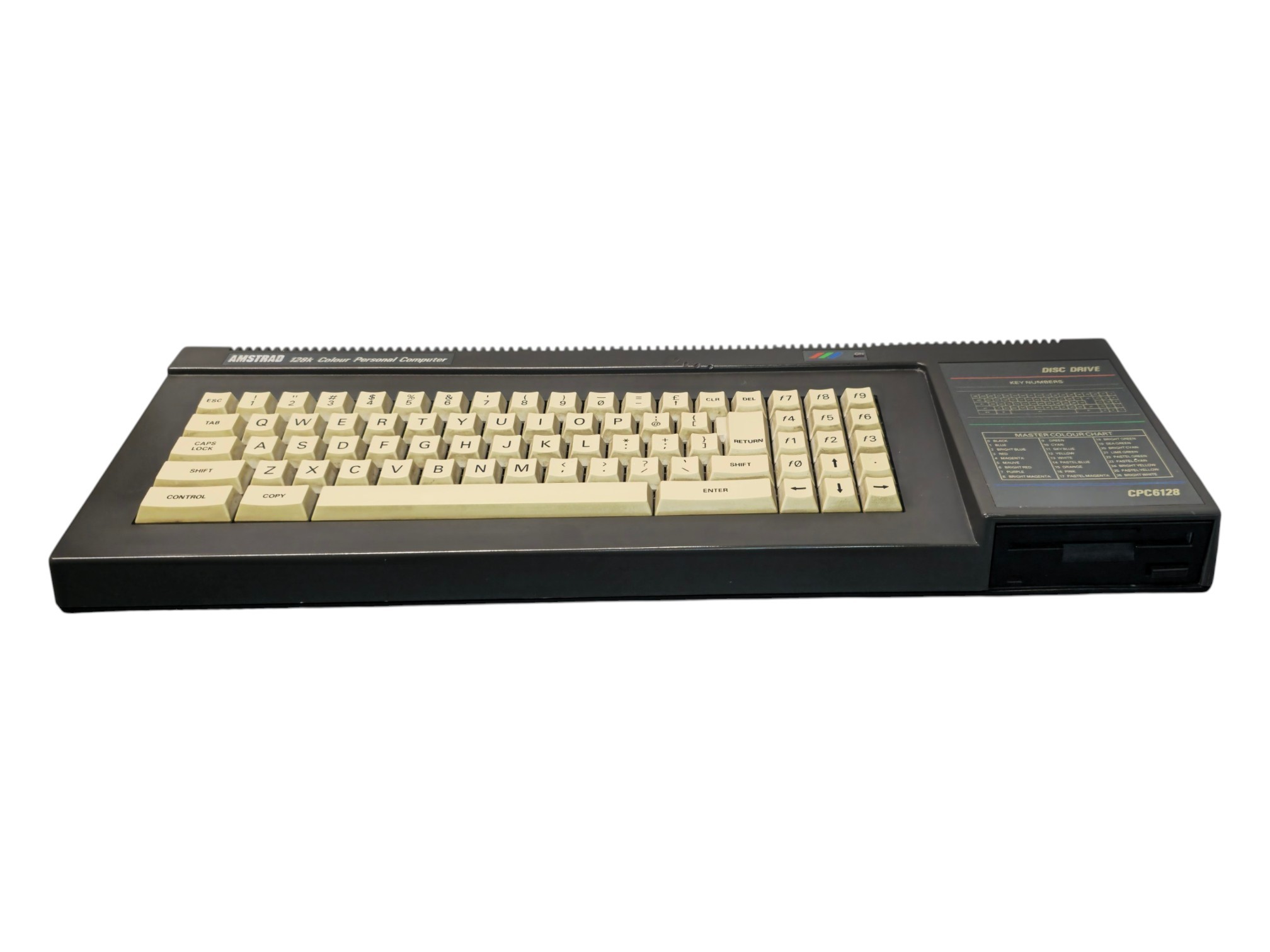
The Amstrad CPC 6128 is one of the most iconic and successful 8-bit home computers of the 1980s. Combining powerful hardware, a built-in floppy disk drive, and an impressive software library, it represented the peak of Amstrad’s original CPC generation. Affordable, versatile, and remarkably capable, the 6128 became a favourite among gamers, students, programmers, and home computer enthusiasts throughout Europe.
With its distinctive design, 128 KB of RAM, and excellent compatibility with earlier CPC models, the 6128 established itself as a true classic of the home computing revolution.
📘 Introduction
Released in 1985, the Amstrad CPC 6128 was introduced as the most advanced model in the original Colour Personal Computer (CPC) family. Following the success of the CPC 464 and the short-lived CPC 664, the 6128 offered twice the memory of its predecessors while retaining the familiar architecture that made the series so popular.
The machine was designed to bridge the gap between affordable home entertainment and serious personal computing.
At a time when competitors such as the Commodore 64 and ZX Spectrum still relied heavily on cassette storage, the CPC 6128 offered an integrated floppy disk system, making everyday computing significantly faster and more convenient.
🖥️ A Complete Home Computing System
Like its predecessors, the CPC 6128 followed Amstrad’s all-in-one philosophy, providing almost everything needed to start computing immediately.
The original retail package included:
- The computer with a full-size keyboard and numeric keypad
- A built-in 3-inch floppy disk drive
- A dedicated colour or green-screen monitor
- Power supplied directly through the monitor
- Locomotive BASIC and disk operating system support
The keyboard featured a more professional appearance than the colourful keys of the CPC 464, giving the 6128 a distinctive identity.
Unlike many competing computers, there was no need to purchase a separate display or external disk drive. This convenience made the CPC 6128 particularly attractive to families, schools, and small businesses.
🧠 128 KB RAM: Twice the Memory, More Possibilities
One of the CPC 6128’s most important improvements was its 128 KB of RAM, double the 64 KB found in the CPC 464 and CPC 664.
Because the Zilog Z80A processor could directly address only 64 KB at a time, Amstrad used memory bank switching to access the additional RAM.
This expanded memory provided several advantages:
- Support for larger and more sophisticated programs
- Additional memory for graphics and game data
- Improved capabilities for productivity applications
- Compatibility with more demanding disk-based software
- Better support for the CP/M Plus operating system
Although many earlier CPC games did not require the additional memory, software developers gradually began using it to create more ambitious experiences.
The extra RAM helped extend the commercial life of the CPC platform well into the late 1980s.
💾 The Built-In 3-Inch Floppy Disk Drive
Perhaps the most recognisable feature of the CPC 6128 was its integrated 3-inch floppy disk drive, which replaced the cassette mechanism found in the CPC 464.
The machine used CF2 floppy disks, a format different from the more familiar 3.5-inch disks that would later become an industry standard.
Floppy Disk Specifications
- Format: 3-inch CF2 floppy disk
- Capacity: 180 KB per side (standard DATA format)
- Media: Double-sided, manually reversible
- File system: AMSDOS and CP/M-compatible formats
- Expansion: Support for a second external floppy drive
Compared with cassette storage, floppy disks offered:
- Significantly faster loading times
- More convenient file management
- Easier saving and editing of programs
- Better support for larger games and applications
- Reduced dependence on lengthy tape-loading procedures
However, the unusual 3-inch format eventually became a disadvantage as 3.5-inch disks gained widespread acceptance.
Today, original 3-inch disks remain an important part of the CPC collecting experience.
🎨 Graphics & Sound
Powered by the Zilog Z80A processor running at 4 MHz, the CPC 6128 retained the graphics and sound architecture of the earlier CPC machines.
Although not fundamentally different from the CPC 464, its audiovisual capabilities remained impressive for an affordable 8-bit computer.
Graphics Modes
The CPC 6128 supported three principal display modes:
- Mode 0: 160×200 resolution, 16 simultaneous colours
- Mode 1: 320×200 resolution, 4 simultaneous colours
- Mode 2: 640×200 resolution, 2 simultaneous colours
All three modes could select colours from a palette of 27 available colours.
Mode 0 was especially popular with game developers because its 16-colour display allowed vibrant backgrounds, detailed sprites, and colourful arcade-style graphics.
Mode 2, meanwhile, was particularly useful for productivity applications thanks to its sharp 80-column text display.
Sound
The machine featured the General Instrument AY-3-8912 sound generator, offering:
- Three independent sound channels
- Programmable tone and noise generation
- Multi-channel music and sound effects
- The distinctive chiptune sound associated with the CPC platform
These capabilities allowed developers to create memorable soundtracks that remain instantly recognisable to retro gaming enthusiasts.
🎮 Games & Software Library
The CPC 6128 inherited the extensive software catalogue of the CPC family while benefiting from the convenience of disk-based distribution.
Its library included arcade conversions, platform games, racing titles, strategy games, adventures, and educational software.
Some of the most memorable CPC games include:
- Rick Dangerous
- Barbarian: The Ultimate Warrior
- Bomb Jack
- Bruce Lee
- R-Type
- Chase H.Q.
- Batman: The Movie
- Gryzor
- Head over Heels
- Sorcery
- The Sentinel
- Operation Wolf
Many games were available on both cassette and disk, but the CPC 6128 offered a noticeably smoother experience when using floppy disks.
Certain later games also took advantage of the machine’s expanded memory, allowing additional content, improved presentation, or more complex gameplay.
Beyond commercial releases, the CPC developed a strong community of hobbyist programmers and independent developers.
Even today, new games continue to appear for the platform.
💻 Programming & Productivity
Although remembered primarily as a gaming computer, the CPC 6128 was also designed for serious computing.
Its built-in Locomotive BASIC 1.1 offered an accessible and powerful programming environment.
Users could experiment with:
- Graphics and animation commands
- Music and sound programming
- File and disk management
- Mathematical calculations
- Educational and personal software development
For many enthusiasts, Locomotive BASIC provided their first experience of writing computer programs.
CP/M: A Step Towards Professional Computing
One of the 6128’s strongest features was its support for CP/M Plus (CP/M 3), supplied on disk.
CP/M opened the door to an established ecosystem of applications, including:
- Word processing
- Spreadsheets
- Database management
- Programming tools
- Business and office utilities
The combination of 128 KB RAM, an 80-column display, and disk storage made the CPC 6128 more suitable for productivity work than many earlier home computers.
It was a machine capable of entertaining children during the afternoon and helping adults complete serious tasks in the evening.
🔧 Build Quality & Longevity
The CPC 6128 earned a reputation for solid construction and dependable operation.
Its robust keyboard, relatively straightforward internal architecture, and integrated design helped many units survive decades of use.
Nevertheless, original machines can require maintenance after more than 40 years.
Common restoration tasks include:
- Replacement of the floppy drive belt
- Cleaning the floppy drive read/write head
- Checking the keyboard membrane
- Inspecting power connections
- Cleaning contacts and expansion connectors
The floppy drive belt is particularly well known among CPC collectors because the original rubber components frequently deteriorate with age.
Fortunately, replacement parts and modern storage solutions are widely supported by the retro computing community.
With proper maintenance, a CPC 6128 can remain fully functional today.
🌍 Popularity Across Europe
The CPC 6128 enjoyed considerable commercial success, particularly in European markets where affordable home computers became essential household technology.
The CPC family developed especially strong communities in:
- The United Kingdom
- France
- Spain
- Germany
- Greece and Cyprus
In Greece, the CPC 6128 became a familiar machine during the second half of the 1980s, helping introduce a generation of young people to computer gaming and BASIC programming.
Its combination of affordability, colour graphics, and a built-in disk drive made it particularly appealing to families investing in their first computer.
The CPC range also benefited from a large network of software publishers, computer magazines, and enthusiast communities.
⭐ Why the CPC 6128 Still Matters
The Amstrad CPC 6128 remains highly regarded among collectors and retro computing enthusiasts because:
- It represents the most advanced model of the original CPC family
- Its 128 KB RAM expanded the capabilities of the platform
- Its built-in floppy drive transformed everyday usability
- It features a distinctive and instantly recognisable design
- Its library contains hundreds of memorable games and applications
- Its compatibility with earlier CPC software makes it exceptionally versatile
- An active community continues to develop hardware and software for it
Modern accessories such as floppy disk emulators, memory expansions, and alternative storage solutions have made the machine easier to use than ever before.
The CPC 6128 also remains an important part of the European demoscene, where programmers and artists continue pushing its hardware far beyond what its original designers imagined.
For collectors, it represents a fascinating combination of nostalgia, engineering, and computing history.
📦 Items Included in This Collection Entry
🏁 Conclusion
The Amstrad CPC 6128 represents one of the finest achievements of the European 8-bit home computing era. Combining the accessibility of a family computer with the expanded memory, floppy disk storage, and software capabilities of a more serious system, it offered exceptional versatility for its time.
Its colourful graphics, memorable games, powerful BASIC environment, and distinctive design helped establish the CPC series as one of the great home computer families of the 1980s.
More than four decades after its introduction, the CPC 6128 continues to inspire collectors, programmers, and retro gaming enthusiasts around the world.
A true 8-bit legend, a milestone in European computing history, and an essential addition to any serious vintage computer collection.
