
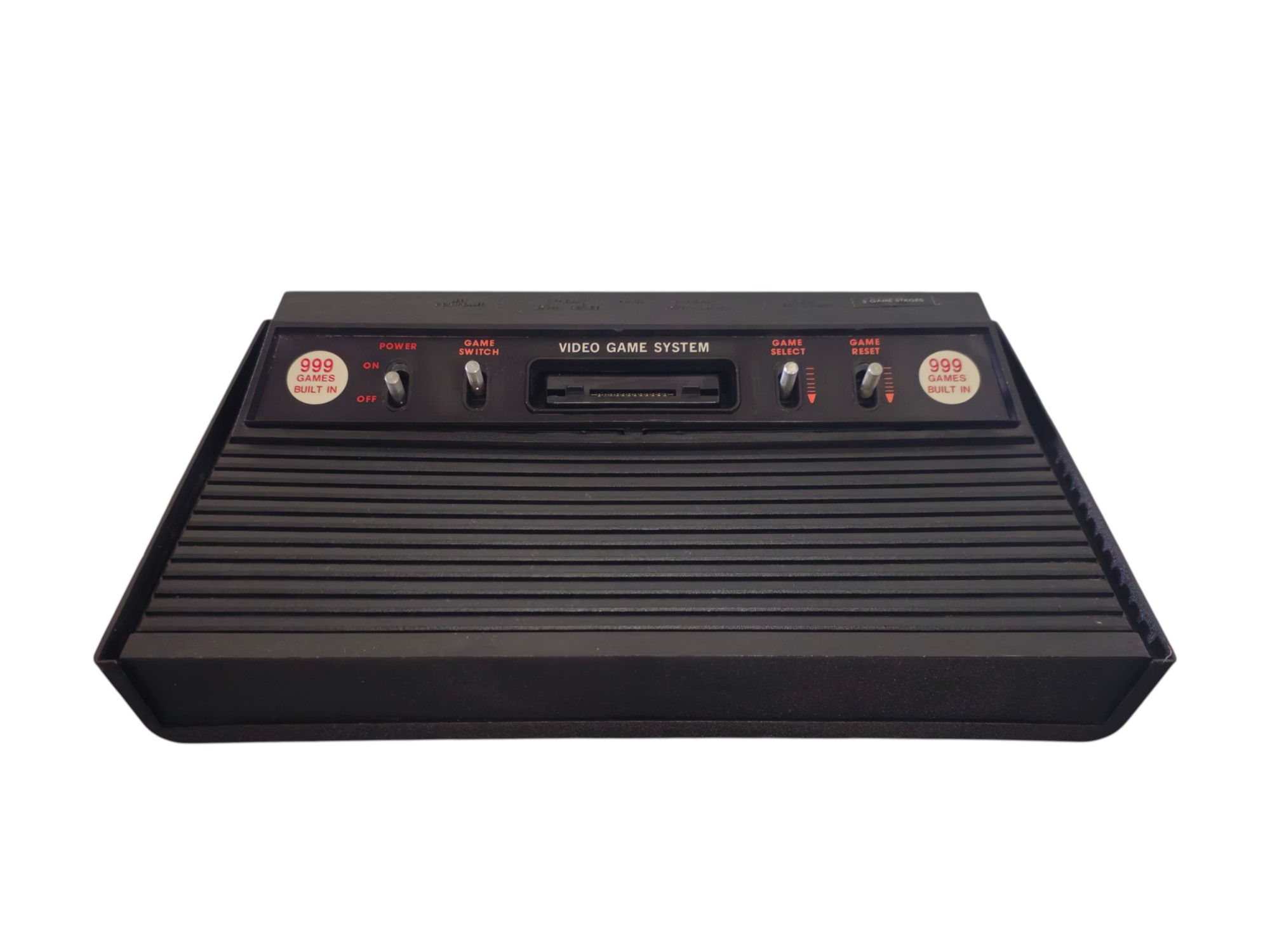
The Atari 2600 Clone – 999 Games represents a fascinating and often overlooked chapter in the history of home video gaming. Inspired by Atari’s legendary Video Computer System, this unofficial Atari-compatible console belongs to a wider generation of affordable gaming machines that brought classic arcade-style entertainment to households around the world.
Advertised with an impressive collection of 999 games, the system reflects an era when manufacturers competed to attract consumers through large multi-game libraries, simplified hardware, and accessible prices.
Although not an official Atari product, the console represents the enduring influence of one of the most important gaming platforms ever created. Its connection to the Atari 2600 tradition places it within a remarkable history of hardware cloning, alternative software distribution, and international consumer electronics manufacturing.
Today, these unofficial systems are valuable reminders that gaming history extends beyond the products of major manufacturers. They also tell the story of the smaller companies, regional distributors, and alternative hardware ecosystems that helped make video games accessible to millions of people.
📘 Introduction
The history of the Atari 2600 Clone – 999 Games is closely connected to the enormous success of the original Atari Video Computer System, introduced in 1977.
The Atari VCS revolutionised home entertainment by allowing players to enjoy different games through interchangeable ROM cartridges.
Its success established a foundation for the modern console industry and inspired numerous competing systems.
As the original Atari hardware became increasingly familiar, third-party manufacturers began producing compatible consoles, alternative cartridges, and multi-game systems.
These products varied considerably in appearance, construction, functionality, and software compatibility.
The 999 Games configuration represents one of the most striking marketing approaches associated with this aftermarket.
Instead of advertising a single game or a small collection, manufacturers promoted access to hundreds of selectable game entries.
The result was a product designed to offer the impression of an enormous entertainment library within a single package.
However, the advertised number of 999 games does not necessarily represent 999 unique titles.
The precise software collection, hardware implementation, and manufacturing history must be established individually for each surviving model.
This makes the console particularly interesting as a museum exhibit.
🏭 The Atari 2600: The Console That Started a Revolution
The original Atari Video Computer System, later known as the Atari 2600, was introduced in North America in September 1977.
Developed by Atari, the machine represented an important step beyond earlier dedicated gaming systems.
Before programmable cartridge consoles became widespread, many home gaming devices offered only a fixed selection of games.
The Atari VCS changed this model.
A New Approach to Home Gaming
The original system introduced:
- Interchangeable ROM cartridges
- Programmable game software
- Joystick-based controls
- Television connectivity
- Multiple game variations
- A growing commercial game library
Players could expand their entertainment options simply by purchasing additional cartridges.
This created an ongoing relationship between the console, software publishers, and consumers.
The Arcade Experience at Home
The Atari 2600 became particularly successful as home versions of popular arcade games appeared.
Titles such as Space Invaders, Asteroids, Missile Command, and Pac-Man helped establish the console as a major entertainment platform.
Although its hardware was extremely limited by modern standards, innovative programmers managed to create surprisingly sophisticated games.
The Atari 2600 became one of the most recognisable symbols of early video gaming.
Its enormous popularity encouraged other companies to develop compatible products and alternative hardware designs.
🧩 The Rise of Atari 2600 Clones
The popularity of the Atari 2600 created opportunities for manufacturers outside Atari’s official production network.
During the 1980s and later years, different companies developed systems intended to reproduce the functionality of the original console.
These machines became known as Atari 2600 clones.
Some closely resembled official Atari models, while others featured completely different designs.
Why Clone Consoles Became Popular
Several factors encouraged their development:
- Strong demand for inexpensive gaming hardware
- The widespread popularity of Atari software
- Familiar joystick and cartridge interfaces
- Increasing availability of electronic components
- Lower manufacturing costs
- Opportunities for regional distribution
- Consumer interest in multi-game collections
Different Approaches to Compatibility
Atari-compatible machines were not necessarily identical internally.
Manufacturers could use:
- Conventional compatible electronic components
- Alternative circuit-board designs
- More highly integrated chipsets
- Modified video circuitry
- Built-in game storage
- Special multi-game cartridges
The degree of compatibility varied between products.
Some machines reproduced much of the original Atari experience, while others supported only a subset of the software or hardware features.
An Important Historical Distinction
These systems were generally not official Atari products.
They formed part of a separate manufacturing and distribution ecosystem.
For modern collectors, this distinction is important because an Atari-compatible clone should be documented under its actual manufacturer whenever that information is available.
🔢 999 Games: The Marketing Power of Big Numbers
One of the most interesting characteristics of this console is its advertised collection of 999 games.
During the era of affordable multi-game hardware, large numerical claims became a common marketing technique.
Products advertised with hundreds of games appeared especially attractive to consumers who wanted a large entertainment selection without purchasing numerous individual cartridges.
What Does 999 Games Mean?
A multi-game product may provide its advertised selection through:
- Internal ROM storage
- A multi-game cartridge
- Multiple selectable ROM banks
- Software selection menus
- Hardware switches
- Alternative game variations
- Repeated or modified game entries
The exact implementation depends on the hardware.
999 Selections vs. 999 Unique Games
One important consideration is that a large advertised game count does not necessarily indicate an equally large number of distinct games.
A collection might contain:
- Original game titles
- Repeated software
- Different starting levels
- Alternative difficulty settings
- Modified gameplay variations
- Games listed under different names
- Multiple configurations of the same program
Consequently, a product advertised as containing 999 games might offer substantially fewer unique experiences.
Why the Number Mattered
From a marketing perspective, a large game count communicated exceptional value.
A consumer comparing a conventional cartridge console with a system advertised as containing hundreds of games might reasonably perceive the latter as an attractive purchase.
The number itself became part of the product’s identity.
For collectors, the 999 Games designation is historically significant even when the exact number of unique titles remains unknown.
🖥️ Design & Construction
Atari-compatible clone consoles appeared in a wide variety of physical configurations.
Some copied the original Atari VCS design, while others adopted styling inspired by later consoles.
Their construction generally reflected the priorities of the manufacturers producing them.
Common Design Characteristics
Depending on the model, Atari-compatible systems could feature:
- Plastic console enclosures
- Power switches
- Reset and game-selection controls
- Joystick connectors
- Cartridge slots
- Internal game-selection mechanisms
- Analogue television outputs
- External power supplies
Not every clone included all these features.
Cost-Effective Engineering
One of the principal objectives of clone manufacturing was often to reduce production costs.
Manufacturers could simplify circuit boards, combine functions into fewer integrated circuits, or eliminate features considered unnecessary.
These changes could make the hardware more affordable.
However, they could also introduce differences in compatibility, video quality, sound, and reliability.
The Importance of Model Identification
Because many unofficial systems used generic names, identifying individual consoles can be difficult.
Useful clues include:
- Exterior design
- Product labels
- Manufacturer markings
- Circuit-board identification
- Controller connectors
- Power specifications
- Packaging artwork
- Printed game lists
For the 999 Games model, these details can help establish its actual production history.
⚙️ Technical Specifications
The Atari 2600 Clone – 999 Games belongs to the wider category of Atari-compatible gaming hardware.
The original Atari 2600 architecture provides an important technical reference, but the exact components of an individual clone can differ.
Original Atari 2600 Reference Architecture
- Original manufacturer: Atari, Inc.
- Original release year: 1977
- Generation: Second-generation video game console
- CPU: MOS Technology 6507
- Processor type: 8-bit
- CPU frequency: Approximately 1.19 MHz (NTSC)
- Main RAM: 128 bytes
- Graphics hardware: Television Interface Adaptor (TIA)
- Typical NTSC display: Approximately 160×192 active pixels
- NTSC colour palette: 128 possible colour values
- Audio: Two programmable sound channels
- Game storage: ROM cartridges
- Controllers: Atari-compatible nine-pin ports
- Video connection: Analogue RF output on original systems
Atari 2600 Clone – 999 Games
- Product category: Atari-compatible video game console
- Official Atari hardware: No
- Advertised collection: 999 games or selectable entries
- Manufacturer: Not yet identified
- Exact production year: Not established
- Processor: Requires hardware verification
- Graphics implementation: Requires hardware verification
- Sound implementation: Requires hardware verification
- Game storage: Internal ROM or multi-game cartridge, depending on model
- Video standard: Requires regional and hardware verification
- Controller interface: Model-dependent
- Power requirements: Must be confirmed from the original hardware
These distinctions are important because original Atari specifications cannot automatically be assigned to every compatible clone.
The exact motherboard and component configuration determine how closely an individual machine reproduces the Atari 2600 architecture.
🧠 The MOS 6507: The Heart of Original Atari Gaming
The original Atari 2600 was built around the MOS Technology 6507, a simplified version of the influential MOS 6502 processor.
Operating at approximately 1.19 MHz on NTSC systems, it provided the computational foundation for some of the most important early video games.
Processor Responsibilities
The 6507 handled:
- Game logic
- Controller input
- Object movement
- Memory operations
- Sound control
- Video timing
- Program execution
Only 128 Bytes of RAM
One of the most remarkable technical characteristics of the original Atari 2600 was its extremely limited memory.
The system contained only 128 bytes of RAM.
For comparison, modern computers use memory measured in billions of bytes.
This limitation forced developers to write exceptionally efficient software.
Programming Under Severe Restrictions
Game programmers relied heavily on assembly language and precise timing.
They frequently used techniques such as:
- Reusing memory locations
- Compact data representations
- Carefully timed instructions
- Efficient graphics routines
- Cartridge bank switching
- Hardware-specific optimisation
These techniques allowed developers to achieve impressive results despite severe technical restrictions.
The challenge of Atari programming became part of the platform’s historical identity.
🎨 Graphics & the Television Interface Adaptor
The original Atari 2600 used a specialised graphics and sound chip called the Television Interface Adaptor, or TIA.
Unlike later gaming systems, the Atari 2600 did not store an entire screen image in a conventional frame buffer.
Instead, the processor and TIA worked together to generate the display in real time.
Original Graphics Capabilities
The hardware provided:
- A programmable background playfield
- Two player graphics objects
- Two missile objects
- One ball object
- Colour and luminance control
- Programmable object positioning
- Direct television signal generation
The NTSC version provided a palette of 128 possible colour values.
Regional PAL and SECAM hardware used different colour characteristics.
The Famous Racing the Beam Technique
One of the most remarkable aspects of Atari programming was a technique known as racing the beam.
The computer generated graphics in synchronisation with the television’s scanning process.
Programmers needed to execute specific instructions at precisely the correct time.
This allowed visual effects that would otherwise have been difficult or impossible with the available memory.
Graphics Compatibility in Clones
Atari-compatible clone manufacturers attempted to reproduce these behaviours.
However, differences in internal hardware could affect:
- Colour accuracy
- Display timing
- Sprite behaviour
- Graphics positioning
- Screen stability
- Compatibility with unusual software techniques
These differences can help identify the quality and technical characteristics of a particular clone.
🎵 The Sound of Early Home Gaming
The Atari 2600’s distinctive electronic audio became an important part of early gaming culture.
The original TIA provided two programmable audio channels.
Although limited compared with later sound processors, this hardware was capable of producing numerous recognisable effects.
Audio Capabilities
- Two independent sound channels
- Programmable tones
- Noise generation
- Adjustable volume
- Simple musical sequences
- Arcade-style sound effects
Memorable Atari Sounds
Classic games used electronic audio to represent:
- Laser weapons
- Explosions
- Vehicle engines
- Collisions
- Movement
- Alarms
- Scoring events
Developers often relied on short sound effects rather than continuous background music.
This approach became closely associated with the earliest generations of console gaming.
Sound in Compatible Hardware
Clone consoles could reproduce these sounds through compatible or alternative circuitry.
However, the accuracy of the audio varied between designs.
Some machines reproduced the original sound characteristics closely, while others introduced differences in pitch, timing, or distortion.
For preservation purposes, these variations can provide useful information about the underlying hardware.
🕹️ The Classic Atari Joystick Experience
One of the most recognisable elements of Atari gaming was its simple joystick controller.
The original Atari CX40 joystick featured a square base, a directional stick, and a single action button.
Its straightforward design helped make video games accessible to a wide audience.
Original Controller Characteristics
- Four-direction digital input
- Single action button
- Compact plastic enclosure
- Nine-pin connector
- Simple internal switching system
The controller became an industry reference point for later home computers and video game systems.
Third-Party Controllers
Numerous manufacturers developed alternative joysticks.
These included controllers with:
- Different handle designs
- Additional fire buttons
- Autofire functions
- Larger bases
- Alternative switch mechanisms
Controller Compatibility
Many Atari-compatible clones used connectors resembling the original Atari standard.
However, physical similarity does not guarantee electrical compatibility.
Some clone systems used modified wiring or non-standard controller arrangements.
For this reason, the exact joystick interface of a particular machine should be verified before connecting unfamiliar accessories.
🎮 The Classic Atari 2600 Software Library
The original Atari 2600 developed one of the most influential software catalogues of the early video game industry.
Its library included arcade conversions, action games, shooters, sports titles, racing games, and original productions.
Some of the most celebrated Atari 2600 games include:
- Combat
- Space Invaders
- Asteroids
- Missile Command
- Adventure
- Pitfall!
- Pitfall II: Lost Caverns
- River Raid
- Enduro
- Yars’ Revenge
- Breakout
- Super Breakout
- Berzerk
- Defender
- Centipede
- Millipede
- Frogger
- Pac-Man
- Ms. Pac-Man
- Kaboom!
- H.E.R.O.
- Keystone Kapers
- Seaquest
- Atlantis
- Demon Attack
- Phoenix
- Solaris
- Pole Position
- Jungle Hunt
- Freeway
- Boxing
- Tennis
- Basketball
- Video Pinball
These titles helped establish many of the gameplay concepts that continue to influence video games.
An Important Collection Distinction
The titles above represent the historic Atari 2600 software library.
They are not a confirmed list of games included in the 999 Games clone.
The actual software collection must be identified through the specific unit’s game-selection system or accompanying documentation.
👾 Space Invaders: The Game That Transformed Atari
One of the most important titles in Atari history was Space Invaders.
Originally developed by Taito in 1978, the arcade game became a worldwide phenomenon.
Atari released its home adaptation for the VCS in 1980.
A Commercial Breakthrough
Space Invaders helped demonstrate the appeal of playing arcade games at home.
Its popularity contributed substantially to the commercial success of the Atari 2600.
The game featured:
- Descending alien formations
- A player-controlled cannon
- Defensive barriers
- Increasing difficulty
- Multiple gameplay variations
- High-score challenges
The Importance of Software
Space Invaders became an early example of a game significantly increasing demand for the hardware required to play it.
This relationship between successful software and console sales would become a defining characteristic of the video game industry.
The title remains one of the most influential games of all time.
🌴 Pitfall! & the Birth of the Platform Adventure
Released in 1982, Pitfall! became one of the Atari 2600’s most important games.
Developed by David Crane and published by Activision, it introduced players to an interconnected jungle environment filled with obstacles and treasures.
Gameplay Features
- Side-view exploration
- Running and jumping
- Dangerous pits
- Moving obstacles
- Underground passages
- Collectible treasures
- Time-limited challenges
An Important Technical Achievement
Pitfall! created the impression of a large game world despite the Atari’s extremely limited memory.
Its carefully designed environments and efficient programming demonstrated the creativity of early console developers.
A Lasting Influence
The game helped establish concepts later associated with platform adventures.
It also contributed to the success of Activision, one of the earliest major third-party console software publishers.
Pitfall! remains an important milestone in the evolution of action-adventure gaming.
🚁 River Raid: Innovation Through Programming
Another influential Atari 2600 game was River Raid, developed by Carol Shaw and released by Activision in 1982.
The game placed players in control of an aircraft navigating a dangerous river.
Its gameplay combined:
- Vertical scrolling
- Enemy vehicles
- Fuel management
- Narrow passages
- Increasing difficulty
- Continuous arcade-style action
Procedural Level Generation
One of the game’s most impressive features was its efficient method of creating scrolling environments.
Rather than storing an enormous fixed map, the program generated sections of the environment using compact data and carefully designed algorithms.
This allowed the game to create a surprisingly extensive experience within the Atari’s limited memory.
A Classic of Early Gaming
River Raid became one of the most recognisable titles of the Atari generation.
Its smooth gameplay and technical ingenuity made it a lasting example of successful software optimisation.
💾 Multi-Game ROMs & Game Selection
The central feature of the Atari 2600 Clone – 999 Games is its advertised software collection.
Multi-game products could store programs in different ways.
Built-In Game Collections
Some clone consoles included game software directly in internal ROM memory.
The player could select titles without inserting individual cartridges.
Possible selection methods included:
- On-screen menus
- Numbered game lists
- Physical switches
- Select buttons
- Automatic game-selection systems
Multi-Game Cartridges
Other systems used cartridges containing multiple programs.
A single cartridge could provide access to many titles through bank switching or dedicated selection circuitry.
Bank Switching
Bank switching allows a processor to access different sections of memory by changing which memory bank is currently visible.
This technique became important for Atari software because the original architecture had a limited directly accessible cartridge address space.
More complex cartridges could use additional hardware to overcome these restrictions.
Why the Implementation Matters
The storage arrangement determines important aspects of a clone’s functionality.
For example, a built-in game collection may behave differently from a removable multi-game cartridge.
The exact configuration can affect:
- Game selection
- Cartridge compatibility
- Software replacement
- Startup behaviour
- Repair procedures
- Collectability
Identifying the storage arrangement is therefore an important part of documenting the 999 Games model.
🔄 Atari 2600 Clone 256 Games vs. 999 Games
Multi-game Atari-compatible systems appeared with different advertised game counts.
Two examples are the 256 Games and 999 Games configurations.
Although both belong to the broader Atari-compatible aftermarket, they should be treated as separate products unless their actual hardware is shown to be identical.
256 Games Configuration
- Advertised selection of 256 entries
- May use internal or cartridge-based storage
- Potentially includes repeated game variants
- Exact manufacturer depends on the unit
- Hardware compatibility requires verification
- Software library may vary between production versions
999 Games Configuration
- Advertised selection of 999 entries
- May use internal or cartridge-based storage
- Potentially includes repeated game variants
- Exact manufacturer depends on the unit
- Hardware compatibility requires verification
- Software library may vary between production versions
More Games Does Not Necessarily Mean Better Hardware
A larger advertised game count does not automatically indicate a more advanced console.
Both products could use similar Atari-compatible architectures.
Differences might be limited to:
- ROM contents
- Menu systems
- Game-selection mechanisms
- Retail packaging
- Internal memory arrangements
Alternatively, they could be based on completely different circuit designs.
Museum Significance
Documenting the two systems separately allows collectors to compare how manufacturers marketed large software collections.
It also provides an opportunity to examine differences in circuit design, game selection, construction quality, and regional distribution.
📺 Television Connectivity & CRT Displays
The original Atari 2600 was designed for connection to analogue CRT televisions.
Its standard output used an RF signal suitable for television antenna inputs.
Many Atari-compatible clones followed similar principles.
However, output connections varied between manufacturers and production periods.
Possible Video Connections
Depending on the specific machine, a clone might use:
- RF output
- Composite video
- Proprietary video connectors
- Other analogue connection arrangements
PAL, NTSC & SECAM
Different regions used different analogue television standards.
These included:
- PAL: Used throughout much of Europe
- NTSC: Used in North America and Japan
- SECAM: Used in selected markets
The standards differed in timing and colour encoding.
A console designed for one standard might not display correctly on equipment intended for another.
The Authentic CRT Experience
A compatible CRT television remains one of the best ways to demonstrate original Atari-era graphics.
Its analogue display characteristics can reproduce the appearance for which the hardware was designed.
Modern Display Compatibility
Modern televisions may not support older RF signals directly.
Using a clone with a modern display may require compatible conversion equipment.
The correct solution depends on the actual video output of the console.
For preservation purposes, the original video system should be documented before making modifications.
🏪 The Culture of Affordable Multi-Game Consoles
The popularity of multi-game consoles reflects an important part of consumer electronics history.
Official gaming systems were not always affordable or widely available in every market.
Clone manufacturers offered alternative products aimed at price-sensitive consumers.
The Appeal of Multi-Game Systems
Consumers were attracted by:
- Lower purchase prices
- Large advertised software collections
- Simple controls
- Television connectivity
- Familiar arcade-style games
- Limited need for additional purchases
The Marketing of Quantity
Advertising a console with hundreds of games created an immediate impression of exceptional value.
Numbers such as 128, 256, 500, and 999 became important marketing tools in different multi-game product categories.
However, the advertised quantity did not always provide meaningful information about software quality or uniqueness.
A Different Commercial Ecosystem
Unlike official consoles, generic gaming systems were frequently sold through smaller distributors.
Packaging, branding, and accessories could vary substantially.
This makes surviving examples interesting documents of regional consumer electronics markets.
🌍 Atari-Compatible Clones Around the World
The worldwide influence of the Atari 2600 extended well beyond its original manufacturing and distribution network.
Compatible systems and unofficial software products appeared in several regions.
Asian Electronics Manufacturing
Manufacturers and distributors in Asian electronics markets contributed to the production of compatible cartridges and clone systems.
Some products used established game collections, while others introduced alternative menus or hardware arrangements.
Taiwan and Hong Kong were particularly important centres of electronics manufacturing and distribution during this period.
South America
Atari-compatible consoles became especially significant in Brazil.
Local manufacturers produced numerous Atari-related products, contributing to a distinctive regional gaming culture.
These systems helped make video gaming accessible to consumers through local manufacturing and distribution.
Europe
European gaming markets developed differently across countries.
In some regions, home computers dominated early gaming culture.
In others, dedicated consoles and compatible gaming systems became increasingly popular.
Atari-compatible clones formed part of this wider commercial environment.
The Importance of Regional Differences
Different markets could receive products with variations in:
- Branding
- Packaging
- Power requirements
- Television standards
- Controller arrangements
- Software collections
These differences can make apparently similar clones historically distinct.
🇬🇷 The Place of Clone Consoles in Greek Gaming History
The development of home gaming in Greece involved a wide range of computers, consoles, and affordable electronic entertainment products.
During the 1980s and early 1990s, consumers encountered systems ranging from dedicated Pong-style machines to increasingly sophisticated home computers.
Generic gaming systems also formed part of the broader electronics market.
Affordable Home Entertainment
For families seeking inexpensive gaming equipment, a multi-game console could offer an attractive alternative to purchasing numerous individual cartridges.
The ability to connect a system directly to a television was particularly convenient.
A Diverse Gaming Landscape
The Greek market included products associated with:
Many less widely documented systems circulated alongside established brands.
Preserving Lesser-Known Hardware
Unlike major consoles, generic clone machines often lack detailed manufacturer records.
Consequently, surviving hardware, packaging, and documentation are valuable historical sources.
They help preserve the experiences of consumers who discovered video games through alternative and affordable systems.
The Atari 2600 Clone – 999 Games belongs to this broader category of historically interesting gaming hardware.
🔧 Build Quality & Longevity
The reliability of Atari-compatible clones varies considerably.
Some were manufactured using relatively robust components, while others were designed with minimal production costs in mind.
After several decades, original hardware may require maintenance.
Common Restoration Tasks
- Cleaning the console enclosure
- Inspecting power connectors
- Testing game-selection controls
- Cleaning joystick connectors
- Inspecting cartridge contacts, if present
- Checking video output
- Testing sound functionality
- Examining internal capacitors
- Inspecting solder joints
- Cleaning circuit boards
Power Supply Safety
The original Atari 2600 used a particular external power supply arrangement.
However, clone systems may have different requirements.
An original Atari power adapter should never be assumed compatible with an unidentified clone.
Incorrect voltage, polarity, or connector wiring can damage the hardware.
The console’s electrical requirements should be verified before connecting a power supply.
Ageing Components
Common age-related problems include:
- Corroded contacts
- Faulty switches
- Damaged cables
- Deteriorated capacitors
- Cracked solder joints
- Faulty connectors
- Damaged plastic components
Long-Term Storage
Proper preservation practices include:
- Maintaining stable temperatures
- Controlling humidity
- Avoiding direct sunlight
- Preventing excessive dust accumulation
- Keeping accessories together
- Preserving original labels
- Retaining documentation and packaging
These practices help protect historically interesting electronic equipment.
🔍 Identifying the Original Manufacturer
One of the most interesting challenges associated with Atari-compatible clones is determining their actual manufacturer.
Many products used generic descriptions rather than clearly identifiable brand names.
A console labelled 999 Games may therefore be difficult to trace without additional evidence.
Important Identification Details
Useful information includes:
- Exact text on the console
- Model numbers
- Manufacturer logos
- Serial numbers
- Printed labels
- Country-of-origin markings
- Power supply specifications
- Circuit-board markings
- Integrated circuit identification
- Original packaging
Motherboard Examination
The internal motherboard can reveal important technical information.
Chip markings and board revisions may help identify:
- Processor architecture
- Graphics implementation
- Memory configuration
- ROM organisation
- Manufacturing period
- Potential hardware compatibility
Game Menu Examination
The software selection interface may also provide clues.
Useful details include:
- Menu appearance
- Game numbering
- Game title list
- Startup screen
- Selection method
- Repeated entries
- Number of distinct games
These observations can help distinguish one multi-game product from another.
For a museum, this process is an important part of establishing accurate hardware provenance.
⭐ Why the Atari 2600 Clone – 999 Games Still Matters
The Atari 2600 Clone – 999 Games represents a distinctive aspect of video game history.
Its significance includes:
- The enduring influence of the original Atari 2600
- The international development of compatible gaming hardware
- The popularity of large multi-game collections
- The importance of affordable electronic entertainment
- The use of alternative manufacturing methods
- The commercial appeal of numerical game-count marketing
- The preservation of classic joystick-based gaming
- The documentation of unofficial console ecosystems
- The continuing interest in early 8-bit technology
More Than a Copy
Although clone systems were inspired by established hardware, they became part of gaming history in their own right.
They document how successful technology could spread through international markets and be adapted for different audiences.
An Alternative View of Console History
Traditional gaming histories often focus on major manufacturers.
However, the experiences of consumers who purchased generic and compatible systems were also part of the growth of home entertainment.
Preserving these machines provides a broader understanding of how gaming became a worldwide phenomenon.
🏛️ Collectability & Historical Preservation
Atari-compatible multi-game consoles represent a specialised area of retro hardware collecting.
Unlike official Atari systems, their value and historical interest often depend on how well an individual product can be identified and documented.
Important Collecting Factors
- Original hardware configuration
- Manufacturer identification
- Console condition
- Functional status
- Original controllers
- Correct power supply
- Original packaging
- Software selection system
- Printed game lists
- Regional information
- Internal motherboard revision
The Importance of Original Packaging
Boxes and documentation can be particularly valuable.
They may reveal details that are absent from the console itself.
These can include:
- Product branding
- Manufacturer information
- Distributor names
- Advertised game counts
- Intended market
- Copyright notices
- Instructions
- Product specifications
Verifying the Game Collection
A complete examination of the advertised 999 Games collection could involve recording:
- Every selectable entry
- Displayed game names
- Repeated titles
- Different gameplay variations
- Non-functioning entries
- Actual unique game count
This information would provide valuable evidence about the software configuration.
Preserving Unofficial Gaming History
Generic consoles are often poorly documented compared with major commercial systems.
For that reason, even relatively inexpensive surviving examples can possess historical interest.
Their preservation helps fill gaps in the history of international electronics manufacturing and video game distribution.
📦 Items Included in This Collection Entry
🏁 Conclusion
The Atari 2600 Clone – 999 Games represents a fascinating extension of the Atari legacy and an important example of the international market for affordable home video gaming.
Inspired by one of the most influential consoles ever created, compatible systems helped preserve and redistribute early gaming experiences through alternative hardware designs, third-party manufacturing, and large advertised software collections.
The 999 Games designation reflects a distinctive period in consumer electronics marketing, when the promise of hundreds of games became a powerful selling point.
Although the exact number of unique titles and the internal hardware configuration depend on the specific product, these consoles remain interesting historical artefacts.
They illustrate how successful technology could continue influencing the market long after its original introduction.
From simple joystick controls and colourful television graphics to the unforgettable sound effects of early arcade gaming, Atari-compatible systems preserve an important connection to the origins of home entertainment.
Their story also demonstrates that video game history is not limited to official hardware and major manufacturers.
It includes the many alternative systems that introduced new audiences to electronic gaming.
A fascinating example of unofficial console manufacturing, a testament to the enduring influence of Atari, and an important addition to any comprehensive collection of vintage video game hardware.
