

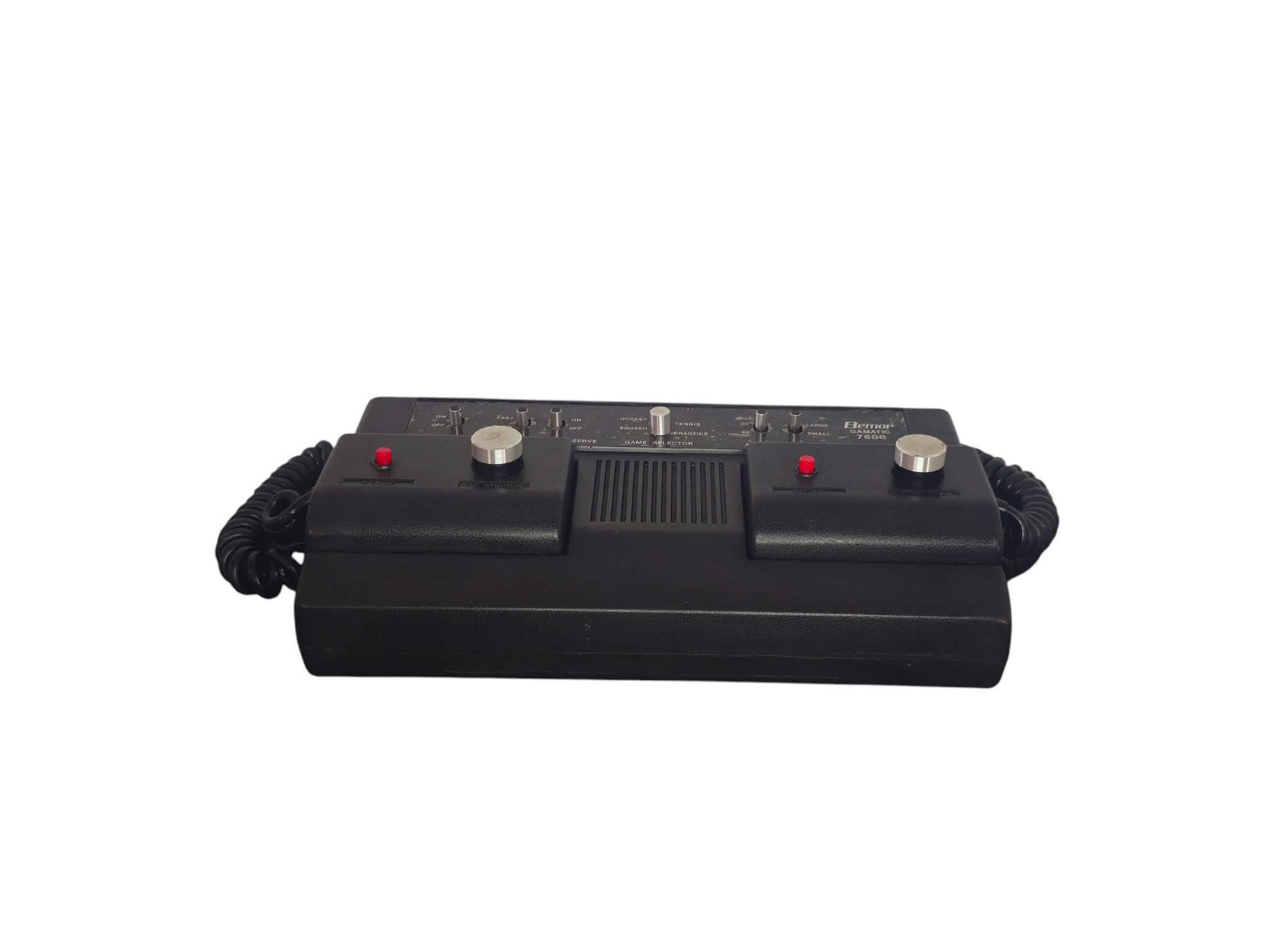
The Bemor Gamatic 7600 is a first-generation home video game console marketed in the United States around 1977, during the rapid expansion of electronic television gaming.
Part of the internationally distributed Gamatic 7600 hardware family, the system represents an important period when manufacturers began offering affordable Pong-style entertainment using specialised integrated circuits rather than complex collections of individual electronic components.
The console provides four built-in games: Tennis, Hockey, Squash, and Practice, combining simple television graphics with interactive paddle controls and adjustable gameplay settings.
Its distinctive design includes a rectangular enclosure, two wired paddle controllers, rotary control knobs, a dedicated game-selection panel, and coiled controller cables.
The Gamatic 7600 family is particularly interesting because versions of essentially the same hardware appeared under numerous international brands, including Otron, Grandstand, Univox, Ridgewood, Bemor, and INTerELektronik.
The electronics were associated with the Texas Instruments TMS-1955 and TMS-1965 families of dedicated game integrated circuits, which provided a cost-effective alternative to more complex early console designs.
Unlike later programmable systems, the Bemor Gamatic 7600 did not use interchangeable cartridges, software stored in ROM, or a conventional general-purpose CPU. Its games were generated directly through dedicated electronic logic.
Today, the Bemor Gamatic 7600 is an important historical artefact illustrating the global spread of Pong technology and the transition from experimental electronic games to mass-market home entertainment.
📘 Introduction
The Gamatic 7600 hardware family appeared in 1976, with related versions subsequently distributed in several international markets.
The Bemor-branded edition is documented in the United States in 1977.
The console belongs to the first generation of home video game systems, generally known as the Pong generation.
During this period, television gaming was still a relatively new experience.
Most household televisions were designed exclusively for watching broadcasts, while interactive gaming required additional dedicated equipment.
The Gamatic 7600 transformed the television into an interactive entertainment device.
Main Features
- Four permanently installed games
- Tennis, Hockey, Squash, and Practice
- Dedicated electronic game-generation circuitry
- Texas Instruments Pong-chip technology
- Monochrome television graphics
- Two wired paddle controllers
- Rotary analogue movement controls
- Manual serve function
- Game reset function
- Adjustable ball speed
- Adjustable paddle size
- Adjustable rebound angle
- Automatic serve selection
- On-screen scoring
- Electronic sound effects
- Analogue RF television output
- Battery operation
- External power-adapter support
Although its capabilities are extremely limited by modern standards, the Gamatic 7600 represented an accessible form of interactive entertainment during the late 1970s.
Its simple game rules allowed players to begin enjoying the system with very little instruction.
🏭 Bemor & the American Consumer Electronics Market
The Bemor name appears on a United States release of the Gamatic 7600.
The surviving documentation of Bemor as a company is relatively limited.
However, the branded hardware and original packaging demonstrate its involvement in distributing dedicated television games during the late 1970s.
A Rapidly Expanding Market
Following Atari’s success with Pong, numerous companies entered the electronic gaming industry.
These included established electronics manufacturers, specialist importers, and regional distributors.
The Role of Rebranding
Many manufacturers supplied similar or identical gaming systems to different retailers.
The same underlying electronics could be marketed under different commercial names.
The Bemor Version
The Bemor Gamatic 7600 belongs to this international distribution model.
Its American retail identity was distinct from the names used for related systems in Europe and Asia.
The Importance of Original Packaging
Surviving Bemor packaging features sports illustrations and the large GAMATIC 7600 title.
The box highlights the console’s television compatibility and built-in games.
An American Market Product
The Bemor edition is associated with American commercial distribution.
This does not necessarily mean that the hardware itself was manufactured in the United States.
Historical Significance
The Bemor Gamatic 7600 provides an example of how regional branding helped electronic game technology reach consumers internationally.
🌏 The Korean Origins of the Gamatic 7600
The Gamatic 7600 was part of a hardware family associated with Korean electronics manufacturing.
Contemporary and surviving collector examples connect the system with Olympos Electronic and its Otron brand.
Olympos Electronic
Olympos Electronic was involved in producing dedicated television game systems during the 1970s.
Its products appeared in several markets under different brand names.
The Otron Connection
Otron-branded Gamatic consoles are among the best-documented representatives of the family.
The Original Hardware
Surviving examples of related systems feature circuit boards identified with markings such as:
GAMATIC-7600
These provide important evidence of the shared hardware design.
International Manufacturing
The console family appeared in:
- South Korea
- Japan
- United States
- Canada
- United Kingdom
- France
- Germany
These references describe documented distribution markets and related versions, rather than establishing a separate factory in every country.
A Shared Electronic Platform
Different distributors could sell essentially the same gaming architecture using their own branding and packaging.
Historical Importance
The Gamatic 7600 illustrates how South Korean electronics manufacturing participated in the international home gaming industry before the rise of the country’s later computer and consumer electronics giants.
🌍 The International Gamatic Family
The Gamatic 7600 is especially interesting because of the number of related consoles distributed worldwide.
Known Related Systems
- Bemor Gamatic 7600
- Otron Gamatic 7600
- Olympos Electronic Gamatic 7600
- Grandstand TV Game Model 2000
- Grandstand TV Game Model 3000
- Univox 41N
- Ridgewood Gamatic 7600
- INTerELektronik TV Sport 1004
- Convoy 7600
Some related systems also appeared with alternative model numbers or retail branding.
The Grandstand Version
Grandstand marketed related systems in the United Kingdom.
The TV Game Model 2000 is a particularly well-documented example.
The Univox Version
The French Univox 41N uses the same general Gamatic hardware design.
Its game names appear in French.
The German Version
INTerELektronik marketed a related version under the TV Sport 1004 designation.
The American Versions
Bemor, Ridgewood, and other distributors marketed closely related products in North America.
Not Every Unit Is Electronically Identical
Despite the shared platform, differences may exist in:
- Main game chip
- Video circuitry
- RF modulator
- Television standard
- Power connector
- Enclosure colour
- Switch labels
- Regional packaging
A Collector’s Challenge
For accurate preservation, the brand, model, internal hardware, and regional version should all be documented separately.
🖥️ The Classic Gamatic 7600 Design
The Gamatic 7600 uses a rectangular tabletop enclosure with a practical layout.
Its design is characteristic of mid-to-late-1970s consumer electronics.
Exterior Features
The well-documented hardware family features:
- Rectangular plastic console
- Upper control panel
- Physical toggle switches
- Game-selection control
- Two paddle controllers
- Large rotary controller knobs
- Red controller buttons
- Coiled controller cables
- Integrated speaker grille
- RF television cable
- Rear power connection
- Battery compartment
Controller Arrangement
The two controllers can be lifted from their positions on the console.
Their coiled cables allow players to move them away from the main unit during gameplay.
A Compact Design
The arrangement reduces the amount of space required for storage.
Known Colour Variations
Gamatic-family consoles appeared in different enclosure colours, including black and lighter finishes.
The Bemor Packaging
Documented Bemor retail packaging shows the console and two wired controllers.
The exact factory colour of an individual unit should be recorded from the physical hardware.
Historical Significance
The enclosure demonstrates how early manufacturers experimented with integrating controllers into a single home entertainment product.
⚙️ Technical Specifications
The Bemor Gamatic 7600 is a dedicated electronic television game system.
Hardware Overview
- Brand: Bemor
- Model: Gamatic 7600
- Original hardware family: Gamatic 7600
- Earliest documented family release: 1976
- Bemor US distribution: 1977
- Generation: First-generation home console
- Hardware type: Dedicated Pong system
- Associated manufacturing origin: South Korea
- Main technology: Dedicated game integrated circuit
- Related chip families: Texas Instruments TMS-1955 / TMS-1965
- Exact installed chip: Not yet verified
- General-purpose CPU: None
- Operating system: None
- Games: Four built-in
- Game media: Internal electronic logic
- Graphics: Monochrome
- Video output: Analogue RF
- Player inputs: Two rotary paddle controls
- Controller connections: Wired, coiled cables
- Game selection: Physical selector
- Difficulty settings: Speed, paddle size, rebound angle
- Serve: Manual / Automatic
- Scoring: On-screen
- Audio: Electronic sound effects
- Speaker: Built-in on documented family versions
- Battery supply: Six 1.5V C-size cells on documented family versions
- External power: 9V DC on documented family versions
- Physical dimensions: Approximately 270 × 145 × 50 mm for related black-enclosure models
- Cartridge compatibility: None
Some specifications relate to documented Gamatic 7600 hardware-family examples.
The precise integrated circuit, power polarity, dimensions, and television-standard implementation of the individual Bemor unit require physical verification.
🧠 Texas Instruments & the Dedicated Pong Chip
Texas Instruments played an important role in the development of early electronic television games.
The company was already a major manufacturer of integrated circuits, calculators, and electronic components.
During the 1970s, it developed dedicated electronic game chips.
TMS-1955 & TMS-1965
The Gamatic 7600 family is associated with Texas Instruments’ TMS-1955 and TMS-1965 game-chip technology.
Certain collector databases identify the Bemor model with the TMS-1955.
Documented related Gamatic boards use the TMS-1965.
The Importance of the Game Chip
A dedicated game chip contains circuitry responsible for functions such as:
- Ball movement
- Paddle positioning
- Collision detection
- Game selection
- Scoring
- Video synchronisation
- Simple audio events
A Complete Game System
These functions were integrated into a relatively small semiconductor package.
Why Integration Mattered
Earlier electronics frequently required numerous separate logic components.
Dedicated integrated circuits simplified production and reduced manufacturing cost.
A Competitor to General Instrument
General Instrument produced its own famous Pong chips, including the AY-3-8500.
Texas Instruments developed related solutions for the same emerging market.
Shared Design Possibilities
Certain Texas Instruments and General Instrument game chips were sufficiently similar to support closely related circuit designs.
The Exact Bemor Chip
Because different references identify different Texas Instruments chips, the exact component fitted to the collection unit should be confirmed from its internal markings.
Historical Significance
The Gamatic 7600 provides a valuable example of how semiconductor competition helped make early home gaming commercially practical.
💻 A Console Without a Conventional CPU
The Gamatic 7600 does not operate like a modern programmable console.
Dedicated Electronic Logic
The games are generated directly through circuits inside the game chip.
No Software Execution
There is no conventional central processor loading instructions from a game cartridge.
No ROM Game Library
The machine does not contain a collection of interchangeable software programs.
No Operating System
The device does not start a software environment.
No Save Storage
Game progress is not saved to memory cards, disks, or internal flash storage.
Direct Gameplay
When power is supplied and a game is selected, the electronic circuits generate the relevant display.
A Different Computing Architecture
The Gamatic is best understood as an electronic game appliance.
Historical Importance
It demonstrates how interactive video games existed before the programmable hardware architecture of systems such as the Atari VCS became dominant.
🎮 The Four Built-In Games
The Bemor Gamatic 7600 provides four games.
These are advertised on surviving Bemor packaging.
Games
- Tennis
- Hockey
- Squash
- Practice
The Pong Formula
All four games are based on simple electronic objects.
These include:
- Moving ball
- Player-controlled paddles
- Boundary lines
- Scoring information
- Goals or walls
Game Selection
Players use the console’s physical game selector.
A Common Hardware Foundation
The games share the same basic electronics.
Different selections modify the rules and arrangement of the playing field.
No Interchangeable Cartridges
All four games are permanently available.
Historical Importance
Offering multiple game modes became an important selling point during the Pong generation.
It provided greater variety than the earliest single-game devices.
🎾 Tennis: The Original Pong Experience
Tennis is the defining game of the first-generation home console era.
Gameplay
Two players control vertical paddles on opposite sides of the television screen.
A ball moves between the paddles.
The Objective
Players attempt to return the ball towards the opponent.
Scoring
A point is awarded when an opponent misses the ball.
Player Controls
Each player rotates a dial to position the on-screen paddle.
Difficulty
Higher ball speeds and smaller paddles make the game more challenging.
A Social Experience
Tennis encourages direct competition between two people.
Historical Importance
This form of electronic tennis helped establish video gaming as a popular household activity.
🏒 Hockey: An Alternative Sports Game
Hockey uses the same underlying technology but introduces a modified playing-field arrangement.
Gameplay
Players attempt to direct the ball into scoring areas.
Different Rules
The arrangement of paddles and boundaries differs from traditional Tennis.
Shared Controllers
Both players use the rotary paddle controls.
Simple Graphics
The game represents sporting action using basic electronic shapes.
A Popular Pong Variation
Hockey appeared in numerous first-generation television games.
Historical Significance
It demonstrates how manufacturers could create multiple games using the same dedicated integrated circuit.
🏓 Squash: Wall-Based Paddle Gaming
Squash provides a game based on returning a ball against a wall or boundary.
Gameplay
A player moves the paddle to intercept the returning ball.
The Main Challenge
Timing and accurate movement are essential.
Difficulty Adjustments
The Speed, Angle, and Paddle Size controls can affect gameplay.
A Different Experience
Squash provides an alternative to direct two-player competition.
Historical Importance
Wall-based sports were particularly suitable for early electronic gaming because their mechanics could be implemented with relatively simple logic.
🧍 Practice: Single-Player Gaming
Practice allows players to become familiar with the console’s controls.
The Purpose
The game provides a simplified ball-and-paddle experience suitable for individual play.
Learning the Controls
Players can practise positioning their paddle and responding to the ball.
Adjustable Settings
Changing the speed and paddle size makes it possible to experiment with different difficulty levels.
An Important Feature
Many early home games focused on multiplayer competition.
A single-player practice activity increased the console’s usefulness.
Historical Significance
Practice represents an early example of providing a game mode intended specifically for individual entertainment.
🎛️ The Physical Game Controls
The Gamatic 7600 family provides several mechanical controls for adjusting gameplay.
Power Switch
Turns the console on or off.
Game Selection
Selects one of the four available games.
Ball Speed
Changes how quickly the ball travels across the screen.
Automatic Serve
Controls whether a new round begins automatically or requires manual input.
Ball Angle
Selects different rebound-angle settings.
Documented family versions provide options such as:
- 20°
- 40°
Paddle Size
Changes the size of the player’s paddle.
Game Reset
Resets the electronic game state.
A Hardware-Based Interface
Every setting is controlled through physical switches.
Historical Importance
The control arrangement provides an excellent example of early user-interface design, before graphical menus became common in video games.
🕹️ The Two Rotary Paddle Controllers
The Gamatic 7600 uses two separate wired paddle controllers.
These are among its most distinctive physical features.
Controller Construction
Documented units feature:
- Rectangular plastic enclosure
- Rotary metal-coloured dial
- Red push button
- Coiled connection cable
- Dedicated player position
Analogue Input
Rotating the control changes the electrical input to the game circuitry.
This determines the paddle’s vertical position on the screen.
Serve Function
On documented versions, the left controller button is used for serving.
Reset Function
The right controller includes a game-reset button on certain versions.
A Practical Design
The controllers can be lifted from the main unit and positioned conveniently for gameplay.
Coiled Cables
The spring-like cable arrangement reduces clutter when the controllers are stored.
Historical Significance
Rotary paddle controllers represent one of the earliest widely used forms of analogue input in home gaming.
📺 Monochrome Television Graphics
The Bemor Gamatic 7600 belongs to the black-and-white Pong hardware tradition.
Simple Electronic Images
The games display basic geometric objects.
Typical elements include:
- Paddles
- Ball
- Boundary lines
- Score numbers
- Goal areas
No Modern Graphics Processor
The console does not contain a programmable GPU.
No Conventional Video Memory
The display is generated through dedicated electronic timing and game logic.
The Importance of Monochrome
Early electronic games did not require elaborate colour graphics.
The player mainly needed to identify moving objects and the playing field.
An Important Packaging Detail
Surviving Bemor packaging advertises compatibility with colour and black-and-white television sets.
This describes the televisions with which the product could be used.
It does not, by itself, establish that the console generates a colour game image.
Historical Significance
The monochrome screen is a defining part of the first-generation gaming experience.
🔢 Electronic On-Screen Scoring
The Gamatic 7600 automatically generates scores on the television.
Digital Numbers
The dedicated electronic game circuitry displays numerical scores.
Automatic Updates
The score changes when a player earns a point.
No Manual Scoring
Players do not need to maintain separate score records.
An Arcade-Like Experience
Automatic scoring made home games resemble contemporary electronic arcade machines.
Historical Importance
On-screen scoring helped establish the basic information-display conventions still used in modern games.
🔊 Electronic Sound Effects
The Gamatic 7600 uses simple electronic audio.
Typical Audio Events
Sound may accompany:
- Ball collisions
- Paddle impacts
- Scoring events
Dedicated Audio Logic
These effects are generated electronically rather than through recorded sound samples.
The Internal Speaker
Documented Gamatic 7600-family machines include an internal speaker.
No Musical Soundtrack
The console does not provide a programmable music synthesiser comparable with later home computers or consoles.
The Pong Sound
Short electronic beeps became characteristic of early television gaming.
Historical Significance
These simple sounds contributed to the sense of interaction and immediate feedback that made electronic games appealing.
📡 RF Television Connection
The Gamatic 7600 was designed for connection to ordinary analogue televisions.
RF Output
The console generates a television-compatible signal through an RF modulator.
Original Installation
A typical setup involves:
- Connecting the RF cable
- Tuning the television
- Supplying power
- Selecting a game
- Adjusting difficulty
- Beginning play
Regional Television Systems
The American Bemor version belongs to the North American consumer market.
However, the actual video standard and RF channel of an individual unit should be confirmed from its hardware.
European Compatibility
An American television game may not work correctly with a European PAL-only television.
Modern Digital Displays
Many modern televisions lack compatible analogue tuners.
Suitable Conversion Equipment
An appropriate RF demodulator or compatible analogue display can be used for testing.
The Authentic Experience
A period-correct CRT television is particularly suitable for preserving the visual characteristics of first-generation gaming.
🔋 Power Supply & Battery Operation
Documented Gamatic 7600-family systems support battery operation.
Battery Power
A common configuration uses:
6 × 1.5V C-size batteries
This produces a nominal 9V supply.
External Power
Related versions support a 9V DC external power adapter.
Important Electrical Differences
Power polarity may vary or require confirmation between related regional designs.
The Importance of Verification
Before connecting an external adapter, confirm:
- Voltage
- AC or DC output
- Centre polarity
- Current capacity
- Connector dimensions
Battery Corrosion
Old batteries can leak and damage the internal contacts.
Long-Term Storage
Batteries should be removed when the console is not in use.
Museum Preservation
The original power markings should be documented before attempting electrical testing.
🧩 The Gamatic Circuit Board
The internal electronics of the Gamatic 7600 family are relatively simple compared with later gaming systems.
The Main Board
Documented boards carry markings associated with the Gamatic 7600 design.
The Game Integrated Circuit
A dedicated Texas Instruments chip generates the electronic games.
Supporting Components
Other circuitry handles:
- Electrical power
- Video output
- Sound
- Controller connections
- Switching
- RF modulation
Manufacturing Variations
Different versions can contain alternative chip markings or supporting components.
The Importance of the Board Number
The original printed circuit board provides useful evidence of the manufacturing design.
The Exact Bemor Configuration
The individual Bemor unit’s motherboard has not yet been inspected.
Historical Significance
Internal photographs can help distinguish visually similar consoles that use different electronic components.
🔄 Bemor Gamatic 7600 vs. Otron Gamatic 7600
The Otron version is one of the best-documented relatives of the Bemor console.
Bemor Gamatic 7600
- American-market branding
- Documented in 1977
- Four built-in games
- Dedicated game-chip architecture
- Two paddle controllers
- Analogue RF output
Otron Gamatic 7600
- Korean-associated branding
- Documented from the 1976–1977 period
- Four built-in games
- Texas Instruments game-chip technology
- Similar enclosure and control arrangement
A Shared Hardware Family
The two consoles are closely related.
Important Possible Differences
Regional video standards, circuit revisions, and branding may differ.
Historical Importance
The comparison demonstrates how a shared electronic design could be distributed internationally under several commercial names.
🔄 Bemor Gamatic 7600 vs. Grandstand TV Game 2000
The British Grandstand TV Game 2000 is another well-documented relative.
Grandstand TV Game 2000
- Marketed in the United Kingdom
- Introduced around 1977
- Four Pong-style games
- Texas Instruments TMS-1965 on a documented board
- Black-and-white graphics
- Two wired paddle controllers
- RF television output
Bemor Gamatic 7600
- American-market version
- Documented in 1977
- Four Pong-style games
- Related Texas Instruments game-chip technology
- Similar controller arrangement
- Regional Bemor branding
The Importance of the PCB
A documented Grandstand board carries the Gamatic 7600 identification.
This provides concrete evidence of the relationship.
An International Product
The Gamatic family demonstrates how the same basic hardware design could be sold in multiple countries.
Museum Significance
Comparing the Bemor and Grandstand versions illustrates the international rebranding practices of the 1970s.
🔄 Gamatic 7600 vs. Gamatic 7706
The Gamatic product family also included models with additional features.
Gamatic 7600
- Four built-in games
- Conventional Pong-style gameplay
- Two paddle controllers
- No standard shooting-game selection
Gamatic 7706
- Related electronic television-game architecture
- Six-game variants
- Additional shooting-game support on documented versions
- Compatible shooting peripherals in relevant configurations
The Main Difference
The 7706 family added gameplay possibilities beyond the four standard sports modes.
Not the Same Model
The model numbers should not be treated as interchangeable.
Historical Importance
The family demonstrates how manufacturers expanded dedicated game systems before programmable consoles became dominant.
🔄 Gamatic 7600 vs. General Instrument Pong Consoles
Many Pong systems of the same era used General Instrument’s AY-3-8500.
The Gamatic 7600 family is particularly associated with Texas Instruments chips.
Texas Instruments Systems
These used dedicated game chips from the TMS family.
General Instrument Systems
These commonly used the AY-3-8500 family.
Similar Gameplay
Both approaches could generate:
- Tennis
- Hockey
- Squash
- Practice
- Electronic scoring
- Basic audio effects
The Competitive Semiconductor Market
Different chip manufacturers offered similar technologies.
An Important Engineering Difference
The same gameplay experience could be implemented using different electronic circuits.
Historical Significance
This competition contributed to lower costs and wider availability of home gaming systems.
🕰️ The First Generation of Home Gaming
The Bemor Gamatic 7600 belongs to the earliest generation of consumer game consoles.
The Magnavox Odyssey
Introduced in 1972, the original Odyssey established the home video game concept.
Atari Pong
Atari’s arcade Pong helped make electronic sports games internationally popular.
Atari Home Pong
The home version, introduced in 1975, expanded the consumer market.
Dedicated Pong Chips
By 1976, integrated circuits allowed many manufacturers to produce affordable Pong systems.
The Gamatic 7600
The console family emerged during this period of rapid expansion.
A Short Commercial Era
Dedicated Pong consoles were eventually challenged by more versatile programmable systems.
Historical Importance
The Gamatic provides an excellent example of the period when home gaming became a mass-market electronics category.
💾 The Transition to Programmable Consoles
The Gamatic 7600 appeared during an important technological transition.
Dedicated Pong Hardware
Its games are permanently implemented in electronic circuitry.
The Main Limitation
Consumers cannot add an entirely new software game.
The Fairchild Channel F
Introduced in 1976, the Fairchild Channel F demonstrated programmable cartridge-based home gaming.
Atari VCS / Atari 2600
Released in 1977, the Atari VCS helped popularise software cartridges.
The Difference
A programmable console executes different software through a general-purpose CPU.
A More Flexible Architecture
Developers can create new games without designing a new dedicated game chip for every title.
The Decline of Dedicated Systems
As programmable consoles became more affordable, fixed-game Pong systems gradually lost commercial importance.
The Gamatic’s Place in History
The Bemor Gamatic 7600 represents the mature dedicated Pong architecture shortly before programmable consoles became dominant.
🇺🇸 The Bemor Gamatic 7600 in the United States
The American market played a central role in the expansion of home video gaming.
The Popularity of Pong
During the mid-1970s, consumers became increasingly interested in electronic television sports games.
A Competitive Retail Environment
Numerous manufacturers and distributors introduced similar products.
Bemor’s Position
The Bemor Gamatic 7600 was part of this competitive market.
Its Main Appeal
The console offered:
- Four familiar games
- Two-player entertainment
- Adjustable gameplay
- Television compatibility
- Simple operation
A Family Entertainment Product
Pong games were commonly marketed as entertainment suitable for people of different ages.
An International Design
Although marketed under an American brand, the console belonged to an internationally distributed hardware family.
Historical Significance
The Bemor edition provides a useful example of how imported electronic gaming products were adapted to local markets through branding and packaging.
🇬🇷 Historical Context for Greek Collectors
The Gamatic 7600 represents a generation of electronic gaming technology that spread internationally during the late 1970s.
Home Gaming Before Computers
Before the widespread adoption of home computers, many consumers experienced electronic games through simple television consoles.
The Pong Phenomenon
Dedicated sports-game systems were among the earliest types of home video gaming equipment.
International Distribution
Similar hardware appeared under different brands in several European countries.
The Bemor Edition
The Bemor-branded Gamatic is associated with the American market rather than a documented Greek retail release.
A Different Regional Perspective
Preserving an American-market model in a Greek collection allows visitors to compare regional hardware and branding.
The Importance of Television Standards
Differences between North American and European analogue television systems are particularly relevant when demonstrating vintage consoles.
Museum Value
The Bemor Gamatic 7600 provides an important connection between the earliest Pong systems and the later programmable game consoles of the 1980s.
🔧 Common Hardware Problems
The Gamatic 7600 is now approximately fifty years old.
Its original electronic and mechanical components may have deteriorated.
Common Maintenance Areas
- Battery contacts
- Power connector
- Main game selector
- Difficulty switches
- Paddle potentiometers
- Controller cables
- Serve button
- Reset button
- RF modulator
- RF cable
- Internal speaker
- Capacitors
- Printed circuit board solder joints
Unstable Paddle Movement
Dirty or worn potentiometers can cause irregular movement.
Switch Contact Problems
Mechanical switches may become unreliable through oxidation.
Battery Corrosion
Old batteries can leak and damage electrical contacts.
RF Problems
A working console may appear defective when connected to an incompatible or incorrectly tuned television.
Capacitor Problems
Ageing electrolytic capacitors may fail and affect power or video circuitry.
Game-Chip Problems
The original integrated circuit is an obsolete component.
Replacement may be difficult.
Historical Preservation
The original circuitry should be retained wherever practical.
🛠️ Restoration & Testing
A careful restoration begins with an inspection of the original hardware.
Initial Inspection
Examine:
- Plastic enclosure
- Controller cables
- Power connector
- Battery compartment
- RF output
- Buttons
- Switches
- Manufacturer labels
Checking the Power Supply
Confirm the exact electrical requirements before connecting an adapter.
Testing the Controllers
Verify that both rotary controls move the on-screen paddles smoothly.
Testing the Games
Select all four modes:
- Tennis
- Hockey
- Squash
- Practice
Testing the Difficulty Controls
Check ball speed, paddle size, angle, and serve settings.
Testing the Reset Function
Confirm the reset button operates correctly.
Testing Audio
Check that electronic sound effects are reproduced.
Testing Video
Use appropriate analogue television equipment.
Documenting the Motherboard
Photographs of the original chip and board markings can help identify the exact production variant.
Preserving Authenticity
Any repairs or replacement components should be documented for future museum reference.
🏛️ Collectability & Historical Preservation
The Bemor Gamatic 7600 is an interesting collectible because of its American branding and connection with an internationally distributed hardware platform.
Important Collecting Factors
- Original Bemor Gamatic 7600 console
- Correct Bemor manufacturer or distributor labels
- Original enclosure
- Original wired paddle controllers, if present
- Functional rotary controls
- Original red controller buttons
- Functional adjustment switches
- Original RF cable
- Original battery compartment
- Correct power adapter, if present
- Original retail box, if present
- Original instruction manual, if present
The Bemor Packaging
Surviving retail packaging provides important information concerning:
- Product branding
- Game selection
- Controller design
- Television compatibility
- Marketing presentation
The Importance of Regional Variants
Different Gamatic consoles may have different colour schemes and electronic components.
The Exact Game Chip
Identifying the original Texas Instruments chip helps document the specific hardware revision.
Original Controllers
The coiled cables and rotary controls are important characteristics of the console.
Historical Significance
The Bemor Gamatic 7600 preserves evidence of the international consumer electronics industry at the beginning of the home gaming revolution.
⭐ Why the Bemor Gamatic 7600 Still Matters
The Bemor Gamatic 7600 is historically significant for several reasons:
- It belongs to the first generation of home gaming
- It represents the Pong boom of the 1970s
- It was marketed in the United States around 1977
- It belongs to an internationally distributed hardware family
- It uses dedicated Texas Instruments game-chip technology
- It provides four built-in sports games
- It supports two-player competition
- It includes rotary analogue controls
- It offers adjustable game difficulty
- It displays automatic scoring
- It produces simple electronic audio effects
- It connects to an ordinary analogue television
- It demonstrates international electronics rebranding
- It documents the era before programmable cartridges became standard
A Global Product
The same basic hardware architecture reached numerous countries through different brands.
An Important Semiconductor Technology
Dedicated game chips allowed manufacturers to build inexpensive television games.
A Familiar Form of Entertainment
The simple ball-and-paddle games helped introduce interactive gaming to everyday households.
A Valuable Technical Artefact
The console demonstrates how video games could be generated through fixed electronic circuitry rather than software.
📦 Items Included in This Collection Entry
Gamatic hardware family introduced: 1976
Bemor US edition: 1977
Generation: First-generation home console
Games: Tennis, Hockey, Squash, Practice
Associated technology: Texas Instruments dedicated Pong-chip family
Display: Monochrome RF television graphics
Original controller system: Two wired rotary paddle controllers
Exact chip revision: Not yet verified
Individual accessories and original packaging: To be documented separately from the physical collection item
🏁 Conclusion
The Bemor Gamatic 7600 represents an important period in the early history of home video gaming.
Marketed in the United States around 1977, it belongs to the internationally distributed Gamatic 7600 hardware family, which appeared during the rapid expansion of Pong-style electronic entertainment.
The console offered four games—Tennis, Hockey, Squash, and Practice—using dedicated electronic circuitry instead of conventional software.
Its Texas Instruments game-chip technology, rotary paddle controllers, adjustable difficulty settings, automatic scoring, and analogue television output were characteristic of first-generation home gaming.
One of the most interesting aspects of the Gamatic 7600 is its international distribution history.
Closely related systems appeared under names such as Otron, Grandstand, Univox, Ridgewood, Bemor, and INTerELektronik.
These variations demonstrate how electronic hardware designs could be manufactured centrally and distributed through numerous independent brands.
The Bemor edition provides a particularly useful example of the American commercial market for Pong consoles during the late 1970s.
Although the system’s four games are simple compared with modern entertainment software, they contain the essential foundations of interactive gaming: player movement, competition, scoring, timing, and audiovisual feedback.
The Gamatic 7600 also helps explain the distinction between dedicated electronic consoles and the programmable cartridge systems that eventually replaced them.
Today, surviving Bemor Gamatic 7600 consoles are valuable historical artefacts documenting the beginnings of mass-market home gaming and the international semiconductor technology that made it possible.
A classic American-market Pong console, an important representative of the international Gamatic hardware family, and a fascinating survivor from the pioneering generation of home video games.
