
The Super Nintendo Entertainment System (SNES) is one of the most influential and celebrated home video game consoles ever created. Introduced in Japan in 1990 as the Super Famicom and launched across Europe in 1992, it represented Nintendo’s transition into the 16-bit generation, introducing more advanced graphics, sophisticated stereo sound, and an extraordinary library of games.
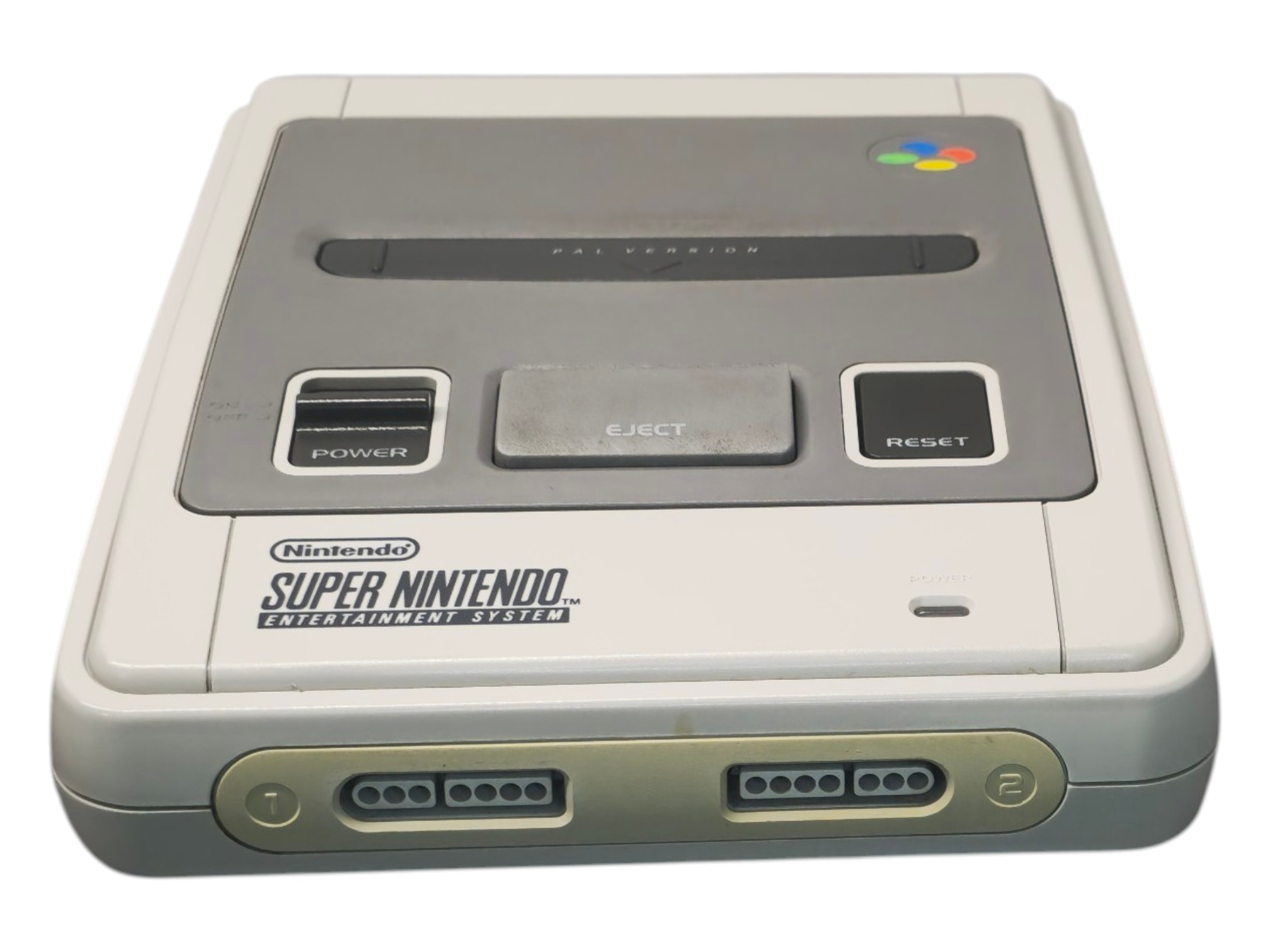
The SNSP-001A (FRG) is an original European PAL version associated with distribution in Germany and other German-speaking markets. Featuring the familiar light-grey enclosure, rounded cartridge slot, colourful controller buttons, and Nintendo’s distinctive industrial design, it represents the European identity of one of the most successful consoles of the 1990s.
Powered by a custom Ricoh 5A22 processor, advanced Picture Processing Units, and a revolutionary Sony-developed audio subsystem, the Super Nintendo delivered experiences that established new standards for home gaming.
Its legendary library included Super Mario World, The Legend of Zelda: A Link to the Past, Super Metroid, Donkey Kong Country, Super Mario Kart, F-Zero, Street Fighter II, and Secret of Mana.
The console also introduced influential technologies such as Mode 7 graphics, advanced sprite processing, cartridge-based enhancement chips, and the now-standard L and R shoulder buttons.
With approximately 49.10 million consoles sold worldwide, the Super Nintendo became the best-selling console of the fourth generation and remains one of Nintendo’s most historically important products.
Today, the European SNSP-001A represents a remarkable period when 2D video game development reached unprecedented levels of sophistication.
📘 Introduction
The Super Nintendo Entertainment System was Nintendo’s successor to the Nintendo Entertainment System, commonly known as the NES.
It was released in:
- Japan: November 21, 1990, as the Super Famicom
- North America: August 1991, as the Super Nintendo Entertainment System
- United Kingdom and Ireland: April 11, 1992
- Other major European markets: June 6, 1992
The console entered a market where Nintendo had already achieved exceptional success through the NES and Game Boy.
However, the growing popularity of Sega’s Mega Drive created intense competition.
Nintendo responded with a system designed around improved graphics, sound, and gameplay capabilities.
Key Innovations
- 16-bit main processor architecture
- Advanced sprite and background graphics
- Mode 7 rotation and scaling effects
- Large colour palette
- Dedicated stereo audio hardware
- Eight-channel sample-based sound
- L and R controller shoulder buttons
- Interchangeable ROM cartridges
- Support for specialised cartridge coprocessors
- Expansion through optional accessories
The Super Nintendo became famous not merely for technical specifications but for how developers used its capabilities.
Its games combined carefully crafted pixel art, expressive animation, memorable music, and increasingly sophisticated gameplay systems.
🏭 Nintendo: From the NES to the 16-Bit Era
Nintendo’s development of the Super Nintendo was part of a much longer history.
Founded in Kyoto, Japan, in 1889, Nintendo originally manufactured playing cards before gradually expanding into toys and electronic entertainment.
During the 1970s and 1980s, the company became a major force in the video game industry.
Game & Watch
Introduced in 1980, the Game & Watch series helped establish Nintendo’s reputation for innovative portable gaming hardware.
Famicom / Nintendo Entertainment System
The Family Computer, released in Japan in 1983, became one of the most influential consoles in history.
Its international version, the Nintendo Entertainment System, helped revitalise the video game market.
The Need for a Successor
By the late 1980s, competitors were introducing more sophisticated gaming hardware.
Sega’s Mega Drive offered advanced 16-bit processing and strong arcade-style gaming capabilities.
Nintendo needed a new platform capable of maintaining its competitive position.
The Super Famicom Project
Nintendo developed a more powerful system that retained its focus on accessible gameplay and carefully designed software.
The Super Famicom launched in Japan in November 1990.
Its success established the foundation for international distribution.
The European Super Nintendo
The European version followed in 1992.
It adopted a design closely related to the Japanese Super Famicom rather than the substantially different North American enclosure.
The result became one of the most recognisable gaming products in European households during the early and mid-1990s.
🇩🇪 The SNSP-001A (FRG) European Edition
The SNSP-001A (FRG) is a specific regional version of the Super Nintendo Entertainment System.
Its designation provides useful information about its intended market.
Understanding SNSP-001A
The SNSP prefix identifies the PAL-region Super Nintendo hardware family.
The 001 designation identifies the console itself.
The complete code differentiates this hardware from other products and accessories within Nintendo’s system.
The FRG Suffix
The FRG suffix refers to the Federal Republic of Germany.
In Nintendo’s historical regional identification system, it was associated with the German-speaking European distribution area.
This included markets such as:
- Germany
- Austria
- Switzerland
The regional suffix identifies the intended distribution configuration rather than establishing the exact country in which an individual console was purchased.
Nintendo of Europe
European Nintendo hardware and packaging commonly carried the address of Nintendo of Europe GmbH in Großostheim, Germany.
The designation D-63760 Großostheim refers to the company’s former German address.
It is not a manufacturing date, console model, or motherboard identifier.
Regional Distinctions
The FRG version is part of the standard European PAL hardware family.
It differs from certain France-specific versions, which used alternative video output arrangements.
Why This Version Matters
The SNSP-001A (FRG) provides a useful example of Nintendo’s regional hardware distribution during the 1990s.
It is particularly relevant for documenting how the Super Nintendo reached continental European consumers.
🖥️ The Original European SNES Design
The European Super Nintendo features a compact light-grey plastic enclosure.
Its rounded design closely resembles the Japanese Super Famicom.
Exterior Features
- Light-grey plastic housing
- Dark-grey control elements
- Top-mounted cartridge slot
- Power switch
- Reset button
- Cartridge Eject mechanism
- Two front controller ports
- Red power indicator LED
- Rear AV Multi Out connector
- RF television output on standard FRG configurations
- External power connection
- Underside expansion connector
A Distinctive Cartridge System
Games are inserted vertically into the upper cartridge slot.
A mechanical Eject button helps remove cartridges.
Power & Reset
The Power switch activates the console.
The Reset button restarts supported software without requiring the cartridge to be removed.
A Compact Appearance
The European Super Nintendo is relatively small compared with many later consoles.
Its rounded shape and simple controls were designed for convenient home use.
A Recognisable Design
The grey enclosure and colourful Nintendo controller became symbols of the 16-bit generation.
The hardware remains instantly recognisable to retro gaming enthusiasts.
⚙️ Technical Specifications
The Super Nintendo combines a custom 16-bit processor with dedicated graphics and audio hardware.
Hardware Overview
- Manufacturer: Nintendo
- Console: Super Nintendo Entertainment System
- Model: SNSP-001A (FRG)
- Original platform release: November 21, 1990
- European release: 1992
- Region: PAL / Europe
- Distribution designation: FRG
- Generation: Fourth-generation home console
- Colour: Light Grey
- CPU: Ricoh 5A22
- Architecture: 16-bit WDC 65C816-derived
- CPU clock: Variable, approximately 1.79–3.58 MHz
- Main RAM: 128 KB
- Video RAM: 64 KB
- Audio RAM: 64 KB
- Graphics: Dedicated Picture Processing Units
- Graphics modes: Eight principal background modes, numbered 0–7
- Typical resolution: 256×224 pixels
- High-resolution modes: Up to 512×448 pixels
- Colour palette: 32,768 colours
- Common simultaneous colour capability: Up to 256 colours in standard display modes
- Sprite capability: Up to 128 hardware sprites
- Audio processor: Sony SPC700
- Audio DSP: Sony S-DSP
- Audio channels: Eight
- Game media: ROM cartridges
- Controller ports: Two
- Video connection: Nintendo AV Multi Out and regional RF output
- Video standard: PAL, 50 Hz
- Power input: 9V AC, approximately 1.3A
- External expansion: Cartridge enhancement hardware and compatible peripherals
- Dimensions: Approximately 200 × 72 × 242 mm
The exact motherboard revision is not established by the exterior model designation alone.
Different internal board designs were used during the European SNES production period.
🧠 The Ricoh 5A22: Nintendo’s 16-Bit Processor
At the heart of the Super Nintendo is the Ricoh 5A22.
This custom processor is based on the Western Design Center’s 65C816 architecture.
The 65C816 Connection
The 65C816 evolved from the 6502 processor family.
Related processor technology had appeared in many influential earlier computers and consoles.
16-Bit Computing
The SNES processor offers 16-bit internal processing capabilities and a larger address space than the original NES.
This enabled more sophisticated games and software systems.
Variable Clock Frequency
The CPU does not operate at one constant frequency during every memory access.
Depending on the operation and memory region, effective speeds range from approximately 1.79 MHz to 3.58 MHz.
Processor Responsibilities
The CPU handles:
- Game logic
- Artificial intelligence
- Character movement
- Collision detection
- Input processing
- Memory management
- Coordination with the graphics hardware
- General software execution
A Different Philosophy from Sega
The Sega Mega Drive used a Motorola 68000 processor running at approximately 7.67 MHz.
The SNES CPU operated at a lower clock frequency.
However, the overall capabilities of the two systems cannot be determined through clock speed alone.
Nintendo relied heavily on specialised graphics and audio hardware.
The Importance of Hardware Balance
The Ricoh processor was only one part of the SNES architecture.
The console’s visual and audio capabilities depended on dedicated processing components working together.
This design allowed developers to create visually sophisticated games without requiring a particularly fast general-purpose CPU.
🎨 Picture Processing Units & Advanced 2D Graphics
The Super Nintendo includes dedicated graphics hardware responsible for rendering backgrounds, sprites, and special effects.
These components are commonly identified as the Picture Processing Units, or PPUs.
Graphics Capabilities
- Multiple background layers
- Tile-based rendering
- Hardware sprites
- Palette-based graphics
- Scrolling
- Transparency effects
- Colour mathematics
- Mosaic effects
- Window masking
- Rotation and scaling in Mode 7
A Major Improvement over NES
The original NES supported relatively simple background and sprite arrangements.
The Super Nintendo offered more flexible graphical layers and significantly richer colour.
The Colour Palette
The SNES supports a palette of 32,768 possible colours.
This was a substantial improvement over Nintendo’s previous home console.
Sprites
The hardware supports up to 128 sprites, subject to display and scanline limits.
Sprites can represent:
- Playable characters
- Enemies
- Projectiles
- Animated objects
- Interface elements
Multiple Scrolling Backgrounds
Different background layers can move independently.
This creates depth effects commonly known as parallax scrolling.
A New Standard for Pixel Art
The graphics capabilities encouraged developers to create detailed characters, expressive animation, and richly illustrated environments.
Many Super Nintendo games remain celebrated for their pixel art.
🌪️ Mode 7: Rotation, Scaling & Simulated 3D
One of the most famous SNES technologies is Mode 7.
It is a special graphics mode that allows a background layer to be rotated and scaled through hardware-assisted transformations.
What Mode 7 Does
Mode 7 can transform a two-dimensional background to create the impression of movement through a three-dimensional space.
Its effects include:
- Rotation
- Scaling
- Perspective-like views
- Rapid background movement
- Simulated ground planes
Not True Polygonal 3D
Mode 7 does not transform the Super Nintendo into a conventional polygon-based 3D system.
It manipulates a two-dimensional background through mathematical transformations.
F-Zero
F-Zero used Mode 7 to create a futuristic racing experience.
The track could rotate and scale as the player’s vehicle moved.
Super Mario Kart
Super Mario Kart used Mode 7 for its racing tracks.
The characters and objects were combined with the transformed background to create a convincing arcade racing experience.
Pilotwings
Pilotwings used scaling and rotation effects to simulate aerial movement.
A Major Technical Achievement
Mode 7 became one of the Super Nintendo’s most recognisable technological features.
It allowed developers to create effects that were difficult to achieve efficiently on earlier consoles.
🌈 PAL Graphics & the European 50 Hz Experience
The SNSP-001A (FRG) belongs to the European PAL hardware family.
This means it uses video timings different from Japanese and North American consoles.
PAL Television
Traditional European PAL gaming systems commonly operate at a 50 Hz field rate.
Japanese and North American NTSC systems use approximately 60 Hz.
The Difference in Gameplay
Some European game conversions were not fully optimised for the PAL format.
As a result, certain titles could display:
- Slower gameplay
- Different frame timing
- Black borders
- Adjusted image height
- Different screen positioning
Not Every PAL Game Was the Same
Developers could optimise games for European television standards.
Some later releases used techniques that reduced differences between PAL and NTSC versions.
Why the Distinction Matters
A PAL Super Nintendo reproduces the timing characteristics of the European hardware.
This is important when comparing original games across regions.
Cartridge Compatibility
PAL SNES systems use a regional lockout mechanism.
Unmodified European consoles do not normally accept and run NTSC cartridges simply by inserting them.
Physical Differences
Cartridge shells and console slots can also differ between regions.
This creates an additional compatibility consideration.
Historical Preservation
For a technology museum, retaining the original PAL configuration helps document the authentic European gaming experience.
📺 RF, Composite Video & RGB SCART
The European Super Nintendo was designed for analogue televisions.
The standard FRG configuration provides video connections suited to the European consumer electronics market.
RF Output
RF allows a compatible television to receive the console’s picture through its analogue tuner.
This was particularly useful for older television equipment.
Composite Video
Composite video carries brightness and colour information through one analogue signal.
It was widely supported by televisions during the 1990s.
RGB Video
The Super Nintendo can provide RGB video through its AV Multi Out interface.
RGB separates the primary colour signals, producing a cleaner image than composite on compatible equipment.
SCART
SCART was common on European televisions.
A correctly specified RGB SCART cable can provide high-quality analogue output.
PAL Cable Differences
European and NTSC Nintendo video cables are not always electrically identical.
Certain RGB and composite cable arrangements use different resistors or capacitors.
Using a cable designed specifically for PAL SNES hardware is recommended.
Modern Displays
The original SNES does not have HDMI.
Modern televisions may require suitable analogue inputs, retro video scalers, or conversion equipment.
The CRT Experience
A period-correct CRT television remains an excellent way to demonstrate the system’s original graphics.
Its analogue characteristics complement the console’s pixel art and standard-definition output.
🎵 Sony SPC700: One of Gaming’s Greatest Sound Systems
The Super Nintendo’s audio hardware was developed with significant involvement from Sony.
Its sound system includes the Sony SPC700 processor and a dedicated digital signal processor.
Audio Architecture
- Sony SPC700 sound processor
- Dedicated S-DSP
- 64 KB audio RAM
- Eight audio channels
- Sample-based synthesis
- Digital filtering and effects
- Stereo output
- Echo and reverb capabilities
The SPC700
The SPC700 controls audio-related operations.
It works with the sound DSP to reproduce music and sound effects.
Sample-Based Audio
Unlike earlier systems relying heavily on comparatively simple waveforms, the SNES can reproduce digitised sound samples.
This allows games to use more realistic instrument sounds.
Eight Audio Channels
The system can mix up to eight audio voices.
Developers can allocate these to music, sound effects, and other audio elements.
Echo & Reverb
The sound processor supports effects that create additional depth and atmosphere.
A Distinctive Sonic Identity
The Super Nintendo became famous for warm, expressive soundtracks.
Many composers used its capabilities to produce music that remains highly regarded today.
🎼 Legendary Super Nintendo Soundtracks
The SNES produced some of the most memorable music in video game history.
Super Mario World
Composed by Koji Kondo, its cheerful melodies became closely associated with the console.
The Legend of Zelda: A Link to the Past
The game introduced and refined musical themes that became central to the Zelda franchise.
Super Metroid
Its atmospheric soundtrack contributed significantly to the game’s sense of isolation and exploration.
Donkey Kong Country
David Wise and the other contributing composers created a sophisticated audio identity using the SNES sample-based hardware.
Secret of Mana
Hiroki Kikuta’s soundtrack became one of the most celebrated RPG scores of the generation.
Chrono Trigger
The Japanese and North American releases became famous for music by Yasunori Mitsuda, with additional contributions from Nobuo Uematsu and Noriko Matsueda.
Chrono Trigger was not originally released as a standard European PAL SNES cartridge.
A Lasting Audio Legacy
SNES music remains important to musicians, composers, and video game historians.
The system demonstrated that electronic game music could become a major artistic component of interactive entertainment.
💾 ROM Cartridges & Game Storage
The Super Nintendo continued Nintendo’s established approach of distributing games on interchangeable ROM cartridges.
Advantages of Cartridges
- Fast data access
- Minimal loading times
- Durable construction
- No optical drive
- Convenient handling
- Direct access to game program data
Cartridge Capacity
Game Paks varied considerably in storage capacity.
Nintendo’s commercial range included titles from a few megabits to much larger cartridges containing tens of megabits.
The Role of Memory
Cartridges could contain different types of memory.
These included:
- Program ROM
- Battery-backed SRAM
- Additional processing hardware
- Specialised memory components
Battery-Backed Saves
Some games stored progress using SRAM maintained by a small internal battery.
This enabled players to resume longer adventures.
An Important Difference from Later Consoles
The SNES did not use a conventional removable Memory Card system.
Save capabilities were generally provided within the individual game cartridge.
Long-Term Preservation
Original cartridges may contain ageing batteries and electronic components.
For games with battery-backed saves, replacing a depleted battery may be necessary to preserve save functionality.
🧩 Enhancement Chips: Extra Hardware Inside Game Cartridges
One of the Super Nintendo’s most innovative architectural features was its ability to use special processors inside individual game cartridges.
These chips extended the capabilities of the base console.
Why Enhancement Chips Mattered
The SNES hardware remained unchanged throughout most of its commercial life.
However, developers could include additional processing technology inside certain games.
This allowed more advanced effects without requiring consumers to purchase a completely new console.
The Super FX Chip
Developed with Argonaut Software, the Super FX chip enabled advanced graphics calculations.
It became particularly associated with polygonal games.
SA-1
The SA-1 is a specialised coprocessor used by certain later games.
It provides additional processing capabilities beyond those of the main SNES CPU.
DSP Chips
Specialised digital signal processors assisted with mathematical operations required by particular games.
Other Enhancement Hardware
Additional cartridge hardware included decompression and other specialised capabilities.
Historical Importance
The enhancement-chip approach allowed Nintendo to extend the practical capabilities of its 16-bit platform.
It represents an unusual form of hardware expansion through software media.
🦊 Starwing / Star Fox: Polygonal Gaming on SNES
One of the most important demonstrations of enhancement-chip technology was Star Fox, released in Europe under the title Starwing.
The game was introduced in 1993.
The Super FX Chip
Starwing used the Super FX processor within the cartridge to perform calculations associated with three-dimensional graphics.
Gameplay Features
- Polygonal spacecraft
- Three-dimensional environments
- Rail-shooter gameplay
- Multiple stages
- Aerial combat
- Cinematic presentation
A Technological Milestone
The game demonstrated that the SNES could support polygon-based experiences with additional cartridge hardware.
The European Name
The European title Starwing is an important example of regional game branding.
A Lasting Franchise
The success of Star Fox led to later games on Nintendo 64, GameCube, and other Nintendo systems.
Historical Importance
Starwing represents one of the most important attempts to bring real-time polygonal gaming to a mainstream 16-bit console.
🕹️ The Super Nintendo Controller: A New Standard
The Super Nintendo controller is one of the most influential input devices in gaming history.
Its design evolved from the original NES controller while introducing additional buttons and improved ergonomics.
Controller Features
- Directional pad
- A button
- B button
- X button
- Y button
- L shoulder button
- R shoulder button
- Start button
- Select button
The European Colour Scheme
European and Japanese controllers feature four colourful action buttons.
This distinguishes them visually from the predominantly purple button arrangement used on the North American SNES controller.
The L & R Buttons
The two shoulder buttons were an important innovation.
They provided additional controls without requiring more buttons on the front surface.
The Diamond Layout
The A, B, X, and Y buttons form a diamond arrangement.
This became highly influential in later controller design.
Improved Ergonomics
The rounded enclosure was more comfortable than the original rectangular NES controller for many players.
A Lasting Legacy
The SNES controller helped establish the basic arrangement used by countless later gamepads.
Its design influenced Nintendo’s own controllers and competing systems.
🎮 Games & Software Library
The Super Nintendo developed one of the most celebrated software libraries in gaming history.
Its catalogue includes platformers, role-playing games, racing titles, fighting games, strategy games, action adventures, and experimental software.
Notable SNES Games
- Super Mario World
- Super Mario All-Stars
- Super Mario World 2: Yoshi’s Island
- The Legend of Zelda: A Link to the Past
- Super Metroid
- Super Mario Kart
- F-Zero
- Pilotwings
- Starwing / Star Fox
- Donkey Kong Country
- Donkey Kong Country 2: Diddy’s Kong Quest
- Donkey Kong Country 3: Dixie Kong’s Double Trouble!
- Street Fighter II
- Street Fighter II Turbo
- Super Street Fighter II
- Mortal Kombat II
- Super Castlevania IV
- Super Probotector: Alien Rebels
- Secret of Mana
- Secret of Evermore
- Terranigma
- Illusion of Time
- Lufia
- ActRaiser
- Mega Man X
- Earthworm Jim
- Super Bomberman
- Super Bomberman 2
- Super Bomberman 3
- Kirby’s Dream Course
- Kirby’s Fun Pak
- Super Punch-Out!!
- Super Tennis
- Super Soccer
- Stunt Race FX
- Axelay
- Super R-Type
- SimCity
- Tetris Attack
- Batman Returns
- Aladdin
- The Lion King
- Prince of Persia
- International Superstar Soccer Deluxe
The complete international SNES library contains many additional releases, including regional exclusives that were not officially distributed throughout Europe.
🍄 Super Mario World: A Legendary Launch Game
Released alongside the Japanese Super Famicom in 1990, Super Mario World became one of the most important games in Nintendo history.
It introduced players to Dinosaur Land and Mario’s new companion, Yoshi.
Gameplay Features
- Side-scrolling platforming
- Large interconnected world map
- Hidden exits
- Secret levels
- New power-ups
- Yoshi gameplay
- Detailed animation
- Colourful environments
A New Generation of Mario
Super Mario World expanded the formula established by earlier NES titles.
Its levels were larger, and its gameplay offered more exploration.
Yoshi
The introduction of Yoshi became one of the game’s most memorable features.
The character subsequently developed into a major part of Nintendo’s gaming universe.
Technical Achievement
The game demonstrated the Super Nintendo’s graphical and audio capabilities.
Historical Importance
Super Mario World remains one of the defining platform games of the 16-bit era.
It is also closely associated with the SNES launch experience.
🗡️ The Legend of Zelda: A Link to the Past
Released in Japan in 1991 and Europe in 1992, The Legend of Zelda: A Link to the Past became one of the most influential action-adventure games ever created.
Gameplay Features
- Large explorable world
- Dungeons
- Environmental puzzles
- Real-time combat
- Equipment upgrades
- Hidden secrets
- Parallel-world gameplay
- Rich fantasy storytelling
A Major Evolution
The game expanded significantly on the structure of the original Legend of Zelda.
Its world design, item progression, and dungeon structure became important conventions within the series.
Graphics & Sound
The SNES hardware allowed detailed environments and expressive animation.
Its soundtrack introduced several memorable musical themes.
Historical Importance
A Link to the Past became a benchmark for action-adventure game design.
It continues to influence Zelda games and other adventure titles.
🏎️ Super Mario Kart & the Birth of a Franchise
Released in 1992, Super Mario Kart introduced one of Nintendo’s most successful racing franchises.
Gameplay Features
- Kart racing
- Familiar Nintendo characters
- Power-ups
- Competitive gameplay
- Split-screen multiplayer
- Battle Mode
- Mode 7 track graphics
Mode 7 Racing
The game’s tracks use rotated and scaled backgrounds to create the appearance of three-dimensional movement.
Two-Player Competition
The game became particularly popular because of its competitive multiplayer.
A New Gaming Genre
Although kart-style racing ideas existed earlier, Super Mario Kart helped establish the modern mascot kart-racing formula.
A Lasting Legacy
The Mario Kart franchise subsequently became one of Nintendo’s most important gaming properties.
The original SNES game remains an essential part of its history.
🦍 Donkey Kong Country: The Pre-Rendered Graphics Revolution
Released in 1994, Donkey Kong Country became one of the SNES’s greatest commercial successes.
Developed by Rare, it introduced a visual presentation that appeared unusually advanced for a 16-bit console.
Pre-Rendered Graphics
Rare created detailed three-dimensional character models using computer graphics workstations.
These models were rendered into two-dimensional animation frames suitable for the SNES.
Gameplay Features
- Side-scrolling platform action
- Detailed character animation
- Multiple playable characters
- Animal companions
- Hidden areas
- Challenging levels
- Memorable soundtracks
The Role of Rare
Rare became one of Nintendo’s most important development partners during the 1990s.
A Technical Achievement
Donkey Kong Country demonstrated how sophisticated artwork and clever software techniques could extend the perceived capabilities of existing hardware.
A Major Franchise Revival
The game successfully reintroduced Donkey Kong to a new generation.
It also led to two celebrated SNES sequels.
🚀 Super Metroid: Exploration & Atmosphere
Released in 1994, Super Metroid became one of the most influential action-adventure games of its generation.
Players control Samus Aran while exploring the alien planet Zebes.
Gameplay Features
- Interconnected environments
- Nonlinear exploration
- Weapon upgrades
- Hidden passages
- Atmospheric storytelling
- Environmental puzzles
- Challenging combat
A Connected World
Super Metroid allowed players to explore a large interconnected environment.
New abilities opened access to previously inaccessible areas.
Atmosphere
The game used lighting, music, and environmental design to create a strong sense of isolation.
The Metroidvania Connection
Super Metroid became one of the most important inspirations for the genre commonly called Metroidvania.
Historical Importance
Its level design and exploration systems continue to influence modern independent and mainstream games.
⚔️ Street Fighter II & the Console Fighting Boom
The Super Nintendo became an important platform for Street Fighter II, one of the most influential fighting games ever released.
The Arcade Phenomenon
Developed by Capcom, Street Fighter II became a worldwide arcade success.
The SNES Conversion
The home version allowed players to experience the fighting game in their living rooms.
Gameplay Features
- Multiple playable fighters
- Special attacks
- Competitive multiplayer
- Distinctive fighting styles
- Responsive controls
- Arcade-inspired presentation
The Controller Advantage
The SNES’s six action and shoulder buttons were particularly suitable for Street Fighter’s control system.
A Major Commercial Success
Street Fighter II contributed significantly to the Super Nintendo’s popularity.
An Important Genre
The game helped establish competitive fighting games as a major part of console gaming culture.
🌳 Secret of Mana: A Multiplayer Action RPG
Released in Europe in 1994, Secret of Mana became one of the most celebrated role-playing games on the Super Nintendo.
Developed by Square, it combined action combat with a fantasy adventure.
Gameplay Features
- Real-time combat
- Character progression
- Large fantasy world
- Weapon upgrades
- Magic systems
- Cooperative multiplayer
- Memorable music
An Unusual Multiplayer RPG
With a compatible multitap accessory, Secret of Mana supports up to three players.
A Distinctive Experience
The game combines the exploration and storytelling of a role-playing game with direct action controls.
Historical Importance
Secret of Mana became especially influential among European RPG enthusiasts.
It remains one of the most celebrated games from the SNES generation.
🦖 Super Mario World 2: Yoshi’s Island
Released in 1995, Yoshi’s Island introduced a distinctive visual style and creative platforming mechanics.
Gameplay Features
- Yoshi as the playable character
- Egg-throwing mechanics
- Detailed animated environments
- Hand-drawn visual style
- Puzzle-platform gameplay
- Extensive level design
The Super FX2 Chip
Yoshi’s Island uses specialised cartridge hardware associated with the Super FX family.
This helps support additional graphical effects.
An Artistic Direction
Instead of concentrating on realistic graphics, the game uses a colourful illustrated appearance.
Technical Creativity
The game demonstrates how additional processing hardware and strong artistic direction could expand the capabilities of a mature console.
A Lasting Legacy
Yoshi’s Island remains one of Nintendo’s most celebrated platform games.
🧩 Super Nintendo Accessories
Nintendo developed numerous peripherals for the SNES.
Super Game Boy
The Super Game Boy allows compatible original Game Boy games to be played through a television-connected SNES.
It uses additional hardware inside a cartridge-shaped adapter.
SNES Mouse
The SNES Mouse was designed for compatible software, particularly Mario Paint.
It offered an alternative to the conventional gamepad.
Super Scope
The Super Scope is a light-gun-style accessory designed for compatible CRT televisions.
It introduced shooting and targeting gameplay.
Multitap
Multitap accessories allow additional controllers to be connected for supported multiplayer games.
Super Advantage
The Super Advantage is an arcade-style controller featuring a joystick and larger buttons.
Game Genie
Third-party accessories such as Game Genie allowed supported gameplay values and behaviour to be modified.
Satellaview
The Satellaview was a Japan-only Super Famicom expansion that supported satellite-delivered software and content.
It was not a standard European SNES accessory.
An Expandable Platform
These peripherals demonstrate how Nintendo and third-party manufacturers expanded the console beyond its standard two-controller configuration.
🎮 The Super Game Boy: Handheld Games on Television
Released in 1994, the Super Game Boy is one of the most historically important SNES peripherals.
The Concept
The device is shaped like a Super Nintendo cartridge.
It contains an additional slot for compatible Game Boy cartridges.
How It Works
The accessory incorporates Game Boy-related processing hardware and communicates with the SNES for display and control functions.
Additional Features
- Game Boy compatibility
- Colour palettes
- Decorative borders
- Television display
- SNES controller input
- Special enhancements in certain games
A Cross-Platform Experience
The Super Game Boy allowed players to enjoy Game Boy software on a home television.
Historical Importance
This represented an important early attempt to connect Nintendo’s handheld and home-console gaming ecosystems.
The concept later influenced products such as the Game Boy Player for Nintendo GameCube.
🥊 Super Nintendo vs. Sega Mega Drive
One of the most famous commercial rivalries in gaming history was the competition between the Super Nintendo and Sega Mega Drive.
Super Nintendo
- Ricoh 5A22 CPU
- Advanced dedicated graphics hardware
- Mode 7
- 32,768-colour palette
- Eight-channel sample-based stereo audio
- L and R shoulder buttons
- Cartridge enhancement chips
Sega Mega Drive
- Motorola 68000 CPU
- Zilog Z80 secondary processor
- Yamaha FM sound hardware
- Traditional sprite and tile graphics
- Faster main CPU clock
- Extensive arcade-oriented game library
Different Strengths
The Mega Drive became associated with fast action, arcade-style presentation, and a powerful main processor.
The Super Nintendo became particularly famous for detailed graphics, colour effects, and sophisticated audio.
The 16-Bit Console War
Nintendo and Sega competed through hardware, exclusive games, marketing, and pricing.
The rivalry became one of the defining commercial stories of the early 1990s.
A Creative Golden Age
Both consoles produced legendary games.
Their competition contributed significantly to the evolution of video game design.
🔄 Super Nintendo vs. Nintendo NES
The SNES represented a major technological improvement over Nintendo’s previous console.
Nintendo NES
- Introduced in 1983 in Japan
- 8-bit processor architecture
- Limited system memory
- Relatively simple colour graphics
- Basic sprite hardware
- Five-channel sound system
- Two-button controller
Super Nintendo
- Introduced in 1990 in Japan
- 16-bit processor architecture
- 128 KB main RAM
- Advanced background and sprite hardware
- Large colour palette
- Mode 7
- Eight-channel stereo sound
- Six-button controller arrangement with shoulder buttons
A Generational Leap
The SNES offered larger games, more elaborate music, and considerably improved graphics.
Not Natively Backward Compatible
The original Super Nintendo does not play NES game cartridges.
The two consoles use different hardware and cartridge interfaces.
Nintendo’s Continuing Design Philosophy
Despite the hardware improvements, Nintendo maintained its focus on accessible controls and carefully designed games.
🌍 Worldwide Sales & Cultural Impact
The Super Nintendo became one of the most successful video game consoles of the 1990s.
Nintendo’s official historical figures record approximately:
- 49.10 million consoles sold worldwide
- 379.06 million software units sold worldwide
A Global Success
The platform achieved significant popularity in:
- Japan
- North America
- Europe
- Australia
- Other international markets
Major Franchises
The console strengthened several of Nintendo’s most important properties, including:
- Super Mario
- The Legend of Zelda
- Donkey Kong
- Metroid
- Mario Kart
- Kirby
- F-Zero
Third-Party Contributions
Companies such as Capcom, Konami, Square, Enix, Rare, and others produced important games for the platform.
An Artistic Golden Age
The SNES became especially associated with beautifully designed two-dimensional games.
Its graphics and music remain influential among modern developers.
A Lasting Legacy
Many contemporary independent games draw inspiration from the SNES era.
Its pixel art, gameplay systems, and musical style continue to influence modern gaming culture.
🇬🇷 The Super Nintendo in Greece
The Super Nintendo reached Europe in 1992, during an important period for the Greek gaming market.
Greek players were already familiar with Nintendo through the NES and Game Boy.
However, Sega’s Master System and Mega Drive were also highly visible in European markets.
The 16-Bit Generation
The Super Nintendo offered experiences that differed considerably from earlier 8-bit systems.
Its colourful graphics, stereo sound, and advanced gameplay attracted dedicated players.
Popular Franchises
Titles such as Super Mario World, Street Fighter II, Donkey Kong Country, and Super Mario Kart became associated with the platform’s international popularity.
The European PAL Configuration
A PAL SNES represents the hardware intended for traditional European television standards.
This is particularly relevant when documenting gaming equipment used in Greece.
The FRG Edition
Although FRG denotes a German-speaking distribution configuration, such European hardware can also be encountered in collections outside its original intended market.
An Important Museum Exhibit
The Super Nintendo represents the development of mature 2D gaming technology before the mainstream transition to 3D consoles.
For a technology museum, it provides a valuable connection between the NES generation and the Nintendo 64 era.
🔧 Build Quality & Long-Term Reliability
The Super Nintendo is generally regarded as a durable home console.
However, original units are now more than thirty years old.
Their electronic and mechanical components may require maintenance.
Common Maintenance Areas
- Cartridge connector
- Power switch
- Reset button
- Eject mechanism
- Controller ports
- AV Multi Out connector
- RF output
- Internal capacitors
- Voltage regulation circuitry
- Power input connector
- Motherboard solder joints
Cartridge Reading Problems
Dirty or oxidised contacts can cause:
- Blank screens
- Failed startup
- Corrupted graphics
- Intermittent operation
- Game crashes
Plastic Yellowing
One of the most recognisable problems affecting original SNES consoles is yellowing of the plastic enclosure.
Certain plastic formulations can change colour over time.
Factors include:
- Ageing
- Exposure to heat
- Ultraviolet light
- Environmental conditions
- Chemical changes within the plastic
Preserving the Original Shell
The original enclosure is historically important.
Gentle cleaning is generally preferable to aggressive chemical treatment.
Audio & Graphics Problems
Ageing capacitors or defective processing components can produce audio or video faults.
Correct diagnosis is important before replacing components.
Long-Term Storage
Recommended preservation practices include controlled temperature, moderate humidity, minimal dust, and protection from direct sunlight.
🔌 An Important Detail: PAL SNES Power Supply
The European Super Nintendo uses a different power arrangement from certain Japanese and North American models.
The FRG Power Requirement
The standard European SNSP-001A system is designed for approximately:
9V AC — 1.3A
AC vs. DC
This is particularly important.
The Japanese Super Famicom and North American SNES use different DC power arrangements.
The European PAL SNES uses an AC-input circuit.
Why This Matters
An adapter that physically fits the connector is not necessarily electrically appropriate.
The voltage, current capacity, connector dimensions, and AC/DC output type should all be verified.
A European Design Feature
The PAL motherboard contains circuitry that rectifies the AC input and provides internal regulated power.
It also supports voltage generation associated with SCART television switching functions.
Preservation Advice
When testing original hardware, a correctly specified power adapter is essential.
Improper power supplies can create faults or damage electronic components.
For museum use, the power requirements should be documented alongside the console.
🧩 Motherboard Revisions: Multi-Chip vs. 1CHIP
The Super Nintendo was manufactured with different internal motherboard designs.
These revisions reflected improvements in component integration and manufacturing efficiency.
Early Multi-Chip Hardware
Early systems use separate integrated circuits for functions such as:
- Main CPU
- Picture Processing Unit 1
- Picture Processing Unit 2
European examples include the SNSP-CPU-01 and SNSP-CPU-02 families.
Later 1CHIP Hardware
Nintendo later introduced revised hardware that integrated the main CPU and graphics processing units into a more consolidated design.
PAL variants include the SNSP-CPU-1CHIP family.
Image Quality Differences
Later 1CHIP consoles are particularly well known among retro gaming enthusiasts because of their sharper analogue RGB output.
However, these revisions can have their own minor display and software compatibility differences.
The Model Number Is Not Enough
The external SNSP-001A designation does not identify the precise internal motherboard.
Both earlier and later hardware variations can appear within the broad European console family.
How to Identify the Board
Reliable identification requires additional physical evidence, such as:
- Internal board markings
- Component layout
- Confirmed motherboard photographs
- Other revision-specific hardware characteristics
Why This Matters for Collectors
Motherboard revision information helps document:
- Original manufacturing technology
- Video output characteristics
- Reliability differences
- Repair compatibility
- Historical hardware development
🛠️ Modern Restoration & Video Improvements
The Super Nintendo remains a popular system among retro hardware enthusiasts.
Modern accessories and restoration techniques can help preserve functioning original consoles.
Common Restoration Activities
- Capacitor inspection
- Cartridge connector cleaning
- Controller port maintenance
- Power supply replacement
- Video connector repair
- Enclosure cleaning
- Switch and button maintenance
- Internal board cleaning
Modern RGB Cables
Correctly specified PAL RGB cables can provide excellent video quality on compatible equipment.
Retro Gaming Scalers
Modern scalers can process the SNES’s analogue output for digital displays.
Flash Cartridges
Specialised flash cartridges can run compatible homebrew and other appropriately sourced software.
Support for games using enhancement chips depends on the particular cartridge hardware.
50/60 Hz Modifications
Certain hardware modifications can allow compatible systems to switch between PAL and NTSC-like video timings.
However, compatibility and correct operation vary by game and modification.
Preserving Authenticity
For museum purposes, original unmodified hardware is valuable.
If modifications are introduced, they should be documented.
Reversible modifications are generally preferable when historical authenticity is a priority.
🏛️ Collectability & Historical Preservation
The SNSP-001A (FRG) is an important collectible because it represents the original European Super Nintendo hardware family.
Its regional designation provides useful information about Nintendo’s continental European distribution.
Important Collecting Factors
- Original Nintendo Super Nintendo console
- Correct SNSP-001A (FRG) identification
- Original light-grey enclosure
- Intact cartridge slot
- Functional Eject mechanism
- Original controller ports
- Correct PAL video output
- Original power adapter, if present
- Original controllers, if present
- Manufacturer labels
- Original packaging
- Instruction manuals
- Original game cartridges
The Importance of the FRG Label
The FRG suffix distinguishes this version from other regional configurations.
Examples include French, British, Scandinavian, and other European distribution variants.
Serial Number Documentation
A console’s individual serial number is useful for distinguishing physical units in a collection database.
However, it does not automatically establish the manufacturing date or motherboard revision.
The Importance of Originality
Collectors often examine:
- Original shell condition
- Yellowing
- Cartridge connector
- Eject operation
- Controller ports
- Rear labels
- Motherboard revision
- Power supply
- Signs of modification
The Original European Experience
The FRG version preserves Nintendo’s historical approach to PAL hardware distribution.
It represents the Super Nintendo as it was intended to be used within important continental European markets.
⭐ Why the Super Nintendo Still Matters
The Super Nintendo Entertainment System remains historically significant for numerous reasons:
- It established Nintendo’s successful 16-bit platform
- It introduced more advanced dedicated graphics hardware
- It popularised Mode 7 rotation and scaling effects
- It supported a palette of 32,768 colours
- It featured advanced stereo audio designed with Sony
- It helped popularise L and R controller shoulder buttons
- It supported cartridge-based enhancement processors
- It introduced landmark games such as Super Mario World and Super Mario Kart
- It hosted some of the most celebrated role-playing games of the 1990s
- It became one of the defining products of the Nintendo–Sega rivalry
- It helped establish the modern language of 2D game design
- It achieved nearly 50 million worldwide hardware sales
A Golden Age of 2D Gaming
The SNES is often regarded as one of the finest platforms for traditional two-dimensional gaming.
Its strongest titles combined technical craftsmanship with imaginative design.
An Influential Controller
Its controller established important conventions that remain familiar today.
A Lasting Creative Influence
Modern games continue to borrow from SNES-era graphics, music, storytelling, and gameplay.
An Essential Historic Console
The Super Nintendo represents the maturity of cartridge-based 16-bit gaming before the widespread arrival of CD-ROM and fully polygonal 3D systems.
📦 Items Included in This Collection Entry
Original platform release: 1990
European release: 1992
Regional designation: FRG — German-speaking European distribution
Video standard: PAL / 50 Hz
Original exterior: Light Grey
Motherboard revision: Not yet verified
🏁 Conclusion
The Nintendo Super Nintendo Entertainment System SNSP-001A (FRG) represents one of the most important chapters in the history of home video gaming.
Introduced in Europe in 1992, the Super Nintendo brought advanced 16-bit computing, sophisticated graphics, remarkable stereo sound, and a legendary collection of games into millions of homes.
Its custom Ricoh processor, dedicated Picture Processing Units, Mode 7 technology, and Sony-developed audio system provided developers with powerful tools for creating memorable interactive experiences.
Games such as Super Mario World, The Legend of Zelda: A Link to the Past, Super Metroid, Donkey Kong Country, Super Mario Kart, and Secret of Mana established new standards for creativity and technical achievement.
The system also demonstrated the value of hardware expansion through specialised cartridge coprocessors, allowing selected games to exceed the capabilities of the base console.
Its famous controller design, colourful European buttons, and intuitive shoulder controls influenced the evolution of modern gamepads.
The SNSP-001A (FRG) is particularly interesting because it represents Nintendo’s historical distribution of PAL hardware into German-speaking European markets.
Its regional identification, original video configuration, and distinctive European enclosure make it an important subject for accurate museum documentation.
With 49.10 million consoles sold worldwide, the Super Nintendo became one of the defining entertainment products of the 1990s.
More than three decades after its European introduction, its games remain celebrated, its music continues to inspire composers, and its hardware remains an important subject of technical preservation.
A legendary 16-bit gaming system, a masterpiece of Nintendo hardware design, and one of the most influential home consoles ever created.
