

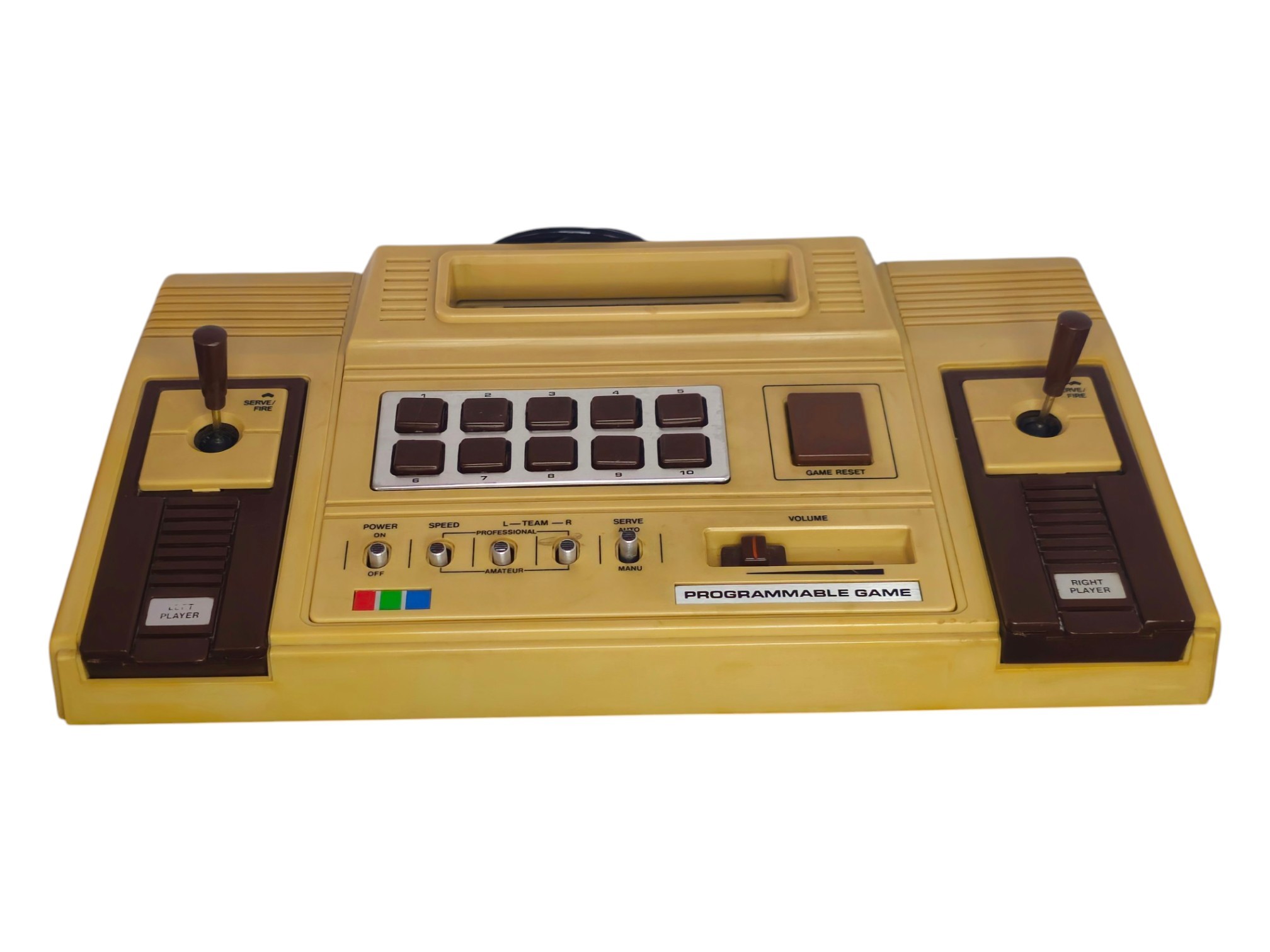
The Programmable Game 9015, as catalogued in this collection, is a fascinating late-1970s television game console belonging to the extended PC-50x family of interchangeable-cartridge gaming systems. Its distinctive cream-and-brown enclosure, two integrated storage compartments for joystick controllers, ten numbered game-selection buttons, and large cartridge slot make it an excellent example of the experimental period between dedicated Pong machines and modern programmable video game consoles.
The physical design closely matches the Soundic SD-090 Programmable TV Game, a system manufactured in Hong Kong around 1978 and distributed internationally under several names, including Programmable Game, Grandstand SD-90 Programmable Game, and ITMC Téléjeu Programmable SD-90.
Unlike traditional Pong consoles containing a permanently installed selection of games, this hardware family uses interchangeable cartridges. These cartridges are particularly interesting because they contain dedicated General Instrument AY-3-8xxx integrated circuits, which generate the actual gameplay.
Consequently, the word programmable has a different meaning from its modern interpretation. The console is not a general-purpose programmable computer, and the cartridges do not operate like conventional ROM-based software cartridges.
Instead, different electronic modules provide different games by changing the hardware responsible for generating them.
This approach allowed players to move beyond Tennis, Hockey, and Squash and experience motorcycle racing, car racing, tank battles, submarine combat, Breakout-style games, and target shooting.
Today, the Programmable Game represents a remarkable stage in the development of cartridge-based entertainment and an important reminder that early console technology followed several different evolutionary paths before software-driven systems became dominant.
📘 Introduction
The Programmable Game belongs to the first-generation home console era, particularly the period between 1977 and 1979, when manufacturers began experimenting with interchangeable electronic game cartridges.
The photographed collection unit features the distinctive enclosure associated with the Soundic SD-090 hardware design, generally dated to 1978.
Its ten numbered buttons, Game Reset control, adjustable difficulty switches, volume slider, and two stored joystick controllers distinguish it from many earlier Pong consoles.
Principal Features
- Interchangeable electronic game cartridges
- Hardware-based game generation
- Ten numbered game-selection buttons
- Large Game Reset button
- Two wired joystick controllers
- Integrated controller storage compartments
- Adjustable game speed
- Independent player difficulty settings
- Automatic and manual serve selection
- Adjustable sound volume
- Colour-capable television output
- Analogue RF television connection
- Optional light-gun support on documented SD-090 configurations
- Battery and external power operation
- Access to the PC-50x family of dedicated game chips
The precise model identification of the photographed individual remains subject to verification from its original manufacturing label.
However, its appearance and control arrangement closely correspond to well-documented Soundic SD-090-type machines.
The 9015 designation is also associated with a related family of cartridge-based Pong consoles, although not all consoles described as 9015 use the same enclosure or cartridge connector.
🏭 Soundic & the Hong Kong Electronics Industry
The hardware design associated with this Programmable Game emerged from Hong Kong’s rapidly growing electronics industry.
During the 1970s, Hong Kong became an important production centre for affordable consumer electronics.
Manufacturers supplied radios, calculators, electronic toys, televisions, and home video game systems to international markets.
Soundic
Soundic was among the manufacturers associated with dedicated television game systems.
Its products appeared under the Soundic name and through numerous international distributors.
The Pong Boom
Following the success of Atari’s Pong, demand for electronic home entertainment expanded rapidly.
Manufacturers began producing increasingly varied gaming devices.
Dedicated Game Chips
General Instrument’s integrated circuits played a particularly important role.
They allowed manufacturers to create sophisticated electronic games without developing a conventional programmable computer.
Soundic Console Families
Important Soundic-related systems included:
- SD-050
- SD-070
- SD-070C
- SD-090
These machines explored the possibilities of interchangeable electronic game modules.
International Rebranding
Related products appeared under different commercial names in several countries.
The same basic hardware design could be marketed through local electronics distributors.
Historical Importance
This international manufacturing system helped spread video gaming across Europe before major console manufacturers established more unified worldwide platforms.
🌍 The Many Names of the Programmable Game
One reason early cartridge-based Pong consoles are difficult to identify is the extensive use of alternative branding.
The SD-090-type design appeared in several markets.
Documented Names
- Soundic SD-090 Programmable TV Game
- Grandstand SD-90 Programmable Game
- ITMC Téléjeu Programmable SD-90
- Programmable Game
- Mark III Video Programmable TV Game
- Mercury Commander Mark III Programmable TV Game
Regional variations could use different branding and packaging.
The Generic Name
Some examples were sold with very little visible manufacturer branding.
Their front panels simply displayed PROGRAMMABLE GAME.
Why This Creates Confusion
Collectors may encounter physically similar machines carrying different names.
At the same time, unrelated or only partially compatible systems may use generic phrases such as Programmable TV Game.
The Importance of Physical Identification
Useful identification details include:
- Enclosure shape
- Controller design
- Numbered buttons
- Cartridge connector
- Original underside label
- Manufacturer markings
- Internal board layout
The 9015 Connection
The broader PC-50x ecosystem includes systems known as 9015, including products associated with Sanwa, Mustang, and Poppy.
These share technological concepts and cartridge-chip families with Soundic systems.
However, a 9015 designation should not automatically be treated as proof of identical internal hardware or interchangeable cartridges.
🖥️ The Distinctive Cream-and-Brown Enclosure
The collection unit features a striking late-1970s industrial design.
Its main enclosure is made from cream or yellow-toned plastic with contrasting dark-brown controller areas.
Visible Features
- Broad, low-profile plastic housing
- Cream-coloured centre section
- Brown side compartments
- Two upright joystick handles
- Central cartridge slot
- Ten dark rectangular selection buttons
- Large Game Reset button
- Physical adjustment switches
- Horizontal volume slider
- Programmable Game nameplate
The Colour Scheme
The combination of cream and brown is characteristic of consumer electronics produced during the late 1970s.
These colours were common in household electrical products and early personal computing equipment.
The Red, Green & Blue Decoration
Three coloured rectangles appear near the lower-left area of the control panel.
They provide a small but recognisable decorative detail.
A Large Central Console
Unlike very compact Pong devices, this machine provides enough space for the controllers to be stored within the main enclosure.
Historical Significance
The design demonstrates a period when manufacturers were experimenting with the physical relationship between the console, controllers, and removable game media.
🕹️ Two Joysticks with Integrated Storage
One of the most distinctive features of this console is the arrangement of its two controllers.
Each joystick fits into a dedicated compartment at the side of the main unit.
Left Player
The left-hand controller is identified as LEFT PLAYER.
Right Player
The right-hand controller is identified as RIGHT PLAYER.
Multi-Directional Movement
The joysticks support directional movement appropriate to the selected cartridge.
Serve/Fire Controls
Documented SD-090 controllers include an additional SERVE/FIRE button.
This is used for certain gameplay actions.
Permanent Wiring
On documented examples, the controllers remain connected through cables.
They can be lifted from the storage compartments for gameplay.
Cable Storage
The side compartments also help conceal the controller cables.
A Practical Design
This reduces cable clutter when the console is stored.
Historical Importance
The design is more integrated than that of many earlier Pong consoles with loose external controllers.
It also differs from later systems in which detachable controllers became standard.
⚙️ Technical Specifications
The Programmable Game hardware family uses specialised game chips inside interchangeable cartridges.
Hardware Overview
- Collection designation: Programmable Game 9015
- Photographed hardware type: Soundic SD-090-style
- Approximate release year: 1978
- Historical generation: First-generation / transitional cartridge-based console
- Associated manufacturer: Soundic, Hong Kong
- Original marketing: Multiple international brands
- Enclosure: Cream / Yellow and Dark Brown
- Main architecture: Dedicated electronic game circuitry
- General-purpose CPU: None
- Game processing: Cartridge-contained integrated circuits
- Game-chip family: General Instrument AY-3-8xxx
- Standard cartridge family for SD-090-type systems: PC-50x
- Game-selection buttons: Ten
- Reset control: Dedicated Game Reset button
- Controllers: Two integrated-storage wired joysticks
- Controller functions: Directional input and Serve/Fire
- Graphics: Dedicated hardware-generated 2D video
- Colour capability: Supported on documented PAL models
- Audio: Electronic sound effects
- Sound output: Internal mono speaker on documented hardware
- Volume: Adjustable
- Video connection: Analogue RF
- Documented SD-090 television system: 625-line PAL
- External power on documented examples: 9V DC, centre-positive
- Battery power on documented examples: Six 1.5V C-size batteries
- Optional shooting peripheral: Compatible photoelectric light gun
- Exact individual board revision: Unverified
- Exact cartridge connector compatibility: To be confirmed from the unit
The essential distinction is that the console itself provides the interface and support electronics, while much of the game-generation circuitry resides inside the inserted cartridge.
🧠 What Did “Programmable” Mean in 1978?
The term programmable could be misleading when applied to early video game consoles.
Today, a programmable computer normally contains a CPU capable of executing software instructions stored in memory.
The Programmable Game uses a different approach.
Changing the Game Hardware
Each cartridge contains a specialised integrated circuit designed for particular games.
Changing the cartridge effectively changes the electronic hardware responsible for gameplay.
No Conventional Software CPU
The base console does not contain a conventional general-purpose processor executing interchangeable game programs.
No Operating System
There is no software dashboard, disk operating system, or program-loading environment.
Hardware-Defined Rules
Game behaviour is established by the dedicated circuitry inside the cartridge.
An Important Intermediate Step
This approach was more flexible than permanently installed games.
However, it was less flexible than true software-based systems.
The Historical Meaning
The term programmable was often used commercially to emphasise the ability to change games.
It did not necessarily mean that owners could write their own programs.
💾 Cartridges Containing the Game Electronics
The most important technological feature is the interchangeable cartridge system.
Modern cartridges usually contain ROM, flash memory, or other storage holding software.
These early modules work differently.
The Game Chip
A cartridge generally contains a dedicated General Instrument integrated circuit.
The chip generates the rules and electronic signals needed by the game.
A Different Kind of Storage Medium
The cartridge is not merely a passive storage device.
It is an active electronic module.
The Role of the Console
The main machine supplies functions such as:
- Electrical power
- Controller input
- Game-selection controls
- Video processing
- RF output
- Audio output
Why This Was Innovative
Consumers could purchase additional electronic games without replacing the entire base console.
The Limitation
Each new game type typically required a new specialised hardware circuit.
A Transitional Technology
These cartridges represent an important stage in the evolution from dedicated Pong machines to software-driven home consoles.
🧩 The General Instrument AY-3-8xxx Family
General Instrument developed some of the most influential integrated circuits used in early home video games.
Its AY-3-8xxx series included chips for different genres of electronic entertainment.
Ball-and-Paddle Games
Certain chips generated:
- Tennis
- Hockey
- Squash
- Practice
- Football
- Basketball
Racing Games
Other chips generated motorcycle or car-racing gameplay.
Combat Games
Dedicated circuits could support tank battles and submarine combat.
Target Games
Additional chips generated shooting-gallery challenges.
A Modular Approach
Rather than placing every game chip permanently inside one console, manufacturers could put individual chips into interchangeable cartridges.
The Engineering Advantage
The base console could be reused for a variety of game categories.
Historical Importance
General Instrument’s technology helped create one of the earliest widespread cartridge-based gaming ecosystems.
🎮 The PC-50x Cartridge Family
The SD-090-type systems are particularly associated with the PC-50x cartridge series.
Eight principal cartridge references are documented in the wider family.
| Cartridge | Game title | Dedicated game chip |
|---|---|---|
| PC-501 | Supersportic / Sports | AY-3-8610 |
| PC-502 | Motor Cycle | AY-3-8760 |
| PC-503 | Tank Battle | AY-3-8710 |
| PC-504 | Car Race / Grand Prix | AY-3-8603 |
| PC-505 | Submarine | AY-3-8605 |
| PC-506 | Super Wipeout | AY-3-8606 |
| PC-507 | Shooting Gallery | AY-3-8607 |
| PC-508 | Fundamental | AY-3-8500 family |
Not every cartridge was equally common.
Some were widely distributed, while others are rare or poorly documented.
Different Regional Labels
The same cartridge technology sometimes appeared under alternative names.
An Important Compatibility Distinction
The related 9015 cartridge series used different physical cartridge arrangements on certain systems.
Sharing a chip family does not guarantee electrical or mechanical compatibility.
Preservation
An original cartridge should only be used with a console after confirming the correct connector and pinout.
🏓 PC-501 Supersportic: Ten Game Variations
The PC-501 Supersportic is one of the best-known cartridges in the family.
It uses the General Instrument AY-3-8610.
The Ten Games
Typical Supersportic selections include:
- Squash
- Hockey
- Tennis
- Target II
- Target I
- Basketball
- Soccer
- Gridball
- Basketball Practice
- Practice
The numbered arrangement can vary according to cartridge labelling and regional versions.
The AY-3-8610
The chip provides multiple ball-and-paddle variations, together with target-shooting functions.
The Ten Selection Buttons
The console’s ten numbered buttons were particularly suitable for this cartridge.
Each button could activate a corresponding game mode.
A Flexible First-Generation Experience
A single electronic cartridge could provide a substantial collection of games by late-1970s standards.
Historical Importance
Supersportic demonstrates how game manufacturers expanded beyond the traditional four-game Pong format.
🏍️ PC-502 Motor Cycle
The PC-502 Motor Cycle cartridge introduces motorcycle-themed electronic gameplay.
It uses the AY-3-8760 integrated circuit.
Gameplay Concept
The player controls a motorcycle-like object through simple electronic racing environments.
Game Variations
The cartridge supports several racing modes, commonly documented as four variations.
The Stunt Cycle Connection
The gameplay is related to the motorcycle jumping concept popularised by Atari’s Stunt Cycle arcade game.
A New Genre
Motorcycle gaming offered a different experience from traditional paddle-and-ball games.
Historical Significance
The PC-502 shows how dedicated game chips expanded the variety of home electronic entertainment.
🪖 PC-503 Tank Battle
The PC-503 Tank Battle cartridge is one of the more unusual modules.
It uses the General Instrument AY-3-8710.
Tank Combat
The chip supports electronic games involving opposing tanks.
Different Gameplay
Instead of moving a paddle to hit a ball, players control vehicles and attempt to defeat an opponent.
A More Complex Concept
The game requires different movement and combat rules.
Collector Interest
Tank Battle is among the less commonly encountered PC-50x cartridges.
A Historically Interesting Chip
Related dedicated tank-game technology appeared in other first-generation gaming systems.
Significance
Tank Battle demonstrates that early cartridge-based gaming was already exploring combat genres beyond conventional electronic sports.
🏎️ PC-504 Car Race / Grand Prix
The PC-504 cartridge contains the General Instrument AY-3-8603 racing-game chip.
The Racing Concept
The player controls a vehicle in an electronic racing environment.
Game Modes
Documented variants include:
- Single-player racing
- Two-player racing
Alternative Titles
The cartridge may be labelled:
- Car Race
- Racing Cars
- Grand Prix
- Car Race GP
A Different Input Requirement
Racing games benefit from the console’s joystick controls.
Historical Importance
The PC-504 demonstrates how the interchangeable-cartridge system could move beyond Pong-style gameplay without replacing the main console.
🚢 PC-505 Submarine
The PC-505 Submarine cartridge uses the AY-3-8605 chip.
Naval Combat
The cartridge provides submarine- and naval-themed electronic action.
Documented Variations
Depending on cartridge version and documentation, modes include activities associated with:
- Submarine
- Sea Battle
- Destroyer
- Night Sea
- Space-themed variations
Simple Graphics
The game uses basic electronic objects rather than detailed images.
A Different Experience
Submarine gameplay introduces themes of targeting, movement, and combat.
Historical Importance
The cartridge demonstrates the range of specialised electronic games developed by General Instrument during the late 1970s.
🧱 PC-506 Super Wipeout
The PC-506 Super Wipeout cartridge uses the AY-3-8606.
It is associated with Breakout-style electronic gameplay.
The Breakout Concept
A player controls a paddle to reflect a ball towards a wall of targets.
The objective involves clearing or destroying the targets.
A Familiar Arcade Inspiration
Atari’s Breakout became one of the influential electronic games of the 1970s.
Game Variations
The AY-3-8606 supports multiple gameplay configurations.
The Importance of Different Rules
Some variations can change:
- Ball behaviour
- Target arrangement
- Difficulty
- Game progression
Historical Significance
Super Wipeout shows how dedicated electronic game modules could reproduce gameplay ideas that extended beyond the original Pong formula.
🎯 PC-507 Shooting Gallery
The PC-507 Shooting Gallery cartridge is associated with the AY-3-8607.
Target-Shooting Gameplay
The cartridge is designed for compatible photoelectric shooting accessories.
The Light-Gun Concept
A light-sensitive pistol detects information from the television image.
An Alternative Form of Interaction
The player aims at the screen rather than controlling a paddle or vehicle.
CRT Display Requirements
Traditional photoelectric light guns generally require compatible CRT television behaviour.
A Collectible Accessory
A surviving original light gun is important for demonstrating shooting-game cartridges.
Historical Importance
Shooting Gallery belongs to the early history of light-gun gaming, a genre that continued through several later console generations.
🎮 PC-508 Fundamental
The PC-508 Fundamental cartridge is one of the less commonly encountered members of the PC-50x family.
It uses technology related to the General Instrument AY-3-8500.
Traditional Pong Games
The cartridge provides basic electronic sports-game variations.
A Return to the Original Concept
Unlike racing or combat cartridges, Fundamental concentrates on the simpler ball-and-paddle gameplay that defined the earliest Pong era.
Historical Interest
The module demonstrates how manufacturers continued offering familiar game types alongside newer electronic genres.
Collector Significance
Original examples are comparatively uncommon in surviving collections.
🔢 The Ten Numbered Game Buttons
The central control panel features ten numbered buttons arranged in two rows.
This is one of the clearest identifying details of the photographed console.
Buttons 1–10
Each button selects a function or game mode defined by the inserted cartridge.
Not Ten Built-In Games
The presence of ten buttons does not mean that the base console contains ten permanently installed games.
Cartridge-Dependent Functions
A Supersportic cartridge may provide ten selectable activities.
A racing cartridge may provide fewer.
Why the Same Buttons Work
The game cartridge interprets the hardware selection signals according to its own circuitry.
A Simple User Interface
There is no need for software menus.
The user selects the desired activity directly.
Historical Importance
This arrangement represents an intermediate approach between the fixed switches of early Pong consoles and the software-driven menus of later systems.
🔄 The Game Reset Button
Next to the numbered selection buttons is a large rectangular button labelled:
GAME RESET
Function
The button resets the active game or its current state.
Cartridge Behaviour
Its precise effect depends on the electronic cartridge being used.
Immediate Interaction
The reset function is controlled directly through the console’s hardware.
A Characteristic Feature
The large reset button is visually distinctive and helps identify the SD-090-style design.
🎛️ The Adjustable Game Controls
The console provides several physical configuration controls beneath the game-selection buttons.
POWER
The power switch turns the machine on or off.
SPEED
The Speed switch controls relevant gameplay characteristics.
Depending on the cartridge, it may affect the movement speed of game objects.
L-TEAM and R-TEAM
Separate difficulty controls are provided for the left and right players.
Professional / Amateur
The difficulty markings identify two levels:
- Professional
- Amateur
SERVE
A switch selects between automatic and manual serving.
VOLUME
The horizontal volume slider adjusts the sound level.
Direct Hardware Control
All these functions are implemented through physical controls.
The Importance of Adjustability
The player can modify gameplay without accessing menus or changing software.
🔊 Electronic Audio & Volume Control
The Programmable Game provides electronic sound associated with the inserted cartridge.
Game-Dependent Sound
Different cartridges can generate different effects.
Typical Audio Events
- Ball impacts
- Scoring
- Vehicle movements
- Shooting
- Collisions
- Other gameplay events
The Internal Speaker
Documented SD-090 machines include internal mono sound output.
Volume Adjustment
The front-panel slider allows the player to adjust the sound level.
A Significant Convenience Feature
Many earlier Pong consoles provided limited or no volume adjustment.
Preservation
The original sound circuit and speaker are important parts of the historic gaming experience.
📺 Colour Graphics & Analogue Television
The SD-090-type console was designed for analogue televisions.
Documented PAL variants support colour game graphics.
Hardware-Generated Images
The game chips generate simple electronic visual elements.
Typical Objects
- Paddles
- Balls
- Vehicles
- Tanks
- Ships
- Projectiles
- Targets
- Scoring numbers
Colour Capability
Colour graphics provide a more attractive presentation than monochrome Pong systems.
However, the colour and video characteristics depend on the console configuration and cartridge.
RF Output
The console uses analogue radio-frequency output to connect to a television.
The PAL System
Documented European SD-090 examples use a 625-line PAL television configuration.
Modern Display Compatibility
Most contemporary televisions no longer provide the analogue functionality required by early gaming systems.
The CRT Experience
A compatible CRT television provides an authentic demonstration environment.
It is also particularly important for the operation of period photoelectric shooting accessories.
🔋 Power Supply & Battery Operation
Documented SD-090-type machines support battery and external power operation.
Battery Power
A documented configuration uses:
6 × 1.5V C-size batteries (R14/LR14)
This provides a nominal 9V supply.
External Power
Documented examples use:
9V DC — centre-positive
Important Identification Limitation
The exact electrical requirements of this collection unit have not yet been verified from its underside label.
Power Safety
An incorrect power adapter can damage vintage electronic circuitry.
Before Connecting an Adapter
Check:
- Voltage
- AC or DC output
- Connector polarity
- Current capacity
- Connector dimensions
Battery Corrosion
Old batteries can leak and damage the internal contacts.
Preservation Recommendation
Batteries should be removed during long-term storage.
The power circuit should be inspected before operating an unfamiliar vintage unit.
🧩 The PC-50x and 9015 Families: Related but Not Identical
An important part of understanding this console is distinguishing related hardware families.
The PC-50x Family
This family includes consoles marketed under numerous international brands.
Typical cartridges are identified as PC-501 through PC-508.
The 9015 Family
Closely related systems used cartridge designations such as:
These contained specialised game circuits from the same broader General Instrument chip family.
The Main Similarity
Both families use dedicated game electronics within interchangeable modules.
The Main Difference
Physical cartridge shapes and electrical connectors can differ.
Why This Matters
A cartridge using the same AY-3-8610 chip is not necessarily compatible with every console that supports that game technology.
No Universal Compatibility
A cartridge must fit physically and use the correct electrical pin arrangement.
The Collection Unit
The photographed console’s design matches the Soundic SD-090 family.
Therefore, the exact cartridge compatibility should be confirmed from the physical connector before treating it as interchangeable with Sanwa or Mustang 9015 cartridges.
🔄 Programmable Game vs. Unimex Mark IX
The Programmable Game and Unimex Mark IX belong to related technological traditions.
Both represent cartridge-based systems from the late 1970s.
Programmable Game – SD-090 Type
- Interchangeable game cartridges
- Ten game-selection buttons
- Two stored joystick controllers
- Integrated reset button
- Physical difficulty switches
- Soundic-related hardware design
Unimex Mark IX
- Interchangeable electronic cartridges
- General Instrument game-chip technology
- Different enclosure design
- Different controller arrangement
- Cartridge system related to Conic 4A8 / 9015 machines
A Shared Principle
Both use game chips inside cartridges rather than conventional software ROMs.
Different Hardware Ecosystems
Their cartridge formats should not automatically be considered interchangeable.
A Valuable Historical Comparison
These consoles demonstrate how several manufacturers developed different physical systems around similar semiconductor technologies.
🔄 Programmable Game vs. Traditional Pong Consoles
The Programmable Game is more expandable than an ordinary dedicated Pong system.
Traditional Pong Console
- Fixed number of games
- Dedicated game chip inside the console
- No interchangeable cartridges
- Usually simple sports-game selection
Programmable Game
- Interchangeable cartridges
- Game chip inside the cartridge
- Multiple game categories
- Different electronic functions
- Broad game-selection interface
The Fundamental Innovation
A different cartridge can introduce different gameplay circuitry.
Why This Was Important
Consumers no longer needed an entirely new console to experience every new game type.
The Limitation
Each cartridge still required its own specialised electronic design.
An Evolutionary Step
The system demonstrates one of the important intermediate stages between fixed-game Pong machines and programmable home computers.
🕰️ The Transition to ROM-Based Consoles
The late 1970s witnessed a fundamental change in gaming technology.
Dedicated Electronic Consoles
The first generation included systems in which game behaviour was permanently built into the hardware.
Hardware Cartridges
Systems such as the Programmable Game introduced electronic modules containing dedicated game circuits.
Fairchild Channel F
Introduced in 1976, the Fairchild Channel F became one of the pioneering programmable ROM-cartridge consoles.
Atari Video Computer System
Released in 1977, the Atari VCS demonstrated the commercial potential of software-based cartridge gaming.
The Main Difference
In a ROM-based console, the main CPU executes different software stored in cartridges.
The Advantage
New games can be developed without designing a completely new dedicated game-generation chip for each type of gameplay.
The Historical Result
Programmable systems gradually replaced most dedicated-chip console designs.
The Programmable Game’s Legacy
Although its architecture became obsolete, it remains a valuable example of an alternative approach to electronic game expansion.
🌍 European Distribution & the Late-1970s Gaming Market
The Programmable Game hardware family appeared during a period of rapid growth in European consumer electronics.
A Developing Industry
Home video gaming was still a relatively new market.
Regional Distributors
Electronic consoles were sold by different companies under different names.
International Manufacturing
Asian electronics manufacturers played a central role in supplying affordable hardware.
The Role of Television
Most households already possessed a television, making a dedicated gaming device a relatively convenient entertainment product.
The Attraction of Cartridges
Interchangeable modules offered the promise of additional games.
The Commercial Challenge
These systems soon faced increasing competition from fully programmable consoles.
A Brief Technological Era
Hardware-cartridge Pong machines occupied a relatively short period between fixed-game systems and more flexible software platforms.
Historical Importance
Their preservation helps document the variety of technologies that existed before the modern console industry became standardised.
🇬🇷 Early Cartridge-Based Gaming in Greece
During the late 1970s and early 1980s, electronic gaming gradually reached households across Europe, including Greece.
Imported Television Games
Many early gaming systems were imported from other European markets or directly from Asian manufacturers.
A New Type of Entertainment
Consumers could interact with a television instead of using it exclusively for broadcast programmes.
The Appeal of Multiplayer
Two-player games were particularly suitable for family entertainment.
The Importance of Expandable Games
Cartridge-based systems introduced the possibility of purchasing new games for an existing console.
Historical Documentation
Specific original Greek distribution records for this exact generic Programmable Game variant have not been conclusively established.
Museum Significance
A surviving machine of this family provides an important example of the transition between the Pong generation and later programmable consoles.
It also complements other early cartridge-based systems preserved in European collections.
🔧 Common Hardware Problems
This family of consoles is now nearly fifty years old.
Age-related deterioration can affect numerous components.
Important Maintenance Areas
- Cartridge connector
- Game-selection buttons
- Game Reset button
- Power switch
- Speed switch
- Difficulty switches
- Serve selector
- Volume slider
- Joystick mechanisms
- Controller cables
- Battery contacts
- External power socket
- RF cable
- Internal speaker
- Capacitors
- Printed circuit board connections
Cartridge Connector Problems
Dirty or oxidised contacts may prevent the console from communicating correctly with a cartridge.
Button Problems
The ten game-selection buttons can develop unreliable electrical contacts.
Controller Problems
Joystick movement and Serve/Fire buttons may be affected by wear.
Volume Problems
A dirty volume control can produce inconsistent sound.
Battery Corrosion
Leaking batteries can damage electrical contacts and nearby circuitry.
RF Problems
A working console may appear defective when connected to an incompatible television system.
Power Supply Problems
Incorrect voltage or polarity can cause serious damage.
🛠️ Restoration & Testing
A careful restoration should begin with a physical inspection.
Initial Examination
Inspect:
- Main enclosure
- Original labels
- Cartridge connector
- Joystick cables
- Buttons
- Switches
- Battery compartment
- Power connection
Identifying the Cartridge System
The connector should be examined before inserting any cartridge.
Testing With Compatible Media
A suitable cartridge is necessary for meaningful gameplay testing.
Testing the Selection Buttons
Verify the numbered buttons appropriate to the installed cartridge.
Testing the Reset Function
The Game Reset button should operate correctly.
Testing the Joysticks
Check both directional movement and action buttons.
Testing Sound
The volume control and internal audio should be examined.
Testing Video
Use a suitable analogue television or compatible RF equipment.
Documenting the Main Board
The underside label and internal PCB markings can help confirm the exact variant.
Preserving Authenticity
Original components should be retained wherever practical.
Repairs and modifications should be documented for future museum research.
🏛️ Collectability & Historical Preservation
The Programmable Game is particularly interesting because of its unusual cartridge architecture and distinctive enclosure.
Important Collecting Factors
- Original console enclosure
- Original cream-and-brown colour scheme
- Original Programmable Game badge
- Ten functional selection buttons
- Original Game Reset button
- Original Power switch
- Original difficulty switches
- Original volume control
- Two joystick controllers
- Intact controller cables
- Cartridge connector
- Battery compartment
- RF connection
- Original manufacturer label
- Compatible cartridges, if present
- Original packaging, if present
- Instruction manual, if present
- Original power adapter, if present
The Importance of Controllers
The two stored joystick controllers are defining parts of the machine’s appearance.
The Cartridge Connector
The connector is particularly important because it identifies the compatible hardware ecosystem.
Original Game Cartridges
Surviving PC-50x cartridges are valuable examples of dedicated semiconductor technology.
Packaging
Boxes and manuals can help establish regional branding and original distribution.
A Challenging Identification Problem
Because similar machines were sold under many names, accurate identification requires careful comparison of physical and electronic details.
Museum Value
The console provides an excellent opportunity to explain that early interchangeable cartridges did not always contain software.
⭐ Why the Programmable Game Still Matters
This console is historically significant for numerous reasons:
- It belongs to the late-1970s Pong generation
- It uses interchangeable electronic cartridges
- It is closely associated with the Soundic SD-090 design
- It represents the wider PC-50x game ecosystem
- It supports different game types through dedicated hardware
- It uses General Instrument integrated circuits inside cartridges
- It features ten numbered selection buttons
- It has two joystick controllers stored within its enclosure
- It provides physical difficulty adjustments
- It supports electronic sound with volume control
- It reflects Hong Kong electronics manufacturing
- It demonstrates international console rebranding
- It belongs to the transition towards programmable home gaming
A Different Meaning of Programmable
Its greatest historical interest is the way it changes games.
The player changes the dedicated electronic circuit rather than loading software into a conventional CPU.
An Unusual Design
The integrated controller compartments make the console distinctive.
A Connection Between Generations
The machine illustrates an important evolutionary step between Pong consoles and later cartridge-based systems.
A Valuable Technological Survivor
Today, these systems are particularly useful for understanding the diverse experimental approaches used during the earliest years of home video gaming.
📦 Items Included in This Collection Entry
- Programmable Game cartridge-based television game console unit — SD-090-style enclosure, catalogued as 9015
- Left Player joystick controller, stored in the left compartment
- Right Player joystick controller, stored in the right compartment
Approximate release year: 1978
Associated hardware design: Soundic SD-090
Hardware family: PC-50x
Enclosure colour: Cream / Yellow and Dark Brown
Game selection: Ten numbered buttons
Game medium: Interchangeable electronic cartridge
Cartridge currently documented in the photograph: None
Original model label and internal board revision: Not yet verified
🏁 Conclusion
The Programmable Game 9015, represented here by a console with the characteristic Soundic SD-090-style enclosure, is a fascinating example of the technological experimentation that defined home video gaming during the late 1970s.
Its cream-and-brown housing, two joystick controllers, ten numbered game-selection buttons, adjustable difficulty settings, and interchangeable cartridge system reflect a period when manufacturers were still exploring the possibilities of electronic entertainment.
Unlike conventional dedicated Pong consoles, the system could provide different categories of games through separate cartridges.
Unlike later programmable consoles, however, those cartridges contained specialised game-generation integrated circuits rather than software intended for execution by a general-purpose CPU.
The wider PC-50x family offered ball-and-paddle sports, motorcycle racing, automobile racing, tank combat, submarine games, Breakout-style challenges, and shooting-gallery activities.
This variety demonstrated that a home gaming system could expand beyond a permanently installed selection of games.
The machine also illustrates the importance of Hong Kong electronics manufacturing and international rebranding during the 1970s.
Similar hardware appeared under different commercial names, creating a complicated but historically fascinating family of electronic consoles.
The SD-090-style arrangement is particularly distinctive because of its two joystick storage compartments, large central cartridge slot, and comprehensive physical controls.
Although this technological approach was eventually superseded by ROM-based programmable consoles, it remains important for understanding the evolution of electronic gaming.
For a technology museum, the Programmable Game provides a valuable link between first-generation dedicated Pong systems and the later software-driven Atari, Nintendo, and Sega generations.
A remarkable cartridge-based Pong-era console, an unusual example of game circuitry contained in removable modules, and an important survivor from the experimental beginnings of home video gaming.
