

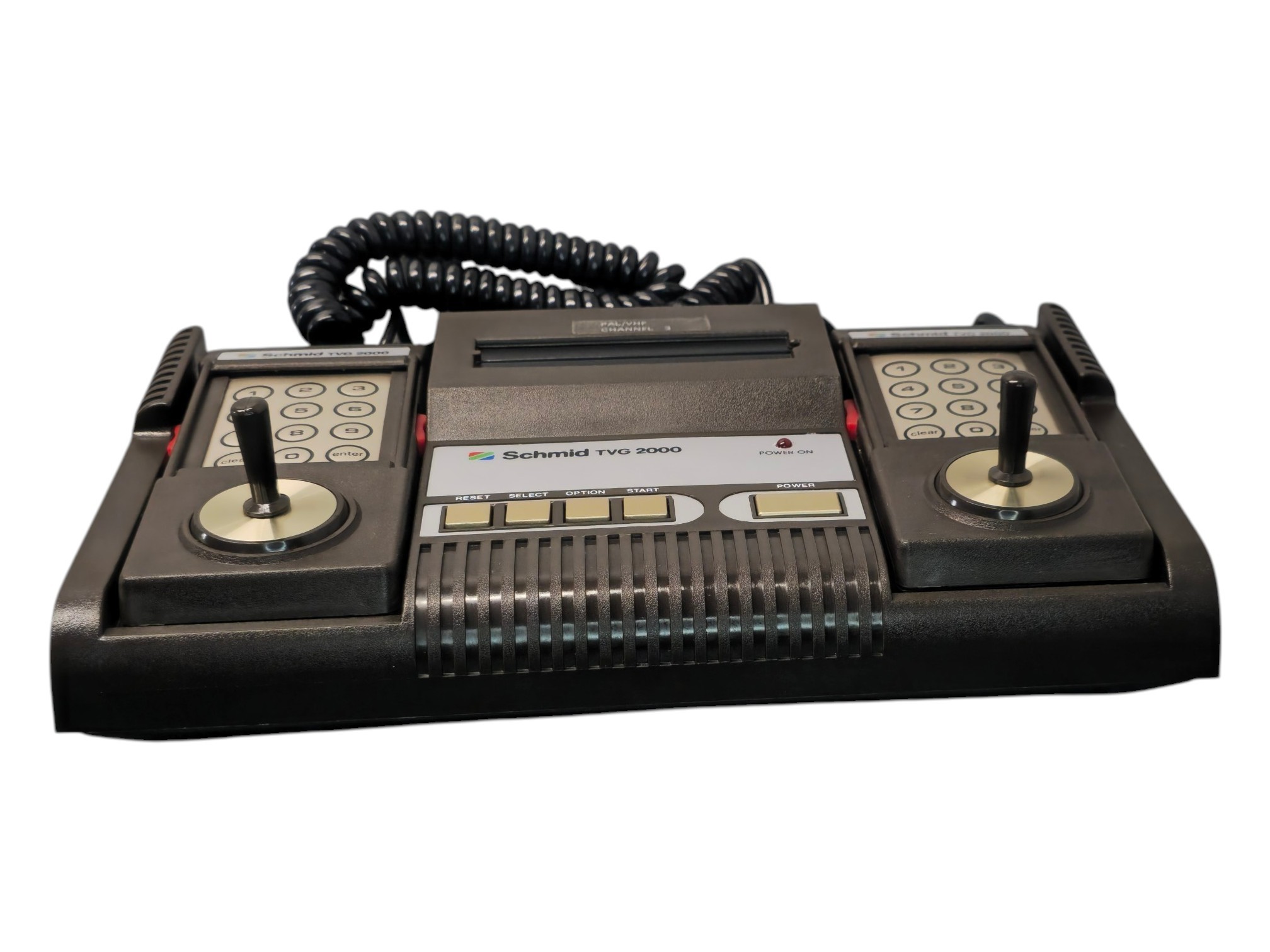
The Schmid TVG 2000 is a fascinating and relatively uncommon home video game console from the early 1980s. Introduced in 1982 and marketed by the German company Schmid, it belongs to the international family of consoles based on the Emerson Arcadia 2001 architecture.
Unlike earlier dedicated Pong-style television games, the Schmid TVG 2000 is a fully programmable, cartridge-based entertainment system. Its hardware combines an 8-bit Signetics processor, specialised graphics and sound circuitry, interchangeable ROM cartridges, and two unusual controllers featuring numeric keypads and detachable joystick attachments.
The console represents a period when numerous manufacturers experimented with alternative gaming systems, competing against established platforms such as the Atari 2600, Mattel Intellivision, and Philips Videopac.
Although the Schmid TVG 2000 never achieved the international recognition of its more successful competitors, it remains an interesting example of European video game distribution and the global expansion of home console technology.
Today, the system is particularly appealing to collectors interested in obscure consoles, regional hardware variations, and the early history of programmable home entertainment.
📘 Introduction
The Schmid TVG 2000 appeared in the European market in 1982, during a period of rapid development in the video game industry.
By this time, the original generation of dedicated Pong-style consoles was gradually being replaced by more sophisticated systems capable of running interchangeable software.
The Atari Video Computer System had already demonstrated the commercial potential of cartridge-based gaming.
Other manufacturers responded with their own platforms, offering different graphics hardware, controllers, and software libraries.
The Schmid TVG 2000 was one of these alternatives.
It was marketed as a colour television gaming system and provided capabilities considerably beyond the simple ball-and-paddle games of the preceding decade.
Its most important features included:
- Interchangeable game cartridges
- An 8-bit microprocessor
- Dedicated graphics and sound circuitry
- Colour television graphics
- Two integrated wired controllers
- Twelve-button numeric keypads
- Directional control discs
- Detachable joystick attachments
- Game-selection and difficulty controls
Its hardware belonged to the same technical family as the American Emerson Arcadia 2001.
This connection makes the Schmid TVG 2000 particularly interesting because it represents one of several internationally distributed versions of a shared console architecture.
🏭 Schmid Electronics & the German Gaming Market
The Schmid TVG 2000 was marketed by Schmid Electronics, associated with Dillingen in Germany.
During the late 1970s and early 1980s, the German consumer electronics market supported a diverse selection of television gaming systems.
Unlike later console generations dominated by a few major companies, the early European market included numerous manufacturers and distributors.
Some developed their own products.
Others imported, licensed, or rebranded hardware originally designed elsewhere.
A Growing Industry
Early home gaming products included:
- Dedicated Pong-style consoles
- Cartridge-based television games
- Programmable entertainment systems
- Microprocessor-based home consoles
- Early personal computers
Consumers encountered systems from companies such as Atari, Philips, Interton, Radofin, Hanimex, and numerous smaller brands.
The Schmid TVG 2000 entered this competitive environment.
A German Identity for an International Platform
Although Schmid marketed the system under its own brand, the console’s underlying architecture was closely related to the Emerson Arcadia 2001.
This approach allowed a regional company to participate in the developing console market without creating an entirely new software platform.
The TVG 2000 therefore illustrates an important commercial practice of the period: distributing related hardware under different names across international markets.
🌎 The Emerson Arcadia 2001 Connection
The history of the Schmid TVG 2000 cannot be separated from the Emerson Arcadia 2001.
Introduced in the United States in 1982 by Emerson Radio Corporation, the Arcadia 2001 was an 8-bit cartridge-based video game console.
Its architecture was built around the Signetics 2650 processor and Signetics 2637 graphics hardware.
The platform was designed to compete with established second-generation consoles.
A Shared Hardware Architecture
The Schmid TVG 2000 used the same general technology as the Emerson system.
Important common characteristics included:
- Signetics 2650-family CPU
- Signetics 2637 graphics and sound hardware
- Cartridge-based software
- Small system RAM capacity
- Colour television output
- Numeric-keypad controllers
- Directional input discs
Multiple International Versions
The Arcadia hardware family appeared under numerous names.
Examples included:
- Emerson Arcadia 2001 — United States
- Schmid TVG 2000 — Germany
- Hanimex HMG-2650 — various international markets
- Bandai Arcadia — Japan
- Leisure-Vision — Canada
- Advision Home Arcade — France
- Leonardo — Italy
- Tchibo Tele-Fever — Germany
- Tunix Home Arcade — New Zealand
These machines were part of a broader international group sharing closely related hardware and software.
Why the Relationship Matters
The connection to the Arcadia 2001 makes the TVG 2000 more than an isolated German console.
It demonstrates how a single gaming architecture could be manufactured and distributed through multiple brands.
This was an important characteristic of the early console industry, before hardware ecosystems became more strictly controlled by individual manufacturers.
🖥️ Design: A Compact Cartridge-Based Console
The Schmid TVG 2000 features a compact horizontal design closely related to the original Emerson Arcadia 2001.
Its enclosure is designed to sit beneath or beside a household television.
The console incorporates two controllers that can be placed in dedicated storage areas.
Exterior Features
- Compact plastic enclosure
- Top-mounted cartridge slot
- Central control buttons
- Power indicator
- Two permanently wired hand controllers
- Storage spaces for the controllers
- RF television connection
- External power connection
- Auxiliary controller sockets
Unlike the large woodgrain appearance of early Atari consoles, the Schmid system reflects the more compact electronics styling of the early 1980s.
The Cartridge Slot
The cartridge slot is positioned on the upper surface of the console.
Games are inserted vertically.
This arrangement allows players to change software without opening the console or handling complicated storage equipment.
Front Controls
The console provides dedicated controls for:
- Power
- Reset
- Select
- Option
- Start
These buttons support the operation of different cartridge games.
The exact function of Select and Option can vary according to the software.
The Integrated Controllers
The two controllers are permanently attached to the console through coiled cables in the original configuration.
This makes the system immediately recognisable and distinguishes it from many consoles using detachable external controllers.
Their unusual appearance also reflects the experimental controller designs of the period.
⚙️ Technical Specifications
The Schmid TVG 2000 is an 8-bit, second-generation home video game console.
Its internal hardware is based on the Emerson Arcadia 2001 architecture.
Hardware Overview
- Brand: Schmid
- Model: TVG 2000
- Release year: 1982
- Market: Germany and selected European markets
- Generation: Second-generation video game console
- System family: Emerson Arcadia 2001 compatible
- CPU: Signetics 2650A
- Processor architecture: 8-bit
- Main RAM: 1 KB
- Video and sound chip: Signetics 2637N
- Graphics hardware: Universal Video Interface (UVI)
- Graphics palette: 8 colours
- Graphics modes: 128×208 and 128×104 in the Arcadia hardware family
- Hardware sprites: Up to four independently controlled sprites
- Audio: Simple tone and noise generation
- Sound output: Mono television audio
- Software medium: ROM cartridge
- Controllers: Two wired keypad controllers
- Controller keypads: 12 buttons each
- Directional controls: Discs with detachable joystick attachments
- Video output: Analogue RF
- Power: External DC power adapter
The hardware is modest compared with later consoles.
However, its architecture was significantly more sophisticated than that of traditional dedicated Pong machines.
The ability to execute cartridge-based software allowed it to support multiple types of games rather than a fixed collection of built-in variations.
🧠 The Signetics 2650A Processor
At the heart of the Schmid TVG 2000 is the Signetics 2650A, an 8-bit microprocessor developed from the Signetics 2650 family.
The processor was introduced during the 1970s and appeared in various computing and electronic applications.
These included:
- Early microcomputers
- Industrial electronics
- Educational systems
- Arcade machines
- Home video game consoles
Processor Responsibilities
The CPU handles:
- Game logic
- Controller input
- Object movement
- Score calculations
- Software execution
- Communication with graphics hardware
- Game timing
The Signetics processor uses an instruction set different from the MOS 6502 found in the Atari 2600.
This means software developed for the Atari cannot run directly on the Schmid TVG 2000.
A Different Architecture
The early console market featured several competing processor families.
The Atari 2600 used the MOS 6507.
The Philips Videopac used an Intel 8048-family processor.
The Schmid TVG 2000 used Signetics technology.
These architectural differences created distinct software ecosystems.
Why Signetics Matters
The use of the 2650 processor connects the Schmid console to an interesting family of early programmable gaming systems.
Although Signetics processors never became as dominant in home computing as the MOS 6502 or Zilog Z80, they played an important role in certain early video game designs.
🧩 The Signetics 2637: Graphics & Sound
The Schmid TVG 2000 uses the Signetics 2637N Universal Video Interface, commonly abbreviated to UVI.
This specialised component handles important graphics and sound functions.
The Role of the UVI
Its responsibilities include:
- Television graphics generation
- Display timing
- Colour processing
- Sprite handling
- Character graphics
- Simple sound generation
The UVI works alongside the main processor to create the game’s television image.
Hardware Sprites
The graphics system supports up to four independently controlled hardware sprites.
Sprites are small graphical objects that can move around the screen.
They are particularly useful for representing:
- Player characters
- Enemy objects
- Projectiles
- Vehicles
- Moving obstacles
Programmable Characters
The graphics hardware also supports programmable character patterns.
This allows developers to create visual elements such as simple backgrounds, symbols, and game objects.
The Advantages of Dedicated Graphics Hardware
Rather than generating every graphical detail entirely through software, the console uses specialised hardware.
This reduces the workload on the main processor.
The design illustrates how early console engineers used dedicated chips to compensate for limited CPU performance.
🎨 Graphics: Eight Colours & Early Sprite Gaming
The Schmid TVG 2000 supports colour graphics through its Signetics 2637 hardware.
The Arcadia-compatible architecture provides a palette of eight colours.
Although this may seem extremely limited today, it represented a meaningful improvement over the monochrome or extremely simple graphics of many earlier dedicated gaming systems.
Graphics Features
- Eight-colour palette
- Programmable character graphics
- Hardware sprites
- Multiple display arrangements
- Television-based output
- Simple animation
- Arcade-style visual effects
Display Modes
The Arcadia architecture is commonly documented with graphics modes of approximately:
- 128×208
- 128×104
The mode and visible picture characteristics depend on the software and television-standard implementation.
Simple but Effective Graphics
Developers could create games featuring:
- Coloured backgrounds
- Moving enemies
- Player-controlled objects
- Score displays
- Maze structures
- Animated targets
- Sports playfields
These features allowed the console to reproduce many popular arcade-style game concepts.
The Limitations
Compared with more advanced consoles, the TVG 2000 offered relatively limited graphical capabilities.
Its small memory capacity and restricted hardware palette required careful optimisation.
Nevertheless, the system remains an interesting example of early colour television gaming.
💾 One Kilobyte of RAM
One of the most remarkable technical characteristics of the Schmid TVG 2000 is its extremely small memory capacity.
The console contains approximately 1 KB of main RAM.
This memory is used for temporary information during gameplay.
What RAM Is Used For
The computer may need to store:
- Player positions
- Current scores
- Enemy positions
- Game states
- Temporary calculations
- Controller information
Programming Under Severe Limitations
With only a small amount of available RAM, software developers had to be extremely efficient.
Programs were designed around compact data structures and carefully managed memory.
The console relied on ROM cartridges to store the actual game programs.
The Importance of ROM
ROM, or Read-Only Memory, holds software that does not disappear when the console is switched off.
Cartridges allowed the system to access a program without requiring a floppy disk, cassette recorder, or internal mass-storage device.
For early-1980s consoles, this arrangement was practical and reliable.
🎮 Interchangeable ROM Cartridges
The Schmid TVG 2000 uses removable ROM cartridges as its primary software format.
This distinguishes it from dedicated Pong consoles, which typically contained their games in fixed internal circuitry.
The Cartridge Experience
To play a game, the user generally:
- Connects the console to a compatible television
- Connects the correct power adapter
- Inserts a game cartridge
- Switches on the console
- Selects the desired game options
- Begins playing
The cartridge contains the program required to operate the game.
Why Cartridges Were Revolutionary
Interchangeable cartridges offered several advantages:
- Expandable game libraries
- Fast access to software
- Durable storage
- No mechanical drive
- Simple operation
- Convenient game replacement
The Schmid Cartridge Range
Historical collecting records document approximately 27 Schmid-branded titles, while the wider Arcadia-compatible software family included additional regional releases and variations.
The exact number of cartridges varies depending on whether regional versions, unreleased products, and software variations are counted.
For collectors, the original Schmid cartridges are especially interesting because they represent the German distribution of the Arcadia software ecosystem.
🕹️ Games & Software Library
The Schmid TVG 2000 offered a selection of arcade-style, sports, puzzle, and action games.
Documented Schmid-labelled titles and their variants include:
- Brain Quiz
- Crazy Gobbler
- Space Attack
- Robot Killer
- Super Gobbler
- Space Vultures
- Breakaway
- Alien Invaders
- Space Mission
- Ocean Battle
- 3-D Bowling
- Capture
- Soccer
- Tanks A Lot
- Escape
- Missile War
- Cat Trax
- Space Raiders
- Jungler
- Space Squadron
- Star Chess
- Grand Slam Tennis
- Funky Fish
- Pleiades
- Spiders
- Red Clash
- The End
- Turtles / Turpin
- Jump Bug
- R2D Tank
- Hobo
Not every title in the wider Arcadia-compatible catalogue necessarily received the same commercial distribution or packaging in every country.
A Diverse Collection
The library covered several popular genres:
- Space shooters
- Maze games
- Sports simulations
- Puzzle games
- Educational entertainment
- Arcade action
- Combat games
The Importance of Cartridge Compatibility
The Schmid TVG 2000 belongs to the Emerson-compatible subgroup of Arcadia systems.
This allows compatibility with various cartridges released under other related brands.
However, not every console marketed as Arcadia-compatible uses the same physical cartridge connection.
Consequently, compatibility should be verified at both the software and connector levels.
🧱 Breakaway: The Classic Brick-Breaking Game
One of the documented cartridges released for the Schmid TVG 2000 is Breakaway.
The game belongs to the same general tradition as Atari’s famous Breakout.
Players control an on-screen paddle and attempt to destroy a field of blocks by bouncing a moving ball.
Gameplay Features
- Ball-and-paddle action
- Destructible blocks
- Increasing challenges
- Different game variations
- One-player and multiplayer options
A Connection to Pong
Breakaway demonstrates the relationship between early Pong-style entertainment and later programmable consoles.
Its basic concept involves controlling an object to keep a ball in motion.
However, unlike a dedicated Pong machine, the TVG 2000 runs Breakaway through a software cartridge.
Historical Importance
Games of this kind helped bridge the transition between dedicated electronic games and fully programmable home entertainment systems.
They provided familiar gameplay while demonstrating the flexibility of cartridge technology.
👾 Alien Invaders & the Space Shooter Era
Space shooters were among the most popular genres during the late 1970s and early 1980s.
The success of games such as Space Invaders encouraged numerous developers to create similar experiences.
Alien Invaders, released within the Arcadia-compatible software family, belongs to this tradition.
Gameplay Characteristics
The game features arcade-style science-fiction action.
Players must react to moving enemies while attempting to survive increasingly difficult encounters.
Why Space Shooters Were Popular
These games offered:
- Simple controls
- Clear objectives
- Increasing difficulty
- High-score competition
- Fast-paced gameplay
- Strong replay value
Their design was well suited to early consoles with limited graphics and memory.
The Arcade Influence
The TVG 2000’s software library demonstrates how strongly arcade gaming influenced home entertainment.
Consumers increasingly wanted to reproduce the arcade experience without leaving their homes.
Cartridge-based consoles made this possible.
🐱 Cat Trax & Maze-Based Entertainment
Cat Trax is another game associated with the wider Emerson Arcadia software family and documented Schmid cartridge releases.
The game represents the popularity of maze-based gaming during the early 1980s.
The Maze Game Boom
Following the success of Pac-Man, many manufacturers introduced games featuring:
- Maze navigation
- Pursuing enemies
- Collectible objects
- Increasing difficulty
- Score-based challenges
These concepts became popular because they combined simple controls with engaging gameplay.
A Distinctive Early Console Experience
The Schmid TVG 2000’s keypad and directional controller arrangement provided a different physical experience from the joystick-only designs of some competing consoles.
Its software library reflects a period when developers were still experimenting with how arcade gameplay should be adapted to household televisions.
🕹️ Unusual Controllers with Numeric Keypads
One of the most distinctive features of the Schmid TVG 2000 is its controller design.
The system includes two wired controllers, each featuring a numeric keypad and a circular directional control.
Controller Features
- Twelve-button keypad
- Directional control disc
- Detachable joystick attachment
- Side-mounted action buttons
- Permanently connected coiled cable
- Storage position on the console
The Twelve-Button Keypad
The keypad contains numeric and function buttons.
These can be used for:
- Game selection
- Entering information
- Selecting options
- Choosing special functions
- Activating cartridge-specific commands
The exact functions depend on the game.
Directional Disc
The circular disc allows players to control movement in different directions.
The original manual describes sixteen directional positions.
Detachable Joystick Attachment
A small joystick attachment can be mounted onto the directional disc.
This allows the controller to be used in a more conventional joystick-like manner.
Side Action Buttons
The controllers include action buttons positioned on both sides.
This allows comfortable operation by both left-handed and right-handed players.
A Distinctive Historical Design
The controller resembles the experimental input devices used on several early-1980s systems, including Mattel’s Intellivision.
It reflects a period when console manufacturers had not yet standardised modern controller layouts.
🔢 Controller Overlays
One interesting accessory associated with the TVG 2000 is the controller overlay.
Different cartridges could include thin printed overlays designed to fit over the numeric keypad.
Why Overlays Were Useful
Because the controller contained twelve programmable buttons, their functions could vary between games.
Printed overlays helped players remember which button performed each action.
Typical Applications
An overlay might identify:
- Game options
- Player actions
- Difficulty settings
- Special functions
- Movement-related commands
Collectability
Original overlays are particularly important to collectors.
They are small, relatively fragile accessories that could easily be lost.
A complete cartridge package with its original overlays, manual, and box provides a more complete picture of how the game was originally intended to be played.
🎛️ Power, Reset, Select, Option & Start
The Schmid TVG 2000 includes a distinctive group of system-control buttons.
These buttons support different aspects of game operation.
Power
Switches the console on or off.
A power indicator confirms when the system is operating.
Reset
Restarts the software or returns to the initial game selection state, depending on the cartridge.
Select
Allows players to choose between available game variations.
Option
Changes specific settings or difficulty levels where supported.
Start
Begins or restarts the selected game.
Why These Controls Mattered
Many early video game cartridges included multiple gameplay variations.
Instead of using complicated on-screen menus, players selected options using dedicated hardware buttons.
This arrangement was common during the second generation of home consoles.
📺 RF Television Output & the CRT Experience
The Schmid TVG 2000 was designed for connection to an analogue television.
Its original video system uses an RF television signal.
This was a common approach during the 1970s and early 1980s.
How RF Connections Work
RF output combines video and audio information into a signal that can be received through a compatible television’s antenna input.
Players select the appropriate television channel and adjust tuning until the game image appears.
Advantages of RF
- Compatibility with many period televisions
- No specialised computer monitor required
- Relatively inexpensive hardware
- Simple household installation
The Limitations
RF picture quality can be affected by:
- Electrical interference
- Incorrect tuning
- Weak connections
- Ageing cables
- Signal instability
- Colour distortion
PAL Television Compatibility
European versions were intended for the television standards used in their respective markets.
However, the exact channel and output characteristics should be confirmed from the specific console.
Connecting to Modern Displays
Modern televisions may not support analogue RF signals.
Depending on the equipment, a working installation may require:
- A compatible CRT television
- An analogue RF tuner
- An RF demodulator
- Suitable video conversion equipment
Why CRT Displays Matter
Original CRT televisions remain particularly suitable for demonstrating early console graphics.
Their image characteristics reflect the technology for which these games were originally designed.
🎵 Simple Electronic Sound
The Schmid TVG 2000 uses the audio capabilities of its Signetics graphics and sound hardware.
Its sound system is relatively simple compared with later consoles.
Audio Characteristics
- Basic electronic tones
- Noise-based effects
- Mono output
- Television speaker playback
- Game-specific sound effects
The Sound of Early Gaming
Games use short electronic sounds to represent actions such as:
- Shooting
- Collisions
- Scoring points
- Movement
- Successful actions
- Game-over events
Although the system cannot reproduce sophisticated sampled music, its audio is typical of the second generation of home consoles.
These characteristic electronic effects form an important part of the early video game experience.
🔄 Schmid TVG 2000 vs. Emerson Arcadia 2001
The Schmid TVG 2000 and Emerson Arcadia 2001 share a closely related hardware architecture.
Emerson Arcadia 2001
- Released in the United States in 1982
- Signetics 2650 processor
- Signetics 2637 graphics hardware
- Cartridge-based gaming
- Numeric-keypad controllers
- Colour television output
- Original American distribution
Schmid TVG 2000
- Marketed in Germany in 1982
- Signetics 2650A processor
- Signetics 2637N graphics hardware
- Cartridge-based gaming
- Numeric-keypad controllers
- European television configuration
- Schmid branding and software packaging
The Main Differences
The primary differences concern:
- Regional branding
- Retail packaging
- Software labels
- Television standards
- Power arrangements
- Distribution channels
The Same Software Family
Both consoles belong to the Emerson-compatible Arcadia group.
This makes software compatibility one of their defining characteristics.
For collectors, the Schmid TVG 2000 is therefore particularly interesting as a regional variation of an international system.
🔄 Schmid TVG 2000 vs. Tchibo Tele-Fever
Another interesting console related to the TVG 2000 is the Tchibo Tele-Fever.
This German-market system appeared later in the 1980s.
Although its exterior design differed from the Schmid console, it shared closely related internal hardware.
Schmid TVG 2000
- Original early-1980s design
- Conventional Arcadia-style enclosure
- Two wired controllers
- Top-mounted cartridge slot
- Schmid branding
Tchibo Tele-Fever
- Later alternative German distribution
- Different exterior design
- Related Arcadia-compatible architecture
- Support for compatible cartridges
- Tchibo retail identity
An Interesting Connection
The Tele-Fever illustrates how the Arcadia architecture continued appearing in alternative forms after its initial introduction.
This makes the history of the TVG 2000 more complicated and interesting than that of a conventional single-brand console.
🥊 Schmid TVG 2000 vs. Atari 2600 vs. Philips Videopac
The Schmid TVG 2000 competed within a market already containing several important programmable consoles.
Atari 2600 (1977)
- MOS 6507 processor
- ROM cartridges
- Joystick controllers
- Extremely limited RAM
- Extensive software library
- Major worldwide commercial success
Philips Videopac G7000 (1978)
- Intel 8048-family processor
- ROM cartridges
- Character-based graphics architecture
- Numeric-keypad controllers
- Strong European distribution
Schmid TVG 2000 (1982)
- Signetics 2650A processor
- Signetics 2637N graphics hardware
- ROM cartridges
- Eight-colour graphics
- Two numeric-keypad controllers
- Arcadia-compatible software ecosystem
Different Commercial Fortunes
Although the Schmid system offered genuine programmable gaming capabilities, it lacked the enormous software library and brand recognition of the Atari 2600.
The Philips Videopac also benefited from an established European electronics manufacturer.
The TVG 2000 therefore occupied a smaller and more specialised position.
Its limited commercial impact contributes to its obscurity today.
🌍 European Distribution & Historical Importance
The Schmid TVG 2000 belongs to a distinctive period in European consumer electronics history.
During the early 1980s, several companies marketed related console architectures under different brand names.
The German Market
Germany became an important market for programmable home video games.
Consumers could choose from a wide variety of systems, including official international consoles and regional alternatives.
The Schmid TVG 2000 formed part of this broader selection.
Austria & Switzerland
Historical advertising research also records the TVG 2000 in Austria and Switzerland.
Its regional distribution demonstrates that the system was not confined exclusively to Germany.
An International Family
The Arcadia-compatible architecture reached several continents under different identities.
This reflected the international nature of early electronics manufacturing.
The Importance of Regional Models
For technology historians, regional consoles provide valuable evidence about:
- Local markets
- Distribution networks
- Hardware licensing
- Product rebranding
- Regional software packaging
- Television compatibility
The Schmid TVG 2000 is particularly interesting because it combines an American-origin console architecture with German-market branding.
🇬🇷 The Schmid TVG 2000 & Greek Retro Gaming
The Schmid TVG 2000 belongs to the broader European history of early programmable gaming systems.
During the late 1970s and early 1980s, the Greek market featured a wide variety of television gaming devices.
These included dedicated Pong consoles, imported cartridge systems, and early home computers.
Early Gaming in Greece
Greek consumers encountered products associated with manufacturers and brands such as:
The availability of particular models varied according to importers and local retailers.
A Less Familiar Platform
Unlike the Atari 2600 or Philips Videopac, the Schmid TVG 2000 is not well documented as a mainstream Greek-market system.
Its presence in a modern Greek collection is therefore particularly interesting.
The Value of Preservation
Preserving less familiar systems helps create a more complete understanding of European gaming history.
It demonstrates that the early console market included many alternative technologies beyond the major brands that eventually dominated the industry.
🔧 Build Quality & Longevity
The Schmid TVG 2000 is a relatively simple electronic system compared with later consoles.
However, surviving units are now several decades old.
Their long-term reliability depends on the condition of the original components.
Common Maintenance Tasks
- Cleaning the exterior enclosure
- Inspecting the power connector
- Checking the RF television cable
- Cleaning the cartridge connector
- Testing the controller keypads
- Inspecting the directional discs
- Checking the coiled controller cables
- Testing system buttons
- Inspecting internal capacitors
- Checking solder joints
Cartridge Connection Problems
Dirty or oxidised contacts can prevent games from loading correctly.
Careful cleaning of the cartridge and connector contacts may improve reliability.
Controller Wear
The permanently wired controllers are an important part of the console’s identity.
Common problems may involve:
- Damaged cables
- Dirty button contacts
- Worn directional controls
- Broken joystick attachments
- Intermittent electrical connections
Power Supply Safety
Original power adapters can deteriorate over time.
Replacement adapters must match the console’s actual electrical requirements.
The voltage, polarity, current capability, and connector arrangement should be confirmed from the original hardware.
A power adapter should never be connected solely because its plug fits the socket.
Preservation Environment
Suitable storage conditions include:
- Controlled humidity
- Moderate temperatures
- Minimal dust exposure
- Protection from direct sunlight
- Careful storage of controllers
- Protection of original cartridges
These practices are particularly important for consoles with rare or difficult-to-replace accessories.
🛠️ Modern Preservation & Emulation
The Schmid TVG 2000 has attracted interest from enthusiasts studying the Arcadia 2001 hardware family.
Although it remains much less familiar than major commercial consoles, its architecture has been documented by preservation communities.
Software Preservation
Modern researchers have worked to preserve cartridge ROM data and identify regional software variations.
This helps document the system’s historical catalogue.
Hardware Emulation
The Arcadia family is represented in projects such as MAME, which includes the Schmid TVG 2000 among its supported machine definitions.
Emulation can assist with:
- Studying software behaviour
- Testing preserved ROM data
- Researching hardware compatibility
- Documenting regional game releases
However, emulation accuracy can vary, particularly for unusual graphics and sound behaviours.
Original Hardware Remains Important
Software emulation does not replace the historical value of an authentic console.
Original hardware preserves:
- Physical controller design
- Electrical characteristics
- Cartridge connections
- Analogue video output
- Historic construction techniques
- Manufacturer-specific details
For museum purposes, original hardware and software preservation complement each other.
⭐ Why the Schmid TVG 2000 Still Matters
The Schmid TVG 2000 is historically significant for several reasons:
- It represents a German-market version of the Arcadia 2001 architecture
- It demonstrates the international distribution of early console technology
- It uses a relatively uncommon Signetics processor family
- It features dedicated graphics and sound hardware
- It supports interchangeable ROM cartridges
- It incorporates unusual keypad controllers
- It belongs to the second generation of programmable home consoles
- It preserves an alternative to the dominant Atari and Philips systems
- It documents early regional branding and hardware compatibility
- It represents a lesser-known part of European gaming history
Beyond Commercial Success
The TVG 2000 never achieved the popularity of major international consoles.
Nevertheless, commercial success is not the only measure of historical importance.
Its unusual hardware, controllers, and international connections make it an important example of early console experimentation.
A Transitional Machine
The system also illustrates the transition from dedicated television games to programmable cartridge-based entertainment.
It belongs to a generation in which developers and manufacturers were experimenting with technologies that would shape the future of gaming.
🏛️ Collectability & Historical Preservation
Today, the Schmid TVG 2000 is a relatively obscure system within the vintage console collecting community.
Its appeal comes from its historical significance, unusual hardware, and connection to the international Arcadia family.
Important Collecting Factors
- Original Schmid TVG 2000 console
- Manufacturer labels
- Serial number
- Original wired controllers
- Detachable joystick attachments
- Functional keypad buttons
- Original power adapter
- Original game cartridges
- Controller overlays
- Instruction manuals
- Retail packaging
The Importance of Original Controllers
The permanently attached controllers are particularly important.
Their numeric keypads, directional discs, and detachable joystick attachments are distinctive features of the console.
Damaged or incomplete controllers may be difficult to replace with equivalent original parts.
Original Cartridges
Schmid-branded cartridges are especially interesting because they document the German software catalogue.
Original labels, manuals, and packaging provide valuable information about regional distribution.
Documenting the Hardware
Useful museum records include:
- Exact model name
- Manufacturer information
- Serial number
- Country-of-origin markings
- Motherboard revision
- Processor identification
- Graphics chip markings
- Power requirements
- Television output standard
- Cartridge compatibility
- Working condition
A Valuable Museum Exhibit
The Schmid TVG 2000 represents a part of video game history that is often overlooked.
It provides an opportunity to explain the diversity of early programmable consoles and the way common hardware architectures appeared under different international brands.
📦 Items Included in This Collection Entry
🏁 Conclusion
The Schmid TVG 2000 represents a fascinating chapter in the early history of programmable home video gaming.
Introduced in 1982 and marketed under a German brand, the console belongs to the international Emerson Arcadia 2001 hardware family.
Its Signetics 2650A processor, dedicated 2637 graphics and sound hardware, interchangeable cartridges, and unusual numeric-keypad controllers distinguish it from earlier dedicated Pong-style systems.
Although the console never achieved the commercial success of the Atari 2600 or Philips Videopac, it offers valuable insight into the diversity of the early-1980s gaming market.
Its software library, regional branding, and relationship with other Arcadia-compatible machines demonstrate how home entertainment technology circulated internationally.
Today, surviving Schmid TVG 2000 consoles are important historical artefacts that preserve a lesser-known part of European electronics and gaming history.
The system reminds us that the development of video games was not driven exclusively by the most famous manufacturers.
Numerous smaller companies participated in the rapid expansion of the industry, introducing their own variations of the technologies that shaped home entertainment.
A rare example of early European cartridge gaming, a distinctive member of the Emerson Arcadia 2001 family, and an important addition to any comprehensive collection of historic video game consoles.
