
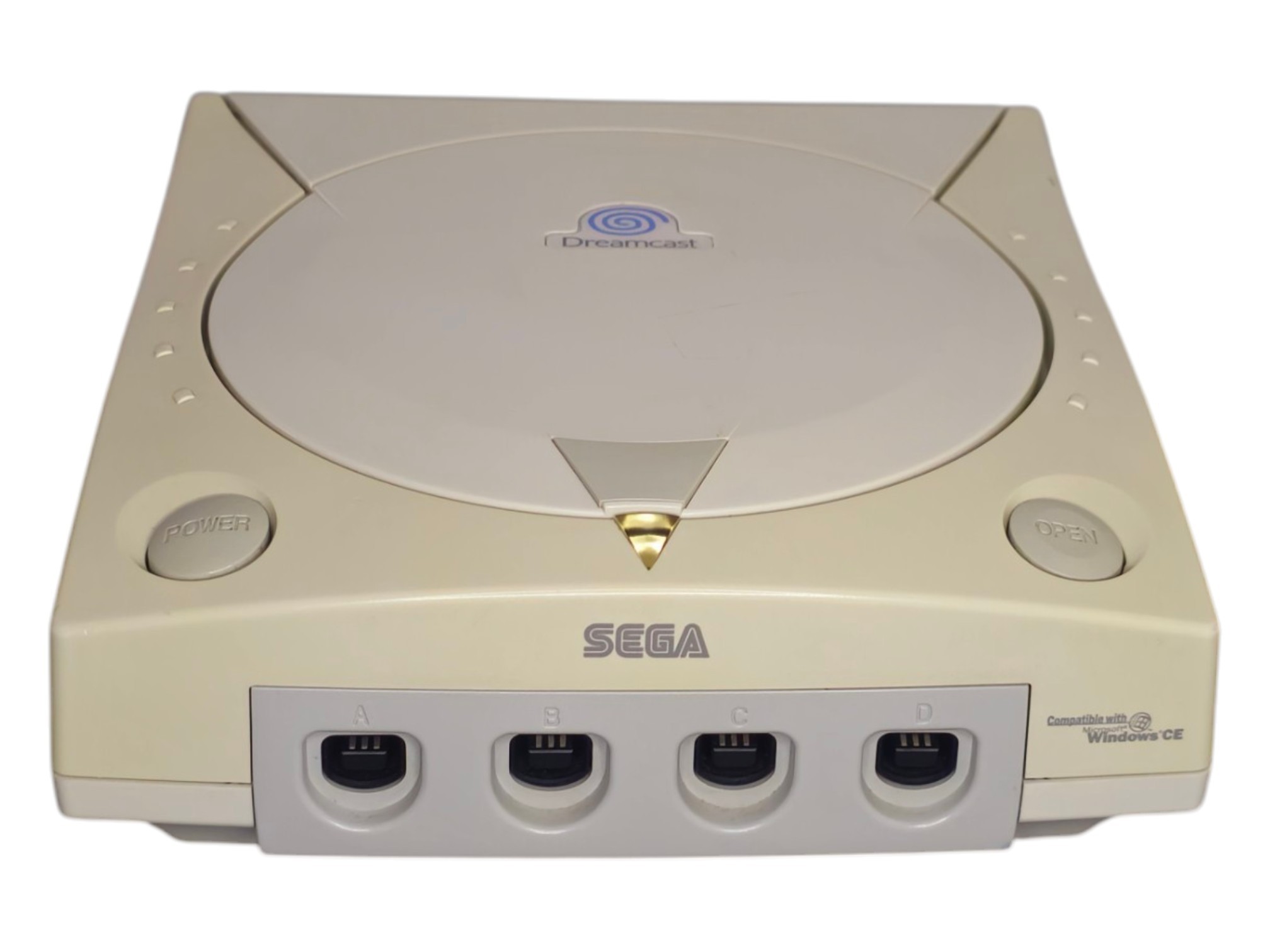
The Sega Dreamcast HKT-3030 is the European PAL version of Sega’s final home video game console and one of the most innovative gaming systems of the late 1990s. Released in Europe on October 14, 1999, the Dreamcast represented Sega’s ambitious entry into the sixth generation of gaming, introducing sophisticated three-dimensional graphics, online connectivity, a unique memory card with its own screen, and arcade-quality gaming experiences.
Powered by the Hitachi SH-4 processor running at 200 MHz, the PowerVR2 graphics system, and a specialised Yamaha audio processor, the Dreamcast delivered impressive performance at a time when Sony’s original PlayStation and Nintendo 64 still dominated much of the home console market.
Its distinctive white enclosure, blue European Dreamcast logo, four controller ports, and built-in 33.6 Kbps modem made it immediately recognisable.
The console introduced or popularised remarkable technologies, including GD-ROM optical media, the Visual Memory Unit (VMU), internet-enabled console gaming, VGA display output, and online multiplayer experiences.
With legendary games such as Sonic Adventure, Shenmue, Crazy Taxi, Soulcalibur, Jet Set Radio, Skies of Arcadia, Resident Evil – Code: Veronica, and Phantasy Star Online, the Dreamcast developed an extraordinary reputation for creativity and technological innovation.
Despite its relatively short commercial lifespan, the Dreamcast became one of the most celebrated consoles in gaming history.
Today, the European HKT-3030 remains an important collectible and a remarkable reminder of Sega’s influence on the development of modern gaming.
📘 Introduction
The Sega Dreamcast was first released in Japan on November 27, 1998, followed by North America on September 9, 1999, and Europe on October 14, 1999.
It was Sega’s successor to the Sega Saturn and represented the company’s final attempt to compete as a major manufacturer of home video game consoles.
The Dreamcast arrived before the Sony PlayStation 2, Microsoft Xbox, and Nintendo GameCube.
This gave Sega an opportunity to introduce advanced sixth-generation technology ahead of its principal competitors.
The European version received the model designation HKT-3030.
Its most important features included:
- Hitachi SH-4 processor operating at 200 MHz
- NEC / VideoLogic PowerVR2 graphics technology
- 16 MB main RAM
- 8 MB dedicated video memory
- 2 MB sound RAM
- Yamaha AICA sound processor
- GD-ROM optical disc drive
- Four controller ports
- Built-in, removable 33.6 Kbps modem
- Online gaming capabilities
- Visual Memory Unit support
- Analogue video and VGA output options
- Advanced 3D rendering
- Arcade-style gaming experiences
The Dreamcast was a bold attempt to combine affordable hardware, sophisticated graphics, and internet functionality within a single entertainment system.
Although its commercial lifespan was shorter than Sega originally intended, its innovations influenced the development of later consoles.
🏭 Sega: From Arcade Machines to Home Consoles
The history of the Dreamcast is closely connected to Sega’s long involvement in the video game industry.
Sega became one of the most influential manufacturers of arcade machines and home entertainment systems during the 1970s, 1980s, and 1990s.
Its products helped shape the development of both arcade and home gaming.
Sega SG-1000 (1983)
The SG-1000 was Sega’s first dedicated home video game console.
Released in Japan in 1983, it represented the company’s entry into the consumer console market.
Sega Master System (1985)
The Master System introduced more sophisticated hardware and became particularly popular in parts of Europe and Brazil.
It helped establish Sega as a serious competitor to Nintendo.
Sega Mega Drive / Genesis (1988)
The Mega Drive became one of Sega’s greatest commercial achievements.
Its 16-bit processor, arcade-inspired games, and aggressive marketing contributed to strong international popularity.
The introduction of Sonic the Hedgehog gave Sega one of gaming’s most recognisable characters.
Sega Saturn (1994)
The Sega Saturn represented Sega’s entry into the 32-bit generation.
Its complex architecture offered strong arcade and two-dimensional gaming capabilities.
However, the system faced intense competition from Sony’s PlayStation.
Sega Dreamcast (1998)
The Dreamcast represented a major technological and strategic change.
Sega introduced more developer-friendly hardware, sophisticated three-dimensional graphics, and standard internet connectivity.
The result was one of the most technically ambitious consoles of its era.
🧠 Project Dural, Katana & Dreamcast Development
Development of Sega’s next-generation hardware began while the Saturn was still commercially active.
Sega understood that it needed a fundamentally new approach to compete with Sony and Nintendo.
During development, different hardware concepts were explored.
Black Belt & Dural
Sega’s international development efforts included concepts commonly associated with the names Black Belt and Dural.
Different teams investigated alternative graphics technologies and hardware approaches.
Project Katana
The design eventually selected for commercial development became associated with the codename Katana.
The final hardware combined:
- Hitachi SH-4 processing
- PowerVR graphics technology
- Yamaha audio hardware
- GD-ROM storage
- Integrated networking capabilities
A Developer-Friendly Architecture
One of Sega’s objectives was to make the Dreamcast easier to develop for than the Saturn.
The Saturn’s complex internal architecture had presented challenges to developers.
The Dreamcast used a more streamlined and modern design.
A New Brand Identity
The final name, Dreamcast, reflected Sega’s ambition to introduce an exciting new generation of interactive entertainment.
The console was designed to represent a fresh start for the company.
Its launch marked one of Sega’s boldest attempts to regain leadership in the home gaming industry.
🖥️ The European HKT-3030 Design
The European Dreamcast HKT-3030 features a compact white enclosure with a distinctive circular disc lid.
Its appearance differs considerably from Sega’s earlier black consoles, including the Mega Drive and Saturn.
Exterior Features
- White plastic enclosure
- Circular top-loading disc lid
- Blue Dreamcast spiral logo
- Power button
- Open button
- Power indicator
- Four front controller ports
- Rear AV Out connection
- Rear Serial connector
- Removable modem
- Telephone line connection
- Internal AC power supply
The Circular Disc Lid
The disc lid occupies most of the upper surface.
It opens mechanically, allowing users to insert a GD-ROM or compatible audio CD.
The optical drive is positioned directly beneath the lid.
The Four Controller Ports
The front of the console includes four controller ports, labelled A, B, C, and D.
This allows four compatible controllers to be connected without requiring a separate multitap accessory.
The White Enclosure
The Dreamcast’s light-coloured exterior represented a significant change in Sega’s industrial design.
Its rounded shape and relatively compact dimensions gave it a friendly and modern appearance.
The European Blue Logo
One of the most important identifying characteristics of the European Dreamcast is its blue spiral logo.
Japanese and North American consoles generally feature an orange spiral.
This makes the blue logo particularly useful for identifying the PAL European edition.
🔵 The Blue Dreamcast Spiral: A European Identity
The Dreamcast logo is one of the most recognisable symbols in video game history.
It consists of a simple spiral accompanied by the Dreamcast name.
Different Regional Colours
The logo appeared in different colours depending on the region.
- Japan: Orange spiral
- North America: Orange spiral
- Europe: Blue spiral
The European Design
The European HKT-3030 uses a blue spiral on its disc lid and corresponding regional branding.
This was an official factory design rather than a later modification.
A Distinctive Collecting Feature
The blue logo allows the European Dreamcast to be distinguished visually from other regional versions.
Historical Importance
The different logo colours demonstrate how manufacturers adapted product branding for international markets.
For a museum collection, the European blue spiral is an important identifying detail.
It represents the regional identity of the original PAL Dreamcast hardware.
⚙️ Technical Specifications
The Sega Dreamcast introduced a powerful hardware architecture designed for advanced three-dimensional graphics and connected gaming.
Hardware Overview
- Manufacturer: Sega Enterprises
- Console: Sega Dreamcast
- Model: HKT-3030
- Region: Europe / PAL
- Original Japanese release: November 27, 1998
- European release: October 14, 1999
- Generation: Sixth-generation home console
- CPU: Hitachi SH-4
- CPU architecture: 32-bit SuperH RISC
- CPU frequency: 200 MHz
- Floating-point processing: 128-bit vector capabilities
- GPU: NEC PowerVR2 CLX2
- GPU frequency: Approximately 100 MHz
- Graphics architecture: Tile-based deferred rendering
- Main RAM: 16 MB
- Video RAM: 8 MB
- Audio RAM: 2 MB
- Audio processor: Yamaha AICA
- Audio channels: Up to 64
- Optical drive: GD-ROM
- Disc capacity: Approximately 1 GB or more, depending on disc layout
- Video capabilities: 2D and hardware-accelerated 3D
- Display resolution: Multiple modes, including 640×480
- Video output: Analogue A/V, with supported VGA output
- Controller ports: Four
- Memory accessories: Visual Memory Unit and compatible memory cards
- Networking: Removable 33.6 Kbps dial-up modem
- Additional connectivity: Serial port
- Power: AC 220–240V, 50/60 Hz
- Dimensions: Approximately 190 × 196 × 76 mm
- Weight: Approximately 1.5 kg
The Dreamcast was often marketed as a 128-bit console.
However, its primary processor is a 32-bit SH-4 CPU.
The 128-bit designation reflects aspects of the processor’s floating-point and vector capabilities, rather than a conventional 128-bit general-purpose CPU architecture.
🧠 Hitachi SH-4: The Heart of Dreamcast
The Dreamcast uses the Hitachi SH-4, a powerful processor operating at 200 MHz.
The SH-4 belongs to Hitachi’s SuperH family of RISC microprocessors.
It was developed for high-performance embedded and multimedia applications.
Processor Features
- 32-bit RISC architecture
- 200 MHz operating frequency
- Superscalar execution
- Floating-point processing
- Vector mathematics
- Multimedia-oriented instructions
- Efficient embedded-system design
Processor Responsibilities
The CPU handles:
- Game logic
- Artificial intelligence
- Physics calculations
- Character movement
- Geometry processing
- Animation
- System functions
- Communication with graphics hardware
The 128-Bit Marketing Claim
The Dreamcast was widely promoted as a 128-bit gaming system.
This terminology referred partly to advanced floating-point processing capabilities.
The main SH-4 processor nevertheless remains fundamentally a 32-bit CPU.
An Advanced Processor for 1998
The SH-4 offered considerable processing capability for its era.
Combined with the dedicated graphics and audio hardware, it enabled games with sophisticated three-dimensional environments and arcade-like performance.
A Different Architecture from Competitors
The Dreamcast’s processor differed from the hardware used in the Nintendo 64, Sony PlayStation, and later PlayStation 2.
This gave the platform its own distinctive technical characteristics.
🎨 PowerVR2: Revolutionary Graphics Technology
One of the Dreamcast’s greatest technological achievements is its PowerVR2 graphics processor.
Developed through technology associated with VideoLogic and NEC, PowerVR2 provided advanced real-time 3D rendering capabilities.
Graphics Features
- Tile-based deferred rendering
- Hardware texture mapping
- Perspective correction
- Bilinear texture filtering
- Trilinear filtering support
- Gouraud shading
- Transparency
- Lighting effects
- Fog effects
- Z-buffering
- Anti-aliasing techniques
- Bump mapping
Tile-Based Rendering
Unlike conventional graphics systems that process an entire screen in a straightforward sequence, PowerVR divides the display into smaller regions known as tiles.
The hardware processes visible geometry within these regions.
Efficiency Advantages
Tile-based rendering can reduce unnecessary work involving pixels hidden behind other objects.
This improves memory efficiency.
The Importance of Bandwidth
Memory bandwidth was a major limitation for late-1990s graphics hardware.
PowerVR’s architecture helped make effective use of the available resources.
Arcade-Quality Graphics
The Dreamcast became famous for visually impressive games.
Titles such as Soulcalibur, Sonic Adventure, Shenmue, and Dead or Alive 2 demonstrated the capabilities of its graphics hardware.
A Lasting Legacy
Tile-based graphics technology remained influential in later graphics systems, especially in power-efficient devices.
The Dreamcast represents an important early consumer application of this approach.
🌄 A Major Leap in Three-Dimensional Gaming
The Dreamcast introduced a substantial improvement in visual complexity compared with earlier console hardware.
Its graphics system supported detailed polygonal characters, large environments, and advanced rendering effects.
Important Visual Capabilities
- Detailed character models
- Smooth animation
- Dynamic lighting
- Realistic texture effects
- Complex environments
- Reflections and transparency
- Higher-resolution output
- Arcade-style graphics
A New Level of Detail
Games could display more sophisticated character models than those typically found on the original PlayStation.
Improved Texture Quality
The 8 MB of dedicated video memory allowed developers to use comparatively detailed textures.
Smooth Three-Dimensional Movement
The combination of CPU, GPU, and memory helped provide fluid gameplay.
High-Resolution Output
With compatible software and equipment, the Dreamcast could output 640×480 progressive video.
This offered a notably clean picture compared with the lower-resolution output common on earlier consoles.
An Important Transitional Platform
The Dreamcast helped bridge the gap between fifth-generation graphics and the more advanced worlds that became common on PlayStation 2, Xbox, and GameCube.
💾 16 MB RAM, 8 MB VRAM & 2 MB Sound RAM
The Dreamcast uses three principal memory areas.
16 MB Main RAM
The main system memory stores:
- Game code
- Character data
- World information
- Artificial intelligence
- Game logic
- Temporary calculations
8 MB Video RAM
The graphics memory is used for:
- Textures
- Graphics buffers
- Rendering data
- Display information
2 MB Sound RAM
The audio memory stores:
- Digital samples
- Sound effects
- Music-related data
- Audio buffers
A Balanced Design
This memory arrangement provided a practical balance between cost and performance.
Development Advantages
The separation of memory resources allowed the graphics and audio hardware to operate with dedicated storage.
Hardware Limitations
Although the Dreamcast was powerful for its time, the relatively small amounts of memory still required efficient software development.
Games often relied on streaming data from optical media and carefully managing available memory.
💿 GD-ROM: Sega’s Proprietary Optical Format
One of the Dreamcast’s most distinctive features is its GD-ROM drive.
GD-ROM stands for Gigabyte Disc Read-Only Memory.
The format was developed for Sega’s console as an alternative to conventional CD-ROM technology.
GD-ROM Features
- Proprietary optical media
- High-density data storage
- Capacity of approximately 1 GB
- Disc-based game distribution
- Fast access to large amounts of game data
- Support for complex 3D games
- No cartridge required
Why Sega Developed GD-ROM
Standard CD-ROMs commonly offered approximately 650–700 MB of storage.
GD-ROM provided more capacity.
This allowed developers to include:
- Larger game environments
- Voice acting
- High-quality audio
- Video sequences
- Detailed textures
- Complex game data
A Format Between CD & DVD
GD-ROM offered more capacity than a standard CD but less than a DVD.
It reflected Sega’s effort to balance storage requirements with manufacturing costs.
The Important Limitation
The Dreamcast does not include a DVD-ROM drive.
Unlike the PlayStation 2, it cannot natively play DVD movies.
Audio CDs
The system can play compatible conventional audio CDs.
This gives it additional multimedia functionality beyond gaming.
Preservation Significance
Original GD-ROM discs are important historical artefacts.
Their packaging, labels, and regional variations document Sega’s final physical home-console game format.
📀 The Top-Loading GD-ROM Drive
The Dreamcast uses a top-loading optical drive positioned directly beneath its circular lid.
Unlike front-loading tray mechanisms, the user places a disc directly onto the spindle.
Advantages
- Compact design
- Simple disc insertion
- No motorised loading tray
- Easy visual access to the disc
- Relatively straightforward mechanical layout
Drive Operation
The drive contains:
- Optical pickup
- Laser assembly
- Spindle motor
- Tracking mechanism
- Disc detection components
- Drive control electronics
The Characteristic Drive Noise
Original Dreamcast consoles often produce distinctive mechanical sounds during gameplay.
These arise from movement of the optical pickup and operation of the disc mechanism.
An Important Part of the Experience
The sound of the GD-ROM drive became familiar to Dreamcast owners.
It forms part of the console’s original physical character.
Ageing Components
After decades of operation, optical drives can develop reading problems.
Typical symptoms include:
- Failure to recognise discs
- Interrupted loading
- Excessive seeking
- Read errors
- Mechanical noises beyond normal operation
Careful diagnosis is important before attempting repairs or replacing components.
🎵 Yamaha AICA: Advanced Digital Sound
The Dreamcast includes a specialised audio processor developed by Yamaha.
Known as AICA, the sound system offers sophisticated sample-based audio capabilities.
Audio Features
- Up to 64 audio channels
- PCM playback
- ADPCM playback
- Dedicated sound RAM
- ARM7-based audio control
- Stereo output
- Digital sound effects
- Advanced music playback
The Role of the ARM Processor
The sound architecture includes an ARM7-based processor.
It coordinates audio-related tasks and helps manage the system’s sound capabilities.
A Major Advance
Compared with earlier consoles, Dreamcast games could feature more elaborate music and sound effects.
Memorable Dreamcast Soundtracks
Important examples include:
- Sonic Adventure
- Sonic Adventure 2
- Jet Set Radio
- Shenmue
- Skies of Arcadia
- Crazy Taxi
- Rez
- Space Channel 5
Music & Game Identity
The Dreamcast generation became particularly associated with distinctive music.
Sega’s games combined electronic music, rock, orchestral compositions, and experimental sound design.
An Important Multimedia Achievement
The Yamaha AICA system helped establish the Dreamcast as a powerful audio-visual entertainment platform.
🕹️ The Dreamcast Controller
The Dreamcast controller features one of the most unusual designs of the sixth console generation.
Its rounded enclosure combines traditional digital controls with an analogue stick and analogue triggers.
Controller Features
- Analogue thumbstick
- Directional pad
- A, B, X, and Y buttons
- Two analogue shoulder triggers
- Start button
- Two accessory slots
- Wired connection
- Ergonomic rounded enclosure
The Analogue Stick
The controller’s analogue stick enables precise movement in three-dimensional environments.
This was particularly useful for games such as Sonic Adventure and Shenmue.
Analogue Triggers
The triggers provide pressure-sensitive input.
They are especially useful in racing games where acceleration or braking can be controlled progressively.
The Accessory Slots
The controller includes two expansion slots.
These support devices such as:
- Visual Memory Units
- Rumble accessories
- Compatible memory devices
A Distinctive Cable Arrangement
The cable exits from the lower part of the controller and can be routed through a retaining channel.
This arrangement is one of its recognisable design characteristics.
Influence on Later Controllers
The Dreamcast controller combined features that became standard in later gaming hardware.
Its analogue triggers were particularly influential in the evolution of console controls.
🖥️ The Visual Memory Unit: A Memory Card with Its Own Screen
One of Sega’s most remarkable innovations was the Visual Memory Unit, commonly abbreviated to VMU.
Unlike a conventional memory card, the VMU includes its own screen, buttons, processor, speaker, and battery power.
It can operate independently from the Dreamcast.
VMU Technical Features
- Miniature monochrome LCD
- 48×32 pixel resolution
- 128 KB flash memory
- Approximately 200 usable save blocks
- Integrated controls
- Miniature speaker
- Independent processing hardware
- Two CR2032 batteries
- Clock functionality
- Portable minigame support
An Interactive Memory Card
When connected to a Dreamcast controller, the VMU can display game-related information.
Depending on the game, this may include:
- Character icons
- Health information
- Game status
- Secret information
- Animated graphics
Independent Minigames
Compatible games can transfer small applications to the VMU.
These applications can then run independently.
Chao Adventure
Sonic Adventure provided VMU functionality involving its virtual Chao creatures.
Players could interact with their Chao through portable activities.
A Connected Gaming Experience
The VMU allowed game-related activities to continue away from the television.
This made it one of the most innovative accessories of its era.
Battery Operation
The VMU uses two CR2032 batteries for independent operation.
Its saved game data is stored in non-volatile flash memory.
Therefore, exhausted VMU batteries do not automatically erase saved games.
Historical Importance
The VMU anticipated later concepts involving connected gaming accessories, portable companion applications, and second-screen interaction.
🔄 VMU vs. Sony PocketStation
The Dreamcast VMU is frequently compared with Sony’s PocketStation, released in Japan in January 1999.
Both devices combine memory storage with independent miniature gaming capabilities.
Dreamcast VMU
- Introduced with Dreamcast in 1998
- 48×32 monochrome LCD
- Independent minigames
- Two CR2032 batteries
- Direct controller integration
- Device-to-device connection
- Game information displayed during play
Sony PocketStation
- Released in 1999
- 32×32 monochrome LCD
- ARM-based processor
- One CR2032 battery
- PlayStation Memory Card connection
- Infrared communication
- Downloadable minigames
Different Approaches
The Dreamcast VMU is designed to operate inside the controller.
The PocketStation connects through the PlayStation Memory Card slot.
Shared Innovation
Both devices demonstrate how manufacturers experimented with extending console games into miniature portable systems.
They remain important examples of connected gaming technology before smartphones and modern companion applications.
🌐 The Built-In 33.6 Kbps Modem
One of the Dreamcast’s most historically significant features is its built-in networking capability.
The European HKT-3030 includes a removable 33.6 Kbps dial-up modem.
A Console Designed for the Internet
At a time when many home consoles lacked standard internet hardware, the Dreamcast was designed with online connectivity in mind.
Modem Capabilities
- Analogue telephone-line connection
- Dial-up internet access
- Online gaming
- Web browsing
- Compatible online services
- Game-related network functions
Regional Differences
The modem speed differed by market.
- European Dreamcast: 33.6 Kbps
- Japanese Dreamcast: 33.6 Kbps
- North American Dreamcast: 56 Kbps
The Importance of Dial-Up
In the late 1990s, dial-up connections were common in households.
Users accessed the internet through conventional telephone lines.
The Limitations
Dial-up connections offered relatively low speeds and comparatively high latency.
They also depended on the availability and cost of telephone services.
A Major Innovation
Despite these limitations, the Dreamcast demonstrated that online connectivity could become a standard feature of home consoles.
This was one of Sega’s most forward-looking decisions.
🌍 Dreamarena: The European Online Service
The European Dreamcast was associated with Dreamarena, Sega’s regional internet service.
Dreamarena launched alongside the European console in October 1999.
Dreamarena Features
Depending on the period, territory, and software, the service supported:
- Internet access
- Web browsing
- Online gaming
- Community features
- Messaging-related services
- Online information
- Dreamcast-specific content
DreamKey
European users could access internet-related services through DreamKey, Sega’s browser software.
DreamKey allowed the console to connect to supported dial-up services.
A New Console Experience
For many users, Dreamcast represented an early opportunity to access internet services through a television-connected game console.
Online Gaming
Compatible games could connect players across different locations.
This represented a major change from traditional local multiplayer gaming.
Discontinuation
Dreamarena eventually closed in 2003.
The original official service is no longer available.
Historical Importance
Dreamarena illustrates Sega’s early commitment to online gaming in Europe.
The service anticipated many features that later became standard through Xbox Live, PlayStation Network, and other console ecosystems.
🌐 Phantasy Star Online: A Console Online RPG Milestone
One of Dreamcast’s most historically important games is Phantasy Star Online.
Developed by Sega’s Sonic Team, it brought cooperative online role-playing gameplay to a major home console audience.
Gameplay Features
- Online cooperative adventures
- Character creation
- Science-fiction environments
- Combat
- Equipment collection
- Character progression
- Multiplayer missions
Connecting Players
Phantasy Star Online allowed players to communicate and cooperate through an online network.
This was especially notable at a time when online gaming was more strongly associated with personal computers.
An Important Achievement
The game demonstrated that online role-playing experiences could be successful on home consoles.
The Dreamcast Modem
The built-in modem made online gaming accessible without requiring a separate network expansion.
A Lasting Legacy
Phantasy Star Online became one of Sega’s most influential online franchises.
Its design helped establish the viability of cooperative online console RPGs.
📡 Broadband Adapters & Modern Connectivity
Although the standard Dreamcast used a dial-up modem, Sega also produced a Broadband Adapter for selected markets.
The Broadband Adapter
The accessory could replace the original modem in compatible hardware.
It provided an Ethernet connection.
Advantages
- Faster network communication
- Reduced dependence on analogue telephone lines
- Compatibility with supported network software
- New possibilities for development and experimentation
Important Limitations
The Broadband Adapter was not universally supported by every game.
Its availability also varied by region.
Modern Community Projects
The Dreamcast remains popular among networking enthusiasts.
Community-developed systems can enable selected games to connect to replacement online services.
Not a Universal Replacement
Modern online functionality depends on:
- The specific game
- Network hardware
- Compatible software
- Available community servers
- Correct configuration
The original Dreamarena service has not been restored as a universal official platform.
🖥️ VGA Output: A Console Ahead of Its Time
One of the Dreamcast’s most impressive capabilities is its support for VGA video output.
With a compatible VGA accessory, supported games can display progressive video at 640×480 pixels.
Why VGA Matters
During the late 1990s, many consoles primarily used standard-definition television connections.
The Dreamcast could also connect to compatible computer monitors.
Advantages of VGA
- Progressive video
- Sharper image
- Reduced interlacing artefacts
- Compatibility with suitable CRT computer monitors
- Clear presentation of detailed 3D graphics
480p Output
VGA mode commonly uses 640×480 progressive output at approximately 60 Hz.
This provided an excellent image for the period.
Not Every Game Supports VGA
VGA compatibility varies according to the game.
Some PAL titles do not support VGA mode without additional modifications or compatibility solutions.
An Important Distinction
The original HKT-3030 does not have a conventional built-in VGA socket.
VGA output requires a suitable accessory connected through the console’s AV interface.
Modern Display Options
Collectors may use:
- Original VGA boxes
- RGB SCART cables
- Compatible video scalers
- Analogue-to-digital conversion hardware
- Specialised HDMI solutions
Preservation Value
VGA support makes Dreamcast particularly interesting for demonstrating the transition between CRT television gaming and high-resolution computer-monitor graphics.
🪟 Windows CE: Microsoft’s Unusual Connection to Sega
The Dreamcast has an interesting historical connection with Microsoft Windows CE.
Selected Dreamcast software could use a Windows CE-based development environment.
The Purpose of Windows CE
Microsoft promoted Windows CE as a development platform for embedded and portable devices.
Its Dreamcast-related software tools provided an alternative approach to game development.
An Important Clarification
The Dreamcast does not normally boot into a Windows desktop.
Windows CE was not the universal operating system used by every Dreamcast game.
Many commercial titles used Sega’s native development libraries and software environment.
A Familiar Development Environment
Windows CE support allowed certain developers to use tools and programming methods related to Microsoft’s wider software ecosystem.
The Dreamcast Logo
European Dreamcast consoles commonly display branding indicating Windows CE compatibility.
Historical Significance
This collaboration is especially interesting because Microsoft later entered the console industry with the original Xbox in 2001.
The Dreamcast therefore represents an earlier connection between Sega hardware and Microsoft software technology.
🕹️ Dreamcast & the Sega NAOMI Arcade System
One of the most important reasons the Dreamcast developed such an impressive arcade-game library was its close relationship with Sega NAOMI hardware.
NAOMI was an arcade platform introduced by Sega in 1998.
Its architecture shared important technological characteristics with Dreamcast.
Shared Technology
Both systems used related technologies, including:
- Hitachi SH-4 processing
- PowerVR graphics
- Yamaha audio architecture
Important Differences
NAOMI used different memory and hardware configurations.
It was designed for commercial arcade machines rather than household entertainment.
A Major Development Advantage
The related hardware architectures made it practical for developers to adapt certain arcade games to Dreamcast.
Famous Arcade Conversions
Examples include:
- Crazy Taxi
- Virtua Tennis
- The House of the Dead 2
- Power Stone
- Marvel vs. Capcom 2
- Sega Bass Fishing
Arcade Quality at Home
The ability to bring visually impressive arcade games to a relatively affordable home console became one of Dreamcast’s greatest strengths.
A Lasting Sega Tradition
Sega had long been associated with arcade innovation.
The Dreamcast continued this tradition by bringing advanced arcade-style gaming into the living room.
🎮 The Dreamcast Games Library
Despite its relatively short commercial lifespan, the Dreamcast developed an exceptionally creative software library.
Its games included arcade conversions, racing simulations, action adventures, role-playing games, fighting games, rhythm games, and experimental experiences.
Notable Dreamcast Games
- Sonic Adventure
- Sonic Adventure 2
- Shenmue
- Shenmue II
- Crazy Taxi
- Crazy Taxi 2
- Soulcalibur
- Jet Set Radio
- Phantasy Star Online
- Phantasy Star Online Ver. 2
- Skies of Arcadia
- Resident Evil – Code: Veronica
- Resident Evil 2
- Resident Evil 3: Nemesis
- Power Stone
- Power Stone 2
- Virtua Tennis
- Virtua Tennis 2
- The House of the Dead 2
- Sega Rally 2
- Daytona USA 2001
- Metropolis Street Racer
- Sega GT
- F355 Challenge
- Space Channel 5
- Rez
- Samba de Amigo
- ChuChu Rocket!
- Quake III Arena
- Unreal Tournament
- Dead or Alive 2
- Marvel vs. Capcom 2
- Capcom vs. SNK
- Street Fighter III: 3rd Strike
- Grandia II
- Ecco the Dolphin: Defender of the Future
- Headhunter
- Dynamite Cop
- Zombie Revenge
- Ikaruga
Some games, including Ikaruga, were officially released for Dreamcast only in selected regions.
The available software catalogue therefore differs between PAL, NTSC-U, and NTSC-J markets.
🦔 Sonic Adventure: Sega’s Mascot Enters the 3D Era
Released alongside the Japanese Dreamcast launch in 1998, Sonic Adventure became one of the console’s defining games.
It brought Sega’s famous Sonic the Hedgehog franchise into a fully three-dimensional environment.
Gameplay Features
- Large 3D stages
- High-speed platforming
- Multiple playable characters
- Cinematic storytelling
- Character-specific abilities
- Exploration
- Chao Garden activities
A Major Technological Leap
Sonic Adventure demonstrated the Dreamcast’s ability to create colourful, detailed 3D environments.
The Chao Garden
One of the game’s most memorable features was the Chao Garden.
Players could raise and interact with virtual Chao creatures.
VMU Integration
Compatible VMU functionality allowed Chao-related activities to continue through portable minigames.
A New Sonic Generation
Sonic Adventure became strongly associated with the identity of Dreamcast.
Its success helped introduce Sega’s mascot to a new generation of gaming hardware.
🥋 Soulcalibur: Arcade Fighting at Home
Released for Dreamcast in 1999, Soulcalibur became one of the most acclaimed fighting games of its era.
Developed by Namco, it was an enhanced home conversion of an arcade fighting game.
Gameplay Features
- Three-dimensional combat
- Weapon-based fighting
- Detailed character models
- Smooth animation
- Extensive character roster
- Multiple game modes
A Technological Showcase
Soulcalibur demonstrated the Dreamcast’s advanced graphics capabilities.
Its character models and animation were particularly impressive for 1999.
A Landmark Console Conversion
The home version received substantial improvements and additional content compared with its arcade origins.
Historical Importance
Soulcalibur helped establish Dreamcast as a platform capable of delivering exceptional arcade-quality experiences.
It remains one of the most celebrated games released for the console.
🚕 Crazy Taxi: The Arcade Experience
Crazy Taxi is one of the most recognisable Dreamcast games.
Originally developed for Sega’s arcade hardware, it became a major success on Dreamcast.
Gameplay Features
- Open urban environments
- Taxi driving
- Time-based passenger delivery
- Arcade-style scoring
- High-speed driving
- Unconventional shortcuts
- Energetic soundtrack
A Simple but Addictive Concept
Players drive a taxi through a busy city while transporting passengers to destinations as quickly as possible.
Arcade Design
The game rewards aggressive driving, speed, and creative route selection.
The Importance of Dreamcast
Crazy Taxi became an excellent demonstration of the console’s ability to reproduce exciting arcade experiences at home.
A Lasting Sega Classic
Its energetic presentation and distinctive gameplay made it one of the most memorable titles of the Dreamcast generation.
🚶 Shenmue: An Ambitious New Type of Adventure
Released in Japan in 1999, Shenmue became one of the most ambitious games of its generation.
Directed by Yu Suzuki, it combined detailed environments, cinematic storytelling, character interaction, and open-ended exploration.
Gameplay Features
- Detailed 3D environments
- Daily schedules
- Character conversations
- Interactive objects
- Cinematic storytelling
- Quick Time Events
- Investigation
- Martial arts combat
A Living World
Shenmue presented an unusually detailed representation of everyday life.
Non-player characters followed schedules, shops operated during particular hours, and the game world changed over time.
Quick Time Events
The game helped popularise Quick Time Events, which require players to respond to on-screen prompts during action sequences.
An Ambitious Production
Shenmue was a technically and financially ambitious project.
It demonstrated Sega’s willingness to invest heavily in innovative software.
A Lasting Legacy
Shenmue influenced later open-world and cinematic adventure games.
Its historical importance extends far beyond Dreamcast’s commercial lifespan.
🎨 Jet Set Radio: Graffiti, Music & Cel-Shaded Graphics
Released in 2000, Jet Set Radio became one of Dreamcast’s most distinctive games.
Developed by Sega’s Smilebit studio, it combined roller skating, graffiti art, music, and stylised urban environments.
Gameplay Features
- Roller-skating movement
- Graffiti-based objectives
- Large urban stages
- Dynamic music
- Police pursuit
- Stylised animation
- Character selection
Cel-Shaded Visuals
The game became famous for its cartoon-like graphical appearance.
Its use of cel-shading techniques created a striking alternative to conventional realistic 3D graphics.
A Distinctive Soundtrack
Jet Set Radio featured an energetic mixture of electronic music and other contemporary styles.
A Strong Cultural Identity
The game reflected late-1990s and early-2000s youth culture.
Its visual design and music became integral to its identity.
Historical Importance
Jet Set Radio is remembered as one of the most creative games released for the Dreamcast.
🚗 Metropolis Street Racer: A New Approach to Racing
Released in 2000, Metropolis Street Racer became one of the Dreamcast’s most important racing games.
Developed by Bizarre Creations, it introduced a system that rewarded stylish driving as well as speed.
Gameplay Features
- Real-world-inspired city environments
- Licensed vehicles
- Driving challenges
- Time-based events
- Vehicle progression
- Style-based scoring
The Kudos System
The game rewarded players for driving skill and style.
This encouraged an alternative approach to racing.
Detailed Cities
Metropolis Street Racer featured environments inspired by cities including:
- London
- Tokyo
- San Francisco
Dynamic Time
The game incorporated time-related features that contributed to its distinctive presentation.
A Lasting Influence
Metropolis Street Racer became an important predecessor to the Project Gotham Racing series.
It remains one of Dreamcast’s most interesting racing simulations.
🌌 Skies of Arcadia: A Dreamcast RPG Classic
Released in 2000, Skies of Arcadia became one of the most beloved role-playing games on Dreamcast.
Developed by Sega, it introduced a fantasy world filled with floating islands, airships, and exploration.
Gameplay Features
- Turn-based combat
- Character development
- Large fantasy world
- Airship battles
- Exploration
- Story-driven adventures
- Hidden discoveries
A Distinctive Setting
The game followed a group of young adventurers travelling through a world of floating continents.
Airship Battles
Special combat sequences allowed players to control large flying vessels.
The Importance of Exploration
Skies of Arcadia emphasised discovery and adventure.
Its optimistic atmosphere helped distinguish it from several contemporary RPGs.
A Lasting Reputation
The game remains one of the most celebrated role-playing experiences associated with Sega’s final home console.
🧟 Resident Evil – Code: Veronica
Released for Dreamcast in 2000, Resident Evil – Code: Veronica became one of the platform’s most important survival horror games.
Developed and published by Capcom, it represented a major technical evolution of the Resident Evil series.
Gameplay Features
- Survival horror
- Three-dimensional environments
- Exploration
- Item management
- Environmental puzzles
- Cinematic storytelling
- Combat
A Major Graphical Improvement
Unlike several earlier Resident Evil games that relied heavily on pre-rendered backgrounds, Code: Veronica used fully three-dimensional environments.
The Dreamcast Advantage
The console’s graphical capabilities made more dynamic camera and environmental effects possible.
Historical Importance
Code: Veronica became one of Dreamcast’s defining exclusive releases before appearing on other platforms.
It remains an important chapter in Capcom’s survival horror history.
🎵 Space Channel 5 & Samba de Amigo
Sega also used Dreamcast to introduce unusual rhythm-based entertainment.
Two particularly memorable games were Space Channel 5 and Samba de Amigo.
Space Channel 5
This rhythm game featured a futuristic television reporter named Ulala.
Players followed musical patterns and dance sequences.
Its distinctive presentation combined:
- Music
- Rhythm-based commands
- Humorous storytelling
- Colourful science-fiction graphics
- Stylish character design
Samba de Amigo
Samba de Amigo introduced a different approach to musical gaming.
The game was designed around rhythm and movement.
Maraca Controllers
A special maraca-style controller accessory was available for compatible gameplay.
A Creative Console
These titles demonstrated Sega’s willingness to experiment with unusual game concepts.
They also helped establish Dreamcast as a platform associated with originality and playful design.
🧩 Dreamcast Accessories
The Dreamcast supported a wide range of official and third-party accessories.
Visual Memory Unit
A memory card with its own display, buttons, and portable minigames.
Vibration Pack
Also known as a rumble accessory, it provides vibration feedback through compatible controllers.
VGA Box
Allows suitable games to display progressive video on compatible monitors.
Keyboard
Supports compatible typing, communication, and internet applications.
Mouse
Provides mouse input for supported software.
Fishing Controller
A special controller designed for Sega Bass Fishing and related games.
Arcade Stick
A controller designed for fighting and arcade-style games.
Light Gun
Available for compatible Dreamcast shooting games and CRT displays.
Microphone
Used with selected voice-related applications and games.
Broadband Adapter
Provides Ethernet networking for compatible software.
DreamEye
A camera accessory released in Japan for selected Dreamcast applications.
Collectability
Original accessories are important because they demonstrate the platform’s experimental approach to interaction.
For accurate museum documentation, individually owned accessories should be recorded separately from optional peripherals that were available commercially.
🔄 Sega Dreamcast vs. Sega Saturn
The Dreamcast succeeded the Sega Saturn, introduced in 1994.
Although both systems were designed by Sega, their hardware philosophies differed considerably.
Sega Saturn
- Released in 1994
- Dual Hitachi SH-2 processors
- CD-ROM storage
- Complex graphics architecture
- Strong 2D capabilities
- Arcade-oriented software
- Primarily offline gaming
Sega Dreamcast
- Released in 1998
- Hitachi SH-4 processor
- PowerVR2 graphics
- GD-ROM storage
- Standard modem
- VMU support
- VGA capabilities
- Online gaming emphasis
A Simpler Architecture
Dreamcast was designed to be easier for developers to use than the Saturn.
A Major Graphics Improvement
The transition brought more advanced 3D environments and improved rendering features.
An Online Future
The inclusion of standard network hardware made Dreamcast fundamentally different from Sega’s previous consoles.
No Native Saturn Compatibility
Dreamcast does not natively play Sega Saturn game discs.
The two systems use different hardware and software architectures.
A New Sega Identity
The Dreamcast represented an attempt to reinvent Sega’s home console business.
It introduced a new visual identity, hardware architecture, and online strategy.
🥊 Dreamcast vs. PlayStation 2 vs. GameCube vs. Xbox
The Dreamcast was the first major console of the sixth generation.
Its competitors arrived later.
Sega Dreamcast (1998)
- Hitachi SH-4 CPU
- PowerVR2 graphics
- GD-ROM media
- 16 MB main RAM
- Built-in modem
- VMU support
- Strong arcade gaming identity
Sony PlayStation 2 (2000)
- Emotion Engine processor
- Graphics Synthesizer
- DVD-ROM drive
- PlayStation backward compatibility
- Extensive third-party software support
- DVD movie playback
Nintendo GameCube (2001)
- IBM PowerPC-based processor
- ATI-designed graphics
- Proprietary optical discs
- Four controller ports
- Strong Nintendo exclusives
Microsoft Xbox (2001)
- Intel-derived processor
- NVIDIA graphics
- Built-in hard drive
- Ethernet connectivity
- DVD-ROM games
- Xbox Live support
Different Strategies
Sega concentrated on arcade-quality graphics, creative software, and early internet connectivity.
Sony benefited from the established PlayStation brand, DVD playback, and compatibility with original PlayStation games.
Nintendo focused on distinctive first-party software and compact hardware.
Microsoft emphasised powerful PC-related technology and integrated networking.
Dreamcast’s Historical Position
Although Dreamcast entered the market first, it struggled to maintain commercial momentum.
Nevertheless, many of its features anticipated developments that became standard on competing platforms.
📉 The End of Sega’s Home Console Business
Despite strong technology and a creative software library, the Dreamcast experienced a relatively short commercial life.
The Commercial Challenges
Sega faced several problems:
- Financial losses from earlier hardware generations
- Competition from Sony
- Limited marketing resources
- Pressure from third-party publishers
- High hardware development and manufacturing costs
- Growing consumer anticipation for PlayStation 2
The PlayStation 2 Announcement
Sony’s announcement of the PlayStation 2 generated enormous interest.
Its promise of advanced graphics, DVD playback, and PlayStation compatibility created a powerful competitive advantage.
Sega’s Difficult Position
Sega needed strong Dreamcast sales to recover financially.
However, maintaining a competitive console hardware business required substantial continuing investment.
The 2001 Decision
In January 2001, Sega announced that it would discontinue Dreamcast hardware production and move away from manufacturing home consoles.
Production ended during 2001.
A Major Industry Change
This decision marked the end of Sega’s involvement as a major manufacturer of dedicated home video game consoles.
The company continued developing and publishing games for other platforms.
Not the End of Dreamcast Software
Dreamcast software releases continued after the hardware business was discontinued.
Additional commercial releases appeared in Japan for several years.
The console also became an important platform for independent and enthusiast development.
🌍 Commercial Sales & Cultural Impact
The Dreamcast did not achieve the commercial success Sega needed.
However, it developed an enthusiastic international following.
Historical sales figures commonly place worldwide shipments at approximately 9.13 million consoles.
Major Markets
Dreamcast was released in:
- Japan
- North America
- Europe
- Australia
- Other selected regions
A Strong Launch
The North American launch on September 9, 1999, became especially memorable.
The date was heavily promoted through Sega’s marketing campaign.
A Distinctive Identity
Dreamcast became associated with:
- Arcade-quality gaming
- Experimental software
- Early online multiplayer
- Internet connectivity
- VMU minigames
- High-quality 3D graphics
- Sega’s most ambitious original projects
Commercial Failure vs. Historical Importance
The Dreamcast’s commercial limitations do not diminish its technical importance.
Many systems that sell fewer units than their competitors still introduce important innovations.
Dreamcast is one of the clearest examples.
A Cult Classic
Over time, the Dreamcast developed an exceptionally strong reputation among retro gaming enthusiasts.
Its unique games and distinctive hardware continue to attract collectors.
🇬🇷 The Sega Dreamcast in Greece
The Dreamcast reached European markets in October 1999, during a period when Sony’s PlayStation was extremely popular.
Greek consumers were already familiar with Sega through earlier systems such as:
- Master System
- Mega Drive
- Game Gear
- Mega-CD
- Sega Saturn
A New Sega Console
The Dreamcast introduced a new generation of graphics and gameplay.
Its visual performance represented a substantial improvement over the previous Sega Saturn.
Popular Dreamcast Experiences
Games such as Sonic Adventure, Crazy Taxi, Soulcalibur, and Shenmue demonstrated the system’s capabilities.
The European PAL Model
The HKT-3030 is the model associated with Sega’s original European distribution.
It features:
- Blue Dreamcast logo
- PAL regional configuration
- 33.6 Kbps modem
- European power requirements
- European software compatibility
Regional Game Compatibility
Dreamcast software includes regional restrictions.
Japanese, North American, and PAL game discs are not universally interchangeable on unmodified original consoles.
Compatibility depends on the game, hardware, and any additional region-enabling software or modifications.
The Importance of Preservation
A functioning European Dreamcast provides an authentic representation of how Sega’s final home console was experienced in Europe.
For a Greek technology museum, it represents an important stage between the PlayStation/Nintendo 64 era and the later PlayStation 2/Xbox generation.
🔧 Build Quality & Common Hardware Problems
Dreamcast hardware is now more than twenty-five years old.
Its electronic and mechanical components may require maintenance.
Common Maintenance Areas
- GD-ROM optical drive
- Laser assembly
- Spindle motor
- Cooling fan
- Power supply contacts
- Motherboard capacitors
- Controller port board
- Controller port fuse
- Power and Open buttons
- A/V connector
- Modem connector
- Internal battery
GD-ROM Drive Problems
One of the most common age-related problems involves the optical drive.
Symptoms may include:
- Failure to recognise discs
- Disc read errors
- Interrupted loading
- Excessive seeking noise
- Inconsistent operation
Power Supply Connections
The original Dreamcast power supply connects internally through metal contacts.
Oxidation or poor contact can sometimes contribute to intermittent operation.
Controller Port Fuse
The controller board contains protective electrical components.
Damage to the port fuse can prevent controllers from operating correctly.
Cooling Fan
The cooling fan should operate correctly and remain free of significant dust buildup.
Internal Clock Battery
Dreamcast consoles use an internal rechargeable backup battery for their real-time clock.
After many years, this component may lose its ability to retain the date and time.
Safe Maintenance
The internal power supply operates with mains electricity.
Repairs involving internal electrical components should be performed only by someone with appropriate technical experience.
🛠️ Modern Dreamcast Restoration & Storage Upgrades
The Dreamcast remains popular among hardware modification and preservation enthusiasts.
Several modern solutions have been developed to maintain or extend original systems.
Common Restoration Activities
- Optical drive repair
- Power supply maintenance
- Cooling fan replacement
- Clock battery replacement
- Controller port repair
- Capacitor inspection
- Enclosure cleaning
- Video output improvements
Optical Drive Emulators
Modern storage solutions can replace the original GD-ROM mechanism in compatible console revisions.
Examples of this type of technology include GDEMU-compatible optical drive emulation systems.
How They Work
An optical drive emulator allows compatible game data to be accessed from modern storage rather than the original mechanical drive.
Compatibility Requirements
Not every Dreamcast motherboard revision supports every storage modification.
The internal hardware must be verified before selecting a solution.
Video Enhancements
Modern video hardware can provide improved compatibility with contemporary televisions.
These solutions may use:
- RGB output
- VGA conversion
- External video scalers
- Specialised digital video modifications
Preserving Original Components
For a museum, retaining removed original parts is particularly important.
A reversible upgrade can make a console more practical while preserving its historical hardware.
Originality & Documentation
Any hardware modification should be documented.
This allows future researchers to distinguish the original Sega hardware from modern replacement components.
🔍 Dreamcast Motherboard Revisions
The Dreamcast was produced with different internal motherboard revisions.
These are commonly identified by designations such as:
- VA0
- VA1
- VA2 / VA2.1
VA0
An early hardware revision associated mainly with initial production.
It contains several design differences compared with later boards.
VA1
A widely distributed revision used in many Dreamcast consoles.
It is particularly important because numerous modern replacement and modification solutions were designed around this hardware family.
VA2 / VA2.1
Later revisions introduced additional internal changes.
Some incorporated different GD-ROM control arrangements.
Why the Revision Matters
The motherboard revision affects:
- Optical drive compatibility
- Storage modifications
- Internal component layouts
- Repair procedures
- Certain firmware-related features
The European HKT-3030
The HKT-3030 model designation establishes the European hardware family.
It does not, by itself, confirm the exact motherboard revision of an individual unit.
Museum Identification
Useful details include:
- Full model code
- Regional marking
- Manufacturing label
- Circled hardware-revision number, where present
- Internal motherboard identification
- Original optical drive type
Accurate motherboard identification is useful for both preservation and technical documentation.
🏛️ Collectability & Historical Preservation
The Sega Dreamcast HKT-3030 occupies an important place in retro console collecting.
It represents Sega’s final major home console and one of the most experimental gaming systems of its generation.
Important Collecting Factors
- Original Sega Dreamcast HKT-3030 console
- White factory enclosure
- Blue European spiral logo
- Original manufacturer identification label
- Functional GD-ROM drive
- Original removable modem
- Correct European power supply configuration
- Functional controller ports
- Original Dreamcast controller, if present
- Visual Memory Unit, if present
- Compatible A/V cable
- Original retail packaging
- Instruction manual
- Original GD-ROM game discs
The Importance of the Blue Logo
The European blue spiral is a distinctive identifying characteristic.
It should be preserved during enclosure restoration.
Original Optical Drive
A functioning original GD-ROM drive is particularly valuable for demonstrating the console’s authentic mechanical operation.
Regional Software
PAL game discs and packaging document Sega’s European commercial distribution.
Controller & VMU Preservation
The unusual controller and interactive memory card are essential to understanding the Dreamcast experience.
However, they should be recorded as included items only when they are physically present in the collection.
Individual Unit Documentation
The model designation and serial number should be recorded separately.
The model identifies the product family.
The serial number identifies the individual physical unit.
A serial number alone should not be used to assign an exact manufacturing date without reliable decoding evidence.
⭐ Why the Sega Dreamcast Still Matters
The Sega Dreamcast remains historically important for numerous reasons:
- It was Sega’s final major home gaming console
- It introduced advanced sixth-generation graphics ahead of its principal competitors
- It used the powerful Hitachi SH-4 processor
- It featured efficient PowerVR tile-based graphics
- It supported progressive VGA output
- It introduced the innovative Visual Memory Unit
- It included a removable modem as standard equipment
- It helped establish online console gaming
- It introduced creative titles such as Shenmue and Jet Set Radio
- It supported arcade-quality software conversions
- It demonstrated the potential of connected gaming experiences
- It influenced later console hardware and services
- It developed one of gaming’s most dedicated enthusiast communities
A Console Ahead of Its Time
The Dreamcast introduced concepts that would become common across the gaming industry.
These included online play, removable storage accessories with independent functionality, and high-quality progressive video output.
A Remarkable Software Library
Its games remain celebrated for creativity and originality.
Sega’s development studios experimented with ideas that were unusual for the period.
An Important Industry Turning Point
The end of Dreamcast production marked Sega’s transition away from home console manufacturing.
This changed the competitive structure of the gaming market.
A Continuing Legacy
Dreamcast remains an active subject of hardware preservation, independent software development, and retro gaming research.
Its influence extends well beyond its original commercial lifespan.
📦 Items Included in This Collection Entry
Model: HKT-3030
Region: PAL / Europe
Original European release: October 14, 1999
Original colour: White with blue Dreamcast logo
Original regional networking specification: 33.6 Kbps dial-up modem
🏁 Conclusion
The Sega Dreamcast HKT-3030 represents one of the most innovative and historically significant consoles of the late 1990s.
Released in Europe in October 1999, it combined sophisticated three-dimensional graphics, advanced audio technology, proprietary GD-ROM storage, innovative controller accessories, and internet connectivity.
Its Hitachi SH-4 processor and PowerVR2 graphics architecture delivered impressive gaming performance.
The Visual Memory Unit introduced a remarkable connection between home console games and independent portable entertainment.
The built-in modem demonstrated Sega’s belief that networked gaming would become an essential part of the future.
Games such as Sonic Adventure, Shenmue, Soulcalibur, Crazy Taxi, Jet Set Radio, Skies of Arcadia, and Phantasy Star Online helped establish the Dreamcast as one of the most creative platforms of its generation.
Although Sega ultimately discontinued the console in 2001, the Dreamcast’s influence continued.
Its online capabilities, arcade-related architecture, experimental accessories, and original game concepts anticipated developments that became increasingly important in later gaming systems.
The European HKT-3030 is particularly distinctive because of its blue spiral logo, PAL configuration, and regional modem.
More than twenty-five years after its European launch, the Dreamcast remains a celebrated example of Sega’s engineering ambition and creative spirit.
Sega’s final home console, a pioneer of connected gaming, an arcade powerhouse, and one of the most beloved machines in video game history.
