

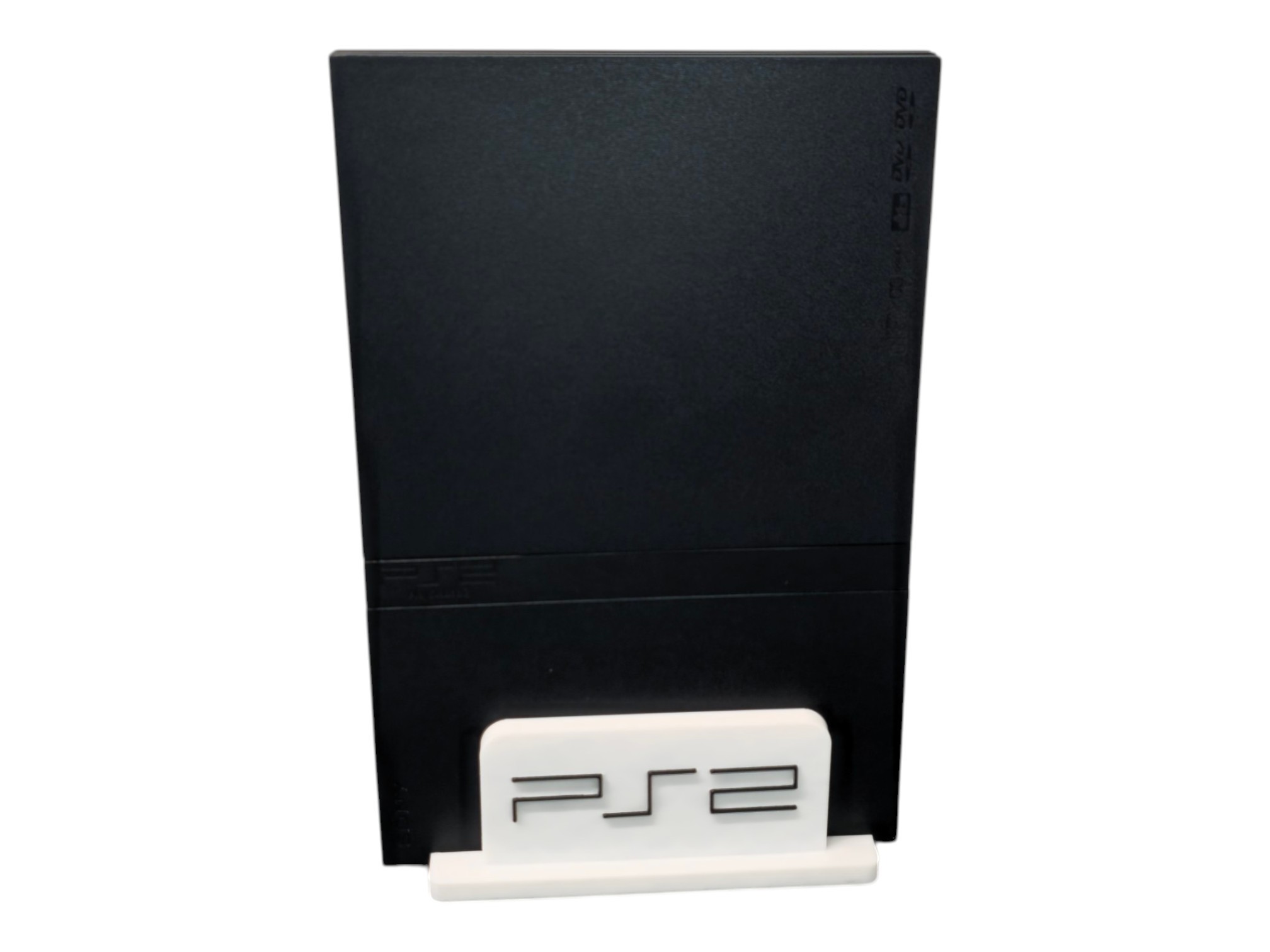
The Sony PlayStation 2 Slim is one of the most recognisable and beloved video game consoles of the 2000s. Compact, elegant, and supported by one of the greatest software libraries in gaming history, it represented the refined evolution of Sony’s legendary PlayStation 2.
Released in 2004, the Slim model transformed the original PlayStation 2 into a significantly smaller and lighter system while preserving its impressive gaming capabilities, DVD playback functionality, and compatibility with most original PlayStation games.
With unforgettable titles such as Grand Theft Auto: San Andreas, Gran Turismo 4, God of War, Metal Gear Solid 3, and Final Fantasy X, the PlayStation 2 generation helped redefine interactive entertainment and established Sony as a dominant force in the global video game industry.
More than two decades after its introduction, the PlayStation 2 Slim remains an essential part of gaming history and one of the most enjoyable consoles for retro gaming enthusiasts.
📘 Introduction
Introduced in November 2004, the Sony PlayStation 2 Slim was a redesigned version of the original PlayStation 2, which had launched in Japan in March 2000.
The original console had already achieved extraordinary commercial success, establishing itself as one of the most influential entertainment systems ever produced.
By 2004, however, Sony faced increasing competition from Microsoft’s Xbox and Nintendo’s GameCube.
Rather than introducing a completely new generation of hardware, Sony decided to modernise the existing PlayStation 2 with a smaller, lighter, and more efficient design.
The result was the PlayStation 2 Slim, officially introduced as the SCPH-70000 series.
The redesigned console retained the fundamental architecture of the original PS2 while introducing several practical improvements, including integrated Ethernet connectivity and a compact top-loading disc mechanism.
Its remarkable size reduction made it particularly attractive to consumers who wanted a powerful entertainment system without sacrificing living-room space.
The PlayStation 2 Slim demonstrated that a successful console could remain relevant for many years through thoughtful hardware refinement and an exceptional software library.
🏭 The Evolution of the PlayStation Brand
The story of the PlayStation 2 Slim begins with Sony’s entry into the video game industry during the 1990s.
The original Sony PlayStation, introduced in Japan in December 1994, revolutionised home gaming through its use of CD-ROM technology, 3D graphics, and strong relationships with third-party software developers.
Its enormous commercial success established Sony as a major competitor to Nintendo and Sega.
In March 2000, Sony introduced the PlayStation 2, bringing several important technological advances to home entertainment.
Compared with the original PlayStation, the PS2 offered:
- Significantly more powerful processing hardware
- Advanced 3D graphics
- DVD-ROM game storage
- DVD movie playback
- Improved audio capabilities
- Backward compatibility with original PlayStation software
- Support for more sophisticated gaming experiences
The PlayStation 2 quickly became a worldwide phenomenon.
By the time the Slim model arrived in 2004, the console already possessed a vast software catalogue and an enormous installed user base.
The redesigned system allowed Sony to extend the PlayStation 2’s commercial lifespan and reach an even broader audience.
🖥️ A Revolutionary Compact Design
The most immediately noticeable characteristic of the PlayStation 2 Slim was its dramatically reduced size.
The original PlayStation 2 featured a relatively large enclosure with an internal disc tray and substantial cooling and power components.
The Slim model adopted a completely different approach.
Sony redesigned the internal architecture to create an exceptionally compact system, making it one of the smallest home consoles of its generation.
Design Improvements
- Approximately 75% reduction in internal volume
- Around 50% reduction in weight
- Thickness reduced from approximately 7.8 cm to 2.8 cm
- Compact black enclosure
- Top-loading optical disc mechanism
- Integrated Ethernet port
- Two controller ports
- Two memory card slots
- Two USB ports
- Support for horizontal or vertical placement
The original Slim model measured approximately 230 × 28 × 152 mm and weighed around 900 grams.
Its compact dimensions were particularly impressive considering that the console retained almost all the gaming capabilities of the original system.
The Top-Loading Disc Mechanism
One of the most significant physical changes was the replacement of the motorised disc tray with a manual top-loading lid.
This eliminated the need for a mechanical tray mechanism and contributed to the console’s reduced size.
The top-loading design also made it easier to access and replace discs.
However, it required the user to leave sufficient space above the console when opening the lid.
The PlayStation 2 Slim became an excellent example of efficient industrial design, combining functionality with a minimalist appearance.
⚙️ Technical Specifications
Despite its much smaller enclosure, the PlayStation 2 Slim retained the core technology that had made the original console so successful.
Hardware Overview
- Manufacturer: Sony Computer Entertainment
- Model: PlayStation 2 Slim
- Original Slim release: 2004
- Generation: Sixth-generation video game console
- CPU: Sony/Toshiba Emotion Engine
- CPU clock speed: Approximately 295 MHz
- Graphics processor: Graphics Synthesizer
- Graphics processor clock speed: Approximately 147 MHz
- Main RAM: 32 MB RDRAM
- Video RAM: 4 MB embedded DRAM
- Sound processor: SPU2
- Audio channels: Up to 48 hardware voices
- Storage medium: CD-ROM and DVD-ROM
- Memory cards: PlayStation 2 Memory Card, typically 8 MB
- Controller ports: Two
- USB ports: Two USB 1.1
- Network connectivity: Integrated 10/100 Ethernet
- Video output: AV Multi Out
- Digital audio: Optical S/PDIF output
- Backward compatibility: Most original PlayStation games
- Optical drive: Top-loading CD/DVD mechanism
The console’s hardware architecture was designed to support complex 3D environments, advanced animation, and detailed character models.
Although its specifications appear modest compared with modern gaming systems, developers achieved extraordinary results by optimising software for the console’s specialised hardware.
🧠 The Emotion Engine: Power Behind the PlayStation 2
At the heart of the PlayStation 2 Slim was Sony’s famous Emotion Engine, a custom-designed processor developed in collaboration with Toshiba.
The Emotion Engine represented a major technological advancement when the original PlayStation 2 launched in 2000.
Based on the MIPS architecture, the processor included specialised vector processing capabilities designed to accelerate mathematical operations used in 3D graphics.
Key Capabilities
- Advanced geometry calculations
- 3D transformations
- Physics and animation processing
- Character movement calculations
- Artificial intelligence routines
- Complex real-time game environments
The processor worked alongside dedicated vector units, allowing developers to distribute demanding calculations across specialised hardware.
This architecture was particularly effective for games involving complex 3D worlds and detailed character animations.
Titles such as Gran Turismo 4, Metal Gear Solid 3, Shadow of the Colossus, and God of War II demonstrated how far developers could push the PlayStation 2’s capabilities.
Even during the final years of the console’s commercial lifespan, studios continued discovering new techniques for improving graphical performance.
🎨 Graphics & Visual Performance
The PlayStation 2 Slim inherited the sophisticated graphics architecture of the original PlayStation 2.
Its custom Graphics Synthesizer worked closely with the Emotion Engine to generate detailed 3D environments and impressive visual effects.
Graphics Capabilities
- Hardware-accelerated 3D rendering
- Texture mapping
- Lighting and shading effects
- Alpha blending and transparency
- Particle effects
- High-speed frame buffer operations
- Support for interlaced and progressive video modes
- Widescreen support in selected games
The console’s 4 MB of embedded video memory provided extremely high internal memory bandwidth, helping support demanding graphics operations.
Although the limited amount of video memory required careful optimisation, experienced developers produced impressive results.
Progressive Scan & Widescreen Gaming
Most PlayStation 2 games were designed for standard-definition CRT televisions.
However, certain titles supported progressive scan output, offering a sharper image when used with compatible displays.
Some games also supported widescreen presentation.
These features became increasingly valuable as flat-panel televisions gained popularity during the 2000s.
The PlayStation 2’s graphical capabilities played a major role in establishing 3D gaming as the dominant format for home consoles.
🎵 Sound & Audio Capabilities
Audio was another important strength of the PlayStation 2 platform.
The console incorporated Sony’s SPU2 sound processor, capable of handling up to 48 hardware voices.
Combined with the increased storage capacity of DVD discs, this allowed developers to create more elaborate soundtracks, atmospheric environments, and cinematic audio experiences.
Audio Features
- Multi-channel sound processing
- Digital audio playback
- High-quality music streaming
- Environmental audio effects
- Positional sound techniques
- Dolby Digital support in compatible content
- DTS support in selected games and DVD content
- Optical digital audio output
Games such as Silent Hill 2, Metal Gear Solid 3, Final Fantasy X, and God of War demonstrated the importance of audio in creating immersive experiences.
The PlayStation 2 also supported high-quality cinematic soundtracks and extensive voice acting.
Compared with the CD-based PlayStation generation, DVD storage gave developers considerably more freedom to include music, dialogue, and pre-rendered cinematic sequences.
🎮 Games & Software Library
One of the greatest strengths of the PlayStation 2 Slim was its access to the extraordinary PlayStation 2 software catalogue.
The platform became home to thousands of games spanning almost every major genre.
Its library included action adventures, racing games, role-playing games, survival horror, sports simulations, fighting games, platformers, and experimental titles.
Some of the most celebrated PlayStation 2 games include:
- Grand Theft Auto III
- Grand Theft Auto: Vice City
- Grand Theft Auto: San Andreas
- Gran Turismo 3: A-Spec
- Gran Turismo 4
- God of War
- God of War II
- Metal Gear Solid 2: Sons of Liberty
- Metal Gear Solid 3: Snake Eater
- Final Fantasy X
- Final Fantasy XII
- Kingdom Hearts
- Kingdom Hearts II
- Shadow of the Colossus
- ICO
- Silent Hill 2
- Resident Evil 4
- Devil May Cry
- Devil May Cry 3: Dante’s Awakening
- Tekken 5
- Soulcalibur II
- Burnout 3: Takedown
- Need for Speed: Underground 2
- Pro Evolution Soccer 6
- Ratchet & Clank
- Jak and Daxter: The Precursor Legacy
- Sly Cooper and the Thievius Raccoonus
- Okami
- Persona 4
- Black
The diversity of the PlayStation 2 catalogue was one of the main reasons behind its extraordinary commercial success.
Players could enjoy cinematic adventures, realistic racing simulations, expansive role-playing games, or simple multiplayer experiences on the same system.
Many of these titles are now considered landmarks in video game design.
🚗 Grand Theft Auto: A New Era of Open-World Gaming
The PlayStation 2 generation played a defining role in the evolution of open-world games.
Rockstar Games transformed the industry with the release of Grand Theft Auto III in 2001.
The game introduced a fully realised 3D urban environment where players could explore freely, interact with characters, complete missions, and experience an unprecedented sense of freedom.
Its successors, Grand Theft Auto: Vice City and Grand Theft Auto: San Andreas, expanded the formula considerably.
San Andreas, released in 2004, offered:
- A massive interconnected game world
- Three major cities
- Extensive vehicle selection
- Character customisation
- Role-playing elements
- Varied missions and activities
- A memorable soundtrack
- A cinematic storyline
These games helped establish the open-world genre as one of the most important categories in modern gaming.
The PlayStation 2 Slim arrived at precisely the right moment to benefit from their enormous popularity.
⚔️ God of War & Cinematic Action Gaming
Another franchise closely associated with the PlayStation 2 is God of War.
Introduced in 2005, the series followed Kratos, a Spartan warrior involved in a brutal struggle against the gods of Greek mythology.
The original game combined:
- Cinematic storytelling
- Fast-paced combat
- Large-scale boss battles
- Environmental puzzles
- Spectacular set pieces
- Detailed mythological environments
The sequel, God of War II, released in 2007, pushed the console’s hardware even further.
Its impressive graphics, enormous environments, and cinematic presentation demonstrated that the PlayStation 2 could continue delivering remarkable gaming experiences even after the arrival of newer hardware.
For Greek gamers, the franchise carried additional significance because of its setting in ancient Greek mythology.
God of War became one of PlayStation’s most successful and recognisable franchises.
💿 DVD Playback: More Than a Gaming Console
One of the most important reasons behind the PlayStation 2’s original success was its ability to function as a DVD movie player.
When the PS2 launched in 2000, standalone DVD players were still relatively expensive.
Sony recognised the opportunity to combine a powerful gaming console with a popular home entertainment technology.
The PlayStation 2 could play:
- PlayStation 2 DVD-ROM games
- PlayStation 2 CD-ROM games
- Compatible original PlayStation CD-ROM games
- DVD movies
- Audio CDs
- Certain recordable optical disc formats
The Slim model retained these multimedia capabilities.
Its compact dimensions made it particularly suitable for use in bedrooms, smaller living rooms, and secondary entertainment systems.
The Importance of DVD Technology
DVD discs offered significantly more storage space than traditional CD-ROMs.
A standard single-layer DVD could store approximately 4.7 GB of data, compared with around 650–700 MB for a conventional CD.
This allowed developers to include:
- Larger game worlds
- Higher-quality audio
- Extensive voice acting
- Full-motion video sequences
- More detailed game assets
- Additional game content
DVD technology became one of the defining characteristics of the PlayStation 2 generation.
🔄 Backward Compatibility with the Original PlayStation
One of the PlayStation 2’s most important features was its ability to run games originally developed for the first Sony PlayStation.
This gave the console access to an enormous existing catalogue of classic titles.
Popular original PlayStation games included:
- Crash Bandicoot
- Crash Bandicoot 2: Cortex Strikes Back
- Crash Bandicoot 3: Warped
- Spyro the Dragon
- Metal Gear Solid
- Final Fantasy VII
- Final Fantasy VIII
- Resident Evil 2
- Tekken 3
- Gran Turismo 2
- Tomb Raider
- Castlevania: Symphony of the Night
The PS2 Slim preserved backward compatibility with most original PlayStation games.
However, compatibility was not perfect, and certain titles could experience issues depending on the console’s hardware revision.
Memory Card Compatibility
Original PlayStation games generally required an original PlayStation-compatible memory card for saving progress.
PlayStation 2 memory cards were intended for PS2 software and could not directly replace original PlayStation memory cards for game saves.
This distinction remains important for collectors using authentic hardware.
Backward compatibility helped make the PlayStation 2 an especially attractive purchase by allowing existing PlayStation owners to continue enjoying their games.
🌐 Built-In Ethernet & Online Gaming
One of the most practical improvements introduced with the PlayStation 2 Slim was its integrated Ethernet port.
Earlier PlayStation 2 models generally required a separate Network Adaptor to access compatible online gaming services.
The Slim model included Ethernet connectivity as standard.
Networking Capabilities
- Integrated 10/100 Mbps Ethernet
- Online multiplayer in supported games
- Local area network gaming
- Network configuration utilities
- Support for compatible network-enabled software
Popular PlayStation 2 titles with online features included:
- SOCOM: U.S. Navy SEALs
- SOCOM II: U.S. Navy SEALs
- Gran Turismo 4 (LAN functionality)
- Battlefield 2: Modern Combat
- Star Wars: Battlefront
- Star Wars: Battlefront II
- Monster Hunter
- Resident Evil Outbreak
- Final Fantasy XI (on compatible HDD-equipped PS2 configurations)
Although many official PlayStation 2 online services have since been discontinued, enthusiast communities have developed alternative servers and networking solutions for selected games.
The built-in Ethernet port also remains useful for certain modern homebrew and preservation applications.
🕹️ DualShock 2 Controllers & Accessories
The PlayStation 2 Slim retained compatibility with Sony’s iconic DualShock 2 controller.
The DualShock 2 built upon the design of the original PlayStation controller while introducing pressure-sensitive functionality on most of its buttons.
DualShock 2 Features
- Two analogue sticks
- Directional pad
- Four face buttons
- Four shoulder buttons
- Start and Select buttons
- Analogue stick buttons (L3 and R3)
- Dual vibration motors
- Pressure-sensitive button functionality
The controller became one of the defining input devices of the sixth console generation.
Its ergonomic design worked well across a wide variety of genres, from racing simulations to fighting games and cinematic action adventures.
Popular Accessories
The PlayStation 2 ecosystem supported numerous peripherals, including:
- PlayStation 2 Memory Cards
- Multitap adapters for additional controllers
- DVD remote controls
- Compatible steering wheels
- Arcade sticks
- USB keyboards
- USB microphones
- SingStar microphones
- EyeToy USB camera
- Guitar Hero controllers
- Dance mats
- Vertical console stands
Certain accessories required specific revisions or additional compatibility checks for use with the Slim model.
The extensive accessory ecosystem helped expand the PlayStation 2 beyond conventional gaming.
📷 EyeToy: An Early Step Towards Motion Gaming
One of the most innovative accessories developed for the PlayStation 2 was the EyeToy, introduced in 2003.
The EyeToy was a USB camera that allowed players to interact with games through body movement.
Instead of relying entirely on a traditional controller, players could use their hands and bodies to interact with objects displayed on the television.
Popular EyeToy titles included:
- EyeToy: Play
- EyeToy: Play 2
- EyeToy: Play 3
- EyeToy: Groove
- EyeToy: Kinetic
The technology represented an early attempt to make video games more accessible and physically interactive.
Although relatively simple compared with later motion-tracking systems, the EyeToy helped demonstrate the possibilities of camera-based gaming.
Its influence can be seen in later technologies developed for interactive entertainment.
🔧 Build Quality & Longevity
The PlayStation 2 Slim is generally regarded as a practical and reliable console, although its compact design introduced several maintenance considerations.
Unlike the original PS2, the Slim used a top-loading optical drive with a more exposed laser assembly.
After many years of operation, some components may require attention.
Common Maintenance Tasks
- Cleaning the optical laser lens
- Inspecting the disc spindle and motor
- Checking the disc lid sensors
- Cleaning controller and memory card ports
- Inspecting the power connector
- Cleaning internal cooling components
- Checking ageing electronic components
- Inspecting the optical drive ribbon cable
The Optical Drive Ribbon Cable
One issue affecting certain PlayStation 2 Slim units involves the ribbon cable connected to the optical laser assembly.
Over time, the adhesive or positioning of this cable can deteriorate.
If the cable rises above its intended position, it may come into contact with a spinning disc, potentially leaving circular scratches.
This issue is not universal across all Slim models, but it is an important consideration for collectors preserving valuable original game discs.
Regular inspection and appropriate maintenance can help reduce the risk.
Laser Wear
As with other optical disc-based consoles, the laser mechanism can become less reliable after extensive use.
Common symptoms include:
- Difficulty reading discs
- Unusually long loading times
- Read errors
- Problems recognising specific disc formats
Careful maintenance and appropriate replacement components can often restore functionality.
🔄 PlayStation 2 Fat vs. PlayStation 2 Slim
Although both versions belong to the same console generation, their physical designs and certain hardware features differ considerably.
Original PlayStation 2 (2000)
- Larger enclosure
- Motorised disc tray
- Internal power supply
- Expansion bay on compatible models
- Optional Network Adaptor
- Compatible internal HDD support on selected models
- Greater flexibility for certain legacy accessories
PlayStation 2 Slim (2004)
- Significantly smaller enclosure
- Top-loading disc mechanism
- External power adapter on early Slim models
- Integrated Ethernet port
- No standard internal HDD expansion bay
- Reduced weight and power requirements
- Revised internal architecture
- More convenient portable design
The most significant limitation of the Slim redesign was the removal of the original expansion bay.
This prevented conventional installation of the internal hard disk system supported by certain earlier PS2 models.
Consequently, software requiring the official internal HDD could not be used normally on standard Slim hardware.
However, for the vast majority of conventional PlayStation 2 games, the Slim offered essentially the same experience in a much smaller package.
🧩 Different PlayStation 2 Slim Revisions
The PlayStation 2 Slim was produced in several hardware revisions throughout its commercial lifespan.
These models introduced various internal improvements while retaining the familiar compact appearance.
SCPH-70000 Series (2004)
- First Slim generation
- Introduced the compact enclosure
- Integrated Ethernet
- External power adapter
- Top-loading optical drive
- Architecture closely related to earlier PS2 models
SCPH-75000 Series (2005)
- Revised internal components
- Changes to processor integration
- Updated optical drive components
- Some differences in compatibility with older games
SCPH-77000 Series (2006)
- Additional internal hardware revisions
- Improved manufacturing efficiency
- Continued compact design
- Revised components and motherboard layouts
SCPH-79000 Series (2007)
- Further reduction in hardware size and weight
- More compact internal motherboard
- Improved component integration
- Lower overall power requirements
SCPH-90000 Series (2007–2008)
- Final major Slim redesign
- Integrated internal power supply
- Revised external appearance
- Updated motherboard architecture
- Continued Ethernet and optical disc support
The SCPH-90000 series is particularly interesting because it incorporated the power supply inside the console, eliminating the external power brick used by earlier Slim models.
For collectors, identifying the exact SCPH model number is important when evaluating repairs, accessories, hardware compatibility, and preservation options.
📺 Video Output & Modern Connectivity
The PlayStation 2 Slim was designed primarily for analogue televisions.
Its AV Multi Out connector supported several video connection methods, depending on the cable and display.
These included:
- Composite video
- RGB SCART
- S-Video
- Component video (YPbPr)
For European users, RGB SCART was an excellent way to obtain a sharp image from the console when connected to a compatible CRT television.
Component video also offered improved image quality and supported progressive scan in compatible software.
Connecting the PS2 Slim to Modern Televisions
Because the PlayStation 2 does not feature a native HDMI output, modern flat-panel televisions may require additional equipment.
Common solutions include:
- Component video cables
- RGB SCART connections
- Dedicated retro gaming scalers
- Compatible analogue-to-HDMI converters
- Original CRT televisions
A suitable video scaler can provide a cleaner picture and improve compatibility with modern displays.
However, image quality depends heavily on the converter, the original video signal, and the television itself.
For authentic retro gaming, many enthusiasts still prefer CRT displays because they reproduce the visual characteristics for which PlayStation 2 games were originally designed.
🌍 Worldwide Success & Cultural Impact
The PlayStation 2 became one of the most successful consumer electronics products of its generation.
Across its original and Slim versions, the PS2 sold more than 160 million consoles worldwide, making it the best-selling home video game console in history.
Its extraordinary success was supported by several factors:
- A massive software catalogue
- Strong third-party developer support
- DVD movie playback
- Backward compatibility
- Competitive pricing
- Worldwide distribution
- Recognisable PlayStation branding
- Continuous hardware revisions
The PlayStation 2 was particularly successful across:
- Japan
- North America
- The United Kingdom
- France
- Germany
- Spain
- Italy
- Greece and Cyprus
- Australia
- Latin America
The Slim model helped maintain the platform’s popularity even after newer consoles entered the market.
The PlayStation 2 in Greece
In Greece, the PlayStation 2 became one of the most recognisable gaming systems of the 2000s.
It was widely associated with football games, racing simulations, action adventures, and local multiplayer gaming.
Titles such as Pro Evolution Soccer, FIFA, Gran Turismo, Tekken, and Grand Theft Auto became particularly familiar among Greek players.
The console was present in homes, gaming cafés, and social gatherings, helping make PlayStation a household name.
The release of the Slim model made the system even more practical for households looking for a compact and affordable gaming console.
For an entire generation of Greek gamers, the PlayStation 2 remains closely connected with childhood memories, friendships, and countless hours of entertainment.
⭐ Why the PlayStation 2 Slim Still Matters
The Sony PlayStation 2 Slim remains a favourite among collectors and gaming enthusiasts for several reasons:
- It represents the refined evolution of Sony’s most successful console generation
- Its compact design remains impressive
- It provides access to thousands of PlayStation 2 games
- It supports most original PlayStation titles
- Its DVD playback capabilities made it a versatile entertainment system
- Its built-in Ethernet expanded networking possibilities
- Its library includes some of the most influential games ever created
- Its large accessory ecosystem encouraged innovative gameplay
- It helped extend the commercial lifespan of the PlayStation 2 platform
- It remains supported by an active preservation and homebrew community
The PlayStation 2 Slim also represents a time when developers were increasingly exploring cinematic storytelling, large open worlds, sophisticated 3D graphics, and new forms of player interaction.
Many gaming concepts that became standard in later generations were developed or popularised during the PlayStation 2 era.
🏛️ Collectability & Retro Gaming Legacy
The PlayStation 2 Slim remains an important console for collectors interested in the evolution of Sony’s gaming hardware.
Its widespread commercial success means that many original consoles survive today, although condition and completeness vary considerably.
Collectors often look for examples that retain:
- The original PlayStation 2 Slim console
- Original DualShock 2 controllers
- The correct power supply or power cable
- Original AV cables
- Genuine Sony Memory Cards
- Original packaging and protective inserts
- Instruction manuals and documentation
- Authentic PlayStation 2 game discs
- Optional accessories and peripherals
Particularly desirable examples include complete boxed systems, limited-edition colour variants, and well-preserved consoles with their original documentation.
Colour Variations
Although black was the standard colour, Sony released the PlayStation 2 Slim in several additional finishes across different regions.
These included:
- Ceramic White
- Satin Silver
- Pink
- Metallic Blue
- Other regional and limited-edition variations
These colour variations add an additional dimension to PlayStation 2 collecting.
The exact SCPH revision, regional configuration, and cosmetic condition can also influence collector interest.
However, the PlayStation 2 Slim’s historical significance extends far beyond its market value.
It represents one of the most successful periods in the history of interactive entertainment and preserves access to an extraordinary generation of video games.
📦 Items Included in This Collection Entry
- Sony PlayStation 2 Slim console unit
🏁 Conclusion
The Sony PlayStation 2 Slim represents one of the finest examples of successful console redesign in gaming history. By transforming the original PlayStation 2 into a smaller, lighter, and more convenient system, Sony extended the lifespan of an already legendary platform without sacrificing its remarkable capabilities.
Its enormous game library, DVD playback functionality, backward compatibility, and innovative accessories made it far more than a conventional gaming console.
The PlayStation 2 generation helped establish many of the technologies, gameplay concepts, and storytelling techniques that continue to shape modern video games.
From the expansive streets of Grand Theft Auto: San Andreas to the cinematic battles of God of War and the unforgettable adventures of Final Fantasy X, the console delivered experiences that remain influential decades later.
More than twenty years after the Slim model’s release, the PlayStation 2 continues to hold a special place in the hearts of gamers and collectors worldwide.
A true sixth-generation legend, a masterpiece of compact console design, and an essential part of any serious retro video game collection.
