

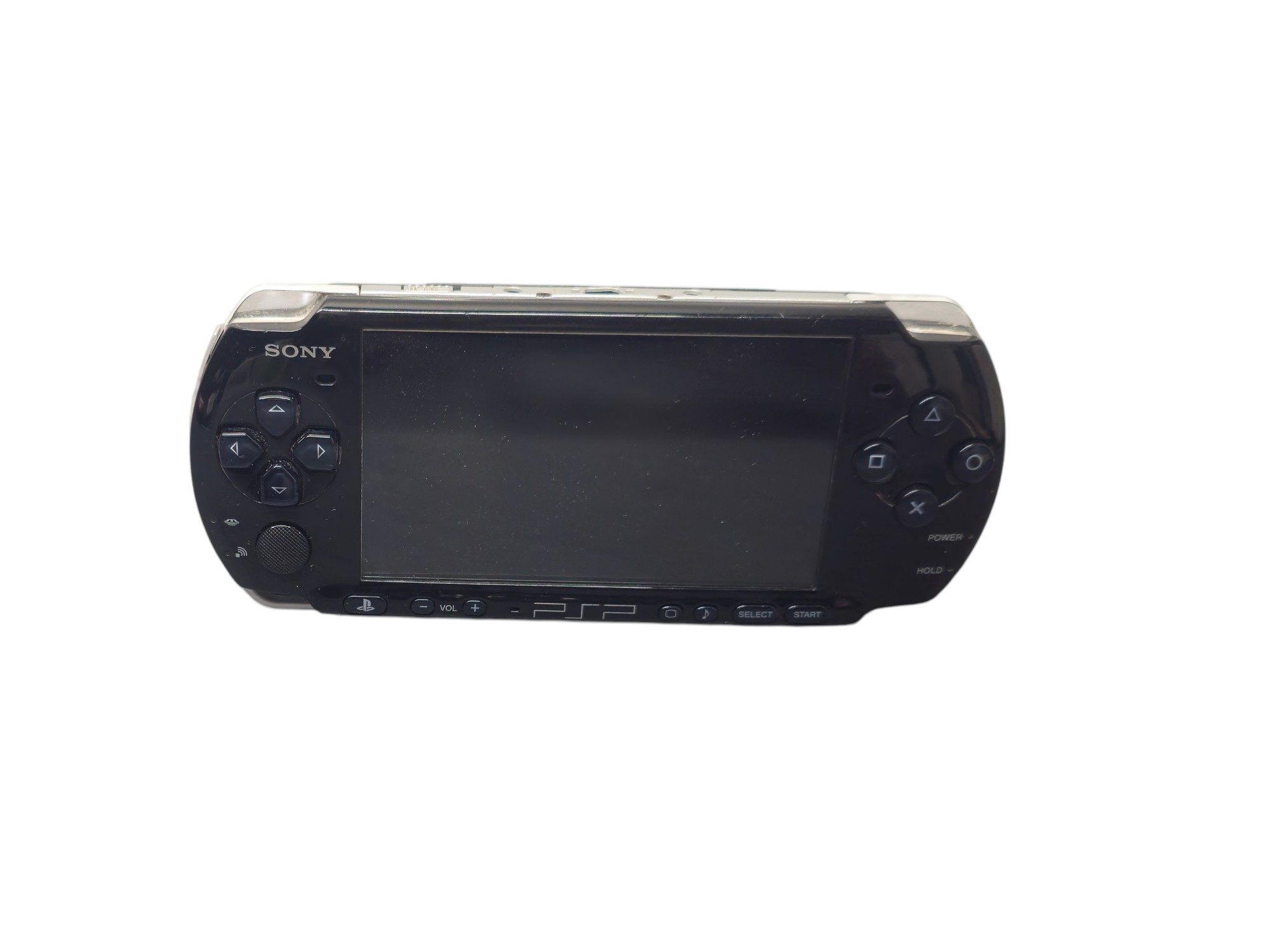
The Sony PSP-3004, part of the third-generation PlayStation Portable family, is one of the most iconic handheld gaming systems of the 2000s. Combining impressive 3D graphics, a vibrant widescreen display, multimedia capabilities, and an extensive library of games, it represented a major achievement in portable entertainment.
Released in 2008, the PSP-3000 series refined Sony’s original handheld console with an improved LCD screen, enhanced colour reproduction, reduced screen reflections, and a built-in microphone.
With legendary titles such as God of War: Chains of Olympus, Grand Theft Auto: Liberty City Stories, Crisis Core: Final Fantasy VII, Gran Turismo, and Metal Gear Solid: Peace Walker, the PlayStation Portable brought experiences previously associated with home consoles into the palms of players’ hands.
The PSP-3004, designed for the European market, remains one of the most desirable and practical versions of Sony’s original handheld gaming system.
📘 Introduction
Introduced worldwide in October 2008, the Sony PSP-3000 was the third major revision of the PlayStation Portable, following the original PSP-1000 and the slimmer PSP-2000.
The PSP platform had first launched in Japan on December 12, 2004, before reaching North America and Europe in 2005.
Sony’s objective was ambitious: create a handheld entertainment system capable of delivering sophisticated 3D gaming, multimedia playback, wireless connectivity, and an experience closer to that of a home console.
The original PSP had already demonstrated that powerful portable gaming was possible.
However, Sony continued refining the hardware to improve comfort, portability, and display quality.
The PSP-3000 represented the culmination of these improvements while preserving compatibility with the established PSP software library.
The PSP-3004 designation identifies a European-market variant of the PSP-3000 series.
Its combination of portability, functionality, and access to physical UMD games has helped make it a favourite among collectors and retro gaming enthusiasts.
🏭 Sony’s Entry into Handheld Gaming
Before the introduction of the PlayStation Portable, the handheld gaming market had been dominated for many years by Nintendo.
Systems such as the Game Boy, Game Boy Color, and Game Boy Advance had established portable gaming as an important part of the entertainment industry.
Sony entered this market with a different philosophy.
Rather than creating a relatively simple handheld gaming device, the company wanted to deliver a premium multimedia system capable of supporting advanced three-dimensional games.
The original PSP introduced several important features:
- A large widescreen LCD display
- Powerful 3D graphics processing
- Optical disc-based games
- Stereo audio
- Wireless networking
- Multimedia playback
- Memory card storage
- Internet connectivity
These features distinguished the PSP from many earlier handheld consoles.
Its stylish design also reflected Sony’s experience in portable consumer electronics, particularly products such as the Walkman and other personal entertainment devices.
The PlayStation Portable became a symbol of technological sophistication during the mid-2000s.
By the time the PSP-3000 appeared in 2008, Sony had established a successful handheld ecosystem supported by major game developers and an extensive software catalogue.
🖥️ A Refined and Elegant Portable Design
The PSP-3004 retained the slim, lightweight design introduced with the PSP-2000 while incorporating several refinements.
Its wide, horizontal layout featured a central display surrounded by familiar PlayStation controls.
The system was designed to be held comfortably with both hands, providing a control arrangement similar to a traditional home console.
Design Features
- Compact widescreen enclosure
- 4.3-inch LCD display
- Directional pad
- Four PlayStation face buttons
- Single analogue control nub
- L and R shoulder buttons
- Built-in stereo speakers
- Integrated microphone
- Top-loading UMD drive
- Memory Stick PRO Duo slot
- Rechargeable removable battery
- Wireless LAN switch
- Headphone and video-output connector
The PSP-3000 measured approximately 169.4 × 18.6 × 71.4 mm and weighed around 189 grams, including its standard battery.
This made it substantially lighter than the original PSP-1000.
The Redesigned Front Controls
Sony also introduced subtle changes to the front button arrangement.
The traditional Home button was replaced with a button featuring the PlayStation logo.
Several system buttons were redesigned, giving the console a more refined appearance.
These changes were relatively minor, but they helped distinguish the PSP-3000 from its predecessor.
The overall design remains one of Sony’s most recognisable examples of portable consumer electronics.
⚙️ Technical Specifications
Despite its compact dimensions, the PSP-3004 contained sophisticated hardware capable of producing detailed 3D graphics and rich multimedia experiences.
Hardware Overview
- Manufacturer: Sony Computer Entertainment
- Model: PSP-3004
- Hardware family: PSP-3000
- Release year: 2008
- Region: Europe
- Generation: Seventh-generation handheld console
- CPU: Sony custom MIPS R4000-based processor
- CPU clock speed: Up to 333 MHz
- Main RAM: 64 MB
- Display: 4.3-inch TFT LCD
- Resolution: 480×272 pixels
- Aspect ratio: 16:9
- Display colours: Approximately 16.77 million
- Graphics: Custom PSP graphics hardware
- Audio: Integrated stereo speakers
- Microphone: Built-in
- Storage medium: Universal Media Disc (UMD)
- Removable storage: Memory Stick PRO Duo
- Wireless connectivity: IEEE 802.11b Wi-Fi
- USB: USB 2.0 mini-B
- Video output: Analogue TV output
- Headphone connection: 3.5 mm
- Battery: Removable rechargeable lithium-ion, typically 1200 mAh
- Operating system: Sony PSP System Software
The PSP’s hardware was designed to provide an efficient balance between performance and battery consumption.
Its ability to run sophisticated 3D games on a portable battery-powered system was particularly impressive during the mid-2000s.
🌈 The Improved LCD Screen: The PSP-3000’s Greatest Advantage
One of the most important improvements introduced with the PSP-3000 series was its redesigned LCD display.
Although the screen retained the same 4.3-inch size and 480×272 resolution as earlier models, Sony substantially improved its image characteristics.
Display Improvements
- Wider colour gamut
- Improved contrast
- More vibrant colour reproduction
- Faster pixel response
- Reduced reflections
- Better visibility under various lighting conditions
These improvements made games appear brighter and more colourful.
Compared with the PSP-1000 and PSP-2000, the PSP-3000 could display richer colours and more visually striking environments.
The improved response time also helped reduce some of the motion blur associated with earlier PSP displays.
The Famous Scanline Effect
The new LCD technology also introduced a characteristic that became controversial among some enthusiasts.
During certain moving images, the screen could display fine horizontal lines or interlacing-like artefacts.
This effect was related to the display’s pixel structure and response characteristics.
Although some players found the effect distracting, others considered the improved colours and reduced ghosting a worthwhile trade-off.
Today, the PSP-3000’s display remains an important point of comparison when evaluating the different PSP revisions.
For many collectors, it represents one of the best original screens available within the UMD-based PSP family.
🧠 Portable Processing Power
At the heart of the PSP-3004 was Sony’s custom processor architecture based on the MIPS R4000 family.
The system’s main processor could operate at frequencies up to 333 MHz.
This provided considerably more advanced capabilities than those associated with earlier generations of handheld gaming hardware.
Processing Capabilities
- Real-time 3D geometry calculations
- Character animation
- Physics and movement processing
- Artificial intelligence routines
- Video decoding
- Audio processing
- Complex game environments
The PSP also included specialised hardware responsible for graphics and multimedia tasks.
This allowed developers to create portable games featuring detailed three-dimensional environments and sophisticated visual effects.
64 MB RAM
The PSP-3000 retained the 64 MB of system memory introduced with the PSP-2000.
The original PSP-1000 contained 32 MB.
The increased memory helped improve software operation, loading behaviour, and system functionality.
It also provided developers with additional resources compared with the original model.
Although the PSP’s hardware was considerably less powerful than the PlayStation 2, its capabilities were remarkable for a compact, battery-powered gaming system of its time.
💿 Universal Media Disc: A Unique Portable Format
One of the most distinctive features of the PlayStation Portable was its use of the Universal Media Disc (UMD).
Developed by Sony specifically for the PSP, the UMD was a miniature optical disc enclosed in a protective plastic cartridge.
Unlike traditional handheld consoles that relied primarily on ROM cartridges, the PSP used optical media for distributing games and movies.
UMD Specifications
- Format: Universal Media Disc
- Disc diameter: 60 mm
- Single-layer capacity: Approximately 900 MB
- Dual-layer capacity: Up to 1.8 GB
- Media type: Read-only optical disc
- Applications: Games, movies, and selected multimedia releases
The UMD format offered significantly more storage than many earlier handheld game cartridges.
This allowed developers to include:
- Detailed 3D environments
- Extensive voice acting
- High-quality music
- Pre-rendered cinematic sequences
- Larger game worlds
- More complex game content
The UMD Experience
Loading a UMD was part of the PSP’s distinctive character.
Players opened the rear disc compartment, inserted the small disc cartridge, and waited for the optical drive to begin reading.
The sound of the drive spinning and moving its laser mechanism became familiar to PSP owners.
Although loading times were generally longer than those of solid-state cartridges, UMD technology helped make the PSP feel like a miniature home console.
Today, the format is particularly interesting to collectors because it represents one of the few successful attempts to bring optical disc gaming to a mainstream handheld device.
🎮 Games & Software Library
The PSP-3004 benefited from one of the strongest software libraries ever developed for a dedicated handheld gaming platform.
Its catalogue included action adventures, racing games, role-playing games, fighting games, platformers, strategy titles, sports simulations, and arcade-style experiences.
Some of the most memorable PlayStation Portable games include:
- God of War: Chains of Olympus
- God of War: Ghost of Sparta
- Grand Theft Auto: Liberty City Stories
- Grand Theft Auto: Vice City Stories
- Crisis Core: Final Fantasy VII
- Metal Gear Solid: Peace Walker
- Metal Gear Solid: Portable Ops
- Gran Turismo
- Daxter
- Ratchet & Clank: Size Matters
- Resistance: Retribution
- Killzone: Liberation
- Tekken: Dark Resurrection
- Tekken 6
- Monster Hunter Freedom Unite
- Patapon
- Patapon 2
- Patapon 3
- LocoRoco
- LocoRoco 2
- Lumines
- Wipeout Pure
- Wipeout Pulse
- Burnout Legends
- LittleBigPlanet
- Dissidia Final Fantasy
- Persona 3 Portable
- Castlevania: The Dracula X Chronicles
- Syphon Filter: Dark Mirror
- The 3rd Birthday
The library was especially impressive because many titles delivered experiences previously associated with full-size home consoles.
Major PlayStation franchises received dedicated portable instalments, often designed specifically around the PSP’s hardware and controls.
The system also became an important platform for Japanese role-playing games and multiplayer action titles.
Many PSP games remain highly regarded for their ambitious design, memorable soundtracks, and impressive technical achievements.
⚔️ God of War: Console-Quality Action on the Move
One of the PSP’s most impressive achievements was the successful adaptation of the God of War franchise.
Developed by Ready at Dawn, God of War: Chains of Olympus arrived in 2008.
The game brought the cinematic combat and mythological environments of the PlayStation 2 series to a portable system.
It featured:
- Fast-paced action combat
- Large mythological environments
- Detailed character models
- Cinematic cutscenes
- Environmental puzzles
- Impressive boss battles
- Memorable orchestral music
Despite the PSP’s limited processing resources, the developers created an experience that closely resembled the console versions.
God of War: Ghost of Sparta
Released in 2010, Ghost of Sparta pushed the PSP hardware even further.
The game introduced improved environmental detail, sophisticated animation, and impressive visual effects.
It became one of the most technically accomplished titles released for Sony’s handheld platform.
For collectors and gaming historians, the two PSP God of War games demonstrate the extraordinary level of optimisation achieved by developers during the system’s later years.
🚗 Grand Theft Auto: Open-World Gaming in Your Pocket
The arrival of the Grand Theft Auto franchise on PSP represented another important technological achievement.
Grand Theft Auto: Liberty City Stories, released in 2005, brought Rockstar’s open-world gameplay to handheld gaming.
Players could explore a detailed three-dimensional city, complete missions, drive vehicles, and experience a cinematic storyline.
The game featured:
- A large open-world environment
- Numerous vehicles
- Story-driven missions
- Radio stations and licensed music
- Character interactions
- Side activities
- Multiplayer features
Its successor, Grand Theft Auto: Vice City Stories, expanded the experience with a new storyline, additional activities, and improvements to the gameplay formula.
These titles demonstrated that large-scale open-world adventures were no longer restricted to television-connected consoles.
For many players, carrying a fully realised Grand Theft Auto experience in their pocket was one of the PSP’s most exciting features.
🏎️ Gran Turismo: Portable Racing Simulation
Released in 2009, Gran Turismo brought Sony’s famous driving franchise to the PlayStation Portable.
Developed by Polyphony Digital, the game offered an extensive collection of vehicles and racing circuits.
Its features included:
- More than 800 vehicles
- Multiple racing circuits and layouts
- Detailed vehicle models
- Realistic driving physics
- Single-player racing
- Local wireless multiplayer
- Extensive car collection
The game demonstrated how effectively the PSP could handle complex racing environments.
Although its structure differed from the traditional career progression of the home console Gran Turismo titles, the portable edition retained the franchise’s emphasis on vehicle variety and driving simulation.
Its technical presentation was particularly impressive for a handheld console released during the 2000s.
🎵 Music, Movies & Multimedia Entertainment
The PlayStation Portable was designed as much more than a gaming console.
Sony positioned the PSP as a complete portable entertainment system capable of handling several types of digital content.
Multimedia Features
- Music playback
- Video playback
- Photo viewing
- UMD movie playback
- Internet browsing
- Digital content management
- Audio through integrated stereo speakers
- Headphone support
- External video output
Music Playback
Users could transfer compatible music files to a Memory Stick and listen through headphones or the built-in speakers.
Supported audio formats included MP3, ATRAC, and selected other formats depending on system software.
The PSP therefore functioned as a portable music player in addition to a gaming device.
Video Playback
The system could play compatible digital video files and UMD movies.
Its 16:9 widescreen display was particularly suitable for watching films.
At a time when smartphones had not yet become the dominant portable multimedia devices, these features made the PSP an attractive all-in-one entertainment product.
Photo Viewing
The PSP could also display digital photographs stored on a memory card.
Users could browse images and create slideshows directly on the handheld screen.
These multimedia capabilities helped distinguish Sony’s handheld from traditional gaming-focused devices.
🎤 Built-In Microphone & Communication Features
One of the practical additions introduced with the PSP-3000 was its integrated microphone.
Earlier PSP models required compatible external accessories for microphone functionality.
The built-in microphone allowed users to take advantage of supported voice communication features without additional hardware.
Microphone Applications
- Voice communication in compatible games
- Online communication features
- Selected voice-input applications
- Skype support during the service’s original availability
Skype on PSP
The PSP supported a version of Skype that allowed users to make voice calls over compatible wireless internet connections.
This was a remarkable feature for a handheld gaming device introduced during the 2000s.
The functionality reflected Sony’s ambition to position the PSP as a multifunctional portable communication and entertainment system.
However, Skype support for the PSP has long since been discontinued.
Today, the microphone remains primarily a historical feature and may still be useful with compatible offline software.
🌐 Wi-Fi & Wireless Multiplayer
The PSP-3004 included integrated wireless networking, allowing players to connect to compatible networks and other PSP systems.
Its wireless hardware supported IEEE 802.11b Wi-Fi.
The console offered two principal networking modes.
Ad Hoc Mode
Ad Hoc mode allowed nearby PSP systems to communicate directly without requiring an internet connection.
This was particularly useful for local multiplayer gaming.
Popular games supporting local wireless multiplayer included:
- Monster Hunter Freedom Unite
- Metal Gear Solid: Peace Walker
- Gran Turismo
- Tekken: Dark Resurrection
- Wipeout Pure
- Phantasy Star Portable
The ability to connect multiple handheld consoles directly was especially appealing to groups of friends.
Infrastructure Mode
Infrastructure mode allowed the PSP to connect through a compatible wireless access point.
Depending on the software and available services, this enabled:
- Online gaming
- Internet browsing
- Digital downloads
- Network communication
- System-related online functionality
Modern Networking Limitations
Because the PSP uses older wireless technology, connecting it to modern routers can be challenging.
The system does not support modern WPA2 or WPA3 wireless security.
Many contemporary routers no longer offer compatible legacy security settings.
For preservation purposes, local Ad Hoc multiplayer remains particularly valuable because it can function independently of online service availability.
🎛️ The XrossMediaBar Interface
Like the PlayStation 3, the PSP used Sony’s distinctive XrossMediaBar (XMB) interface.
The system organised functions into horizontal categories with vertically arranged options.
Its principal categories included:
- Settings
- Photo
- Music
- Video
- Game
- Network
- PlayStation Network
The XMB offered a clean and modern interface that was easy to navigate using the directional controls.
A Shared PlayStation Identity
The interface established a consistent visual language between the PSP and PlayStation 3.
Animated backgrounds, custom themes, and familiar navigation sounds contributed to the system’s distinctive identity.
Users could also customise certain aspects of the interface through themes and wallpapers.
For many PlayStation enthusiasts, the XMB remains one of the most recognisable software interfaces of Sony’s gaming history.
💾 Memory Stick PRO Duo & Digital Storage
Although physical PSP games were distributed on UMD discs, the console also supported removable flash memory.
The PSP-3004 used Memory Stick PRO Duo cards, Sony’s proprietary memory card format.
These cards were essential for many everyday functions.
Memory Card Uses
- Saving game progress
- Storing downloaded games
- Installing selected game data
- Saving photos
- Storing music
- Playing compatible video files
- Managing themes and other content
- Transferring files between devices
The system also used internal flash memory for firmware and system functions, but this was not intended as general-purpose storage for a game library.
Digital Game Distribution
As PlayStation Network developed, Sony increasingly offered PSP games in downloadable form.
This allowed users to store compatible games on memory cards instead of relying exclusively on UMD discs.
The PSP therefore became an early example of a gaming platform supporting both physical and digital software distribution.
Today, downloadable content availability depends on Sony’s current account, storefront, and transfer restrictions.
For collectors, physical UMD releases remain especially important because they provide tangible examples of the system’s original software distribution format.
📺 TV Output: Playing PSP Games on a Larger Screen
Another important feature of the PSP-3004 was its ability to connect to a television through compatible video cables.
The PSP-2000 had already introduced external video output, but the PSP-3000 improved its capabilities.
Supported Video Connections
Depending on the cable and television, the console could use:
- Component video
- Composite video
- S-Video in supported regional configurations
The PSP-3000 could display compatible PSP games using interlaced output, providing more flexibility than the PSP-2000.
On the earlier model, native PSP games generally required progressive component output.
The Benefits of TV Output
External video output allowed users to:
- Display compatible games on a television
- Watch UMD movies on a larger screen
- View photographs
- Play compatible video content
- Demonstrate games to other people
However, the PSP’s native screen resolution remained 480×272 pixels.
Connecting the console to a higher-resolution display did not automatically improve the original rendering resolution.
Some output configurations also displayed PSP games within a smaller image area surrounded by black borders.
Modern Display Compatibility
Because the PSP lacks native HDMI output, modern televisions may require appropriate analogue-to-digital conversion equipment.
Retro gaming scalers can provide improved compatibility with modern displays.
The TV-out feature is particularly useful for collectors who wish to demonstrate original PSP hardware on an external screen.
🔄 PSP-1000 vs. PSP-2000 vs. PSP-3000 vs. PSP Go
The PlayStation Portable family evolved through several major hardware revisions.
Each model introduced changes intended to improve portability, functionality, or manufacturing efficiency.
PSP-1000 (2004)
- Original PlayStation Portable design
- Larger and heavier enclosure
- 32 MB RAM
- 4.3-inch LCD display
- UMD drive
- Removable battery
- Memory Stick PRO Duo support
- No official external video output
- No built-in microphone
The PSP-1000 established the platform’s identity and remains historically important as Sony’s first handheld console.
PSP-2000 (2007)
- Slimmer and lighter design
- 64 MB RAM
- Improved portability
- External video output
- Reduced weight
- Continued UMD support
- Memory Stick PRO Duo compatibility
The PSP-2000 represented a significant refinement of the original hardware.
PSP-3000 (2008)
- Improved high-contrast LCD
- Wider colour gamut
- Reduced screen reflections
- Faster display response
- Built-in microphone
- Enhanced external video output
- 64 MB RAM
- UMD drive
- Removable battery
The PSP-3000 is often considered one of the most balanced models in the original PSP family.
PSP Go (2009)
- Completely redesigned sliding enclosure
- Smaller 3.8-inch display
- No UMD drive
- 16 GB internal flash storage
- Bluetooth connectivity
- Digital game distribution
- Compact portable design
The PSP Go represented Sony’s most ambitious move towards fully digital handheld gaming.
However, the removal of the UMD drive limited its appeal to customers who already owned physical PSP games.
PSP Street (2011)
- Budget-oriented European model
- Simplified construction
- No Wi-Fi connectivity
- Mono speaker
- UMD support
- Reduced manufacturing costs
Each revision reflects a different stage in Sony’s approach to portable entertainment.
For collectors, the PSP-3004 is particularly attractive because it combines the mature design of the PSP-3000 with support for original physical media.
🎮 PSP vs. Nintendo DS: The Handheld Console Rivalry
The PlayStation Portable entered the market during a period of intense competition in handheld gaming.
Its primary rival was the Nintendo DS, introduced in 2004.
Both systems achieved major commercial success but followed very different design philosophies.
Sony PlayStation Portable
- Large widescreen display
- Advanced 3D graphics
- Optical disc-based games
- Analogue control nub
- Multimedia playback
- Emphasis on console-style experiences
- Premium hardware design
Nintendo DS
- Dual-screen configuration
- Touchscreen interaction
- Cartridge-based games
- Microphone support
- Innovative input methods
- Strong emphasis on accessible gameplay
- Extensive first-party Nintendo franchises
Nintendo prioritised unusual forms of interaction and accessibility.
Sony focused more heavily on graphical performance, multimedia features, and experiences resembling home console games.
Although the Nintendo DS achieved greater worldwide hardware sales, the PSP established a substantial user base and became a major commercial success.
The rivalry demonstrated that handheld gaming could support different technological philosophies and audience preferences.
🎨 Special Editions & Colour Variations
The PSP-3000 series was released in numerous colours and special editions.
These variations contributed to the system’s appeal among collectors.
Common and notable finishes included:
- Piano Black
- Pearl White
- Mystic Silver
- Radiant Red
- Vibrant Blue
- Bright Yellow
- Spirited Green
- Blossom Pink
Availability varied by region, production period, and retail bundle.
Special Edition Consoles
Sony also released PSP systems associated with popular games and entertainment franchises.
Selected editions featured:
- Special colours
- Custom artwork
- Limited-edition packaging
- Bundled software
- Exclusive decorative elements
Certain Monster Hunter-themed PSP-3000 editions became particularly well known.
Today, limited-edition systems can attract considerable collector interest, especially when accompanied by original packaging and accessories.
The exact regional model number, colour, and production variation are important details when documenting individual consoles.
🔧 Build Quality & Longevity
The PSP-3004 is generally regarded as a durable handheld console, although several components can deteriorate after many years of use.
Its portable design means that surviving units may show signs of wear from frequent handling, transportation, and battery charging.
Common Maintenance Tasks
- Cleaning the exterior shell
- Inspecting the LCD display
- Checking the UMD drive mechanism
- Cleaning the optical lens
- Inspecting the analogue control nub
- Checking shoulder buttons
- Cleaning the headphone connection
- Inspecting the charging port
- Checking battery condition
- Inspecting the Memory Stick slot
UMD Drive Maintenance
The UMD drive contains moving mechanical components, including a spindle motor and optical laser assembly.
After extensive use, problems may include:
- Difficulty reading discs
- Unusual mechanical noises
- Long loading times
- Disc recognition errors
- Intermittent operation
Careful inspection and appropriate repairs can help preserve the drive.
Battery Ageing
One of the most important preservation concerns is the removable lithium-ion battery.
Original PSP batteries are now many years old.
Some may have lost significant capacity, while others may become physically swollen.
A swollen battery can place pressure on the battery compartment and surrounding components.
Swollen or damaged batteries should not be charged or used.
Collectors should inspect batteries regularly and replace unsafe units with suitable compatible alternatives.
Screen & Cosmetic Condition
The PSP’s front surface can accumulate scratches through everyday use.
Other possible age-related issues include:
- Yellowing or uneven LCD illumination
- Stuck or damaged pixels
- Button wear
- Analogue stick problems
- Scratched plastic surfaces
- Broken battery covers
Well-preserved examples with original components and minimal cosmetic damage are particularly attractive to collectors.
🌍 Worldwide Success & Cultural Impact
The PlayStation Portable became one of the most successful dedicated handheld gaming platforms ever released.
Across the entire PSP hardware family, Sony reported more than 80 million units sold worldwide over the system’s lifetime.
Its popularity extended across major markets, including:
- Japan
- North America
- The United Kingdom
- France
- Germany
- Spain
- Italy
- Greece and Cyprus
- Australia
- Other international regions
The PSP was particularly successful in Japan, where titles such as Monster Hunter encouraged large communities of players to gather for local multiplayer sessions.
In Western markets, games such as Grand Theft Auto, God of War, FIFA, and Gran Turismo contributed significantly to the handheld’s popularity.
The PSP in Greece
In Greece, the PlayStation Portable became a familiar gaming device during the second half of the 2000s.
Its combination of impressive graphics, portable design, and established PlayStation franchises attracted both younger players and existing console enthusiasts.
The system became associated with:
- Portable football games
- Racing simulations
- Action adventures
- Local multiplayer sessions
- Music and video playback
- Digital multimedia entertainment
For many Greek gamers, the PSP represented their first opportunity to enjoy relatively sophisticated 3D console-style games without being connected to a television.
Its popularity also reflected the increasing importance of personal portable electronic devices during the decade.
The PSP helped establish the idea that a handheld console could function as a complete entertainment system rather than simply a device for playing small games.
⭐ Why the PSP-3004 Still Matters
The Sony PSP-3004 remains an important part of gaming history for several reasons:
- It represents one of the most refined versions of the original PSP
- Its improved LCD offers vibrant colours and better contrast
- Its compact design remains practical and attractive
- It retains compatibility with physical UMD games
- Its 64 MB RAM supports the mature PSP software platform
- Its built-in microphone expanded communication capabilities
- Its video output allows connection to external displays
- Its library includes some of the greatest handheld games ever created
- It combines gaming and multimedia functionality
- It represents an important chapter in Sony’s portable gaming history
The PSP-3004 also occupies a fascinating position between traditional handheld consoles and modern multifunctional portable devices.
Its emphasis on music, movies, internet connectivity, and digital downloads anticipated several features that would later become standard on smartphones and other mobile entertainment platforms.
Even today, the PSP maintains an enthusiastic community of players, developers, collectors, and hardware preservation specialists.
🏛️ Collectability & Handheld Gaming Legacy
The PSP-3004 remains a popular choice among collectors interested in Sony’s handheld gaming history.
Its combination of physical UMD compatibility, improved display technology, and mature hardware design makes it one of the most appealing original PSP revisions.
Collectors often look for examples that retain:
- Original Sony PSP-3004 console
- Original battery
- Original AC adapter
- Original battery cover
- Memory Stick PRO Duo
- Original packaging
- Protective inserts
- Instruction manuals
- Authentic UMD game discs
- Original accessories and carrying cases
The Importance of Original UMD Games
Physical UMD releases are particularly significant because the format was developed specifically for the PSP.
Unlike modern digital-only software, UMD games provide tangible examples of the handheld’s original commercial ecosystem.
Collectors can preserve:
- Original game cases
- Cover artwork
- Printed manuals
- UMD disc cartridges
- Regional packaging variations
- Special editions
PSP game discs are generally not region-locked, although UMD movies can be subject to regional playback restrictions.
This distinction is important when building an international PSP collection.
Preserving the PSP Experience
The long-term preservation of PSP hardware involves more than maintaining a working console.
It also includes protecting original batteries, optical media, memory cards, software, packaging, and documentation.
As original hardware ages and official online services change, physical preservation becomes increasingly valuable.
The PSP-3004 represents a particularly interesting stage in gaming history because it combines traditional optical media with early digital distribution and connected entertainment.
📦 Items Included in This Collection Entry
- Sony PSP-3004 (PlayStation Portable) handheld console — European model
🏁 Conclusion
The Sony PSP-3004 represents one of the finest achievements of Sony’s original handheld gaming era. Combining a vibrant widescreen display, powerful portable hardware, physical UMD games, wireless connectivity, and multimedia functionality, it offered an extraordinary entertainment experience for its time.
Its improved LCD screen, integrated microphone, refined design, and expanded video-output capabilities made it one of the most complete versions of the PlayStation Portable.
From the mythological battles of God of War to the open-world adventures of Grand Theft Auto and the impressive driving simulation of Gran Turismo, the PSP delivered memorable gaming experiences that demonstrated the potential of sophisticated portable hardware.
The PSP also played an important role in the transition towards modern mobile entertainment, combining gaming, music, movies, and network connectivity within a single device.
More than two decades after the original PSP’s introduction, the PSP-3004 remains a beloved system among collectors, gaming enthusiasts, and those who appreciate the technological achievements of the 2000s.
A true handheld gaming classic, a remarkable achievement in portable entertainment, and an essential part of any serious PlayStation hardware collection.
