

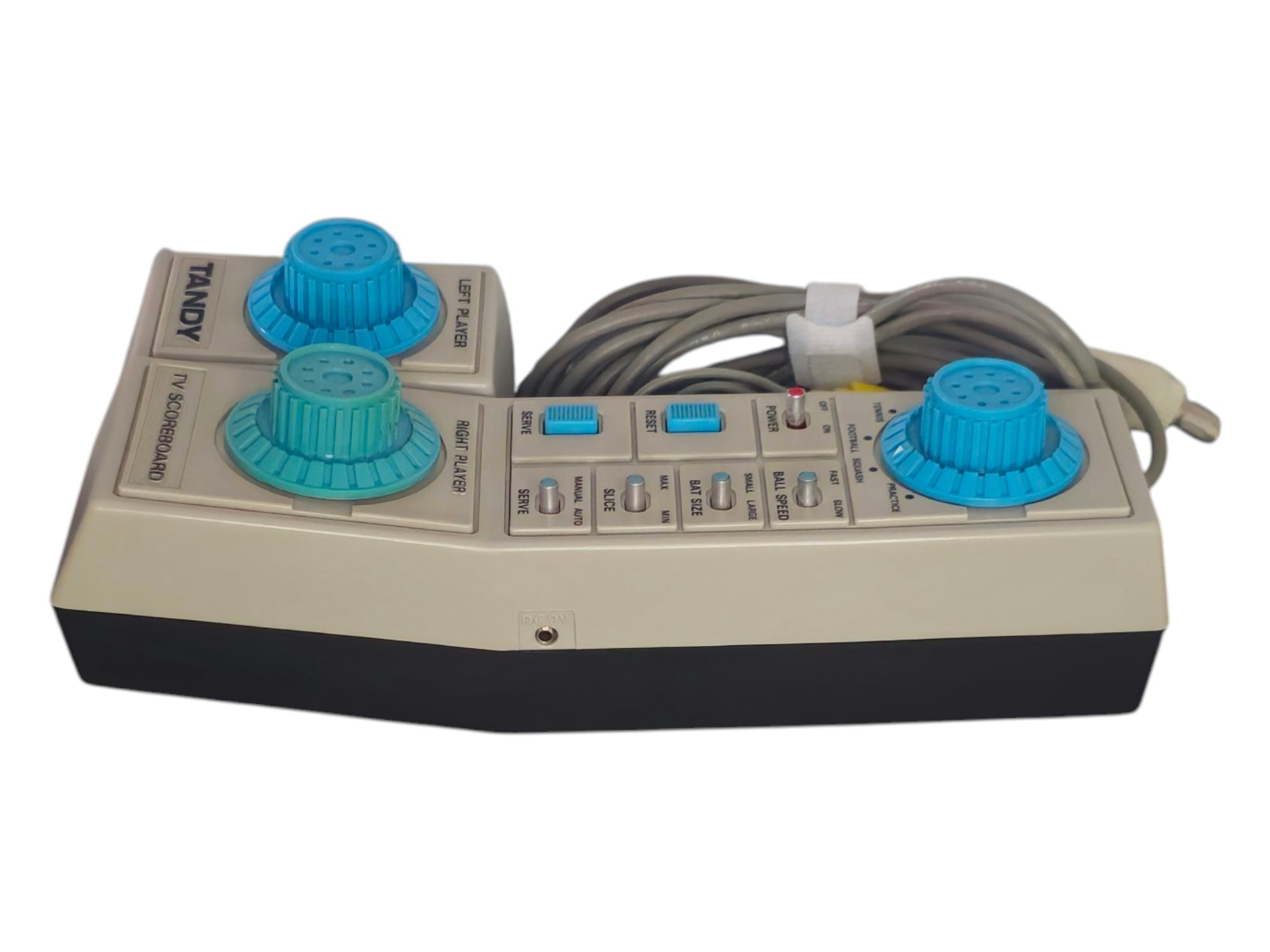
The Tandy Electronic TV Scoreboard, model 60-3060, is a classic first-generation home video game console from the late 1970s. Marketed by Tandy Corporation and RadioShack, it represents an important period in the development of affordable electronic entertainment, when simple ball-and-paddle games were bringing interactive television experiences into ordinary households.
Built around the influential General Instrument AY-3-8500 family of dedicated game integrated circuits, the TV Scoreboard provides four permanently installed games: Tennis, Football, Squash, and Practice.
Its distinctive modular design consists of a compact main control unit with a rotary paddle and an additional wired player controller. The light-coloured plastic enclosure, bright blue controls, physical adjustment switches, and analogue television connection perfectly capture the appearance of consumer electronics during the Pong generation.
Unlike later programmable consoles, the Tandy TV Scoreboard does not contain a conventional software-executing CPU, interchangeable game cartridges, or digital storage. Its games are generated directly through specialised electronic circuitry.
The system also offers surprisingly extensive gameplay adjustments, including ball speed, paddle size, rebound behaviour, and manual or automatic serving.
Today, the Tandy Electronic TV Scoreboard 60-3060 is an important historical artefact, representing the rapid expansion of home gaming before the introduction of more sophisticated cartridge-based entertainment systems.
📘 Introduction
The Tandy Electronic TV Scoreboard family was introduced in 1976, during the first major commercial expansion of home video gaming.
The specific 60-3060 model is generally associated with 1977–1978, with historical sources differing slightly on its precise introduction date.
The model was sold during the late 1970s, including through RadioShack’s catalogue retail network.
Principal Features
- Four built-in electronic games
- General Instrument AY-3-8500-family game circuitry
- Black-and-white television graphics
- Two-player capability
- Rotary paddle controllers
- Compact modular enclosure
- Automatic on-screen scoring
- Adjustable ball speed
- Adjustable paddle size
- Adjustable ball deflection
- Automatic or manual serving
- Electronic sound effects
- RF television output
- Battery operation
- External power adapter support
The TV Scoreboard belongs to the first generation of home video game consoles.
Its games are permanently implemented within the electronic hardware.
The system was designed primarily for entertainment rather than general-purpose computing.
Nevertheless, it represents a major historical step in making interactive electronic technology accessible to everyday consumers.
🏭 Tandy Corporation: From Leather Goods to Electronics
The history of the TV Scoreboard is connected with one of the most recognisable American consumer electronics companies of the twentieth century.
Tandy Corporation began as a business associated with leather goods and craft supplies.
Over time, the company expanded into electronics retailing and technology products.
The Acquisition of RadioShack
In 1963, Tandy Corporation acquired the RadioShack business.
RadioShack had developed a reputation for selling electronic components, radio equipment, and other technology products.
Under Tandy’s ownership, RadioShack grew into a major retail chain.
A Network of Electronics Stores
RadioShack became widely known for products such as:
- Radios
- Audio equipment
- Electronic components
- Calculators
- Citizen-band radio equipment
- Electronic toys
- Consumer electronics
- Personal computers
- Video game systems
The Catalogue Business
RadioShack’s printed catalogues became an important part of American electronics retail history.
They documented new products, technical specifications, prices, and consumer trends.
The Arrival of Video Games
During the mid-1970s, electronic television games became a rapidly growing product category.
Tandy introduced dedicated gaming systems under the TV Scoreboard name.
A Broader Computing Legacy
Tandy subsequently became famous for personal computers such as:
The TV Scoreboard therefore represents an important early stage in the company’s wider involvement with home computing and electronic entertainment.
📺 The Birth of Television Gaming
The TV Scoreboard appeared during a period when the concept of using a television for interactive entertainment was still relatively new.
Magnavox Odyssey (1972)
The Magnavox Odyssey became the first commercially released home video game console.
Its development originated with the pioneering work of Ralph H. Baer and his collaborators.
The Odyssey demonstrated that electronic objects could be controlled by players and displayed on an ordinary television.
Atari Pong (1972)
Atari’s arcade Pong helped popularise electronic gaming.
Its simple tennis-inspired gameplay became a worldwide phenomenon.
Atari Home Pong (1975)
The introduction of Home Pong brought similar gameplay into domestic living rooms.
The Pong Boom
Numerous manufacturers subsequently entered the market.
These companies introduced products offering:
- Different numbers of games
- Alternative controller arrangements
- Difficulty settings
- Colour graphics
- Shooting-game accessories
- Compact enclosures
Tandy’s Entry
The TV Scoreboard family was part of this wave.
It allowed consumers to experience electronic sports games without visiting an arcade.
A Changing Relationship with Television
The television became more than a receiver of broadcasts.
It became an interactive display controlled directly by the user.
This transformation was one of the most important developments in consumer entertainment technology.
🏷️ The Electronic TV Scoreboard 60-3060
The 60-3060 is a specific model within Tandy’s wider family of dedicated television games.
Its model number is particularly important because the TV Scoreboard name was applied to several technically different devices.
The Model Designation
The number 60-3060 is a RadioShack/Tandy catalogue identification number.
It distinguishes this machine from earlier and later Scoreboard products.
The Four-Game Configuration
The 60-3060 provides:
- Tennis
- Football
- Squash
- Practice
The Distinctive Physical Arrangement
The machine features:
- Main control module
- Integrated right-player rotary control
- Separate wired left-player control
- Adjustable hardware switches
- RF television cable
Original Retail Packaging
Surviving packaging uses prominent Electronic TV Scoreboard branding.
It advertises four games and two-player entertainment.
An Important Model Distinction
The related 60-3061 is not identical.
That version adds shooting-game functionality and was marketed with a light-gun accessory.
The 60-3060 should therefore be documented as a four-game system without light-gun gameplay.
Historical Importance
The compact design and separate player controller distinguish this model from earlier, larger tabletop Pong systems.
🖥️ The Compact Modular Design
The TV Scoreboard 60-3060 has an unusual physical arrangement.
Rather than using one large rectangular console with two permanently attached paddle controls, it incorporates a compact main unit and an additional player controller.
Exterior Characteristics
- Light-coloured plastic housing
- Blue rotary control knobs
- Blue adjustment switches
- Red power button
- Blue Reset button
- Blue Serve button
- Printed game-selection labels
- Compact wired controller module
- Cable connections
- RF television output
The Main Module
The principal section contains the electronic game circuitry and most of the control switches.
It also incorporates the right player’s rotary controller.
The Left Player Module
A smaller companion controller provides the left player’s paddle input.
The two units remain electrically connected through a cable.
A Compact Arrangement
The design allows the modules to be positioned together for storage.
During gameplay, the left player’s controller can be separated from the main unit within the length allowed by its cable.
Blue Controls
The distinctive blue rotary knobs and switches are among the most recognisable visual features of the 60-3060.
A Late-1970s Aesthetic
The simple plastic construction, printed labels, and mechanical controls make the machine a characteristic example of the era.
⚙️ Technical Specifications
The Tandy Electronic TV Scoreboard 60-3060 is a dedicated electronic game console built around General Instrument technology.
Hardware Overview
- Brand: Tandy
- Associated retailer: RadioShack
- Product: Electronic TV Scoreboard
- Model: 60-3060
- Product family introduced: 1976
- Specific model period: Approximately 1977–1978
- Generation: First-generation home console
- System type: Dedicated Pong console
- Main game circuitry: General Instrument AY-3-8500 family
- CPU: No conventional programmable CPU
- Game storage: Permanently implemented electronic logic
- Games: Four
- Graphics: Monochrome
- Display connection: Analogue RF
- Scoring: Automatic on-screen scoring
- Players: One or two, depending on game
- Controls: Two rotary paddle inputs
- Game selection: Main rotary selector
- Difficulty: Adjustable
- Audio: Simple electronic effects
- Speaker: Integrated within the console assembly
- Battery supply: Six 1.5V AA batteries
- External supply: Compatible 9V DC adapter
- Cartridge slot: None
- Operating system: None
- Internet connectivity: None
- Video output region: Dependent on the regional hardware configuration
The exact integrated-circuit suffix, video standard, and power polarity of an individual unit should be verified from its physical electronics and labels.
🧠 General Instrument AY-3-8500: The Technology Inside
The TV Scoreboard uses the famous General Instrument AY-3-8500 family.
This semiconductor technology played a fundamental role in the spread of affordable home video gaming.
Pong on a Chip
The integrated circuit contains dedicated logic for generating simple electronic games.
It performs functions such as:
- Ball movement
- Paddle positioning
- Collision detection
- Scoring
- Game selection
- Video synchronisation
- Sound generation
A Major Engineering Achievement
Earlier electronic game systems could require numerous discrete components.
The AY-3-8500 integrated essential gameplay functions into one compact chip.
Two Television Versions
General Instrument produced versions supporting different television systems.
The AY-3-8500 was intended for 625-line operation.
The AY-3-8500-1 was intended for 525-line operation.
The Importance of Regional Identification
For an individual TV Scoreboard, the precise integrated circuit provides useful evidence regarding its intended television configuration.
Six Possible Game Functions
The original chip design includes logic for four sports games and two rifle-shooting modes.
However, manufacturers could implement only selected functions.
The 60-3060 Configuration
Tandy’s 60-3060 exposes four sports games.
It does not provide the full shooting-game arrangement of certain related models.
Historical Significance
The AY-3-8500 helped make electronic television games commercially practical.
Its influence extended across numerous brands and countries.
💻 A Console Without a Conventional CPU
The Tandy Electronic TV Scoreboard is fundamentally different from modern computers and video game consoles.
No Software Execution
A contemporary console typically runs stored software through a programmable CPU.
The 60-3060 does not operate this way.
Dedicated Electronic Logic
The rules of the games are defined directly by the internal circuitry.
No Game Cartridges
There is no removable ROM cartridge containing programs.
No Operating System
The device does not load a software interface.
No Save Storage
The console does not store player progress, settings, or profiles in a conventional memory system.
Immediate Gameplay
The system produces game graphics directly after power is supplied and the appropriate mode is selected.
The Importance of Integration
Although simple, the machine demonstrates how integrated circuits reduced the number of components required to build electronic products.
An Important Historical Distinction
The 60-3060 is best described as a dedicated electronic gaming appliance.
It belongs to the period immediately before software-based cartridge gaming became the dominant console architecture.
🎮 The Four Built-In Games
The TV Scoreboard includes four permanently available games.
The names appear on the original controls and packaging.
Available Games
- Tennis
- Football
- Squash
- Practice
A Shared Graphics Engine
All four use simple electronic objects.
These include:
- Moving ball
- Player-controlled paddles
- Boundaries
- Goals
- Scoring numbers
Different Game Rules
The variations change the playing-field arrangement and player objectives.
Game Selection
A rotary selector on the main unit chooses the desired game.
No Additional Media
The four games are always available because they are implemented in the hardware.
Why Four Games Mattered
During the 1970s, the number of included games was an important marketing feature.
A console offering several variations could provide more entertainment without requiring additional equipment.
🎾 Tennis: Classic Pong Competition
Tennis is the most recognisable game offered by the 60-3060.
Gameplay
Two paddles appear on opposite sides of the television screen.
A ball moves between them.
Player Controls
Each player adjusts the vertical position of their paddle using the rotary control.
Scoring
A player receives a point when the opponent fails to return the ball.
Difficulty Adjustments
The player can modify:
- Ball speed
- Paddle size
- Rebound behaviour
- Serve mode
The Importance of Reaction Time
The basic gameplay requires timing and hand-eye coordination.
A Social Experience
Tennis encouraged direct competition between two players sharing a television.
This type of face-to-face multiplayer entertainment was central to the early success of Pong consoles.
⚽ Football: A Pong-Era Sports Variation
Football is another game included in the Tandy TV Scoreboard.
It is based on the AY-3-8500’s soccer or hockey-style game functionality.
Gameplay
The game uses paddles, a moving ball, and a modified scoring arrangement.
A Different Playing Field
The television displays a layout designed to resemble a simplified team sport.
Player Control
Players move their electronic paddles using the same rotary controllers.
The Importance of Positioning
The arrangement can include multiple paddle elements associated with a player.
This creates a different challenge from the standard Tennis game.
Regional Terminology
The related integrated-circuit game may be called Hockey, Soccer, or Football in different products.
Tandy used Football in the 60-3060’s game-selection labelling.
Historical Importance
The game illustrates how dedicated logic circuits could create different activities using essentially the same graphical building blocks.
🏓 Squash: A Wall-Based Challenge
Squash is a classic single-player-style Pong variation.
Gameplay
The game uses a wall or boundary that reflects the ball towards the player.
The Objective
The player must position the paddle to return the ball.
Increasing Difficulty
The ball-speed and paddle-size switches can make the game more challenging.
Ball Deflection
The Slice control changes aspects of the rebound behaviour.
The Importance of Precision
Unlike simple two-player competition, wall-based gameplay requires continuous timing and accurate positioning.
Historical Significance
Squash became a common game in dedicated Pong systems because it offered an alternative experience without needing substantially different electronic hardware.
🧍 Practice: Learning the Controls
Practice provides an additional ball-and-paddle mode.
The Purpose
The mode allows the player to become familiar with the controls and ball behaviour.
A Simpler Environment
It offers an alternative to conventional competitive play.
Adjustable Difficulty
Players can experiment with settings such as:
- Ball speed
- Paddle size
- Rebound angle
Learning Through Repetition
Practice supports the development of timing and coordination.
An Important First-Generation Feature
Early home video games often focused on two-player entertainment.
Including a practice mode made the machine useful even when only one person wanted to play.
🎛️ The Game Selection & Control Panel
The 60-3060 provides several physical controls that modify gameplay directly.
Game Selector
The large rotary selector chooses:
- Tennis
- Football
- Squash
- Practice
POWER
Turns the console on or off.
RESET
Resets the game state.
SERVE Button
Initiates a serve when manual serving is selected.
BALL SPEED
Provides two speed settings:
- Fast
- Slow
BAT SIZE
Adjusts the paddle size:
- Small
- Large
SLICE
Changes the ball’s deflection behaviour.
The control is marked with maximum and minimum settings.
SERVE Mode
Selects:
- Manual
- Automatic
A Hardware-Based Interface
Every setting is controlled mechanically.
There are no digital menus, configuration screens, or software options.
Historical Importance
The control panel is an excellent example of user-interface design before graphical menus became standard in consumer electronics.
🕹️ The Two Rotary Paddle Controls
The TV Scoreboard uses a pair of rotary controls.
These are essential to the original gameplay experience.
Right Player
The right player’s rotary knob is integrated into the main module.
Left Player
The left player’s controller is housed in a separate wired module.
The Rotary Mechanism
The controls use an analogue electrical principle, typically involving a variable resistance.
Turning the knob changes the position of the corresponding on-screen paddle.
Precise Movement
Rotary controls are particularly well suited to ball-and-paddle games.
They allow direct positioning rather than movement through repeated digital button presses.
An Early Form of Analogue Gaming
The controller demonstrates that analogue player input was common long before modern analogue thumbsticks.
An Unusual Physical Arrangement
The compact modules can be positioned close together for storage.
During use, the left controller can be moved within the limits of its connecting cable.
Preservation Value
Original knobs, cables, and controller housings should be retained wherever practical.
They are important parts of the machine’s authentic design.
📺 Black-and-White Television Graphics
The 60-3060 produces monochrome television graphics.
Typical On-Screen Elements
- Vertical paddles
- Moving ball
- Scoring digits
- Boundary lines
- Goals
- Simple playing fields
Dedicated Video Generation
The game circuit generates the necessary video signals electronically.
No Conventional Graphics Processor
The system does not contain a programmable GPU.
No Framebuffer in the Modern Sense
Graphics are created through dedicated timing and game logic rather than elaborate images stored in video RAM.
The Importance of Contrast
Simple black-and-white objects are suitable for the electronic sports games supported by the console.
Why Colour Was Not Essential
Gameplay depends primarily on the position and movement of a small number of objects.
Colour is not necessary to communicate these basic functions.
A Classic Pong Appearance
The resulting image is one of the defining visual styles of the earliest generation of home video games.
🔢 Automatic Electronic Scoring
One of the console’s important features is its ability to display scores directly on the television.
On-Screen Numbers
The game circuit generates digital scoring information.
Automatic Updates
The score changes according to gameplay events.
No Manual Scorekeeping
Players do not need to record the score independently.
An Important User Experience Feature
Automatic scoring made electronic games more convenient and arcade-like.
The AY-3-8500
The original General Instrument game circuitry supports score display and associated electronic functions.
Historical Significance
Even a simple automatic scoring system helped distinguish electronic television games from traditional board games and mechanical toys.
🔊 Electronic Sound Effects
The TV Scoreboard provides simple electronic audio feedback.
Sound Events
Typical sounds include:
- Paddle impacts
- Ball collisions
- Scoring events
The Game Chip
The AY-3-8500 family includes circuitry for producing sound signals.
Simple Electronic Tones
The system does not reproduce recorded music or digitised samples.
The Internal Speaker
The console assembly includes a speaker arrangement for reproducing the game effects.
A Familiar Pong Sound
Short electronic beeps became closely associated with first-generation gaming.
The Importance of Audio Feedback
Sound helps players recognise successful actions and changes in the game state.
Preservation
The original sound circuitry should be maintained wherever possible, as it forms part of the authentic historical experience.
📡 RF Video & Television Connection
The Tandy Electronic TV Scoreboard was designed to connect to a conventional analogue television.
RF Technology
The game circuitry generates video information.
An RF modulator converts it into a signal that can be received by a compatible television tuner.
The Original Connection Method
The user connects the console’s RF cable to the television’s antenna system.
The RF Switch Box
Original TV game installations frequently used an antenna switch box.
This allowed users to select between ordinary television reception and the game console.
The Importance of the Accessory
The switch box was an important practical component of the original installation.
It demonstrates how electronic games were connected before dedicated video inputs became widespread.
Regional Television Standards
European PAL and North American NTSC television systems used different timing and signal arrangements.
The precise regional configuration of an individual console must be verified.
Modern Display Challenges
Many contemporary televisions lack compatible analogue RF reception.
An Authentic Demonstration
A suitable CRT television provides the most historically accurate environment for displaying the original graphics.
🔋 Battery Operation & External Power
The TV Scoreboard 60-3060 was designed to offer flexible power options.
Battery Power
Documented 60-3060 systems use:
Six 1.5V AA batteries
This provides a nominal 9V supply.
External Adapter
The console can also operate using a suitable external 9V DC power adapter.
The Importance of Polarity
The exact polarity of the external supply should be verified from the original label or electronics.
A physically compatible connector is not necessarily electrically suitable.
The Advantage of Batteries
Battery operation allowed the machine to be used without requiring a nearby mains outlet for the console itself.
A television was still necessary.
Long-Term Storage
Batteries should be removed when the device is not in use.
Battery Leakage
Old batteries can release corrosive substances.
This can damage the electrical contacts and surrounding circuitry.
Preservation Recommendation
The power system should be inspected before attempting to operate a vintage example.
🧩 The RadioShack TV Scoreboard Family
Tandy introduced numerous TV Scoreboard variations during the late 1970s.
Although they share a name, they are not identical.
Early 60-305x Models
Earlier versions used different enclosure arrangements.
Some featured integrated sliding controllers or larger tabletop designs.
Model 60-3060
This version features:
- Compact modular enclosure
- Four games
- Blue rotary controls
- Black-and-white graphics
- Two-player operation
Model 60-3061
The related version introduced additional shooting-game functionality.
It is associated with a light-gun accessory.
Other Models
The wider family also included more elaborate systems offering colour graphics, additional games, and different forms of control.
Why Exact Model Numbers Matter
A generic description of the TV Scoreboard family can easily confuse the features of different devices.
Museum Documentation
The full catalogue number should therefore be included in the official collection record.
For the specific 60-3060, the documented game count is four.
🔫 The Difference from the Light-Gun 60-3061
The 60-3061 is frequently confused with the 60-3060.
The systems share similar design elements but have important functional differences.
Tandy 60-3060
- Four sports games
- Tennis
- Football
- Squash
- Practice
- Two paddle controls
- Monochrome graphics
- No standard light-gun game selection
Tandy 60-3061
- Six games
- Additional shooting modes
- Photoelectric pistol support
- Related dedicated game-chip architecture
- Similar compact modular construction
The Main Difference
The 60-3061 provides shooting functionality that is not part of the standard 60-3060 configuration.
An Important Collecting Detail
An original light-gun accessory should not automatically be listed as part of a 60-3060 set.
Historical Importance
The two models show how manufacturers offered different entertainment features through closely related products.
🥊 Tandy TV Scoreboard vs. Atari Home Pong
The Tandy TV Scoreboard belongs to the same broad technological tradition as Atari’s early Pong systems.
Atari Home Pong (1975)
- Dedicated electronic Pong gameplay
- Two-player competition
- Rotary paddle controls
- Television connection
- Simple sound effects
Tandy 60-3060
- Four built-in games
- Dedicated General Instrument game circuit
- Two-player competition
- Adjustable ball speed
- Adjustable paddle size
- Adjustable serve behaviour
- Compact modular design
A More Varied Experience
The Tandy provides several games rather than only the original Pong arrangement.
The Importance of Competition
Manufacturers attempted to attract customers through additional games, different designs, and improved features.
A Rapidly Changing Industry
Within only a few years, dedicated consoles became considerably more varied.
Historical Significance
The Tandy demonstrates how the Pong concept spread beyond its earliest pioneering manufacturers.
🔄 Tandy TV Scoreboard vs. Temco T-800
The Tandy 60-3060 and Temco T-800 belong to the same generation.
Shared Features
Both systems offer:
- Four fixed games
- Dedicated Pong circuitry
- Two rotary player inputs
- Difficulty adjustments
- Monochrome graphics
- RF television output
Different Design Approaches
The Temco uses its own compact enclosure arrangement.
The Tandy 60-3060 features a distinctive main module and separate wired player-control section.
The Role of General Instrument
Both demonstrate how dedicated semiconductor technology supported a wide range of consumer products.
An Important Comparison
The two machines help illustrate how different manufacturers could create recognisably different products using very similar electronic principles.
🔄 Tandy TV Scoreboard vs. Conic Color TV Sports 406
The Conic 406 provides another useful comparison.
Tandy 60-3060
- Four built-in games
- Monochrome display
- Two paddle inputs
- Compact modular housing
- No standard shooting-game support
Conic Color TV Sports 406
- Six built-in games
- Colour sports graphics
- Two paddle controllers
- Shooting-game functionality
- Photoelectric pistol support
- Larger console enclosure
Shared Technology
Both systems use game circuitry associated with General Instrument’s AY-3-8500 family.
Different Commercial Approaches
The Tandy emphasises compactness and conventional Pong gameplay.
The Conic provides additional games and video features.
A Valuable Museum Comparison
These machines demonstrate how individual manufacturers differentiated products within the highly competitive Pong market.
💾 Dedicated Games vs. Cartridge-Based Gaming
One of the most important developments of the 1970s was the transition from fixed-game electronics to programmable cartridge systems.
Dedicated Consoles
Systems such as the Tandy TV Scoreboard permanently implement their games through hardware.
The Limitation
The player cannot install a completely new game by inserting different software.
Electronic Cartridge Systems
Certain transitional consoles used interchangeable modules containing dedicated game circuitry.
Programmable Consoles
The Fairchild Channel F and Atari VCS introduced software-based cartridge systems.
The Importance of Software
A programmable console can execute different instructions stored in external game media.
A Major Industry Transformation
This made it possible to develop large libraries of games without redesigning the main console electronics for each title.
The Tandy’s Historical Position
The 60-3060 represents the dedicated-game approach near the end of its period of commercial dominance.
🕰️ The First Generation of Home Video Gaming
The TV Scoreboard belongs to the first generation of gaming consoles.
The Era’s Main Characteristics
- Dedicated electronic game logic
- Limited game selection
- Simple geometric graphics
- Analogue controllers
- Television-based output
- Basic electronic sound
- Physical difficulty switches
A New Consumer Experience
For many households, the ability to interact directly with television graphics was revolutionary.
The Importance of Affordability
Integrated circuits reduced the cost of electronic game production.
A Growing Market
Numerous brands entered the industry.
The Arrival of Programmable Platforms
As software-based consoles became more common, consumers increasingly expected larger game libraries.
The Decline of Dedicated Pong
The market gradually moved away from fixed-game television systems.
A Short but Influential Era
Although the dedicated Pong generation was relatively brief, it established many fundamental concepts of home gaming.
🌍 International Distribution & the Tandy Brand
Tandy and RadioShack developed extensive experience selling consumer electronics through retail stores and catalogues.
The American Market
RadioShack was a major electronics retailer in the United States.
International Operations
Tandy-related retail operations also existed in other markets.
Products could be sold with different labels, regional packaging, or technical configurations.
Tandy vs. RadioShack Branding
Some examples display Tandy branding.
Others use RadioShack.
The underlying products may be closely related.
Regional Differences
Television standards and external power supplies could vary by market.
The Importance of Original Packaging
The box and manufacturer label can provide useful evidence about intended distribution.
Historical Value
The TV Scoreboard illustrates how major electronics retailers participated in the rapid worldwide spread of video gaming.
🇬🇷 Early Pong Gaming & the Greek Market
The late 1970s marked an important period in the development of home electronic entertainment across Europe.
Gaming Before Modern Consoles
Before Nintendo, Sega, and home computers became widely established, consumers encountered simple Pong-style systems.
The Role of Imported Electronics
Many early gaming devices reached European markets through electronics retailers and importers.
A Shared Television Experience
The household television became the central display for early gaming.
An Unusual International Artefact
The Tandy 60-3060 represents the type of electronic gaming technology that defined this period.
Greek Distribution
Specific original Greek retail distribution for the 60-3060 has not been conclusively established.
Museum Significance
Preserving the console in a Greek technology collection helps demonstrate the international origins of home gaming.
It also provides a connection between the first Pong systems and the later generations of Atari, Nintendo, Sega, and Sony hardware.
🔧 Maintenance & Common Hardware Problems
The Tandy Electronic TV Scoreboard is now a vintage electronic device approaching fifty years of age.
Its components may require maintenance.
Common Maintenance Areas
- Rotary potentiometers
- Power switch
- Game selector
- Reset button
- Serve button
- Speed switch
- Bat Size switch
- Slice switch
- Serve selector
- Controller wiring
- Battery contacts
- External power connector
- RF cable
- Internal speaker
- Electronic capacitors
- Printed circuit board solder joints
Paddle Movement Problems
Dirty or worn rotary controls can cause the paddles to move incorrectly.
Switch Contact Problems
Mechanical switches may develop oxidation or contamination.
Battery Corrosion
Leaking batteries can damage the contacts and internal wiring.
RF Connection Problems
A working console may appear defective if the television is incorrectly tuned or incompatible.
Power Problems
An unsuitable power adapter can damage the system.
The Original Game Chip
The integrated game circuit is an obsolete component.
It should be preserved carefully.
Conservation
Restoration should prioritise retaining original electronics and mechanical components wherever practical.
🛠️ Testing & Restoring the 60-3060
A careful restoration should begin with an inspection of the complete hardware.
Initial Inspection
Examine:
- Console enclosure
- Original labels
- Battery compartment
- Controller cables
- RF connection
- External power socket
- Switches and buttons
Battery Test
Check for corrosion before installing appropriate batteries.
External Power
Confirm the exact electrical specifications before connecting a replacement adapter.
Controller Test
Verify that both paddle controls move smoothly.
Game Test
Select each game individually:
- Tennis
- Football
- Squash
- Practice
Difficulty Controls
Test:
- Ball Speed
- Bat Size
- Slice
- Manual/Auto Serve
RF Display
Use a compatible analogue television or appropriate RF conversion equipment.
Sound
Confirm that the console produces its electronic audio effects.
Documentation
Photographs of the internal board and component markings can support accurate preservation records.
🏛️ Collectability & Historical Preservation
The Tandy Electronic TV Scoreboard 60-3060 is an interesting collectible because of its distinctive modular enclosure and historical connection with RadioShack.
Important Collecting Factors
- Original Tandy 60-3060 console
- Main player-control module
- Separate left-player controller
- Original rotary knobs
- Original switch arrangement
- Functional game-selection control
- Original RF cable
- Original RF switch box
- Original manufacturer label
- Original battery compartment
- Correct external power adapter, if present
- Original retail packaging
- Instruction manual, if present
The Value of Original Controls
The blue rotary knobs are a defining part of the machine’s physical identity.
The Original Box
Surviving packaging provides important evidence of the period’s marketing and design.
Even damaged original packaging may retain useful historical information.
The RF Switch Box
The antenna switch accessory illustrates how the console originally connected to household televisions.
A Distinctive Retail History
The Tandy and RadioShack branding links the console to one of the most recognisable electronics retail businesses of the period.
A Museum-Quality Context
The combination of console, controllers, RF accessories, and packaging helps document how the product was sold and used.
📦 Items Included in This Collection Entry
This collection entry documents the following original hardware and associated items:
- Tandy Electronic TV Scoreboard console — Catalogue No. 60-3060
- Main console/control unit with integrated right-player paddle
- Wired left-player paddle controller
- Original RF connection cable
- Original RF switch box with antenna terminals
- Metal cable clip / associated connector fitting
- Original retail box, surviving in worn condition
Model: 60-3060
Approximate period: 1977–1978
Generation: First-generation home console
Games: Tennis, Football, Squash, Practice
Game technology: General Instrument AY-3-8500 family
Graphics: Black and white
Controller design: Two analogue rotary paddles
Exact internal chip suffix and manufacturing revision: Not yet verified
⭐ Why the Tandy TV Scoreboard Still Matters
The Electronic TV Scoreboard 60-3060 remains historically significant for several reasons:
- It represents the first generation of home video gaming
- It belongs to Tandy Corporation’s early entertainment hardware range
- It demonstrates RadioShack’s role in consumer electronics distribution
- It uses dedicated General Instrument game circuitry
- It offers four permanently installed games
- It provides two-player competition
- It features analogue rotary controls
- It offers physical difficulty adjustments
- It displays automatic scoring
- It uses an RF television connection
- It supports battery-powered operation
- It illustrates compact modular console design
- It documents the period before programmable cartridge gaming became dominant
An Important Retail Technology
The TV Scoreboard illustrates how electronic games moved from specialist technology to mass-market consumer products.
A Distinctive Industrial Design
Its modular controller arrangement makes it different from many conventional Pong machines.
An Educational Exhibit
The console provides an excellent opportunity to explain dedicated game logic and analogue player input.
A Connection to Later Tandy Computers
The TV Scoreboard predates the company’s famous TRS-80 computer family.
It therefore forms an interesting part of Tandy’s broader technological history.
🏁 Conclusion
The Tandy Electronic TV Scoreboard 60-3060 is an important surviving example of the first generation of home video game consoles.
Introduced during the late 1970s, it brought four electronic sports games to ordinary televisions through a compact and distinctive hardware design.
Its General Instrument AY-3-8500-family circuitry demonstrates how dedicated semiconductor technology made interactive entertainment practical and affordable.
The console’s rotary controls, physical switches, automatic scoring, electronic sound effects, and black-and-white graphics preserve the essential characteristics of the Pong era.
Its modular arrangement, combining a main control unit with a separate wired player controller, distinguished it from many competing tabletop systems.
The Tandy branding also connects the machine to RadioShack, one of the most influential consumer electronics retailers in American history.
Although its gameplay is simple by modern standards, the TV Scoreboard represents an important stage in the evolution of interactive entertainment.
It belongs to the period when manufacturers were experimenting with different console formats before software-based cartridge gaming became the dominant industry standard.
The preservation of the console alongside its original controller, RF connection accessories, and retail packaging provides a valuable historical record of how early electronic games were sold and experienced.
Today, the Tandy Electronic TV Scoreboard remains an important reminder of the ingenuity and simplicity that characterised the earliest years of home video gaming.
A classic first-generation Pong console, a distinctive piece of Tandy and RadioShack history, and an important survivor from the pioneering era of interactive television entertainment.
