
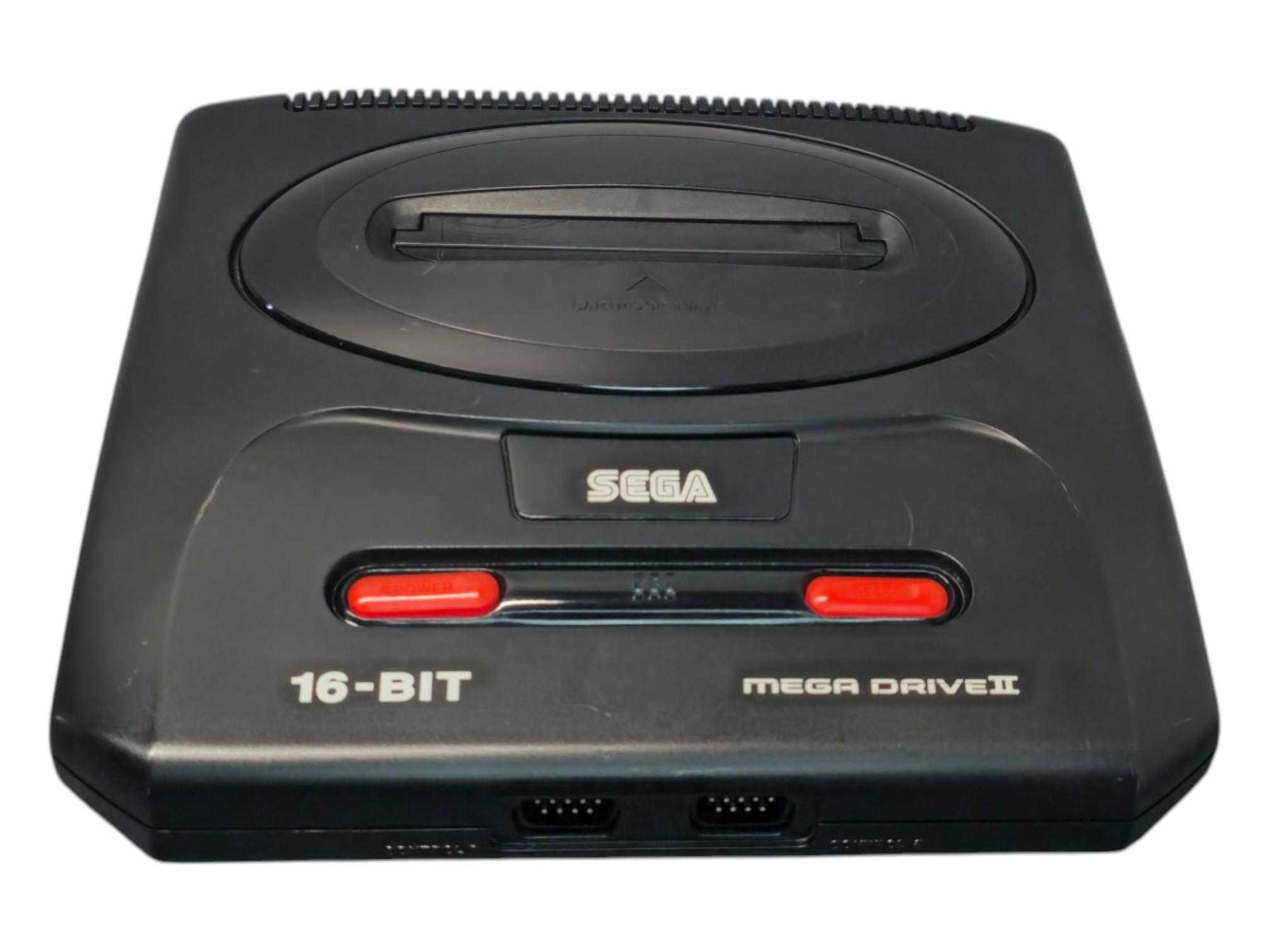
The Sega Mega Drive II is one of the most recognisable 16-bit video game consoles of the 1990s. Compact, stylish, and supported by an extraordinary library of games, it represents an important chapter in Sega’s golden age of home entertainment. Released in 1993 as a redesigned version of the original Mega Drive, the console brought the excitement of 16-bit gaming to an even wider audience.
With legendary franchises such as Sonic the Hedgehog, Streets of Rage, Golden Axe, and Shinobi, the Mega Drive II became a symbol of an era defined by fast-paced action, colourful graphics, unforgettable soundtracks, and fierce competition between Sega and Nintendo.
More than three decades later, it remains one of the most beloved consoles in retro gaming history.
📘 Introduction
Introduced in 1993, the Sega Mega Drive II, known as the Genesis Model 2 in North America, was a smaller and more affordable revision of Sega’s successful 16-bit home console.
The original Mega Drive had debuted in Japan in 1988, followed by North America in 1989 and Europe in 1990. Its powerful hardware, arcade-inspired games, and aggressive marketing helped establish Sega as a major force in the international video game industry.
By the early 1990s, the Mega Drive was competing directly with Nintendo’s Super Nintendo Entertainment System (SNES), creating one of the most famous rivalries in gaming history.
Rather than replacing its successful console with new technology, Sega introduced the Mega Drive II to reduce manufacturing costs and refresh the system’s appearance.
The redesigned model offered the same core gaming capabilities and extensive cartridge library in a considerably smaller enclosure.
For many European gamers, the Mega Drive II became their introduction to the exciting world of 16-bit gaming.
🏭 The Evolution of Sega’s 16-Bit Revolution
The development of the Mega Drive was closely connected to Sega’s experience as a major arcade game manufacturer.
During the 1980s, Sega produced some of the most technically impressive arcade machines of the period, including Out Run, Space Harrier, After Burner, and Golden Axe.
The company wanted to bring a comparable gaming experience into people’s homes.
Its answer was the Mega Drive, a console built around the powerful Motorola 68000 processor, the same family of processors used in several arcade systems and personal computers.
Compared with Sega’s earlier 8-bit Master System, the Mega Drive offered:
- A significantly more powerful processor
- More detailed graphics
- Larger and more complex game worlds
- Improved sprite handling
- Advanced scrolling capabilities
- Multi-channel stereo sound
- Greater potential for arcade-style gaming
The Mega Drive helped establish Sega’s reputation as an innovative console manufacturer.
By 1993, however, the company faced increasing competition and wanted to maintain the platform’s commercial momentum.
The Mega Drive II was the result of this strategy.
Its introduction demonstrated Sega’s commitment to extending the lifespan of its successful 16-bit architecture.
🖥️ A Smaller, More Modern Design
One of the most noticeable characteristics of the Mega Drive II was its completely redesigned enclosure.
The original Mega Drive featured a relatively large, angular design with a distinctive circular area surrounding the cartridge slot.
The second model adopted a more compact, square appearance with a centrally positioned cartridge connector.
Its design included:
- A smaller, lightweight black enclosure
- A top-loading cartridge slot
- A redesigned Power button
- A dedicated Reset button
- Two controller ports
- A combined audio/video output connector
- A side expansion connector
The revised construction made the console easier to position in living rooms and entertainment cabinets.
Simplified Hardware
To reduce manufacturing costs, Sega eliminated several features present on the original Mega Drive.
Most notably, the Mega Drive II removed:
- The front headphone socket
- The adjustable headphone volume slider
- The original Model 1 audio/video connector
- Certain external components through internal chip integration
The redesign also simplified the internal motherboard, combining several functions into fewer integrated circuits.
Despite these changes, the Mega Drive II was not a less powerful console.
Its gaming performance remained fundamentally identical to the original model.
⚙️ Technical Specifications
The Mega Drive II retained the architecture that had established the Mega Drive as one of the most capable 16-bit consoles of its generation.
Hardware Overview
- Manufacturer: Sega
- Model: Mega Drive II
- Release year: 1993
- Generation: Fourth-generation video game console
- Primary CPU: Motorola 68000
- CPU clock speed: Approximately 7.6 MHz
- Secondary processor: Zilog Z80
- Z80 clock speed: Approximately 3.58 MHz
- Main RAM: 64 KB
- Sound RAM: 8 KB
- Video RAM: 64 KB
- Graphics processor: Sega custom Video Display Processor
- Standard resolutions: 320×224 and 256×224 pixels
- Colour palette: 512 colours
- Simultaneous colours: Up to 64 in standard operation
- Sound: Yamaha YM2612-compatible FM synthesis and PSG audio
- Storage medium: ROM cartridges
- Controller ports: Two
- Video output: Composite video and RGB through the multi-output connector
- Audio output: Stereo through the multi-output connector
- Expansion: Mega-CD and 32X compatibility
The combination of a powerful 16-bit processor and dedicated graphics hardware enabled the console to deliver fast, responsive games with detailed environments and impressive animation.
Its architecture also provided programmers with considerable flexibility, helping the Mega Drive remain competitive throughout much of the 1990s.
🧠 The Motorola 68000: Power Behind the Console
At the heart of the Mega Drive II was the Motorola 68000, one of the most influential processors in computing history.
The same processor family was used in machines such as the Commodore Amiga, Atari ST, and early Apple Macintosh computers.
Although commonly described as a 16-bit processor, the Motorola 68000 featured a 32-bit internal register architecture and a 24-bit address bus.
This made it particularly powerful compared with the 8-bit processors used in earlier consoles.
Advantages of the Motorola 68000
- Fast instruction processing
- Support for more complex game logic
- Efficient handling of large amounts of graphical data
- Better performance in action games
- Advanced animation and scrolling techniques
- Greater flexibility for software developers
The console also included a Zilog Z80 processor, primarily responsible for coordinating audio operations and supporting certain compatibility functions.
This dual-processor design contributed to the Mega Drive’s impressive technical capabilities.
The Motorola 68000 became closely associated with Sega’s 16-bit identity and helped give the console its reputation for fast arcade-style gameplay.
🎨 Graphics & Visual Performance
One of the Mega Drive II’s greatest strengths was its ability to display colourful graphics while maintaining smooth movement and responsive controls.
Its custom Video Display Processor supported multiple background layers, hardware sprites, and sophisticated scrolling effects.
Graphics Capabilities
- Standard resolution: 320×224 pixels
- Alternative resolution: 256×224 pixels
- PAL display modes: Additional 240-line modes
- Available colours: 512
- Simultaneous colours: Up to 64 in standard display modes
- Hardware sprites: Up to 80
- Scrolling: Multiple hardware scrolling techniques
- Special effects: Shadow and highlight modes
These capabilities allowed developers to create detailed environments, large animated characters, and impressive visual effects.
The Importance of Scrolling
The Mega Drive became particularly famous for its smooth scrolling capabilities.
Games such as Sonic the Hedgehog demonstrated how effectively the console could display rapidly moving environments.
Other titles used multiple scrolling layers to create the illusion of depth.
Some developers also employed advanced programming techniques to simulate effects beyond the hardware’s original design expectations.
The result was a library filled with visually distinctive games that helped define the 16-bit generation.
🎵 Sound: The Legendary Sega Audio Experience
The Mega Drive II inherited one of the most recognisable sound architectures in video game history.
Its audio system combined Yamaha FM synthesis with a programmable sound generator, providing a distinctive mixture of electronic music and arcade-style sound effects.
FM Synthesis
The console used a sound system compatible with the Yamaha YM2612 architecture.
It offered:
- Six FM synthesis channels
- Complex electronic instrument sounds
- Programmable tones and musical effects
- Digital sample playback through a DAC-capable channel
- Rich bass sounds and characteristic electronic timbres
Programmable Sound Generator
The console also included PSG audio functionality providing:
- Three tone channels
- One noise channel
- Classic arcade sound effects
- Additional musical accompaniment
Together, these systems allowed composers to create memorable soundtracks.
Games such as Streets of Rage 2, Sonic the Hedgehog 2, Thunder Force IV, and The Revenge of Shinobi demonstrated the platform’s musical capabilities.
Audio Differences Between Models
One important distinction between the original Mega Drive and the Mega Drive II concerns their internal audio circuitry.
The second model used revised sound hardware and amplification arrangements.
Depending on the motherboard revision, this could result in noticeable differences in audio clarity, distortion, and overall sound character.
Some enthusiasts prefer the sound produced by certain early Mega Drive models, while others appreciate the cleaner output of selected later revisions.
Importantly, the Mega Drive II provided stereo audio directly through its rear AV connector, eliminating the need to obtain stereo sound through a separate headphone socket.
🎮 Games & Software Library
The Mega Drive II benefited from one of the strongest and most influential game libraries of the 16-bit era.
Its catalogue included arcade conversions, platform adventures, fighting games, racing titles, sports simulations, role-playing games, and innovative original productions.
Some of the most celebrated Mega Drive games include:
- Sonic the Hedgehog
- Sonic the Hedgehog 2
- Sonic the Hedgehog 3
- Sonic & Knuckles
- Streets of Rage
- Streets of Rage 2
- Streets of Rage 3
- Golden Axe
- Golden Axe II
- The Revenge of Shinobi
- Shinobi III: Return of the Ninja Master
- Gunstar Heroes
- Altered Beast
- Castle of Illusion Starring Mickey Mouse
- World of Illusion Starring Mickey Mouse and Donald Duck
- Earthworm Jim
- Ecco the Dolphin
- Thunder Force IV
- Phantasy Star IV
- Shining Force II
- Road Rash II
- Mortal Kombat
- Disney’s Aladdin
- Micro Machines 2: Turbo Tournament
- FIFA International Soccer
The Mega Drive library stood out for its fast-paced gameplay and strong arcade influences.
Developers frequently took advantage of the Motorola 68000 processor to create games featuring rapid movement, complex enemy behaviour, and impressive animation.
The console also became particularly popular among sports enthusiasts, with football, basketball, racing, and other competitive games contributing to its success.
Many of these titles remain highly playable today, demonstrating the lasting appeal of well-designed 16-bit games.
🦔 Sonic the Hedgehog: Sega’s Global Icon
Few characters are more closely associated with the Mega Drive than Sonic the Hedgehog.
Introduced in 1991, Sonic quickly became Sega’s global mascot and one of the most recognisable characters in video game history.
Created as a rival to Nintendo’s Mario, Sonic represented a different philosophy of platform gaming.
His adventures emphasised:
- High-speed movement
- Large, colourful environments
- Momentum-based gameplay
- Multiple routes through levels
- Memorable music
- Distinctive character design
The success of Sonic the Hedgehog helped transform the Mega Drive into a major international gaming platform.
Its sequel, Sonic the Hedgehog 2, introduced Tails and expanded the original formula with larger stages and additional gameplay mechanics.
Later titles such as Sonic the Hedgehog 3 and Sonic & Knuckles pushed the console’s capabilities further.
Sonic & Knuckles: Innovative Cartridge Technology
One of the most unusual innovations of the period was the Sonic & Knuckles cartridge.
It featured Sega’s Lock-On Technology, allowing compatible Sonic cartridges to connect to the top of the game.
This enabled additional gameplay combinations and expanded content, most famously connecting Sonic the Hedgehog 3 with Sonic & Knuckles to create a larger combined adventure.
For many players, the Sonic series defined the Mega Drive generation.
🥊 The 16-Bit Console Wars: Sega vs. Nintendo
The Mega Drive era was defined by one of the most famous commercial rivalries in gaming history.
During the early 1990s, Sega and Nintendo competed aggressively for control of the home console market.
Nintendo promoted the Super Nintendo Entertainment System, while Sega positioned the Mega Drive as a faster, more arcade-oriented alternative.
Both platforms had distinct strengths.
Sega Mega Drive
- Motorola 68000 processor
- Strong arcade-style performance
- Fast scrolling capabilities
- Distinctive FM synthesis sound
- Extensive sports and action game library
- Aggressive marketing aimed at older audiences
Super Nintendo Entertainment System
- Custom Ricoh 5A22 processor
- Advanced colour capabilities
- Hardware effects such as Mode 7
- Sample-based audio
- Strong first-party franchises
- Extensive platform and role-playing game library
In North America, Sega’s famous marketing campaigns emphasised the speed and excitement of Genesis gaming.
The phrase “Genesis Does What Nintendon’t” became one of the most memorable advertising slogans of the period.
In Europe, the Mega Drive developed a particularly strong following, competing successfully for attention alongside Nintendo and the established home computer market.
This rivalry encouraged innovation, competitive pricing, and the creation of some of the most influential video games ever released.
🕹️ Controllers & Accessories
The Mega Drive II retained the familiar controller interface of the original console.
The standard Sega controller featured:
- A directional pad
- A Start button
- Three action buttons: A, B, and C
- A comfortable, rounded enclosure
- A nine-pin connection
Its design worked particularly well for arcade conversions, platform games, and sports titles.
The Six-Button Controller
As fighting games became increasingly popular, Sega introduced an improved six-button controller.
This model added three additional action buttons:
- X
- Y
- Z
It also included a Mode button for compatibility with certain older games.
The six-button controller became particularly useful for fighting games such as Street Fighter II’: Special Champion Edition.
Other Accessories
The Mega Drive ecosystem included a variety of additional peripherals:
- Sega Mega Mouse
- Arcade Power Stick
- Multiplayer adapters
- Light guns for compatible games and displays
- Master System Converter accessories
- Mega-CD expansion systems
- Sega 32X
These accessories demonstrated Sega’s ambition to expand the console beyond conventional cartridge gaming.
💿 Sega Mega-CD: Expanding Beyond Cartridges
One of the most ambitious accessories developed for the Mega Drive was the Sega Mega-CD, known as the Sega CD in North America.
The expansion introduced optical disc technology to Sega’s 16-bit platform.
This allowed developers to create games using substantially more storage space than conventional cartridges.
The Mega-CD offered:
- CD-ROM storage
- CD-quality audio playback
- Additional processing capabilities
- Hardware-assisted scaling and rotation effects
- Full-motion video sequences
- Enhanced game presentation
Notable Mega-CD titles included:
- Sonic CD
- Final Fight CD
- Lunar: The Silver Star
- Lunar: Eternal Blue
- Snatcher
- Silpheed
- Popful Mail
The Mega Drive II was compatible with the Mega-CD expansion through its side connector.
Mega-CD II
To complement the redesigned Mega Drive II, Sega introduced the Mega-CD II, featuring a smaller, top-loading CD mechanism.
The redesigned expansion matched the visual appearance of the newer console.
Although the Mega-CD never achieved the mainstream success Sega had hoped for, it remains an important example of early experimentation with optical storage in home gaming.
🚀 Sega 32X: An Ambitious Hardware Expansion
In 1994, Sega introduced another expansion for the Mega Drive platform: the Sega 32X.
Unlike the Mega-CD, which primarily expanded storage and multimedia capabilities, the 32X was designed to improve the console’s processing and graphical performance.
The accessory connected through the Mega Drive cartridge slot and added new hardware, including two Hitachi SH-2 processors.
Its capabilities included:
- Additional 32-bit processing power
- Expanded colour capabilities
- Enhanced sprite and graphical effects
- More advanced game environments
- Support for dedicated 32X cartridges
Notable titles included:
- Virtua Racing Deluxe
- Virtua Fighter
- Star Wars Arcade
- Knuckles’ Chaotix
- Doom
- After Burner Complete
- Space Harrier
The Mega Drive II supported the 32X using the appropriate connection cables and compatible regional hardware.
However, the accessory faced significant commercial difficulties.
Its relatively small game library, high price, and close proximity to the launch of Sega’s Saturn console limited its success.
Today, the 32X remains a fascinating and unusual part of Sega’s hardware history.
📺 Video Output & Modern Connectivity
One of the practical improvements introduced with the Mega Drive II was its redesigned audio/video connector.
The original Mega Drive used an eight-pin DIN-style connector and provided stereo audio through its front headphone socket.
The Mega Drive II replaced this arrangement with a nine-pin mini-DIN connector.
This connection provided:
- Composite video
- RGB video
- Stereo audio
- Mono audio compatibility
For European collectors, RGB output is especially valuable because it allows the console to produce a sharp analogue picture when connected to a compatible CRT television.
Using the Mega Drive II Today
Original Mega Drive II consoles can still be used with modern displays through suitable equipment.
Common solutions include:
- RGB SCART cables
- Composite video connections
- Retro gaming scalers
- Analogue-to-digital converters
- Original CRT televisions
For the most authentic experience, a CRT display remains an excellent choice.
The console’s graphics were originally designed for analogue television technology, and many games used the characteristics of CRT displays to produce smoother-looking visuals.
High-quality RGB connections can also provide a significantly cleaner image than composite video.
🔧 Build Quality & Longevity
The Sega Mega Drive II is generally considered a durable and reliable console.
Its cartridge-based architecture contains no moving storage mechanisms, reducing the likelihood of mechanical failures.
The redesigned motherboard also used fewer components than many earlier Mega Drive revisions.
Nevertheless, decades of use and storage can affect original hardware.
Common restoration tasks include:
- Cleaning cartridge connectors
- Removing oxidation from game cartridges
- Cleaning controller ports
- Inspecting the power connector
- Checking ageing capacitors
- Cleaning the motherboard
- Inspecting the audio/video connector
- Checking the functionality of the Power and Reset buttons
One of the most important maintenance considerations is the power supply.
The Mega Drive II uses a different power connector and polarity arrangement from the original Mega Drive.
Using an incorrect power adapter can permanently damage the console.
Collectors should therefore verify voltage, polarity, and connector specifications before powering on an original system.
With appropriate maintenance, many Mega Drive II consoles remain fully operational decades after their original release.
🌍 Popularity Across Europe
The Mega Drive enjoyed considerable success across international markets, becoming one of the defining consoles of the fourth generation.
It developed particularly strong communities in:
- The United Kingdom
- France
- Spain
- Portugal
- Germany
- Greece and Cyprus
- Brazil
- Australia
The European market was especially important to Sega.
Unlike Japan, where Nintendo maintained a stronger overall position, Sega successfully established the Mega Drive as a major competitor throughout much of Europe.
The console benefited from a large software catalogue, competitive retail pricing, and extensive promotion.
The Mega Drive in Greece
In Greece, the Mega Drive became one of the most recognisable home consoles of the early 1990s.
Its arrival coincided with a period when dedicated gaming consoles were increasingly competing with traditional home computers such as the Amstrad CPC, Commodore Amiga, and ZX Spectrum.
For many Greek households, the Mega Drive represented a transition from cassette and floppy disk gaming to the convenience of instant-loading cartridges.
Games such as Sonic the Hedgehog, Golden Axe, Streets of Rage, and FIFA became familiar experiences among local gaming enthusiasts.
The Mega Drive II’s smaller design and more accessible pricing helped extend the platform’s appeal during the later years of the 16-bit era.
🔄 Mega Drive I vs. Mega Drive II
Although both consoles offered essentially the same gaming performance, their physical construction and connectivity differed.
Original Sega Mega Drive
- Introduced in Japan in 1988
- Larger, distinctive enclosure
- Circular design surrounding the cartridge slot
- Front headphone connection
- Adjustable headphone volume
- Eight-pin AV connector
- Stereo audio available through the headphone socket
- Earlier motherboard and sound circuit designs
Sega Mega Drive II
- Introduced in 1993
- Smaller, more compact enclosure
- Redesigned central cartridge slot
- No dedicated headphone socket
- No headphone volume slider
- Nine-pin mini-DIN AV connector
- Stereo audio available directly from the AV output
- Simplified motherboard design
- Different power connector and polarity
Despite these differences, both models used the same underlying architecture.
The Mega Drive II did not introduce additional processor power, improved graphics specifications, or a new generation of games.
Instead, it represented a cost-reduced hardware revision of an already successful system.
For collectors, both models are historically significant.
The original Mega Drive represents the beginning of Sega’s 16-bit era, while the Mega Drive II reflects the platform’s maturity and worldwide commercial success.
⭐ Why the Mega Drive II Still Matters
The Sega Mega Drive II remains an important part of gaming history for several reasons:
- It represents one of Sega’s most successful console generations
- Its compact design became instantly recognisable
- It retained the powerful Motorola 68000 architecture
- Its game library includes some of the greatest titles of the 16-bit era
- It introduced countless players to Sonic the Hedgehog
- Its FM synthesis soundtracks remain legendary
- It supported ambitious expansions such as the Mega-CD and 32X
- It played a major role in the Sega-Nintendo console rivalry
- It helped establish Sega as a worldwide gaming icon
The Mega Drive II also represents a time when the video game industry was rapidly evolving.
Arcade-style gaming was becoming increasingly sophisticated, developers were experimenting with larger game worlds, and the competition between manufacturers was driving technological innovation.
Even today, independent developers continue producing new games for the Mega Drive platform.
The console’s architecture remains a popular challenge for programmers interested in creating new experiences within the limitations of original 16-bit hardware.
🏛️ Collectability & Retro Gaming Legacy
The Mega Drive II remains a popular choice among collectors interested in Sega’s hardware history.
Its compact size, extensive game library, and straightforward operation make it an enjoyable console to own and preserve.
Collectors often look for examples that retain:
- The original Sega Mega Drive II console
- Original three-button or six-button controllers
- The correct power adapter
- Original AV cables
- Original packaging and protective inserts
- Instruction manuals and documentation
- Authentic Sega game cartridges
- Optional Mega-CD and 32X accessories
Complete boxed examples with original accessories are particularly desirable.
The condition of the enclosure, cartridge connector, controller ports, and original labels can significantly influence collectability.
Different motherboard revisions may also attract enthusiasts interested in comparing audio and video quality.
However, the Mega Drive II’s importance extends far beyond its monetary value.
It represents a period when Sega was one of the most influential companies in gaming, when 16-bit technology was redefining home entertainment, and when unforgettable franchises were establishing the foundations of modern video game culture.
📦 Items Included in This Collection Entry
- Sega Mega Drive II console unit (PAL)
🏁 Conclusion
The Sega Mega Drive II represents one of the most important chapters in the history of 16-bit home gaming. By refining the design of the original Mega Drive while preserving its powerful hardware and legendary software library, Sega created a compact and accessible console that helped extend the success of its most influential gaming platform.
Its memorable games, distinctive FM synthesis soundtracks, smooth arcade-style gameplay, and iconic franchises defined the childhood of millions of players around the world.
The Mega Drive II also symbolises an extraordinary period of competition and innovation, when Sega and Nintendo pushed the boundaries of interactive entertainment and helped transform video gaming into a global cultural phenomenon.
More than three decades after its release, the Mega Drive II remains a beloved system among collectors, programmers, and retro gaming enthusiasts.
A true 16-bit legend, a symbol of Sega’s golden age, and an essential addition to any serious retro video game collection.
