

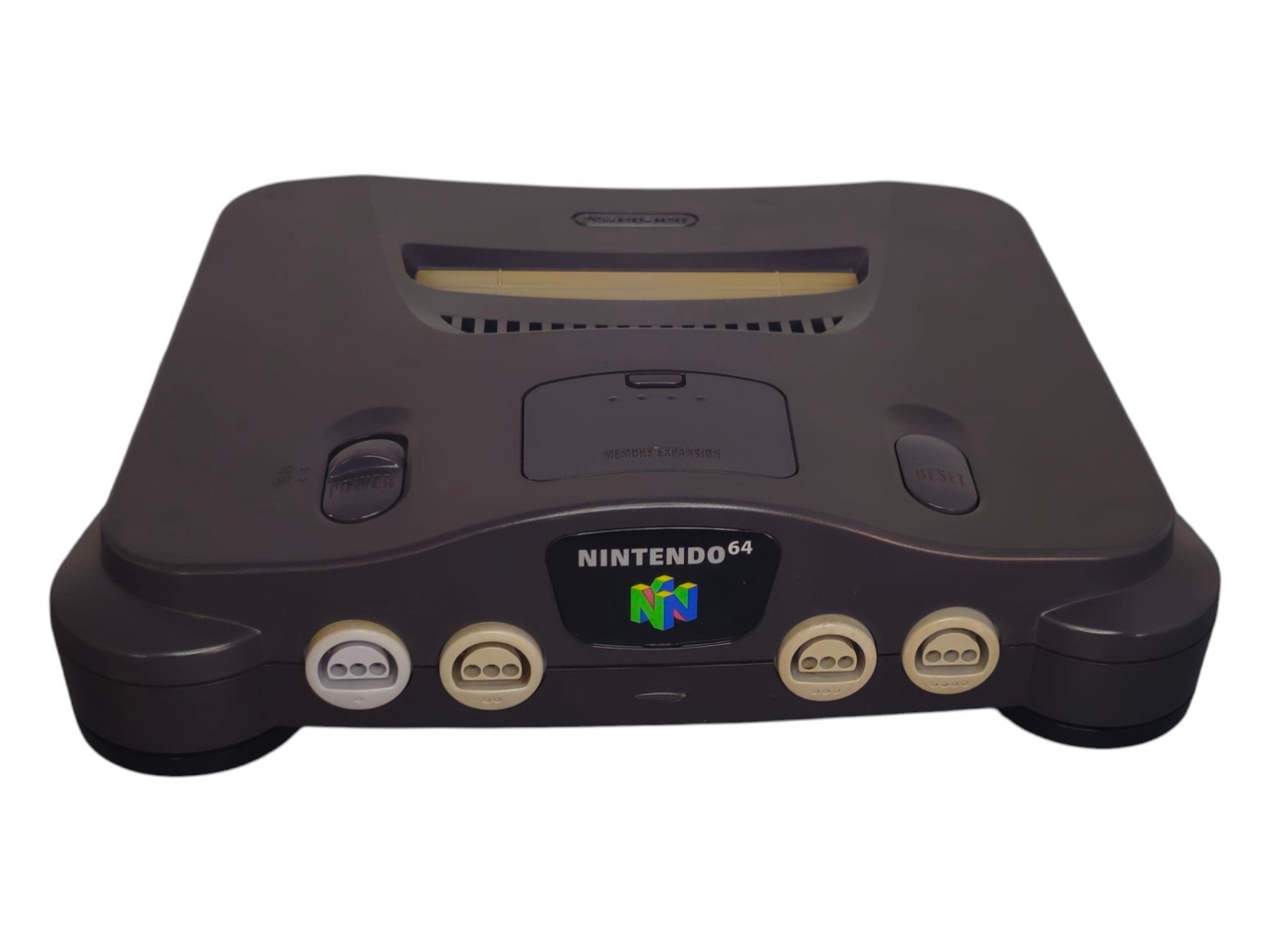
The Nintendo 64, commonly abbreviated to N64, is one of the most influential home video game consoles of the 1990s. Released in Japan in 1996, it marked Nintendo’s transition from the 16-bit era into the world of three-dimensional gaming, introducing a powerful 64-bit processor, advanced graphics hardware developed in collaboration with Silicon Graphics, and one of the most innovative controllers in video game history.
Unlike its major competitors, the Sony PlayStation and Sega Saturn, the Nintendo 64 continued using ROM cartridges rather than adopting CD-ROM technology. This decision provided fast loading times and durable physical media but also introduced significant limitations in storage capacity and manufacturing costs.
With legendary games such as Super Mario 64, The Legend of Zelda: Ocarina of Time, GoldenEye 007, Mario Kart 64, Banjo-Kazooie, and The Legend of Zelda: Majora’s Mask, the Nintendo 64 helped establish many of the conventions that continue to define modern three-dimensional gaming.
Its distinctive three-pronged controller, analogue Control Stick, four built-in controller ports, and innovative accessories created a gaming experience that was fundamentally different from previous Nintendo consoles.
Today, the Nintendo 64 is remembered not only as a remarkable technological achievement but also as one of the most important platforms in the evolution of 3D game design, local multiplayer entertainment, and modern console controls.
📘 Introduction
The Nintendo 64 was officially launched in Japan on June 23, 1996, followed by North America on September 29, 1996, and Europe on March 1, 1997.
Its official hardware designation was NUS-001.
The console succeeded the enormously successful Super Nintendo Entertainment System, also known as the Super Famicom in Japan.
Nintendo had dominated much of the home gaming industry during the 1980s and early 1990s.
However, the arrival of powerful competing hardware and the rapid development of three-dimensional computer graphics created new challenges.
The Nintendo 64 represented Nintendo’s response.
Its most important innovations included:
- 64-bit NEC VR4300 processor
- Graphics technology developed with Silicon Graphics
- Hardware-accelerated 3D rendering
- Perspective-correct texture mapping
- Z-buffering and anti-aliasing
- Four built-in controller ports
- Analogue Control Stick
- Optional vibration feedback
- Expandable system memory
- ROM cartridge storage
- Sophisticated local multiplayer gaming
These capabilities made the Nintendo 64 a powerful and distinctive platform.
Although its overall commercial performance was lower than that of the Sony PlayStation, the console produced some of the most influential games ever created.
🏭 From the Super Nintendo to Project Reality
The development of the Nintendo 64 began during a period of intense technological competition.
The Super Nintendo Entertainment System, introduced in Japan in 1990 and North America in 1991, had demonstrated Nintendo’s expertise in two-dimensional game design.
However, the future of gaming was beginning to move towards fully three-dimensional environments.
Nintendo recognised that a new hardware architecture would be required.
Project Reality
In the early 1990s, Nintendo began collaborating with Silicon Graphics, Inc. (SGI), an American company renowned for advanced computer graphics technology.
SGI specialised in high-performance workstations used for:
- Computer animation
- Film production
- Scientific visualisation
- Industrial design
- Three-dimensional modelling
The collaboration initially became known as Project Reality.
The goal was to bring sophisticated 3D graphics technology into an affordable home console.
Ultra 64
During development, the system was publicly associated with the name Ultra 64.
Promotional materials and arcade-related announcements helped build interest in Nintendo’s next-generation technology.
Before commercial release, the name was changed to Nintendo 64.
A New Generation
The final console introduced a custom 64-bit architecture designed for real-time 3D entertainment.
Nintendo’s collaboration with SGI was particularly important because it brought concepts from professional graphics workstations into consumer gaming.
The result became one of the defining platforms of the fifth console generation.
🖥️ The Distinctive Nintendo 64 Design
The original Nintendo 64 features a compact, rounded enclosure with a distinctive cartridge slot positioned on its upper surface.
The standard launch configuration used a dark charcoal-grey finish.
Its curved design differed substantially from the more angular Super Nintendo.
Exterior Features
- Rounded plastic enclosure
- Top-mounted cartridge slot
- Power switch
- Reset button
- Four front controller ports
- Power indicator LED
- Rear Multi Out A/V connector
- External power supply module
- Upper memory expansion compartment
- Lower expansion connector
A Console Designed for Multiplayer
One of the most immediately recognisable elements is the arrangement of four controller ports.
Earlier consoles commonly offered two controller connections.
Nintendo included four as standard.
This made local multiplayer a central part of the platform’s identity.
The Cartridge Slot
The cartridge slot occupies a prominent position on the top of the machine.
Unlike CD-based systems, the Nintendo 64 has no optical drive or moving disc mechanism.
An Unusual Expansion System
A removable cover on the upper surface provides access to the memory expansion area.
Another connector on the underside was designed for additional hardware, most notably the Japan-only 64DD.
A Memorable Appearance
The Nintendo 64’s curved shape, four controller ports, and cartridge-based design remain instantly recognisable.
Its exterior is now strongly associated with the late-1990s era of 3D console gaming.
⚙️ Technical Specifications
The Nintendo 64 was one of the most technically ambitious home consoles of its generation.
Hardware Overview
- Manufacturer: Nintendo
- Model: Nintendo 64
- Model designation: NUS-001
- Japanese release: June 23, 1996
- North American release: September 29, 1996
- European release: March 1, 1997
- Generation: Fifth-generation home console
- CPU: NEC VR4300
- Architecture: 64-bit MIPS RISC
- CPU frequency: 93.75 MHz
- Graphics coprocessor: Reality Coprocessor (RCP)
- RCP frequency: 62.5 MHz
- Graphics components: Reality Signal Processor and Reality Display Processor
- System memory: 4 MB Rambus RDRAM
- Expandable memory: 8 MB total with Expansion Pak
- Graphics: Hardware-accelerated 3D and 2D
- Video resolution: Multiple modes, including 320×240 and 640×480
- Colour depth: Up to 24-bit RGB colour representation
- Audio: Software-generated digital audio through the system coprocessor
- Storage medium: ROM cartridges
- Game Pak capacity: Up to 64 MB in commercial releases
- Controller connections: Four
- Video output: Nintendo Multi Out
- Optional storage: Controller Pak and cartridge-based save memory
- Optional expansion: Expansion Pak and 64DD
- Dimensions: Approximately 260 × 190 × 73 mm
- Weight: Approximately 1.1 kg
The console’s capabilities were particularly impressive in graphics processing.
However, its relatively limited system memory and cartridge capacity required careful software optimisation.
🧠 The NEC VR4300: A 64-Bit Processor
At the heart of the Nintendo 64 is the NEC VR4300, a custom implementation of the MIPS R4300i processor architecture.
The processor operates at approximately 93.75 MHz.
A 64-Bit RISC Architecture
The VR4300 belongs to the Reduced Instruction Set Computer family.
RISC processors use a relatively streamlined instruction architecture intended to support efficient execution.
Processor Responsibilities
The CPU handles:
- Game logic
- Artificial intelligence
- Physics calculations
- Character movement
- Input processing
- General mathematical operations
- Software execution
- Coordination with graphics hardware
64-Bit Processing
The processor supports 64-bit operations and registers.
This was an important part of Nintendo’s marketing strategy.
However, the practical performance of a gaming console depends on much more than processor bit width.
Memory capacity, graphics hardware, software design, and data bandwidth are also important.
An Advanced Processor for Its Era
The VR4300 was considerably more sophisticated than the processors used in earlier Nintendo home consoles.
It helped make complex 3D environments and more advanced simulation possible.
The Importance of MIPS
MIPS technology also appeared in other influential computing systems, including the Sony PlayStation family.
The Nintendo 64 represents an important example of RISC processor technology being used in consumer entertainment hardware.
🎨 The Reality Coprocessor: Graphics Technology from SGI
One of the most important technical achievements of the Nintendo 64 is its custom Reality Coprocessor (RCP).
Developed through Nintendo’s collaboration with Silicon Graphics, the RCP operates at approximately 62.5 MHz.
It consists of two major processing components.
Reality Signal Processor (RSP)
The RSP is a programmable processor responsible for specialised mathematical and multimedia operations.
Its tasks can include:
- Geometry transformations
- Vector calculations
- Lighting calculations
- Graphics processing
- Audio processing
The RSP uses programmable microcode, allowing developers to select different processing approaches.
Reality Display Processor (RDP)
The RDP handles important rasterisation operations.
These include:
- Texture mapping
- Pixel processing
- Z-buffering
- Colour blending
- Anti-aliasing
- Graphics output
Why This Architecture Mattered
The use of dedicated graphics processing hardware allowed the Nintendo 64 to perform operations that would have been extremely demanding for the CPU alone.
It also demonstrated how professional workstation graphics concepts could be adapted for affordable consumer electronics.
🌄 The Transition to Three-Dimensional Gaming
The Nintendo 64 was developed during the rapid transition from traditional two-dimensional games to sophisticated 3D environments.
Earlier Nintendo consoles had relied heavily on sprites and scrolling backgrounds.
The N64 introduced dedicated graphics hardware suitable for fully three-dimensional worlds.
Important 3D Capabilities
- Polygon-based characters
- Three-dimensional environments
- Perspective-correct texture mapping
- Z-buffering
- Lighting effects
- Camera movement
- Texture filtering
- Anti-aliasing
Perspective-Correct Textures
In 3D graphics, textures must be mapped onto surfaces that change shape as they move in perspective.
The Nintendo 64 included hardware support for perspective-correct texture mapping.
This helped maintain realistic visual relationships on rendered surfaces.
Z-Buffering
Z-buffering allows the graphics system to determine which objects should appear in front of others.
It is an essential technique for rendering three-dimensional environments correctly.
Texture Filtering
The N64 became particularly associated with filtered textures.
This could produce smoother-looking surfaces than the more visibly pixelated textures of some contemporary games.
However, it could also contribute to a softer image.
The Limits of Early 3D
Despite its advanced features, the N64 was constrained by limited memory and texture storage.
Many games used relatively low-resolution textures.
Developers had to balance image quality, visual effects, and performance.
These limitations became part of the platform’s distinctive graphical character.
🖼️ Graphics Resolution & the CRT Experience
The Nintendo 64 was designed primarily for analogue CRT televisions.
Its graphics hardware supported several display modes and resolutions.
Common Video Modes
Depending on the game and regional configuration, software could use resolutions such as:
- 256×224
- 320×240
- 640×480
- Other compatible display arrangements
Most games used relatively low-resolution progressive output, while certain titles supported higher-resolution or interlaced modes.
NTSC & PAL
Nintendo released the console in different regional configurations.
These included:
- NTSC-J for Japan
- NTSC-U for North America
- PAL for Europe and Australia
The regional versions differed in video timing and software compatibility.
European PAL Gaming
Many European games were designed around 50 Hz television operation.
This could result in differences in:
- Game speed
- Frame rate
- Screen borders
- Image positioning
- Vertical resolution
Some titles received PAL optimisations, while others retained characteristics inherited from their original NTSC versions.
The Original Video Connections
The console uses Nintendo’s proprietary Multi Out connector.
The available signal formats depend on the regional hardware revision.
Composite video is common, while S-Video support varies.
RGB & HDMI
Standard Nintendo 64 consoles do not generally provide native HDMI.
RGB output is also not universally available from the factory.
Suitable hardware modifications or conversion equipment may be required.
Why CRTs Matter
The Nintendo 64’s original graphics were designed for CRT displays.
Their analogue presentation can make the console’s characteristic low-resolution graphics appear more natural than on an unprocessed modern LCD.
For historical demonstrations, a compatible CRT television remains an excellent display choice.
🧠 4 MB RDRAM & the Expansion Pak
The Nintendo 64 includes 4 MB of Rambus RDRAM as standard.
This memory is shared by the processor and graphics system.
Unified Memory
The console uses a unified memory architecture.
Rather than separating all graphics and system data into independent memory pools, the hardware accesses a shared RAM system.
Why Memory Mattered
Memory stores:
- Game code
- Textures
- Geometry
- Animation
- Audio data
- Temporary calculations
- Game state information
The Expansion Pak
Nintendo introduced an optional memory expansion called the Expansion Pak.
The accessory adds 4 MB of RAM, increasing total memory from 4 MB to 8 MB.
Games Requiring the Expansion Pak
Two famous games require the Expansion Pak for normal operation:
- Donkey Kong 64
- The Legend of Zelda: Majora’s Mask
Perfect Dark
Perfect Dark can run limited content without the Expansion Pak.
However, its full single-player and major multiplayer features require the additional memory.
Other Enhanced Games
Some compatible games use the Expansion Pak to provide:
- Higher-resolution graphics
- Additional visual effects
- Larger assets
- Expanded game modes
Jumper Pak
Standard consoles originally used a Jumper Pak in the memory expansion compartment.
The Jumper Pak is not additional memory.
It completes the required electrical configuration of the memory system.
A Nintendo 64 normally requires either a suitable Jumper Pak or Expansion Pak to operate.
An Important Hardware Innovation
The Expansion Pak allowed Nintendo to extend the capabilities of its console without releasing a completely new system.
It remains one of the most important N64 accessories.
💾 ROM Cartridges vs. CD-ROM Technology
One of Nintendo’s most controversial decisions was to continue using ROM cartridges.
During the mid-1990s, major competitors had begun adopting optical disc technology.
The Sony PlayStation and Sega Saturn both used CD-ROMs.
Nintendo chose a different path.
Advantages of Cartridges
- Fast data access
- Very short loading times
- Durable physical construction
- No mechanical optical drive
- Reduced sensitivity to movement
- Convenient handling
The Limitations
Cartridges also presented disadvantages:
- Higher manufacturing costs
- Lower storage capacity
- More expensive inventory
- Reduced space for recorded audio
- Reduced space for cinematic sequences
- More limited multimedia content
Game Pak Capacity
Commercial N64 cartridges varied in size.
Later games used capacities reaching 64 MB, much smaller than the approximately 650 MB available on a standard CD-ROM.
The Impact on Game Development
Developers often had to reduce or compress:
- Textures
- Music
- Voice recordings
- Video sequences
- Animation data
A Strategic Consequence
The higher cost and limited capacity of cartridges influenced third-party software support.
Several major publishers moved important projects to CD-based competing consoles.
Nevertheless, Nintendo’s own development teams demonstrated that cartridge technology could still support extraordinary games.
🕹️ The Revolutionary Three-Pronged Controller
The Nintendo 64 controller is one of the most recognisable gamepads ever created.
Its unusual three-pronged design was developed specifically for the transition towards 3D gaming.
Controller Features
- Three-pronged enclosure
- Central analogue Control Stick
- Directional pad
- A and B buttons
- Four yellow C buttons
- L and R shoulder buttons
- Rear Z trigger
- Start button
- Rear accessory slot
Three Ways to Hold the Controller
The controller supports different hand positions.
Left and centre grips are suitable for games using the directional pad and Control Stick.
Centre and right grips became particularly common for 3D games.
Outer grips provide a more conventional button-and-directional-pad arrangement.
The Control Stick
The analogue-style Control Stick was one of the most important innovations.
Unlike a conventional directional pad, it allowed players to control movement direction and intensity with greater precision.
The Z Trigger
The rear Z button was particularly useful for action and shooting games.
The C Buttons
The four yellow C buttons provided additional control possibilities.
Many games used them for camera movement, inventory functions, or other actions.
A Lasting Influence
Although earlier controllers had experimented with analogue input, the Nintendo 64 made analogue thumbstick control central to mainstream 3D console gaming.
Its influence can be seen in virtually every later major console controller.
🎮 Four-Player Local Multiplayer
One of the Nintendo 64’s greatest strengths was its support for four controllers directly connected to the console.
This made multiplayer gaming one of the platform’s defining characteristics.
A Social Console
Unlike systems requiring additional multitap accessories for more than two players, the N64 supported four controllers as standard.
Popular Multiplayer Games
- Mario Kart 64
- GoldenEye 007
- Super Smash Bros.
- Mario Party
- Mario Party 2
- Mario Party 3
- Diddy Kong Racing
- Perfect Dark
- F-Zero X
- Pokémon Stadium
- Bomberman 64
Split-Screen Gaming
Several games used split-screen display modes.
Players could compete or cooperate while sharing the same television.
The Living Room Experience
The Nintendo 64 became closely associated with friends gathering around a CRT television.
Multiplayer sessions often involved:
- Competitive races
- First-person shooter matches
- Party games
- Sports games
- Cooperative challenges
An Important Legacy
The N64 helped establish four-player local multiplayer as a major part of console entertainment.
Even today, the platform is remembered for its strong social gaming experiences.
🎵 Digital Audio & the Nintendo 64 Sound
The Nintendo 64 did not use a conventional dedicated music synthesiser comparable to some earlier gaming systems.
Instead, audio processing was handled through the system’s programmable hardware.
Audio Architecture
The Reality Signal Processor could be used to process digital sound information.
This provided flexibility for software developers.
Audio Capabilities
- Digital sample playback
- Stereo output
- Software-controlled sound mixing
- Dynamic music
- Sound effects
- Game-specific audio processing
A Distinctive Sound Library
The Nintendo 64 produced memorable soundtracks.
Important examples include:
- Super Mario 64
- The Legend of Zelda: Ocarina of Time
- The Legend of Zelda: Majora’s Mask
- Banjo-Kazooie
- Donkey Kong 64
- GoldenEye 007
- Star Fox 64 / Lylat Wars
- F-Zero X
The Cartridge Limitation
Because cartridges offered less storage than CDs, developers often relied on sequenced music and compressed audio samples.
This made efficient music production particularly important.
Creative Audio Design
Despite these limitations, the N64 produced some of the most memorable video game music of the 1990s.
Its soundtracks remain an important part of gaming culture.
🎮 Games & Software Library
The Nintendo 64 developed a comparatively compact but exceptionally influential game library.
Its catalogue includes some of the most important titles in the history of three-dimensional gaming.
Notable Nintendo 64 Games
- Super Mario 64
- The Legend of Zelda: Ocarina of Time
- The Legend of Zelda: Majora’s Mask
- GoldenEye 007
- Perfect Dark
- Mario Kart 64
- Super Smash Bros.
- Mario Party
- Mario Party 2
- Mario Party 3
- Banjo-Kazooie
- Banjo-Tooie
- Donkey Kong 64
- Diddy Kong Racing
- Conker’s Bad Fur Day
- Jet Force Gemini
- Blast Corps
- Wave Race 64
- 1080° Snowboarding
- F-Zero X
- Pilotwings 64
- Star Fox 64 / Lylat Wars
- Paper Mario
- Yoshi’s Story
- Kirby 64: The Crystal Shards
- Pokémon Stadium
- Pokémon Stadium 2
- Pokémon Snap
- Mario Tennis
- Mario Golf
- Turok: Dinosaur Hunter
- Turok 2: Seeds of Evil
- Star Wars: Shadows of the Empire
- Star Wars: Rogue Squadron
- Resident Evil 2
- Rayman 2: The Great Escape
- The World Is Not Enough
- Excitebike 64
- Harvest Moon 64
- Sin and Punishment
The library includes platformers, first-person shooters, racing games, sports titles, action adventures, and role-playing games.
Regional availability varied, with some notable games released only in selected markets.
🍄 Super Mario 64: A Revolution in 3D Platforming
Released alongside the Nintendo 64 in Japan in June 1996, Super Mario 64 became one of the most influential games ever created.
Directed by Shigeru Miyamoto, it transformed Mario’s traditional side-scrolling gameplay into a fully three-dimensional experience.
Gameplay Innovations
- Free movement through 3D environments
- Analogue character control
- Dynamic camera system
- Large explorable levels
- Multiple objectives
- Varied movement abilities
- Innovative level design
The Importance of the Control Stick
The N64 controller allowed Mario to move at different speeds depending on how far the Control Stick was moved.
This provided a new degree of precision.
Camera Control
The game’s camera system, associated with Lakitu, introduced concepts that influenced later 3D platformers.
A New Design Language
Super Mario 64 helped define how players navigate three-dimensional worlds.
Its influence can be seen in decades of subsequent game development.
Historical Significance
For many gaming historians, Super Mario 64 represents the beginning of modern 3D platform game design.
It remains one of the Nintendo 64’s most important achievements.
🗡️ The Legend of Zelda: Ocarina of Time
Released in 1998, The Legend of Zelda: Ocarina of Time became one of the most celebrated games in history.
It brought Nintendo’s famous adventure series into a fully three-dimensional environment.
Gameplay Features
- Large interconnected world
- Three-dimensional exploration
- Sword combat
- Puzzle-solving dungeons
- Horseback riding
- Time-based story progression
- Musical gameplay mechanics
Z-Targeting
One of the game’s most influential innovations was Z-targeting.
This system allowed players to lock onto enemies or objects.
It helped solve one of the major challenges of 3D action gaming: keeping the player properly oriented during combat.
Context-Sensitive Controls
The game also used buttons whose functions changed according to the current situation.
This simplified interaction with a complex three-dimensional environment.
A Benchmark for Adventure Games
Ocarina of Time influenced action-adventure design for decades.
Its camera, targeting, exploration, and combat systems became important references for later games.
A Historic Achievement
The game remains one of the most acclaimed titles in Nintendo’s history.
It represents the extraordinary potential of the Nintendo 64 hardware.
🔫 GoldenEye 007: Console First-Person Shooters Come of Age
Released in 1997, GoldenEye 007 became one of the most influential first-person shooters ever developed for a home console.
Created by Rare and based on the James Bond film, it demonstrated that complex first-person shooting games could succeed outside personal computers.
Gameplay Features
- Story-based missions
- Stealth mechanics
- Multiple objectives
- Varied difficulty levels
- Detailed environments
- Weapon selection
- Four-player split-screen multiplayer
The Controller Challenge
GoldenEye used the N64’s Control Stick and C buttons to create a practical first-person control system.
Although its controls differ from modern dual-analogue layouts, they represented an important step forward.
Multiplayer Gaming
The game’s local multiplayer became legendary.
Up to four players could compete on a single television.
An Influential Console Game
GoldenEye helped establish console first-person shooters as a major genre.
Its influence extended to later games, including Perfect Dark and many subsequent shooters.
🏎️ Mario Kart 64: Multiplayer Racing Redefined
Released in Japan in December 1996, Mario Kart 64 brought Nintendo’s famous racing series into a three-dimensional environment.
Gameplay Features
- 3D racing tracks
- Familiar Nintendo characters
- Competitive kart racing
- Battle mode
- Four-player local multiplayer
- Creative power-ups
- Colourful environments
A Major Multiplayer Experience
Mario Kart 64 became one of the most popular party games of its generation.
Its four-player support was particularly important.
Memorable Tracks
The game introduced unforgettable environments, including:
- Rainbow Road
- Bowser’s Castle
- Koopa Troopa Beach
- Royal Raceway
- Wario Stadium
The Legacy
Mario Kart 64 helped establish the franchise’s approach to three-dimensional racing.
Its influence continues through later Mario Kart releases.
🐻 Banjo-Kazooie & Rare’s Golden Era
Released in 1998, Banjo-Kazooie became one of the most celebrated platform games on the Nintendo 64.
Developed by Rare, it followed the adventures of Banjo the bear and Kazooie the bird.
Gameplay Features
- Large 3D worlds
- Collectible items
- Character abilities
- Exploration
- Platform challenges
- Environmental puzzles
- Humorous dialogue
Rare’s Technical Expertise
Rare became one of the most important Nintendo 64 developers.
The studio produced several highly influential games, including:
- GoldenEye 007
- Banjo-Kazooie
- Banjo-Tooie
- Donkey Kong 64
- Diddy Kong Racing
- Perfect Dark
- Conker’s Bad Fur Day
A Remarkable Partnership
Nintendo’s relationship with Rare contributed significantly to the console’s software identity.
The studio’s combination of advanced graphics, creative gameplay, and memorable characters helped define the N64 generation.
🕰️ The Legend of Zelda: Majora’s Mask
Released in 2000, The Legend of Zelda: Majora’s Mask offered a darker and more experimental adventure than its predecessor.
The game introduced a repeating three-day cycle.
Gameplay Innovations
- Time-based world structure
- Character transformations
- Interconnected side quests
- Dynamic schedules
- Atmospheric storytelling
- Complex puzzle design
A More Demanding Game
Majora’s Mask used the N64’s hardware extensively.
It required the Expansion Pak to operate.
The Importance of Memory Expansion
The additional RAM enabled developers to create more demanding environments and gameplay systems.
A Unique Nintendo Experience
Majora’s Mask became especially admired for its unusual atmosphere and innovative design.
It remains one of the most distinctive adventure games of its generation.
💥 Perfect Dark: Pushing the Hardware
Released in 2000, Perfect Dark was developed by Rare as a spiritual successor to GoldenEye 007.
The game introduced a science-fiction setting and expanded gameplay systems.
Features
- Detailed first-person environments
- Story-based missions
- Advanced enemy behaviour
- Cooperative gameplay
- Competitive multiplayer
- Customisable match options
- Complex weapon mechanics
Expansion Pak Support
Perfect Dark was one of the games most closely associated with the Expansion Pak.
Without it, only restricted multiplayer content is available.
The complete campaign and many additional features require expanded memory.
Technical Ambition
The game’s detailed environments and sophisticated gameplay pushed the original Nintendo 64 hardware significantly.
It remains one of the platform’s most technically impressive releases.
🧩 Nintendo 64 Accessories
Nintendo released several important accessories that expanded the capabilities of the console.
Rumble Pak
The Rumble Pak introduced vibration feedback through a motorised accessory connected to the controller.
Compatible games could produce vibration effects during gameplay.
The original Rumble Pak uses two AAA batteries.
Controller Pak
The Controller Pak provides removable save memory.
It connects to the back of the controller.
Some games require it for saving progress, while others store save data directly on the cartridge.
Expansion Pak
The Expansion Pak increases system RAM from 4 MB to 8 MB.
It enables or improves features in selected games.
Transfer Pak
The Transfer Pak allows compatible Game Boy and Game Boy Color cartridges to exchange data with supported Nintendo 64 games.
It became particularly important for Pokémon titles.
Jumper Pak
The Jumper Pak is installed in the memory expansion compartment when an Expansion Pak is not being used.
It completes the electrical configuration required by the memory system.
Voice Recognition Unit
The Japanese game Hey You, Pikachu! introduced a microphone-based accessory allowing players to communicate with Pikachu.
Regional versions and accessories differed.
64DD
The Nintendo 64DD was a disk-drive expansion released exclusively in Japan.
It represents one of the most unusual chapters in the console’s history.
🟡 The Rumble Pak: Feeling the Game
Introduced in 1997, the Rumble Pak became one of the Nintendo 64’s most influential accessories.
It connected to the rear expansion port of the controller.
How It Works
A small internal motor creates vibrations.
Compatible games activate the motor in response to events such as:
- Collisions
- Explosions
- Weapon fire
- Vehicle movement
- Environmental effects
Star Fox 64 / Lylat Wars
Star Fox 64 became closely associated with the Rumble Pak.
Its European release was titled Lylat Wars.
A Lasting Innovation
Vibration feedback became a standard feature of later game controllers.
The Rumble Pak helped popularise the idea that players should physically feel certain in-game events.
It remains an important milestone in controller design.
🔴 The Transfer Pak & Pokémon Stadium
The Transfer Pak is one of the Nintendo 64’s most distinctive accessories.
It connects to the rear accessory slot of a compatible N64 controller.
It allows selected Game Boy or Game Boy Color games to communicate with supported Nintendo 64 software.
Pokémon Stadium
Pokémon Stadium allowed players to use Pokémon from compatible handheld games in three-dimensional battles.
Compatible Pokémon Games
Depending on the specific Nintendo 64 title, supported games included:
- Pokémon Red
- Pokémon Blue
- Pokémon Yellow
- Pokémon Gold
- Pokémon Silver
- Pokémon Crystal
A Connected Nintendo Ecosystem
The Transfer Pak created a connection between Nintendo’s handheld and home console platforms.
Beyond Pokémon
Other supported applications included compatible editions of Mario Golf, Mario Tennis, and Mickey’s Speedway USA.
Historical Importance
The Transfer Pak anticipated later Nintendo systems that allowed data exchange between handheld and home gaming hardware.
It is an important accessory for demonstrating Nintendo’s early cross-platform strategy.
💿 The Nintendo 64DD: The Expansion That Arrived Too Late
One of the most fascinating chapters in Nintendo 64 history concerns the 64DD, a disk-drive expansion introduced in Japan in December 1999.
The device attached underneath the console.
A Different Storage Format
Unlike the original N64 cartridges, the 64DD used proprietary magnetic disks.
These provided rewritable storage and additional opportunities for expandable content.
The Original Vision
Nintendo intended the 64DD to support:
- Larger game content
- Writable storage
- Creative software
- Expanded game experiences
- Network-related functionality
Important 64DD Software
Notable titles included:
- Mario Artist: Paint Studio
- Mario Artist: Talent Studio
- Mario Artist: Polygon Studio
- Doshin the Giant
- SimCity 64
- F-Zero X Expansion Kit
Randnet
The 64DD also became associated with Randnet, a Japanese network service.
It offered communication and online-related functions.
A Limited Commercial Release
The accessory experienced substantial delays.
By the time it arrived, the Nintendo 64 was already established and the wider industry was preparing for the next console generation.
The 64DD achieved limited commercial success and was never officially released internationally.
An Important Historical Experiment
Despite its failure, the 64DD demonstrates Nintendo’s early experimentation with writable media, content creation, and online services.
Today, it is one of the most unusual and desirable components of the Nintendo 64 ecosystem.
🔄 Nintendo 64 vs. Super Nintendo
The Nintendo 64 represented a major technological transition from the earlier Super Nintendo Entertainment System.
Super Nintendo Entertainment System
- Introduced in 1990 in Japan
- 16-bit-oriented Ricoh 5A22 processor architecture
- Cartridge-based games
- Advanced 2D graphics
- Hardware Mode 7 effects
- Dedicated Sony-designed audio hardware
- Two controller ports
Nintendo 64
- Introduced in 1996
- 64-bit NEC VR4300 processor
- Dedicated 3D graphics architecture
- Cartridge-based games
- Analogue controller
- Four controller ports
- Optional memory expansion
- Rumble Pak support
A Fundamental Change
The transition was not simply about increased processing speed.
It required developers to rethink game design.
Earlier 2D conventions had to be adapted to three-dimensional movement, perspective, and camera control.
A New Nintendo Era
Games such as Super Mario 64 and Ocarina of Time demonstrated how established franchises could successfully make this transition.
🥊 Nintendo 64 vs. Sony PlayStation vs. Sega Saturn
The fifth console generation was defined by competition between Nintendo, Sony, and Sega.
Nintendo 64
- Released in 1996
- 64-bit MIPS processor
- Advanced 3D graphics
- ROM cartridges
- Four controller ports
- Analogue Control Stick
- Strong Nintendo exclusives
Sony PlayStation
- Released in 1994
- 32-bit MIPS-based processor
- CD-ROM storage
- Strong third-party publisher support
- Large software library
- Powerful polygon graphics
Sega Saturn
- Released in 1994
- Dual Hitachi SH-2 processors
- CD-ROM storage
- Sophisticated 2D capabilities
- Complex graphics architecture
- Strong arcade conversion library
Different Design Philosophies
Nintendo prioritised fast cartridge access, sophisticated 3D rendering, and innovative controls.
Sony focused on affordable CD-based software production and strong third-party support.
Sega offered a complex architecture with important strengths in arcade-style and 2D gaming.
The Commercial Result
The PlayStation became the best-selling system of the generation.
Nintendo 64 achieved substantial success but did not match the commercial dominance of its predecessor.
A Lasting Influence
Although the Nintendo 64 sold fewer units than the PlayStation, its strongest games had an enormous influence on the development of modern 3D gaming.
🌈 Special Editions & Console Colours
The original Nintendo 64 was commonly associated with its dark charcoal-grey enclosure.
However, Nintendo later released numerous colour variations and special editions.
Standard Charcoal
The original launch design used a dark enclosure and a grey controller.
This version remains one of the most recognisable configurations.
Funtastic Series
Nintendo introduced colourful translucent versions commonly associated with the Funtastic range.
Depending on the market, colours included:
- Jungle Green
- Ice Blue
- Fire Orange
- Grape Purple
- Watermelon Red
- Smoke Black
- Clear Blue
Pikachu Edition
Nintendo also released distinctive Pikachu-themed hardware.
These consoles featured a redesigned enclosure rather than simply a different colour.
Special Promotional Editions
Other limited and promotional versions appeared in different markets.
Collecting Significance
The large variety of N64 console finishes has become an important area of retro collecting.
Original factory colour variations should be distinguished from aftermarket replacement shells.
🌍 Worldwide Sales & Cultural Impact
The Nintendo 64 became one of the most influential consoles of the late 1990s.
According to Nintendo’s official historical sales data, the platform sold approximately 32.93 million consoles worldwide.
Its software sales reached approximately 224.97 million units.
Regional Popularity
The console achieved particularly strong commercial success in North America.
It also developed important audiences in Japan, Europe, and other markets.
A Strong First-Party Library
Nintendo’s major franchises contributed significantly to the system’s popularity.
These included:
- Super Mario
- The Legend of Zelda
- Mario Kart
- Pokémon
- Donkey Kong
- Star Fox
Rare’s Contribution
Rare also played a major role in the platform’s success.
Its games helped establish the N64 as a home for sophisticated 3D adventures and multiplayer entertainment.
Cultural Importance
The console became strongly associated with:
- Local multiplayer gatherings
- Early 3D platforming
- Console first-person shooters
- Analogue control
- Cartridge collecting
- Four-player party games
A Generation of Memories
For many players, the Nintendo 64 represents the first time they explored freely navigable three-dimensional game worlds.
That experience helped establish the platform’s enduring cultural identity.
🇬🇷 Nintendo 64 in Greece
The Nintendo 64 reached the European market in March 1997.
During this period, Greek gaming culture was changing rapidly.
The Sony PlayStation had become a major commercial force, while Sega and Nintendo retained established communities of players.
A New Generation of Consoles
Greek consumers encountered increasingly sophisticated 3D gaming systems.
The Nintendo 64 offered experiences that differed considerably from earlier 16-bit consoles.
The Appeal of Four-Player Gaming
The console’s four built-in controller ports were particularly attractive for local multiplayer.
Games such as Mario Kart 64, GoldenEye 007, and Mario Party became associated with group entertainment.
The Importance of PAL Hardware
European Nintendo 64 consoles used PAL-region video configurations.
The regional hardware and software standards are important when identifying cartridges and accessories.
A Valuable Museum Exhibit
The Nintendo 64 represents a major stage in the transition from two-dimensional gaming towards modern 3D entertainment.
For a Greek technology museum, it provides an important connection between the classic cartridge-console era and the later development of DVD- and internet-based gaming platforms.
🔧 Build Quality & Long-Term Reliability
The Nintendo 64 is generally considered a relatively durable home console.
Its cartridge-based design avoids the moving optical components found in CD-based competitors.
However, original systems are now several decades old.
Common Maintenance Areas
- Cartridge connector
- Controller ports
- Power connector
- Power supply
- Expansion compartment
- Motherboard capacitors
- A/V connector
- Power and Reset switches
- Internal ventilation
Cartridge Connection Problems
Oxidised or dirty cartridge contacts can cause:
- Blank screens
- Failed startup
- Intermittent operation
- Game crashes
Careful cleaning with appropriate electronic maintenance materials can help restore reliable connections.
Controller Stick Wear
One of the most common Nintendo 64 problems involves the original Control Stick.
The mechanism uses plastic components that can gradually wear through repeated movement.
Symptoms may include:
- Excessive looseness
- Reduced accuracy
- Poor centring
- Inconsistent movement
Power Supply Condition
Original power supplies may deteriorate with age.
A properly specified replacement should match the console’s electrical requirements.
Expansion Pak Connections
The memory expansion compartment should be kept clean.
A missing or incorrectly installed Jumper Pak or Expansion Pak can prevent the console from starting.
Long-Term Storage
Recommended preservation conditions include:
- Controlled humidity
- Moderate temperatures
- Protection from direct sunlight
- Minimal dust exposure
- Careful controller storage
- Protection of cartridge contacts
🛠️ Modern Restoration & Video Upgrades
The Nintendo 64 continues to attract interest from retro hardware enthusiasts.
Modern modifications and replacement components can improve reliability and compatibility with contemporary displays.
Popular Restoration Projects
- Controller stick repair
- Replacement analogue mechanisms
- Cartridge connector cleaning
- Power supply maintenance
- Capacitor replacement
- Enclosure restoration
- A/V connector repair
- RGB modifications
- HDMI output modifications
RGB Modifications
Some Nintendo 64 motherboard revisions can be modified to provide RGB output.
The required method depends on the internal hardware.
HDMI Modifications
Specialised digital video solutions can provide direct HDMI output from modified consoles.
These installations are separate from the original Nintendo hardware specifications.
Modern Video Scalers
External retro gaming scalers can also improve compatibility with modern televisions.
Their results depend on the console’s available video output and the processing equipment.
Cartridge-Based Storage Devices
Modern flash cartridges allow compatible software to be loaded from removable storage.
These devices are popular among developers, preservation enthusiasts, and homebrew communities.
Preserving Original Hardware
For historical collections, reversible modifications are particularly attractive.
They allow the console’s original configuration to remain documented and, where practical, restorable.
🏛️ Collectability & Historical Preservation
The Nintendo 64 is one of the most recognisable consoles among collectors of 1990s gaming hardware.
Its distinctive industrial design, influential software library, and unusual accessories make it an important system to preserve.
Important Collecting Factors
- Original Nintendo 64 console
- Correct regional model
- Original manufacturer labels
- Functional cartridge connector
- Original controllers
- Working Control Sticks
- Original power supply
- Compatible A/V cable
- Jumper Pak or Expansion Pak
- Original packaging
- Instruction manuals
- Game cartridges
- Optional accessories
Identifying Regional Hardware
Important regional designations include:
- Japanese NUS-001 hardware
- North American NUS-001 hardware
- European/PAL NUS-001 hardware
The full regional suffix and identification label are useful when cataloguing a specific unit.
Originality & Condition
Collectors often examine:
- Enclosure scratches
- Plastic discolouration
- Cartridge slot condition
- Controller port functionality
- Motherboard revision
- Power supply condition
- Presence of original expansion components
- Original serial number labels
Original Game Cartridges
Nintendo 64 games remain important physical artefacts.
Their labels, boxes, manuals, and regional variations document the history of software distribution during the late 1990s.
The Importance of Authentic Hardware
Although N64 games are available through modern re-releases and emulation, original hardware preserves the physical controls and technical characteristics of the original experience.
The analogue Control Stick, cartridge interface, and CRT-oriented graphics remain essential parts of the system’s historical identity.
⭐ Why the Nintendo 64 Still Matters
The Nintendo 64 remains one of the most historically significant video game consoles for numerous reasons:
- It introduced Nintendo’s first major 64-bit home console architecture
- It brought advanced SGI-inspired graphics technology into consumer gaming
- It helped establish modern three-dimensional platform game design
- It popularised analogue thumbstick controls
- It made four-player local multiplayer a central hardware feature
- It popularised controller vibration feedback through the Rumble Pak
- It introduced influential games such as Super Mario 64 and Ocarina of Time
- It helped establish console first-person shooters through GoldenEye 007
- It supported expandable system memory
- It experimented with writable disk storage through the 64DD
- It preserved the cartridge format during the transition to optical media
Innovation Beyond Hardware Specifications
The Nintendo 64’s greatest achievements were not limited to processing power.
Its influence came from the combination of hardware design and creative software.
A Turning Point in Game Design
Super Mario 64, Ocarina of Time, and GoldenEye 007 introduced or popularised design techniques that became fundamental to later games.
A Social Gaming Icon
The four-controller design helped make the console a symbol of local multiplayer entertainment.
An Enduring Legacy
Its strongest titles continue to be studied, replayed, and re-released.
The Nintendo 64 remains a benchmark for creativity during the formative years of three-dimensional gaming.
📦 Items Included in This Collection Entry
🏁 Conclusion
The Nintendo 64 represents one of the most important technological and creative milestones in the history of home video gaming.
Introduced in 1996, it brought together a powerful 64-bit NEC processor, advanced graphics hardware developed with Silicon Graphics, an innovative analogue controller, and a strong collection of groundbreaking games.
Although Nintendo’s decision to retain ROM cartridges limited storage capacity and influenced third-party software support, the platform achieved extraordinary results through creative engineering and game design.
Titles such as Super Mario 64, The Legend of Zelda: Ocarina of Time, GoldenEye 007, Mario Kart 64, and Banjo-Kazooie helped establish many of the conventions that continue to define modern gaming.
The console also transformed multiplayer entertainment through its four built-in controller ports and memorable competitive games.
Its Rumble Pak, Expansion Pak, Transfer Pak, and Japan-only 64DD demonstrated Nintendo’s willingness to experiment with new hardware capabilities.
While the Sony PlayStation ultimately achieved greater commercial success, the Nintendo 64 left an exceptional legacy.
Its influence extends beyond the fifth generation and remains visible in modern controller design, 3D platformers, action-adventure games, and local multiplayer experiences.
More than three decades after its development, the Nintendo 64 continues to fascinate players, collectors, programmers, and gaming historians.
A true pioneer of modern three-dimensional gaming, a legend of local multiplayer entertainment, and an essential part of any comprehensive collection of historic video game consoles.
