

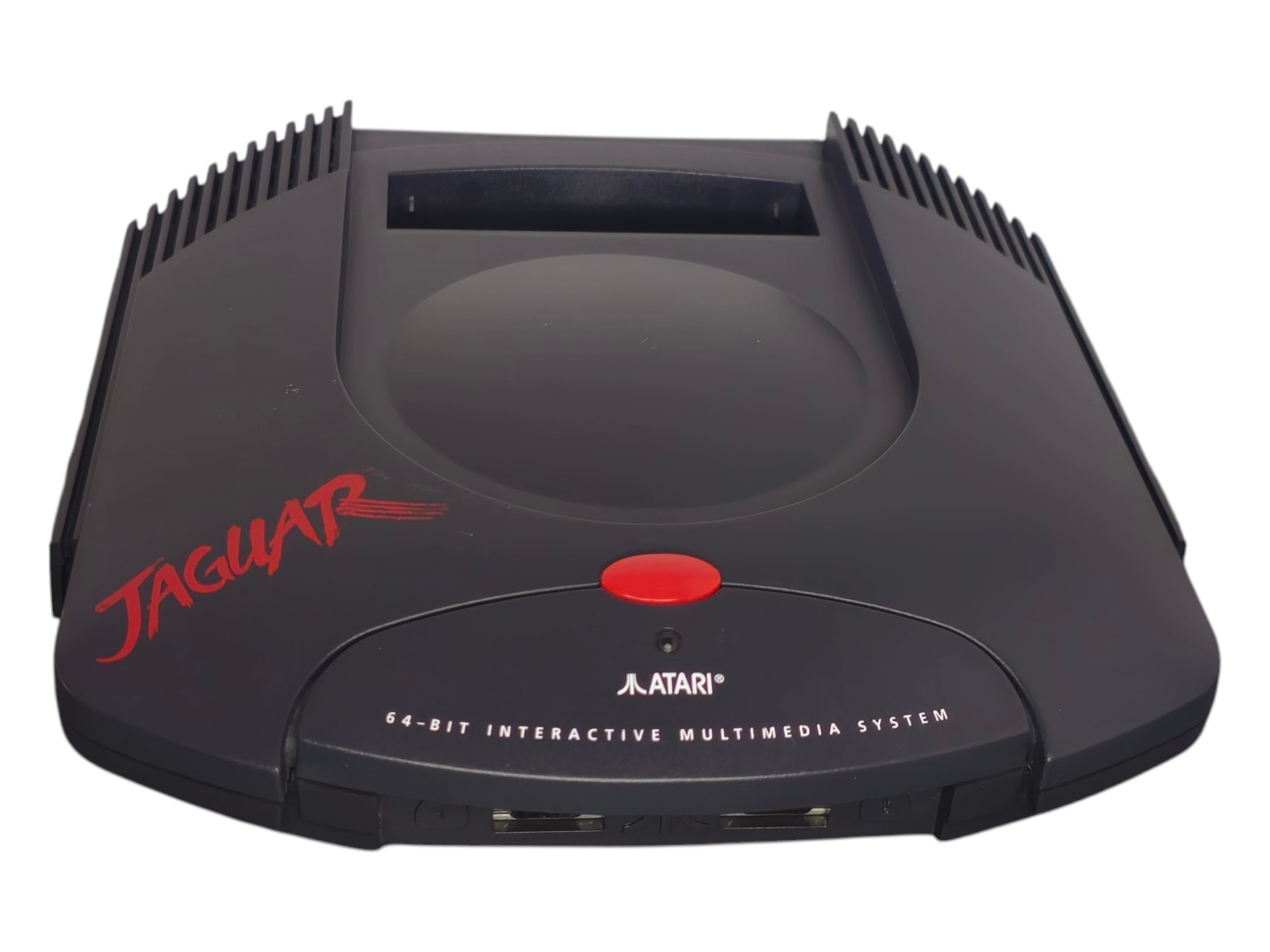
The Atari Jaguar is one of the most ambitious, unusual, and historically fascinating home video game consoles of the 1990s. Introduced by Atari Corporation in 1993, it was marketed as the world’s first 64-bit interactive multimedia entertainment system, representing Atari’s attempt to regain its former prominence in the rapidly evolving video game industry.
Developed around an innovative multiprocessor architecture, the Jaguar combined two custom-designed chips known as Tom and Jerry, a Motorola 68000 processor, advanced graphics hardware, digital stereo sound, and cartridge-based software.
Its distinctive black enclosure, red Jaguar branding, unusual numeric-keypad controller, and optional CD-ROM expansion gave it an identity unlike any competing console.
The Jaguar arrived during a transitional period when the industry was moving from traditional two-dimensional graphics towards fully three-dimensional gaming. It competed initially with established 16-bit systems and later faced increasingly powerful alternatives such as the 3DO, Sega Saturn, Sony PlayStation, and Nintendo 64.
Despite its ambitious hardware, the console struggled commercially because of its complex architecture, limited software library, inconsistent third-party support, and increasing competition.
Nevertheless, games such as Tempest 2000, Alien vs Predator, Doom, Iron Soldier, Rayman, and Wolfenstein 3D demonstrated the potential of the platform.
Today, the Atari Jaguar is remembered as Atari Corporation’s final home video game console, an extraordinary experiment in multiprocessor gaming hardware, and an important collectible representing the final chapter of one of the industry’s pioneering companies.
📘 Introduction
The Atari Jaguar was introduced in North America on November 23, 1993, initially in selected markets, with broader distribution following in 1994.
European PAL versions became available during 1994, with the timing varying between individual countries.
The console belonged to the fifth generation of home video game systems.
Atari positioned the Jaguar as a major technological advance over the 16-bit consoles that dominated the market.
Its original North American retail price was approximately $249.99.
The system was advertised with the memorable slogan:
“Do the Math.”
This advertising campaign emphasised the Jaguar’s claimed 64-bit capabilities and contrasted them with competing systems marketed as 16-bit or 32-bit machines.
Principal Features
- Custom multiprocessor architecture
- Two specialised chips named Tom and Jerry
- Motorola 68000 processor
- 64-bit graphics data path
- 2 MB system RAM
- Hardware-assisted graphics rendering
- Digital stereo sound
- Interchangeable ROM cartridges
- Two controller ports
- Twelve-button numeric keypad controllers
- Optional CD-ROM expansion
- Networking capabilities through external accessories
- PAL and NTSC regional hardware configurations
Although the Jaguar was commercially unsuccessful, its architecture remains one of the most unusual designs in console history.
🏭 Atari: A Pioneer of Electronic Entertainment
Atari played a fundamental role in the development of the video game industry.
Founded in 1972 by Nolan Bushnell and Ted Dabney, the original company helped establish both arcade gaming and home video game consoles.
Pong (1972)
Atari’s arcade game Pong became one of the earliest major commercial successes in electronic entertainment.
Its simple ball-and-paddle gameplay demonstrated the potential of interactive television games.
Atari Video Computer System (1977)
The Atari VCS, later renamed the Atari 2600, introduced interchangeable cartridge gaming to a broad consumer audience.
It became one of the most influential home consoles ever produced.
Atari 400 & Atari 800 (1979)
Atari also developed sophisticated home computers.
The 400 and 800 featured advanced graphics and sound capabilities for their era.
Atari 5200 (1982)
The Atari 5200 introduced hardware related to Atari’s successful 8-bit computer family.
Atari 7800
Developed during the early 1980s and widely released in 1986, the Atari 7800 represented another attempt to compete in the home console market.
Atari ST Computers (1985)
Under Atari Corporation, the Atari ST family became particularly successful in Europe.
Its MIDI capabilities made it popular among musicians, while its affordable graphical environment attracted home computer enthusiasts.
Atari Lynx (1989)
The Atari Lynx was an advanced colour handheld gaming system with sophisticated graphics capabilities.
Atari Jaguar (1993)
The Jaguar represented Atari’s final major attempt to establish a competitive home console platform.
It was intended to return the company to the technological forefront of the gaming industry.
🐆 From Atari Panther to Atari Jaguar
The development of the Jaguar was closely associated with a British electronics design team.
During the late 1980s, engineers Martin Brennan and John Mathieson worked on advanced multiprocessor gaming technology.
Their work became associated with the Flare group of companies.
The Atari Panther
Atari originally investigated a new console project known as Panther.
The Panther was designed as a successor to earlier Atari gaming hardware.
However, work was also progressing on a more sophisticated architecture.
Flare II
The British company Flare II became central to Jaguar development.
The engineering team focused on designing a system using multiple specialised processors rather than depending exclusively on a single conventional CPU.
The Cancellation of Panther
In 1991, Atari cancelled the Panther project to concentrate on Jaguar.
The decision reflected the belief that the more advanced console would be a stronger commercial product.
A Revolutionary Design Philosophy
The Jaguar was designed around dedicated processors performing different functions.
Its graphics and audio capabilities were intended to come from specialised hardware operating alongside the general-purpose processor.
The Technical Ambition
This approach was sophisticated but introduced development challenges.
To achieve maximum performance, programmers needed to understand the interactions between the Jaguar’s different processors, memory system, and graphics components.
The result was hardware with considerable potential but a demanding programming environment.
🖥️ The Distinctive Black Jaguar Design
The Atari Jaguar features an unusual black plastic enclosure with a broad, rounded profile.
Its appearance is noticeably different from the rectangular designs of many competing consoles.
Exterior Features
- Black plastic housing
- Curved upper enclosure
- Central cartridge slot
- Jaguar branding
- Power indicator LED
- Two front controller ports
- Rear video/audio connector
- RF output on applicable regional configurations
- Rear DSP expansion connector
- External power connection
The Cartridge Slot
The cartridge slot occupies a central position on the upper surface.
The Jaguar uses proprietary ROM cartridges rather than conventional optical discs.
An Unusual Power System
The Jaguar’s power-switching arrangement is linked to cartridge insertion.
A properly inserted cartridge is normally required for the console to power on.
This is an important distinction from many other consoles.
A unit that appears inactive without a cartridge should not automatically be considered defective.
Two Controller Ports
The console includes two controller connections as standard.
Additional multiplayer configurations require suitable accessories and supported games.
A Recognisable Appearance
The Jaguar’s broad, curved enclosure and striking logo make it one of the most visually distinctive consoles of the early 1990s.
Its unusual design has become closely associated with Atari’s final home gaming platform.
⚙️ Technical Specifications
The Atari Jaguar uses a custom architecture incorporating several specialised processing units.
Hardware Overview
- Manufacturer: Atari Corporation
- Product: Atari Jaguar
- Original release: November 23, 1993
- European release period: 1994
- Generation: Fifth-generation home console
- Colour: Black
- Architecture: Custom 32/64-bit multiprocessor system
- Graphics and system chip: Tom
- Audio and control chip: Jerry
- General-purpose CPU: Motorola 68HC000
- Motorola CPU frequency: Approximately 13.3 MHz
- Custom GPU frequency: Approximately 26.6 MHz
- Custom DSP frequency: Approximately 26.6 MHz
- Graphics data path: Up to 64 bits
- System RAM: 2 MB
- Graphics palette: Approximately 16.7 million colours
- Graphics: Programmable object processor, blitter, and GPU
- Audio: Digital stereo
- Audio processor: 32-bit DSP
- Primary storage: ROM cartridge
- Commercial cartridge sizes: Up to 6 MB
- Optional optical storage: Jaguar CD
- Controller ports: Two
- Standard controller: Digital directional pad, three action buttons, twelve-button keypad
- Video: Analogue RF and/or A/V connections, depending on model and accessory
- RGB support: Available through a suitable Jaguar video cable
- Power: External 9V DC adapter, approximately 1.2A, centre-negative
- Regional configuration of this exhibit: PAL / Europe
The precise technical performance depends on how software uses the specialised processing components.
The Jaguar’s architecture cannot be adequately represented by a single processor frequency or bit-width figure.
🧠 Was the Jaguar Really a 64-Bit Console?
One of the most frequently debated questions in video game history concerns the Jaguar’s famous 64-bit marketing claim.
Atari promoted the system as the world’s first 64-bit home video game console.
However, the underlying architecture was more complicated than that description suggested.
The 64-Bit Elements
The Jaguar includes hardware capable of performing certain operations across a 64-bit data path.
Its graphics system includes a 64-bit blitter and other specialised circuitry.
These components provided genuine 64-bit capabilities within the system.
The 32-Bit Elements
The two major programmable custom processors use 32-bit RISC architectures.
These include:
- The GPU within Tom
- The DSP within Jerry
The Motorola 68000
The console also contains a Motorola 68000-family processor.
This is a 16/32-bit CISC architecture with a 16-bit external data bus.
Why the Distinction Matters
The Jaguar does not contain one conventional 64-bit general-purpose CPU comparable to the main processors used in later gaming systems.
Instead, it combines processors of different architectures and data widths.
A Hybrid Multiprocessor Design
Its most accurate historical description is a custom multiprocessor console with significant 64-bit graphics capabilities.
Beyond Marketing
The Jaguar’s engineering was genuinely ambitious.
However, processor bit width alone does not determine overall performance.
Software architecture, memory bandwidth, graphics hardware, and programming tools are equally important.
The Jaguar became an important example of the difference between marketing terminology and practical hardware design.
🧩 Tom: The Graphics & System Chip
One of the Jaguar’s two principal custom chips is named Tom.
Tom handles several important graphics and memory-related functions.
Main Components
- Graphics Processing Unit
- Object Processor
- Blitter
- DRAM controller
- Internal memory
- Video-related control circuitry
Graphics Processing Unit
Tom contains a programmable 32-bit RISC graphics processor.
This allows developers to execute specialised graphics-related software.
The Object Processor
The Object Processor handles the display of graphical objects.
These can include:
- Sprites
- Background elements
- Character graphics
- Game interface objects
- Other display components
The Blitter
The blitter is a specialised processing unit designed for moving and manipulating graphical data.
It supports operations involving:
- Image copying
- Pixel manipulation
- Graphics drawing
- Colour processing
- Texture-related work
The 64-Bit Data Path
The blitter and associated architecture make use of the system’s wide graphics data paths.
This is one of the main foundations of Atari’s 64-bit marketing.
An Advanced but Complex Design
Tom provided considerable flexibility.
However, obtaining optimal performance required careful coordination between its components and the Jaguar’s memory system.
🎵 Jerry: Digital Audio & System Control
The second major custom chip is named Jerry.
Jerry combines audio processing with additional system-control functions.
Main Components
- 32-bit Digital Signal Processor
- Audio-related circuitry
- Timers
- Input/output control
- Controller-related functions
- Serial communication
- Internal memory
The Digital Signal Processor
The DSP is a programmable processing unit designed for operations such as:
- Digital audio mixing
- Sound effects
- Sample processing
- Music synthesis
- General signal processing
Digital Stereo Sound
The Jaguar supports 16-bit stereo audio output.
The number of simultaneously produced audio channels depends on how developers program the DSP.
Flexible Sound Architecture
Rather than relying entirely on a fixed set of conventional sound channels, the Jaguar uses a programmable approach.
This can support different audio techniques.
The Importance of Jerry
Jerry demonstrates the sophistication of the Jaguar’s design.
Its audio capabilities were theoretically impressive for a home gaming console introduced in 1993.
However, making effective use of the hardware required specialist programming knowledge.
💻 The Motorola 68000 Processor
In addition to Tom and Jerry, the Jaguar includes a Motorola 68000-family processor operating at approximately 13.3 MHz.
The Motorola 68000 was already well established in computer and gaming hardware.
Other Systems Using the 68000 Family
Related processors appeared in:
- Sega Mega Drive / Genesis
- Commodore Amiga
- Atari ST
- Apple Macintosh
- Numerous arcade systems
The Jaguar’s Use of the Processor
The Motorola processor can perform:
- General software execution
- System management
- Game logic
- Coordination with other processors
The Programming Challenge
Developers sometimes relied heavily on the familiar Motorola processor.
This could simplify development but also limit performance compared with more extensive use of Tom and Jerry.
A Familiar Component in an Unusual System
The Motorola 68000 provided a familiar programming environment within an otherwise highly specialised architecture.
It is one reason the Jaguar can be viewed as a mixture of established computing technology and experimental graphics engineering.
💾 2 MB RAM & Memory Architecture
The Jaguar includes 2 MB of system DRAM.
For a console introduced in 1993, this represented a substantial amount of memory.
Memory Uses
System RAM stores:
- Game code
- Graphic objects
- Textures
- Animation data
- Sound information
- Temporary calculations
- Game states
Memory Bandwidth
The Jaguar’s architecture was designed around a relatively wide system bus.
Its specialised processing components share access to system memory.
The Importance of Coordination
Multiple processors using shared memory create both opportunities and challenges.
Efficient software must manage access carefully.
Graphics Performance
The wide memory interface was intended to support demanding graphics operations.
However, memory contention and programming complexity could reduce practical performance.
The Limitations
Although 2 MB was impressive for its time, software developers still had to use memory carefully.
Sophisticated games required efficient data organisation and compact graphics assets.
🎨 Graphics: Sprites, Polygons & Colour
The Jaguar supports both two-dimensional and three-dimensional graphics techniques.
Its programmable graphics system provides considerable flexibility.
Graphics Features
- Hardware-assisted object rendering
- Sprites
- Bitmap graphics
- Polygon rendering
- Colour blending
- Texture-related effects
- Scrolling
- Digital video output processing
- Multiple colour depths
A Large Colour Palette
The system supports approximately 16.7 million possible colours.
This provides a much larger theoretical colour range than many earlier consoles.
Two-Dimensional Games
The Jaguar’s hardware is capable of producing colourful 2D games with large objects and detailed animation.
Three-Dimensional Games
The console can also render polygonal environments.
Games such as Iron Soldier, Cybermorph, and Club Drive demonstrate different approaches to early 3D graphics.
The Programming Challenge
The Jaguar does not provide the same straightforward 3D development environment as later mainstream consoles.
Developers had to build or adapt significant parts of their own rendering systems.
Why Some Games Looked More Advanced Than Others
The large variation in Jaguar game quality reflects differences in:
- Development experience
- Programming tools
- Available resources
- Development time
- Rendering techniques
- Familiarity with the custom chips
As a result, the same console could produce both visually impressive games and technically disappointing releases.
📺 The PAL European Version
The European Atari Jaguar was designed for PAL television operation.
The regional hardware differs from the North American NTSC configuration primarily in video timing, output format, and the original power arrangement.
PAL Characteristics
- European television configuration
- Approximately 50 Hz video operation
- PAL-compatible analogue output
- External European-market power adapter
- Green power LED on typical PAL hardware
The 50 Hz Difference
European PAL televisions traditionally used a 50 Hz field rate.
North American NTSC televisions used approximately 60 Hz.
Game Performance
The Jaguar does not use conventional cartridge region locking.
However, software must handle the different display timings correctly.
Some games adapt their playfield and timing to the regional hardware.
Others can behave differently between PAL and NTSC systems.
Why This Matters
A game running at 50 Hz does not necessarily produce exactly the same visual experience as its 60 Hz counterpart.
Differences may involve:
- Frame rate
- Game speed
- Image height
- Screen borders
- Vertical positioning
The European Experience
The PAL version is historically important because it documents how Jaguar software was experienced by European consumers.
A Useful Identification Detail
A green power indicator is commonly associated with PAL Jaguar consoles, while red indicators are associated with NTSC models.
The external label and actual video configuration remain important for accurate identification.
🌈 RF, Composite, S-Video & RGB Output
The Jaguar provides analogue video capabilities suitable for televisions of the early 1990s.
The available connection methods depend on the regional console and the cable or adapter used.
RF Output
Many Jaguar configurations include RF television output.
This allows connection through a compatible analogue television tuner.
Composite Video
Composite combines brightness and colour information into one analogue video signal.
It was widely supported by consumer televisions.
S-Video
The Jaguar’s video connector provides signals that can be used with suitable S-Video equipment.
Availability and practical compatibility vary according to the console and cable.
RGB Video
One of the Jaguar’s most attractive features for European collectors is its support for native analogue RGB signals.
With an appropriate cable, RGB can provide a substantially cleaner picture than RF or composite.
SCART
RGB SCART was common on European televisions.
A properly configured Jaguar RGB SCART cable can provide excellent results on compatible CRT displays.
Modern Television Compatibility
The Jaguar does not include native HDMI.
Modern displays may require:
- RGB-compatible equipment
- Analogue video converters
- Retro gaming scalers
- Compatible HDMI conversion devices
The CRT Experience
Original CRT displays remain particularly suitable for demonstrating Jaguar games.
They reproduce the analogue video characteristics for which the console was originally designed.
💾 ROM Cartridges: Fast but Expensive Storage
The Atari Jaguar uses proprietary ROM cartridges.
At a time when manufacturers were increasingly adopting optical media, Atari initially continued with solid-state storage.
Advantages of Cartridges
- Very fast access to program data
- No mechanical optical drive
- Durable construction
- No disc loading mechanism
- Convenient software insertion
- Low access latency
Storage Capacity
Commercial Jaguar cartridges reached capacities of approximately 6 MB.
This was relatively limited compared with CD-ROM technology.
Manufacturing Costs
ROM cartridges were more expensive to manufacture than replicated optical discs.
This could create difficulties for smaller publishers.
Software Limitations
Developers had to manage:
- Graphics storage
- Audio samples
- Game code
- Animation
- Video sequences
- Text data
Why Cartridges Still Worked
The immediate access to data was advantageous for arcade-style games.
The format also avoided mechanical drive failures associated with early optical consoles.
The Jaguar CD Expansion
Atari eventually introduced an optional CD-ROM drive to overcome some of the capacity limitations of cartridge storage.
🕹️ The Unusual Jaguar Controller
One of the console’s most recognisable features is its large controller.
Unlike many competing gamepads, the Jaguar controller includes a twelve-button numeric keypad.
Standard Controller Features
- Eight-directional directional pad
- A button
- B button
- C button
- Pause button
- Option button
- Twelve-button numeric keypad
- Wired connection
The Numeric Keypad
The keypad resembles those found on certain earlier consoles, including the Mattel Intellivision and ColecoVision.
Why So Many Buttons?
The keypad allows individual games to assign additional functions.
These might include:
- Weapon selection
- Game options
- Special abilities
- Map functions
- Inventory controls
- Gameplay configuration
Controller Overlays
Certain games include printed keypad overlays.
These fit over the numeric buttons and identify their functions.
The Importance of Overlays
Original overlays are particularly interesting to collectors because they are easily lost.
They also demonstrate how the controller was intended to support complex games.
Ergonomic Criticism
The controller was criticised for its large dimensions and unusual arrangement.
Some players found it less comfortable than contemporary controllers.
Nevertheless, it remains one of the most distinctive input devices of the fifth console generation.
🎮 The Jaguar Pro Controller
Atari later introduced the Jaguar Pro Controller, an improved alternative to the original gamepad.
Improvements
The Pro Controller includes:
- Revised ergonomics
- Additional action buttons
- Improved access to certain controls
- Shoulder buttons
- Twelve-button keypad
- Compatibility with supported Jaguar games
A More Conventional Layout
The redesigned controller offers a more familiar arrangement for action-oriented games.
Backward Compatibility
It remains compatible with the Jaguar controller interface.
Collecting Significance
The Pro Controller is an important accessory within the Jaguar ecosystem.
Because it was introduced relatively late in the console’s commercial life, it is especially interesting to collectors.
Original vs. Pro Controller
Both controllers demonstrate Atari’s evolving approach to input design.
The original represents the console’s launch philosophy.
The Pro Controller reflects the company’s response to changing gameplay requirements and user feedback.
🎮 Games & Software Library
The Atari Jaguar developed a relatively small commercial software catalogue.
Its original retail-era library is generally documented as approximately 50 cartridge games and 13 Jaguar CD games.
Additional releases have appeared through independent development, unreleased-project recovery, and modern homebrew publishing.
Notable Cartridge Games
- Cybermorph
- Tempest 2000
- Alien vs Predator
- Doom
- Wolfenstein 3D
- Iron Soldier
- Iron Soldier 2
- Rayman
- Raiden
- Zool 2
- Flashback
- Syndicate
- Cannon Fodder
- Theme Park
- Atari Karts
- Super Burnout
- Power Drive Rally
- Val d’Isère Skiing and Snowboarding
- Hover Strike
- Club Drive
- Checkered Flag
- Fight for Life
- Kasumi Ninja
- Ultra Vortek
- Double Dragon V
- Dragon: The Bruce Lee Story
- Bubsy in Fractured Furry Tales
- Troy Aikman NFL Football
- NBA Jam Tournament Edition
- Defender 2000
- Breakout 2000
- Attack of the Mutant Penguins
- Pinball Fantasies
- Ruiner Pinball
- Soccer Kid
- Evolution: Dino Dudes
- Trevor McFur in the Crescent Galaxy
- White Men Can’t Jump
The software library covers a wide range of genres.
However, its size remained considerably smaller than those of the leading competing consoles.
Regional availability and publication dates varied.
🌀 Tempest 2000: The Jaguar’s Defining Game
Released in 1994, Tempest 2000 became one of the Atari Jaguar’s most celebrated games.
Developed by Jeff Minter, it reimagined Atari’s classic arcade game Tempest.
Gameplay
Players control a movable weapon around the edge of geometric playfields.
Enemies advance towards the player from the centre of the screen.
Important Features
- Fast-paced arcade action
- Colourful geometric graphics
- Psychedelic visual effects
- Electronic music
- Increasing difficulty
- Multiple game modes
A Technological Showcase
Tempest 2000 demonstrated how the Jaguar’s specialised graphics hardware could support sophisticated arcade effects.
A Distinctive Soundtrack
The game’s energetic electronic music became an important part of its identity.
Critical Recognition
Tempest 2000 received strong praise and remains one of the most widely admired Jaguar titles.
Historical Importance
For many enthusiasts, Tempest 2000 represents the console’s greatest combination of creative game design and technical capability.
It helped establish a lasting positive reputation for the Jaguar despite its limited commercial success.
👽 Alien vs Predator: Atmospheric First-Person Action
Released in 1994, Alien vs Predator became one of the Jaguar’s most important exclusive titles.
The game was developed by Rebellion Developments.
Gameplay Features
- First-person perspective
- Science-fiction environments
- Multiple playable campaigns
- Alien, Predator, and Marine characters
- Atmospheric exploration
- Combat
- Survival elements
Three Different Perspectives
Players can experience the game through different character types.
Each has distinct gameplay characteristics.
A More Ambitious Experience
Alien vs Predator offered a level of atmosphere and complexity uncommon among many early Jaguar releases.
Commercial Importance
The game became one of the system’s best-known and strongest-selling titles.
Historical Significance
Alien vs Predator demonstrated the Jaguar’s potential for immersive first-person gaming.
It remains an important part of the console’s software identity.
🤖 Iron Soldier: Giant Robots in a 3D City
Iron Soldier was released for the Jaguar in 1994.
Developed by Eclipse Software Design, it became one of the platform’s most notable technical showcases.
Gameplay Features
- First-person robot combat
- Polygonal environments
- Urban missions
- Weapon systems
- Large enemy machines
- Destructible structures
- Three-dimensional navigation
Controlling a Giant Robot
Players operate a large mechanised combat machine.
Missions involve moving through city environments while engaging enemy targets.
The Jaguar’s 3D Capabilities
Iron Soldier demonstrates the hardware’s ability to render polygon-based environments in real time.
The Controller Keypad
The game’s complex controls make use of the Jaguar’s unusual controller arrangement.
A Sequel
Iron Soldier 2 continued the concept and appeared in both cartridge and CD configurations.
Historical Importance
Iron Soldier remains one of the best examples of Atari Jaguar software attempting sophisticated three-dimensional gameplay.
🔫 Doom: A Famous Console Conversion
The Atari Jaguar received a conversion of Doom, one of the most influential first-person shooters in gaming history.
Originally developed by id Software for PC, Doom became a technological and cultural phenomenon.
The Jaguar Conversion
The Jaguar version was released in 1994.
It was developed with direct involvement from id Software.
Gameplay Features
- First-person shooting
- Maze-like environments
- Weapon selection
- Enemy combat
- Hidden areas
- Fast-paced action
A Technically Important Port
The Jaguar conversion became an important reference point for other console versions.
Differences from PC Doom
The Jaguar version includes changes to:
- Level selection
- Visual presentation
- Audio
- Interface features
- Certain gameplay details
The Missing Music
One notable characteristic is the absence of conventional in-game background music during most gameplay.
Historical Importance
Doom demonstrates the Jaguar’s ability to support demanding first-person action.
It is also an important example of early cross-platform game adaptation.
🪖 Wolfenstein 3D: Classic First-Person Shooting
Another important Jaguar title is Wolfenstein 3D.
Originally developed by id Software, Wolfenstein 3D helped establish the modern first-person shooter genre.
Jaguar Features
The console version includes:
- First-person movement
- Maze-based environments
- Enemy combat
- Weapon collection
- Mission progression
- Updated graphical presentation
The Console Experience
Wolfenstein 3D offered one of the more polished action experiences available on the platform.
Historical Importance
Together with Doom, it demonstrated the growing importance of first-person games during the 1990s.
It also showed that the Jaguar could reproduce several influential PC gaming concepts.
🎨 Rayman: A Masterpiece of 2D Animation
Released for the Jaguar in 1995, Rayman became one of the platform’s most visually impressive games.
Developed by Ubisoft, the game introduced the character Rayman.
Gameplay Features
- Side-scrolling platforming
- Colourful environments
- Detailed character animation
- Creative enemies
- Challenging levels
- Distinctive music
- Fantasy-inspired worlds
An Important Visual Showcase
Rayman demonstrated that the Jaguar could produce detailed two-dimensional graphics.
Smooth Animation
The game’s colourful artwork and expressive characters stood out among contemporary platformers.
A Major Franchise
Rayman subsequently appeared on other systems and became one of Ubisoft’s most recognisable properties.
Historical Importance
The Jaguar version is particularly interesting because it belongs to the earliest commercial releases of a franchise that would become internationally successful.
🚀 Cybermorph: The Jaguar Launch Experience
Cybermorph was one of the Jaguar’s earliest games and was originally bundled with the console in certain retail packages.
It became strongly associated with the platform’s launch.
Gameplay
Players pilot a futuristic aircraft through three-dimensional environments.
The objective involves collecting important objects while avoiding enemies.
Technical Features
- Polygon-based environments
- Flight-style movement
- Mission objectives
- Three-dimensional landscapes
- Spoken guidance
A Technological Demonstration
Cybermorph was designed to demonstrate the Jaguar’s new hardware capabilities.
Mixed Reception
Although its graphics were ambitious for the period, the game received mixed reactions.
Some players admired its technology, while others criticised aspects of its gameplay.
Historical Importance
Cybermorph remains an essential part of Jaguar history because of its role in introducing the console to early buyers.
🏎️ Super Burnout & Atari Karts
The Jaguar also offered racing games with very different approaches.
Super Burnout
Super Burnout is a motorcycle racing game released in 1995.
Its gameplay focuses on fast arcade-style racing.
Notable characteristics include:
- Smooth scrolling
- Motorcycle racing
- Multiple tracks
- Competitive gameplay
- Colourful graphics
Atari Karts
Atari Karts was released in 1995.
It adopted a kart-racing concept involving colourful tracks and recognisable characters.
Different Gaming Experiences
Super Burnout concentrated on high-speed motorcycle racing.
Atari Karts provided a more playful racing environment.
The Jaguar’s Diversity
These games demonstrate how developers used the platform for traditional arcade gameplay as well as experimental 3D projects.
💿 Atari Jaguar CD: The Optical Expansion
In September 1995, Atari released the Jaguar CD, an optional optical disc expansion for the console.
The accessory attaches to the Jaguar’s cartridge connection on the upper surface.
Jaguar CD Features
- Double-speed CD-ROM drive
- Proprietary high-density CD software support
- Additional multimedia storage
- Audio CD playback
- Support for Jaguar CD games
- Cartridge pass-through connection
- Compatibility with the Jaguar base console
Storage Capacity
Jaguar CD media could provide roughly 790 MB of storage, depending on format and layout.
This was a major increase over the capacity of Jaguar cartridges.
A Distinctive Appearance
The Jaguar CD has an unusual upright design.
When attached, it creates a distinctive combined system that became famous among collectors.
A Delayed Release
The CD accessory was originally planned earlier in the console’s lifespan.
Delays meant it arrived after the Jaguar was already facing substantial commercial difficulties.
A Limited Library
The original commercial Jaguar CD catalogue contained approximately 13 games.
A Valuable Collectible
Today, the Jaguar CD is an important and relatively uncommon component of the Jaguar ecosystem.
It should be regarded as an optional peripheral rather than a standard component of the base console.
🎮 Jaguar CD Games
The Jaguar CD offered a separate library of software.
Notable releases included:
- Battlemorph
- Blue Lightning
- Highlander: The Last of the MacLeods
- Myst
- Vid Grid
- Hover Strike: Unconquered Lands
- World Tour Racing
- Baldies
- Dragon’s Lair
- Space Ace
- Brain Dead 13
- Primal Rage
Battlemorph
Battlemorph was a successor to Cybermorph.
It introduced more sophisticated environments, expanded missions, and improved presentation.
Highlander
Highlander: The Last of the MacLeods was a story-driven adventure associated with the Highlander animated universe.
Myst
Myst brought the famous puzzle-adventure experience to the Jaguar CD platform.
Vid Grid
Vid Grid was a multimedia puzzle game based around rearranging video imagery.
World Tour Racing
World Tour Racing provided polygonal racing on the CD expansion.
The Preservation Challenge
Original Jaguar CD software is particularly interesting because of the limited commercial catalogue and the relative scarcity of surviving hardware.
💾 The Memory Track Cartridge
The Jaguar CD introduced a special save-memory accessory called Memory Track.
It provides storage for compatible Jaguar CD games.
Memory Track Features
- Removable cartridge format
- Non-volatile storage
- Approximately 128 KB of save capacity
- Compatibility with supported Jaguar CD software
Why It Was Needed
The Jaguar base console did not include a conventional hard drive.
Some cartridge games could store progress using memory inside the game cartridge.
CD-based games required a different approach.
The Role of Memory Track
The accessory allowed compatible CD games to save data without requiring a built-in hard disk.
Collectability
Memory Track is an important accessory because it demonstrates how Atari adapted its cartridge-based architecture for optical software.
Original examples are also useful for preserving historical game-save functionality.
🔗 JagLink: Multiplayer Through Connected Consoles
Atari developed a networking accessory called JagLink.
It allowed compatible Jaguar consoles to communicate directly.
The Concept
Two Jaguar systems could be connected using appropriate networking hardware and cables.
Applications
Supported software could use the connection for multiplayer gaming.
An Early Console Networking Experiment
JagLink represents an interesting attempt to extend console multiplayer beyond a single television.
The Limitations
JagLink did not provide modern internet gaming.
It was primarily intended for direct communication between compatible systems.
Historical Importance
The accessory demonstrates that Atari was experimenting with connected multiplayer before internet networking became standard in home consoles.
🎮 Team Tap & Multiplayer Accessories
The Jaguar includes two controller ports as standard.
Atari also supported multiplayer expansion through accessories such as the Team Tap.
The Team Tap
Team Tap allows additional compatible controllers to be connected.
Multiplayer Applications
Some software supports multiplayer configurations beyond the standard two-controller arrangement.
A Relatively Unusual Accessory
Because the Jaguar’s commercial software library was small, multiplayer expansion accessories are less familiar than comparable devices for more successful consoles.
Preservation Significance
The Team Tap demonstrates Atari’s interest in supporting social gaming experiences.
It is an interesting accessory for collectors documenting the wider Jaguar hardware ecosystem.
🥽 Jaguar VR: A Vision of Virtual Reality
One of Atari’s most ambitious unreleased projects was the Jaguar VR headset.
During the mid-1990s, virtual reality attracted considerable interest from technology companies and game developers.
The Jaguar VR Concept
Atari investigated a headset designed to create a more immersive gaming experience.
Prototype Demonstrations
Prototype hardware was demonstrated publicly, including during the 1995 period.
The Intended Experience
The project explored:
- Head-mounted displays
- Head tracking
- Three-dimensional gaming
- Immersive interaction
Why It Was Never Released
The Jaguar’s commercial difficulties and Atari’s declining resources prevented the project from reaching normal retail distribution.
Historical Importance
Jaguar VR demonstrates how Atari continued experimenting with advanced gaming concepts even during a period of financial instability.
It remains one of the most fascinating unrealised accessories of the 1990s.
🔄 Atari Jaguar vs. Atari Lynx
The Atari Jaguar and Atari Lynx represent two different approaches to gaming hardware.
Atari Lynx (1989)
- Portable handheld console
- Colour LCD
- Cartridge-based software
- Custom graphics capabilities
- Battery operation
- Portable multiplayer features
Atari Jaguar (1993)
- Home television console
- Custom multiprocessor architecture
- Cartridge-based software
- Advanced graphics hardware
- Digital stereo sound
- Optional CD-ROM expansion
A Shared Philosophy
Both systems demonstrated Atari’s willingness to experiment with advanced technology.
Different Commercial Challenges
The Lynx competed in the handheld market against Nintendo’s Game Boy.
The Jaguar faced a changing home console industry dominated increasingly by major international manufacturers.
The End of an Era
Together, the Lynx and Jaguar represent the final major consumer gaming hardware projects of Atari Corporation.
🥊 Atari Jaguar vs. Panasonic 3DO vs. Sony PlayStation
The Jaguar entered the market during a period of intense competition.
Atari Jaguar (1993)
- Custom multiprocessor design
- Tom and Jerry chips
- Motorola 68000 processor
- 2 MB RAM
- ROM cartridges
- Optional CD-ROM expansion
3DO Interactive Multiplayer (1993)
- ARM60 processor
- CD-ROM storage
- Sophisticated graphics hardware
- Multimedia functionality
- High original retail price
Sony PlayStation (1994)
- MIPS-based 32-bit processor
- Dedicated 3D graphics acceleration
- CD-ROM storage
- Strong third-party support
- Extensive software library
Different Design Strategies
Atari promoted specialised graphics technology and a 64-bit architecture.
The 3DO ecosystem emphasised advanced multimedia capabilities through licensed hardware.
Sony concentrated on affordable CD-based game distribution and accessible 3D development.
The Commercial Outcome
Sony’s PlayStation achieved overwhelming commercial success.
The Jaguar struggled to attract enough publishers and consumers.
An Important Lesson
Hardware specifications do not determine commercial success by themselves.
Software quality, developer support, manufacturing costs, marketing, and distribution are equally important.
📉 The Commercial Failure of the Jaguar
Despite substantial technical ambition, the Jaguar failed to achieve Atari’s commercial expectations.
The Main Challenges
The platform faced several difficulties:
- Complex hardware architecture
- Limited development tools
- Small software catalogue
- Uneven game quality
- Limited third-party publisher support
- Strong competition
- Inconsistent marketing
- Financial constraints
Developer Difficulties
The Jaguar required software developers to understand a relatively unusual combination of processors.
Obtaining maximum performance was difficult.
The Software Problem
A console’s success depends heavily on its games.
Although the Jaguar produced several outstanding titles, the overall library remained limited.
The Arrival of New Competitors
The Sony PlayStation and Sega Saturn introduced powerful new alternatives during 1994–1995.
The Nintendo 64 followed in 1996.
Limited Sales
Jaguar worldwide sales are generally estimated in the low hundreds of thousands.
Historical sources vary, with commonly cited estimates ranging roughly from 150,000 to 250,000 units, depending on the distinction between units shipped, manufactured, and sold.
The figures are not directly comparable in precision with the audited lifetime totals available for some later consoles.
Atari’s Withdrawal
By 1996, Atari Corporation had effectively abandoned the Jaguar hardware business.
The company’s merger with JTS marked the end of its role as a major independent console manufacturer.
A Significant Industry Moment
The Jaguar’s failure demonstrated how difficult it had become for smaller manufacturers to compete in the increasingly expensive home console industry.
🌍 Atari Jaguar in Europe
The Jaguar arrived in Europe during 1994.
Its commercial reception varied between countries.
European Markets
The console appeared in markets including:
- United Kingdom
- Germany
- France
- Spain
- Other European territories
Regional Differences
European systems used PAL-oriented video configurations.
Power accessories were adapted for regional mains electricity.
Marketing Challenges
Atari faced intense competition from established console brands.
The Sega Mega Drive and Super Nintendo already had extensive software libraries.
The Sony PlayStation subsequently became a major commercial force.
A Smaller Installed Base
The Jaguar never developed a large mainstream European audience.
Its relatively limited distribution contributed to its present-day collector appeal.
A Recognisable Retro System
Although uncommon, the Jaguar retains a dedicated following among European Atari collectors.
Original PAL systems provide an authentic representation of Atari’s final home-console generation.
🇬🇷 The Atari Jaguar in Greece
During the early to mid-1990s, the Greek gaming market was dominated by increasingly popular Sega and Nintendo systems.
The Sony PlayStation subsequently became a major influence.
Atari’s Earlier Presence
Atari was already familiar to Greek computer and gaming enthusiasts through products such as:
The Jaguar’s Limited Visibility
The Jaguar did not establish the same commercial presence in Greece as the Sega Mega Drive, Super Nintendo, or PlayStation.
Its historical visibility is therefore relatively limited.
The Importance of a PAL Example
A European Jaguar represents the type of hardware intended for the television standards commonly used in Greece.
A Valuable Museum Exhibit
Preserving a PAL Jaguar helps demonstrate a less familiar part of European gaming history.
It provides an important counterpoint to the more commercially successful fifth-generation platforms.
Beyond Mainstream Console History
The Jaguar illustrates that the history of video games includes technically ambitious systems that failed commercially but remain historically significant.
🔧 Build Quality & Common Hardware Problems
The Atari Jaguar is now a vintage electronic system.
Although it contains no mechanical optical drive in its standard configuration, several components can deteriorate with age.
Common Maintenance Areas
- Cartridge connector
- External power supply
- DC power connector
- Controller ports
- Video output connector
- Internal capacitors
- Voltage regulation circuitry
- Power-switching contacts
- Motherboard solder joints
Cartridge Connector Problems
The Jaguar’s cartridge slot can become dirty or damaged.
Symptoms may include:
- No startup
- Failure to load a game
- Intermittent operation
- Blank or incorrect display
The Power-Switching Mechanism
The Jaguar’s power system depends on cartridge insertion.
Dirty or damaged cartridge contacts can therefore cause symptoms that resemble a power failure.
Power Supply Compatibility
The original Jaguar requires a suitable external power supply.
The commonly documented electrical specification is:
- 9V DC
- Approximately 1.2A or greater suitable current capacity
- Centre-negative polarity
Incorrect voltage or polarity can damage the console.
Controller Condition
The controller’s numeric keypad and other buttons can become unreliable through wear or contamination.
Capacitors
Electrolytic capacitors may deteriorate over time.
Electrical inspection is recommended when restoring a malfunctioning unit.
Safe Maintenance
Repairs should be based on proper electrical diagnosis.
Original components should be preserved wherever practical.
🛠️ Modern Preservation & Homebrew Development
The Atari Jaguar has developed an enthusiastic preservation and independent-development community.
Although commercial production ended decades ago, new software and hardware projects continue to appear.
Homebrew Games
Independent programmers have developed new games and demonstrations for the Jaguar.
These projects explore the original hardware’s capabilities.
The Open Platform Announcement
In 1999, Hasbro Interactive, which then controlled Atari-related intellectual property, announced that the Jaguar platform would be opened to independent developers.
This encouraged continued community development.
The announcement should not be interpreted as placing every original Jaguar game, trademark, or associated copyright into the public domain.
Modern Development Tools
Contemporary tools provide alternatives to some of the original programming methods.
These can make Jaguar development more accessible.
Flash Cartridges
Modern flash cartridges can allow compatible software and homebrew games to be loaded from removable storage.
Video Modifications
Retro enthusiasts may use:
- RGB cables
- Analogue video scalers
- Modern display converters
- Selected internal modifications
A Continuing Community
The Jaguar remains an active subject of interest among programmers, collectors, and hardware researchers.
This ongoing activity helps preserve knowledge about one of gaming’s most unusual architectures.
🔍 Hardware Revisions & Manufacturing
The Jaguar was manufactured under Atari’s production arrangements with external electronics companies.
IBM played an important role in assembling and distributing early Jaguar hardware.
Additional manufacturing arrangements were used during the console’s production history.
Different Production Groups
Collectors commonly distinguish Jaguar units through serial-number prefixes and internal hardware characteristics.
Two frequently discussed groups are:
- K-prefixed serial units
- M-prefixed serial units
K-Series Hardware
K-prefixed serial numbers are commonly associated with IBM-related production.
Some early K-series units included hardware characteristics that differed from later examples.
M-Series Hardware
M-prefixed consoles are associated with later manufacturing arrangements, including JVC-related production.
Important Limitations
A serial prefix does not necessarily identify every internal component.
Hardware characteristics can vary within a manufacturing group.
The Importance of Physical Inspection
Useful identification details include:
- Original manufacturing labels
- Motherboard revision markings
- Internal chip identification
- Installed components
- Evidence of previous repairs
Museum Documentation
For accurate preservation, original factory information should be maintained in the collection inventory.
However, the exact original manufacturing date or board configuration should not be inferred from a serial prefix alone without suitable supporting evidence.
🏛️ Collectability & Historical Preservation
The Atari Jaguar has become an important collectible because of its unusual hardware, limited commercial production, and distinctive place in gaming history.
Important Collecting Factors
- Original Atari Jaguar console
- Correct regional hardware
- Original black enclosure
- Manufacturer identification labels
- Functional cartridge connector
- Original controller, if present
- Keypad overlays, if present
- Correct external power supply
- Compatible A/V cable
- Original packaging
- Instruction manual
- Game cartridges
- Optional accessories
The Importance of PAL Identification
European models should be documented separately from NTSC systems.
The regional video configuration is an important part of the hardware’s historical identity.
Original Controllers
The Jaguar’s unusual keypad controller is central to understanding the console.
Its condition is an important collecting consideration.
Cartridge Preservation
Original game cartridges should be protected from:
- Dust
- Moisture
- Physical damage
- Connector corrosion
- Excessive heat
Original Packaging
Boxes and manuals provide valuable evidence concerning:
- Regional distribution
- Product branding
- Software marketing
- Retail pricing
- Included accessories
Jaguar CD & Optional Hardware
The Jaguar CD, Pro Controller, JagLink, Team Tap, and Memory Track represent significant parts of the wider hardware ecosystem.
They should be documented separately when present.
A Distinctive Museum Exhibit
The Jaguar offers an opportunity to explain a rare combination of advanced hardware technology and commercial failure.
It also represents the end of Atari Corporation’s involvement in mainstream home-console manufacturing.
⭐ Why the Atari Jaguar Still Matters
The Atari Jaguar remains historically significant for numerous reasons:
- It was Atari Corporation’s final major home console
- It used an ambitious custom multiprocessor architecture
- It incorporated genuine 64-bit graphics operations
- It combined specialised 32-bit processors with a Motorola 68000
- It included advanced programmable graphics hardware
- It provided digital stereo audio
- It introduced unusual controller features
- It supported optical expansion through Jaguar CD
- It experimented with networking and virtual reality
- It produced influential games such as Tempest 2000
- It demonstrated the challenges of developing for complex hardware
- It illustrated the increasing importance of software libraries and publisher support
- It developed a lasting homebrew and preservation community
Technological Ambition
The Jaguar was far more sophisticated than its commercial performance might suggest.
Its architecture was unusual and technically ambitious.
The Importance of Software
The platform demonstrated that hardware potential alone cannot guarantee success.
Developers must be able to use the technology effectively.
The End of an Atari Era
The Jaguar symbolises the end of Atari Corporation as a major manufacturer of home consoles.
An Enduring Legacy
Despite its commercial failure, the Jaguar continues to attract attention from engineers, collectors, programmers, and gaming historians.
Its distinctive hardware and unusual history ensure that it remains an important subject of retro computing research.
📦 Items Included in This Collection Entry
Platform introduction: 1993
European release period: 1994
Region: PAL / Europe
Original exterior colour: Black
Hardware architecture: Atari Tom and Jerry custom multiprocessor system
🏁 Conclusion
The Atari Jaguar represents one of the most ambitious and unusual chapters in the history of home video gaming.
Introduced in 1993, it was designed to restore Atari’s reputation as a technological leader.
Its combination of specialised processors, 64-bit graphics capabilities, advanced digital audio, and cartridge-based gaming represented an innovative approach to console engineering.
The Jaguar’s unusual architecture allowed developers to create memorable experiences, including Tempest 2000, Alien vs Predator, Iron Soldier, Doom, and Rayman.
However, the console also demonstrated the limitations of technological ambition when hardware complexity, software availability, and commercial resources are not properly balanced.
The introduction of Jaguar CD, Jaguar networking accessories, and experimental virtual reality hardware further illustrated Atari’s willingness to explore future gaming technologies.
Despite these innovations, the console struggled against increasingly successful competitors.
Its discontinuation marked the end of an important period in Atari’s history.
Today, the Jaguar enjoys a lasting reputation as a fascinating experimental gaming platform.
Its architecture continues to interest programmers, while its unusual games and accessories remain important to collectors.
The European PAL version is particularly valuable for documenting how Atari’s final console was introduced to the European market.
More than three decades after its original release, the Atari Jaguar remains a powerful reminder that the history of gaming is shaped not only by commercial winners but also by bold technological experiments.
Atari’s final home-console masterpiece of engineering ambition, a fascinating 32/64-bit hybrid, and one of the most distinctive collectibles of the fifth generation of video gaming.
