

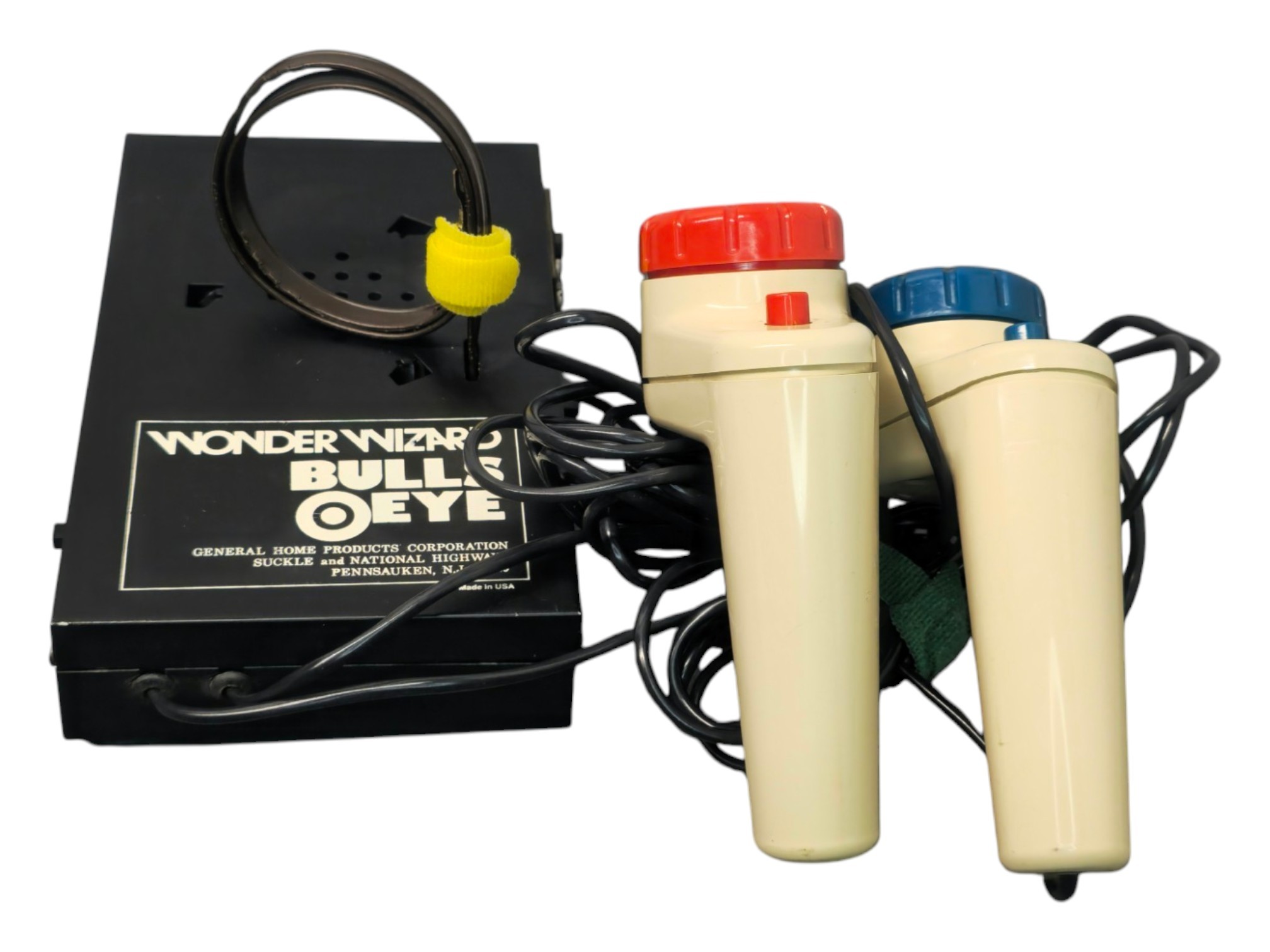
Magnavox Wonder Wizard Bulls Eye – Model 7704 (1977)
The Magnavox Wonder Wizard Bulls Eye, model 7704, is an unusual and historically significant first-generation home video game console introduced in the United States in 1977. Combining traditional Pong-style television games with electronic target shooting, it represents an important stage in the early development of interactive home entertainment.
Manufactured by Magnavox and marketed under the Wonder Wizard brand by General Home Products, the Bulls Eye was designed around the influential General Instrument AY-3-8500 integrated circuit.
Unlike conventional Pong consoles offering only paddle-and-ball games, the Bulls Eye supported six built-in games, including two shooting activities controlled through a specialised light-sensitive pistol.
Its distinctive compact metal enclosure was designed to occupy very little space and could be attached to the side of a television cabinet, reflecting the close relationship between early gaming equipment and domestic television technology.
The system included dedicated paddle controls, adjustable difficulty settings, monochrome television graphics, and an unconventional light-gun accessory resembling a miniature revolver.
The Bulls Eye also belongs to an important family of Wonder Wizard consoles that emerged from Magnavox’s involvement in the earliest years of home gaming.
Today, the Wonder Wizard Bulls Eye is a fascinating collectible that illustrates how manufacturers experimented with different forms of player interaction before programmable cartridge-based consoles became dominant.
📘 Introduction
The Wonder Wizard Bulls Eye 7704 appeared during the period when dedicated Pong consoles were becoming increasingly common in American households.
Following the success of Atari’s Pong and the pioneering Magnavox Odyssey, many companies entered the television gaming market.
General Home Products marketed the Wonder Wizard family, with Magnavox manufacturing important models in the series.
The Bulls Eye introduced a distinctive combination of sports and shooting games.
Principal Features
- Six built-in electronic games
- General Instrument AY-3-8500 game chip
- Four paddle-and-ball game variations
- Two electronic shooting games
- Photoelectric light-gun support
- Two paddle controllers
- Adjustable skill settings
- Automatic on-screen scoring
- Monochrome television output
- RF television connection
- Compact metal enclosure
- Side-of-television mounting design
- Dedicated game-selection controls
The Wonder Wizard Bulls Eye belongs to the first generation of home video game systems.
It does not use conventional software cartridges, optical discs, or a programmable operating system.
Its games are generated directly through specialised electronic circuitry.
This makes it particularly valuable for understanding the technological foundations of home video gaming.
🏭 Magnavox: A Pioneer of Home Video Gaming
The history of the Wonder Wizard Bulls Eye is closely connected with Magnavox, one of the most important companies in the origins of the video game industry.
Magnavox was an established American consumer electronics manufacturer involved in televisions, radios, audio equipment, and other household technologies.
The Magnavox Odyssey (1972)
In September 1972, Magnavox introduced the original Odyssey.
Developed from the pioneering work of Ralph H. Baer and his collaborators, the Odyssey became the first commercially released home video game console.
It allowed users to control simple electronic objects on a television screen.
An Entirely New Entertainment Concept
The Odyssey demonstrated that televisions could be used for interactive experiences rather than only passive viewing.
This was a revolutionary idea.
The Growth of Home Video Gaming
Following the Odyssey’s introduction, electronic television games became increasingly popular.
Atari helped expand the market through its successful Pong products.
Magnavox continued developing dedicated home gaming systems.
Later Odyssey Models
During the mid-1970s, Magnavox introduced several dedicated consoles, including:
- Odyssey 100
- Odyssey 200
- Odyssey 300
- Odyssey 400
- Odyssey 500
- Odyssey 2000
- Odyssey 3000
- Odyssey 4000
These machines offered various combinations of electronic sports games.
The Wonder Wizard Connection
Magnavox also manufactured systems distributed under the Wonder Wizard name.
This makes the Bulls Eye particularly interesting because it belongs to the broader history of the same company that introduced home console gaming in 1972.
🧙 General Home Products & the Wonder Wizard Brand
The Wonder Wizard name was used by General Home Products, commonly abbreviated to GHP.
The company marketed dedicated home video game systems during the 1970s.
A Separate Consumer Brand
Wonder Wizard was not simply another name for every Magnavox Odyssey console.
It was a distinct retail brand associated with hardware manufactured by Magnavox.
The Wonder Wizard Family
Known models included:
| Model | Product |
|---|---|
| 7701 | Gulliver Triple Challenge |
| 7702 | Wonder Wizard Television Sports Games |
| 7704 | Wonder Wizard Bulls Eye |
| 7705 | Wonder Wizard Sharp Shooter |
| 7706 | Wonder Wizard Scoreboard |
| 7707 | Desert Fox, planned but unreleased |
| 7709 | Later Wonder Wizard design, commercial release uncertain |
Some additional model numbers remain poorly documented.
An Evolving Product Range
The series demonstrates how rapidly home video gaming changed during the late 1970s.
Different models experimented with:
- Sports games
- Shooting games
- Expanded game selection
- Improved graphics
- Different enclosure designs
- Different control systems
The Bulls Eye’s Position
The Bulls Eye was one of the more unusual machines because of its extremely compact metal housing and light-gun functionality.
It moved beyond conventional paddle games while retaining the simplicity of dedicated electronic hardware.
🖥️ The Unusual Compact Metal Enclosure
One of the most distinctive features of the Bulls Eye is its small metal console housing.
Unlike many early Pong systems, which were built into large plastic tabletop enclosures, the Bulls Eye used a relatively compact design.
Exterior Characteristics
- Small metal main unit
- Dark exterior finish
- Dedicated game-selection controls
- Skill adjustment
- External controller connections
- Light-gun connection
- RF television output
- External power connection
Designed for the Television
The unit could be mounted at the side of a compatible television cabinet.
This reduced the amount of space required near the television.
A Different Industrial Design
Most home gaming systems gradually developed into independent entertainment units placed on shelves or tables.
The Bulls Eye reflects an earlier design philosophy.
It was treated almost as an attachment to the television.
Space-Saving Marketing
Contemporary packaging promoted the unusually small design as a selling point.
Historical Importance
The enclosure demonstrates how manufacturers were still experimenting with the physical appearance and installation of home video game systems.
The familiar modern console format had not yet become standard.
⚙️ Technical Specifications
The Wonder Wizard Bulls Eye is a dedicated electronic television game system built around a specialised General Instrument chip.
Hardware Overview
- Product: Wonder Wizard Bulls Eye
- Model: 7704
- Magnavox model designation: PH 7704
- Manufacturer: Magnavox
- Brand / Distributor: General Home Products
- Country: United States
- Documented release year: 1977
- Console generation: First generation
- Hardware type: Dedicated television game
- Main integrated circuit: General Instrument AY-3-8500
- Processor architecture: Dedicated game logic
- Conventional programmable CPU: None
- Graphics: Monochrome
- Video standard: North American analogue television system
- Television connection: RF
- Television channels: 3 or 4
- Game selection: Hardware switches
- Number of games: Six
- Sports games: Four
- Shooting games: Two
- Primary controllers: Two paddle-style controllers
- Shooting controller: Photoelectric light-gun design
- Difficulty settings: Four preset skill combinations
- Scoring: On-screen digital scoring
- Sound: Simple electronic effects
- Enclosure: Compact metal housing
- Power: External AC adapter as documented in original retail packaging
- Cartridge system: None
- Optical drive: None
- General-purpose RAM: Not applicable as in later programmable consoles
The original power adapter’s electrical rating should be verified from the individual hardware or authentic documentation rather than copied from another Wonder Wizard model.
🧠 General Instrument AY-3-8500: The Pong-on-a-Chip Revolution
The core of the Wonder Wizard Bulls Eye is the General Instrument AY-3-8500.
Introduced in 1976, this integrated circuit helped make home video gaming affordable for a broad consumer audience.
An Entire Game System in One Chip
The AY-3-8500 contains dedicated logic for multiple electronic games.
It generates the essential elements required for gameplay, including:
- Player-controlled paddles
- Moving ball
- Collision responses
- Game boundaries
- Scoring
- Video synchronisation
- Simple sound signals
- Shooting-game targets
No Conventional CPU
The chip does not function like a modern programmable processor.
There is no separate game program being loaded and executed.
Instead, the game’s behaviour is defined through electronic circuits within the chip.
Why It Was Important
Earlier electronic game systems could require numerous individual components to generate a complete television game.
The AY-3-8500 integrated much of this functionality into one component.
Lower Manufacturing Costs
This allowed manufacturers to build relatively inexpensive television games.
A Widely Used Chip
Numerous brands adopted the AY-3-8500 or closely related components.
As a result, different consoles could offer similar games despite having completely different enclosures.
The Bulls Eye’s Advantage
The AY-3-8500 supported both paddle games and target-shooting modes.
The Bulls Eye exploited this versatility by including a compatible light-gun controller system.
💻 A Console Without Software or Cartridges
The Wonder Wizard Bulls Eye belongs to the dedicated-game era.
Its architecture differs fundamentally from later programmable consoles such as the Atari 2600, Nintendo NES, and Sega Master System.
Hardwired Gameplay
The games are implemented directly in the electronic circuitry.
No Game Cartridge Slot
Users cannot insert additional ROM cartridges to install new games.
The available games are permanently determined by the hardware.
No Operating System
The console does not boot into a dashboard or software interface.
No File Storage
There are no saved games, profiles, or conventional digital storage devices.
Immediate Operation
Once connected to a compatible television and powered correctly, the system generates its video game display directly.
A Different Kind of Computer
The Bulls Eye is best described as a dedicated interactive electronic appliance rather than a general-purpose computer.
Historical Importance
These systems demonstrate that interactive gaming existed before the widespread adoption of software-based console architecture.
🎮 The Six Built-In Games
The Wonder Wizard Bulls Eye supports six games.
They are based on the capabilities of the AY-3-8500.
Sports Games
- Tennis
- Hockey
- Handball / Practice
- Jai Alai / Squash
Shooting Games
- Target
- Skeet
Historical documentation sometimes uses different names for the closely related Handball, Practice, Jai Alai, and Squash game variants.
The exact names visible on the original retail packaging should be preserved when cataloguing a specific example.
How Game Selection Works
The player uses the console’s physical controls to choose a game.
A Shared Graphics System
The sports games rely on simple electronic objects.
These include:
- Paddles
- Ball
- Lines
- Goals
- Scoring indicators
The shooting games use a different interaction method based on detecting the position of a target on the television.
An Expanded Gaming Experience
The combination of paddle games and shooting games made the Bulls Eye more versatile than the earliest single-game home Pong machines.
🎾 Tennis: The Classic Pong Game
Tennis represents the traditional Pong-style experience.
Two players control vertical paddles on opposite sides of the screen.
Gameplay
A moving ball travels between the paddles.
Players attempt to return it towards the opponent.
Scoring
When a player fails to return the ball, the other player receives a point.
Controller Input
The paddle controls determine the position of the player’s on-screen paddle.
Adjustable Difficulty
The skill selector changes aspects of the game’s behaviour.
Why Tennis Mattered
Tennis was one of the most widely understood electronic games of the 1970s.
Its simple rules helped introduce video gaming to people who had never used an interactive electronic system before.
An Early Multiplayer Experience
The game encouraged direct competition between two people sitting in front of the same television.
This became one of the foundations of social home gaming.
🏒 Hockey: A Different Sports Arrangement
Hockey uses the same general electronic game technology but introduces a different playing-field arrangement.
Gameplay
Players attempt to control the ball and score against an opponent.
On-Screen Objects
The chip generates the paddles, ball, goals, and other required field elements.
The Importance of Variation
Even relatively minor changes in the playing field can create a different gaming experience.
A Common 1970s Theme
Sports were among the most popular subjects for early video games because they could be represented using simple geometric shapes.
Historical Significance
Hockey demonstrates how manufacturers expanded their game collections without requiring complex additional hardware.
🏓 Handball & Jai Alai: Playing Against a Wall
The Bulls Eye includes additional paddle-based variations associated with names such as Handball, Jai Alai, Squash, and Practice.
These games use alternative playing-field arrangements.
Wall-Based Gameplay
Rather than simply returning the ball across a central dividing line, the player interacts with a wall or a modified playing area.
Ball Reflection
The ball rebounds from boundaries according to the rules of the selected game.
Single-Player Possibilities
Some variations are particularly suitable for individual play.
The Skill Selector
The player can change the difficulty through the available presets.
Historical Importance
These games illustrate how a relatively small set of electronic objects could support multiple activities.
The technology was simple, but game designers were already experimenting with different rules and challenges.
🎯 Target: Early Electronic Shooting
One of the Bulls Eye’s most interesting features is its Target game.
Unlike the sports games, Target is designed around a light-sensitive shooting controller.
Gameplay Concept
The player aims the pistol at a target displayed on the television.
The system determines whether the shot corresponds with the intended screen position.
The Photoelectric Pistol
The controller contains a light-sensitive component.
This allows it to detect changes in light from the screen.
An Unusual Input Method
Instead of turning a dial to move an object, the player interacts directly with the television picture.
A Major Change in Gameplay
This introduced a different relationship between the player and the game.
The television screen became something at which the player could aim.
Historical Importance
Target belongs to the early history of light-gun gaming.
It demonstrates how manufacturers were exploring alternative input methods long before modern motion-control and camera-based systems.
🔫 Skeet: A Moving-Target Shooting Game
The second light-gun game is Skeet.
It is based on the idea of shooting moving targets.
Gameplay
The player attempts to hit targets moving across the television screen.
Timing
Successful play requires aiming at the correct position and activating the light-gun controller at the appropriate moment.
A Different Challenge
Compared with a stationary or simpler target activity, moving-target gameplay introduces additional difficulty.
A Recognisable Sports Theme
Skeet shooting is a familiar real-world target sport.
The electronic version translates the basic concept into a simplified television game.
An Early Interactive Experiment
Although its graphics are basic, Skeet demonstrates an important development in video game interaction.
Historical Significance
The inclusion of Skeet helps distinguish the Bulls Eye from conventional Pong systems.
It is one of the reasons this particular model deserves special attention in collections of early video game hardware.
🔫 The Photoelectric Light-Gun Controller
The Bulls Eye’s light-gun controller is one of its most visually distinctive accessories.
It resembles a small revolver.
Physical Design
The accessory features:
- Pistol-shaped enclosure
- Hand grip
- Trigger
- Light-sensitive detection element
- Wired connection
How It Works
Early light-gun systems use a photoelectric sensor to detect light from the television.
The electronic circuitry interprets the sensor’s response during the shooting sequence.
Why CRT Televisions Matter
Traditional CRT televisions produce images through a scanning electron beam.
Many early light-gun systems rely on the timing and brightness characteristics of this display technology.
Modern Display Limitations
Conventional LCD and OLED televisions generally do not reproduce the same timing behaviour.
Consequently, early light-gun accessories may not operate correctly on modern digital displays.
A Historic Controller Type
The Bulls Eye’s pistol demonstrates how manufacturers were experimenting with gameplay that extended beyond simple paddle controls.
Preservation Value
An original compatible light gun is an important accessory because it is required to demonstrate the console’s shooting games as originally intended.
🎛️ Paddle Controllers & Skill Settings
The Bulls Eye also supports two conventional paddle-style controllers for its sports games.
Paddle Control
The player adjusts the position of the on-screen paddle through a rotary control.
Additional Buttons
Documented controller designs include auxiliary buttons used for console functions.
Historical accounts describe colour-coded controls associated with power and reset operations.
The Skill Selector
The system provides four preset difficulty combinations.
These affect characteristics such as:
- Paddle size
- Ball speed
- Deflection angle
Why Presets Were Useful
Many Pong consoles offered individual switches for each difficulty parameter.
The Bulls Eye used preset combinations to simplify the adjustment process.
Different Gameplay Difficulty
A smaller paddle can make it harder to return the ball.
Higher ball speed reduces reaction time.
Greater deflection angles can make the ball’s movement less predictable.
An Early User Interface
The entire experience is controlled through physical mechanisms.
There is no software menu, touchscreen, or graphical configuration screen.
Historical Importance
These controls reflect the design of consumer video gaming before software-defined interfaces became common.
📺 Monochrome Television Graphics
The Bulls Eye produces a black-and-white video image.
Although colour television was already widespread in the United States, monochrome games remained common among inexpensive dedicated consoles.
Screen Elements
Depending on the selected game, the system displays:
- Paddles
- Moving ball
- Boundaries
- Scoring numbers
- Goals
- Shooting targets
Simple Geometric Objects
The AY-3-8500 generates these elements electronically.
It does not rely on conventional polygon rendering or a general-purpose graphics framebuffer.
A Distinctive Visual Style
Early Pong graphics consist primarily of high-contrast geometric shapes.
This made them practical to display on contemporary televisions.
Why Monochrome Was Sufficient
Simple sports games require relatively little visual information.
The player mainly needs to identify the ball, paddle, and scoring area.
The Colour Alternative
The related Wonder Wizard Sharp Shooter, model 7705, introduced colour output.
This makes the Bulls Eye particularly useful for comparing different stages of the same general hardware design.
📡 RF Output & North American Television Standards
The Bulls Eye was developed for the American television market.
It connects through an analogue RF television interface.
Television Connection
Original packaging describes operation through television channels 3 or 4.
RF Modulation
The game signal is converted into a form that can be received through an analogue television tuner.
The Original Setup
A typical user would connect the console to the television, select the appropriate channel, and adjust the game settings.
NTSC-Era Hardware
The original American model belongs to the era of 525-line, approximately 60 Hz television systems.
Compatibility in Europe
A European PAL television does not automatically support the console’s original American RF signal.
Compatibility depends on the television’s tuner and supported standards.
A Modern Preservation Challenge
Many contemporary televisions no longer offer compatible analogue tuning.
The Ideal Demonstration
A suitable period-correct American television or a properly configured RF conversion arrangement can reproduce the original gaming experience.
Special Consideration for the Light Gun
The shooting games also depend on appropriate display behaviour.
A standard RF-to-HDMI converter may display the game but not necessarily preserve light-gun functionality.
🔊 Electronic Sound Effects
The General Instrument AY-3-8500 provides basic electronic sound-generation capabilities.
Typical Game Sounds
Sound effects can accompany:
- Ball collisions
- Paddle impacts
- Scoring
- Shooting events
Simple Electronic Audio
The sound circuitry produces basic tones rather than recorded music or complex digital samples.
A New Entertainment Experience
During the early Pong era, even simple sound effects helped make electronic games feel more responsive and engaging.
Audio Preservation
The original sound circuit is an important part of the console’s historical identity.
A restoration should preserve its characteristic tones wherever practical.
🔌 Power Supply & Electrical Safety
The Wonder Wizard Bulls Eye was sold with an external power adapter in documented retail packaging.
An Important Distinction
The electrical specifications of the Bulls Eye should not automatically be taken from the larger Wonder Wizard 7702 or other Magnavox Odyssey consoles.
Different models can use different power arrangements.
Before Applying Power
The following should be confirmed:
- Required voltage
- AC or DC output
- Connector polarity, if DC
- Current capacity
- Connector dimensions
- Original power markings
The Risk of Incorrect Adapters
Vintage electronic systems can be damaged by incorrect voltage or polarity.
A connector that fits physically is not necessarily electrically compatible.
Preservation Recommendation
An original adapter, if available, should be inspected before use.
Any modern replacement must match the actual electrical requirements of the unit.
Historical Importance
Power accessories are important parts of the original hardware configuration and should be documented when present.
🔄 Wonder Wizard Bulls Eye vs. Wonder Wizard 7702
The earlier Wonder Wizard 7702 was introduced in 1976.
It was a more conventional dedicated television sports system.
Wonder Wizard 7702
- Introduced in 1976
- Large plastic enclosure
- Design related to the original Magnavox Odyssey case
- Circuit board based on Magnavox Odyssey 300 hardware
- Three built-in sports games
- Integrated paddle controls
- Black-and-white graphics
Wonder Wizard Bulls Eye 7704
- Documented in 1977
- Compact metal enclosure
- Side-of-television mounting concept
- Six built-in games
- Four paddle games
- Two shooting games
- Photoelectric light-gun support
- Black-and-white graphics
A Different Design Philosophy
The 7702 resembles a conventional tabletop console.
The Bulls Eye is more compact and designed to integrate physically with the television.
Expanded Interaction
The Bulls Eye also introduces shooting games.
This creates a substantially different entertainment experience.
Collecting Significance
The two machines should be documented as separate console models because of their different designs, games, and control systems.
🌈 Wonder Wizard Bulls Eye vs. Sharp Shooter
The Wonder Wizard Sharp Shooter, model 7705, is closely related to the Bulls Eye.
The two consoles share their basic game architecture.
Wonder Wizard Bulls Eye – 7704
- Dedicated AY-3-8500 hardware
- Six games
- Sports and shooting modes
- Photoelectric pistol
- Compact metal enclosure
- Monochrome video
Wonder Wizard Sharp Shooter – 7705
- Dedicated AY-3-8500 hardware
- Six games
- Sports and shooting modes
- Photoelectric pistol
- Compact metal enclosure
- Colour video output
The Principal Difference
The most important documented difference is the video output.
The Bulls Eye generates black-and-white graphics.
The Sharp Shooter adds colour.
Why This Is Important
The two models illustrate how manufacturers could offer different product versions while maintaining similar underlying gameplay technology.
Museum Presentation
A comparison between the Bulls Eye and Sharp Shooter provides a clear example of the transition from monochrome to colour electronic gaming.
🔄 Bulls Eye vs. Atari Home Pong
The Atari Home Pong system became one of the major commercial successes of early home gaming.
Atari Home Pong (1975)
- Dedicated electronic Pong game
- Two-player competition
- Rotary paddle controllers
- Television output
- Simple electronic sound
Wonder Wizard Bulls Eye (1977)
- Six game variations
- Four paddle-based games
- Two shooting games
- General Instrument AY-3-8500
- Photoelectric pistol
- Compact metal enclosure
A Rapidly Evolving Market
Within only a few years, dedicated home consoles expanded from single-game entertainment into systems offering several types of activities.
The Importance of Competition
Manufacturers competed through:
- Number of games
- Controller design
- Visual presentation
- Enclosure size
- Price
- Novel accessories
Historical Significance
The Bulls Eye demonstrates how the early home gaming market became more sophisticated before programmable consoles began dominating consumer attention.
🕰️ The First Generation of Video Game Consoles
The Bulls Eye belongs to the first generation of home gaming hardware.
First-Generation Characteristics
Typical systems used:
- Dedicated electronic game circuits
- Simple television graphics
- Basic scoring
- Paddle controls
- Minimal sound effects
- Fixed game selections
A Different Development Model
Software development in the modern sense was not yet the central method of producing new games.
Many game rules were defined directly through hardware.
The Importance of Integration
Specialised integrated circuits made these games significantly easier to manufacture.
The Rise of Programmable Consoles
The introduction of systems such as the Fairchild Channel F in 1976 and Atari VCS in 1977 demonstrated the growing importance of software-based cartridge gaming.
The Beginning of a Transition
Dedicated consoles increasingly faced competition from systems that could run completely different programs.
The Bulls Eye’s Historical Position
The Bulls Eye represents an advanced example of the dedicated Pong design, incorporating multiple games and a specialised shooting peripheral.
It belongs to the final period before programmable architecture became the dominant commercial model.
🔫 The Evolution of Light-Gun Gaming
The light gun became an important input device during the history of video gaming.
Early Shooting Games
Electronic shooting concepts appeared in both arcade and home entertainment systems.
The Magnavox Odyssey Shooting Gallery
The original Magnavox Odyssey offered a Shooting Gallery accessory.
This demonstrated the potential for interacting with television games through a light-sensitive gun.
The Wonder Wizard Bulls Eye
The Bulls Eye continued this tradition within a more integrated electronic sports console.
Later Light-Gun Systems
More sophisticated shooting peripherals appeared on later platforms.
Examples include:
- Nintendo NES Zapper
- Sega Master System Light Phaser
- Atari XG-1
- Sega Menacer
- Super Nintendo Super Scope
- Namco GunCon
Different Generations of Technology
Light-gun detection methods varied between systems.
Some relied on brightness detection, while others used more elaborate television scanning or peripheral technologies.
Historical Influence
The Bulls Eye is an early representative of an input-device category that would remain popular for decades.
🌍 The American Home Gaming Market in 1977
The United States was one of the most important markets for early consumer video games.
By 1977, televisions were already standard household appliances.
Electronic games represented an exciting new use for these devices.
The Pong Boom
Following Atari’s success, numerous manufacturers introduced dedicated television games.
Consumer Electronics Retailers
Many systems were sold through department stores, electronics shops, and catalogue retailers.
A Competitive Market
Manufacturers competed to provide more games and additional features.
The Role of Magnavox
Magnavox had already established itself as a pioneer through the Odyssey.
Its manufacturing involvement with Wonder Wizard systems extended the company’s presence in the early gaming market.
A Short Commercial Window
The popularity of dedicated Pong hardware began declining as programmable consoles became more capable and affordable.
A Historical Snapshot
The Bulls Eye represents the intense experimentation of a period when companies were still discovering what a home video game system should look like and how people should interact with it.
🇬🇷 Historical Context for European Collectors
The Wonder Wizard Bulls Eye was originally associated with the American consumer market.
It was not designed as a conventional European PAL television game.
A Different Regional Configuration
European television equipment generally used different broadcast standards and power arrangements.
The Importance of Compatibility
An American Bulls Eye requires appropriately compatible video and power equipment for safe operation in Europe.
Early Gaming in Greece
During the late 1970s, Greek consumers encountered electronic television games through imported Pong systems and other consumer electronics products.
A Different Example of the Same Era
The Bulls Eye represents the American branch of this early gaming history.
Preserving International Hardware
An American television game in a European museum provides an opportunity to compare regional design and technological differences.
Educational Value
The system can help explain:
- Early North American video gaming
- Dedicated game-chip technology
- Light-gun operation
- RF television standards
- The relationship between Magnavox and home gaming
- The transition to programmable systems
🔧 Maintenance & Common Hardware Problems
The Wonder Wizard Bulls Eye is now an electronic artefact approaching fifty years of age.
Its simple architecture is an advantage for preservation, but individual parts may have deteriorated.
Common Maintenance Areas
- External power connection
- RF output connection
- Game-selection switches
- Skill selector
- Controller cables
- Paddle potentiometers
- Light-gun cable
- Photoelectric sensor
- Internal capacitors
- Metal enclosure
- Original circuit board
- AY-3-8500 integrated circuit
Controller Problems
Worn or contaminated potentiometers can cause unstable paddle movement.
Light-Gun Problems
A malfunctioning photoelectric sensor or cable may prevent the shooting games from operating correctly.
Display Compatibility
A working light gun may appear defective when used with an unsuitable modern television.
RF Tuning
The correct analogue television standard and channel are required.
Power Supply Problems
An unsuitable power adapter can damage the circuit board.
Preserving Original Electronics
The AY-3-8500 is an obsolete historical integrated circuit.
Careful handling is essential.
Restoration Philosophy
Whenever possible, original components should be retained and repairs documented.
The goal is to preserve both the device’s functionality and its technical authenticity.
🛠️ Authentic Operation & Museum Demonstration
The Bulls Eye is especially interesting as a working museum exhibit because it supports two different input methods.
Paddle Gaming
The paddle controllers demonstrate the traditional Pong interaction model.
Light-Gun Gaming
The photoelectric pistol introduces direct aiming at the television screen.
The Importance of a CRT
A compatible CRT television is particularly important for demonstrating the shooting games.
Video Standards
The American RF configuration must be matched to appropriate equipment.
Electrical Safety
The original power requirements should be confirmed before connecting electricity.
A Complete Demonstration
An effective historical presentation could show:
- One conventional paddle game
- A difficulty-setting change
- On-screen scoring
- The Target game
- The Skeet game
- The difference between paddle and light-gun controls
Educational Importance
These activities demonstrate how early video games translated simple electrical signals into interactive entertainment.
The Bulls Eye is especially suitable for explaining the basic relationship between player input, electronic logic, television output, and game feedback.
🏛️ Collectability & Historical Preservation
The Wonder Wizard Bulls Eye is an important collectible because of its unusual design, early date, and connection with Magnavox.
Important Collecting Factors
- Original Wonder Wizard Bulls Eye console
- Correct model 7704 identification
- Original compact metal enclosure
- Functional AY-3-8500 circuitry
- Original paddle controllers
- Original photoelectric pistol
- Intact controller connections
- Functional skill selector
- Correct RF television connection
- Original power adapter
- Original mounting hardware
- Manufacturer identification labels
- Original retail packaging
- Instruction manual
- Warranty documentation
The Importance of the Pistol
The photoelectric light-gun design is central to the Bulls Eye’s identity.
An example retaining its original pistol is especially useful for documenting the complete functionality of the system.
The Metal Enclosure
The small metal case distinguishes this console from many other Pong-era products.
Original Mounting Hardware
The television-side mounting arrangement is another important design characteristic.
Retail Packaging
Original boxes provide information about:
- Model identification
- Game selection
- Manufacturer branding
- Controller design
- Power accessories
- Marketing claims
Authenticity
Replacement controllers or power supplies should be documented separately from factory-original equipment.
A Historically Significant Brand
Wonder Wizard consoles occupy an unusual position between Magnavox’s own Odyssey products and the many independent Pong consoles of the 1970s.
⭐ Why the Wonder Wizard Bulls Eye Still Matters
The Wonder Wizard Bulls Eye remains historically significant for several reasons:
- It belongs to the first generation of home video game consoles
- It was manufactured by Magnavox, a pioneer of home gaming
- It was marketed by General Home Products
- It uses the influential General Instrument AY-3-8500
- It provides six built-in games
- It combines sports games with target shooting
- It uses an early photoelectric pistol
- It features a distinctive compact metal enclosure
- It was designed for mounting beside a television
- It includes adjustable gameplay difficulty
- It produces games through dedicated hardware rather than software
- It represents the evolution of Pong systems before programmable consoles became dominant
A Connection to the First Home Console
The involvement of Magnavox connects the Bulls Eye to the company responsible for introducing the original Odyssey.
An Unusual Input Device
The photoelectric pistol expands the gaming experience beyond conventional paddle controls.
An Experimental Design
The compact, television-mounted enclosure shows that console design had not yet settled into a standard format.
A Rare Historical Perspective
The Bulls Eye demonstrates that early video gaming was more varied than simple Tennis and Hockey consoles.
Manufacturers were already exploring different genres, interaction methods, and physical designs.
📦 Items Included in This Collection Entry
- Magnavox / General Home Products Wonder Wizard Bulls Eye home video game console unit — Model 7704
Documented release year: 1977
Country of origin: United States
System type: Dedicated first-generation television game console
Main integrated circuit: General Instrument AY-3-8500
Built-in games: Six
Video system: Monochrome, North American RF
Original accessory configuration: Paddle controllers and photoelectric shooting pistol; the accessories present with this individual collection unit remain to be verified.
🏁 Conclusion
The Magnavox Wonder Wizard Bulls Eye 7704 represents an important and unusual chapter in the earliest years of home video gaming.
Introduced in 1977, it combined traditional Pong-style electronic sports with shooting games controlled through a specialised photoelectric pistol.
Its General Instrument AY-3-8500 integrated circuit provided six built-in game variations, while its compact metal enclosure allowed the system to occupy very little space beside the television.
Manufactured by Magnavox and distributed under General Home Products’ Wonder Wizard brand, the Bulls Eye also has a direct historical connection with one of the most important pioneers of interactive home entertainment.
The console’s design illustrates an era when manufacturers were experimenting with different approaches to both electronic game circuitry and player interaction.
Its paddle controllers represent the traditional Pong experience, while the light gun demonstrates an early attempt to make gameplay more physically interactive.
The Bulls Eye also provides an important contrast with later programmable consoles.
Its games were permanently implemented through specialised electronic hardware rather than stored as software on interchangeable cartridges.
Although such dedicated systems were eventually replaced by more flexible gaming platforms, they established many of the concepts that continue to define electronic entertainment.
Today, the Wonder Wizard Bulls Eye is a fascinating historical artefact, combining early Magnavox manufacturing, innovative controller technology, and one of the most distinctive enclosure designs of the Pong generation.
A remarkable first-generation video game console, an early example of light-gun gaming, and an important survivor from the pioneering years of interactive television entertainment.
