

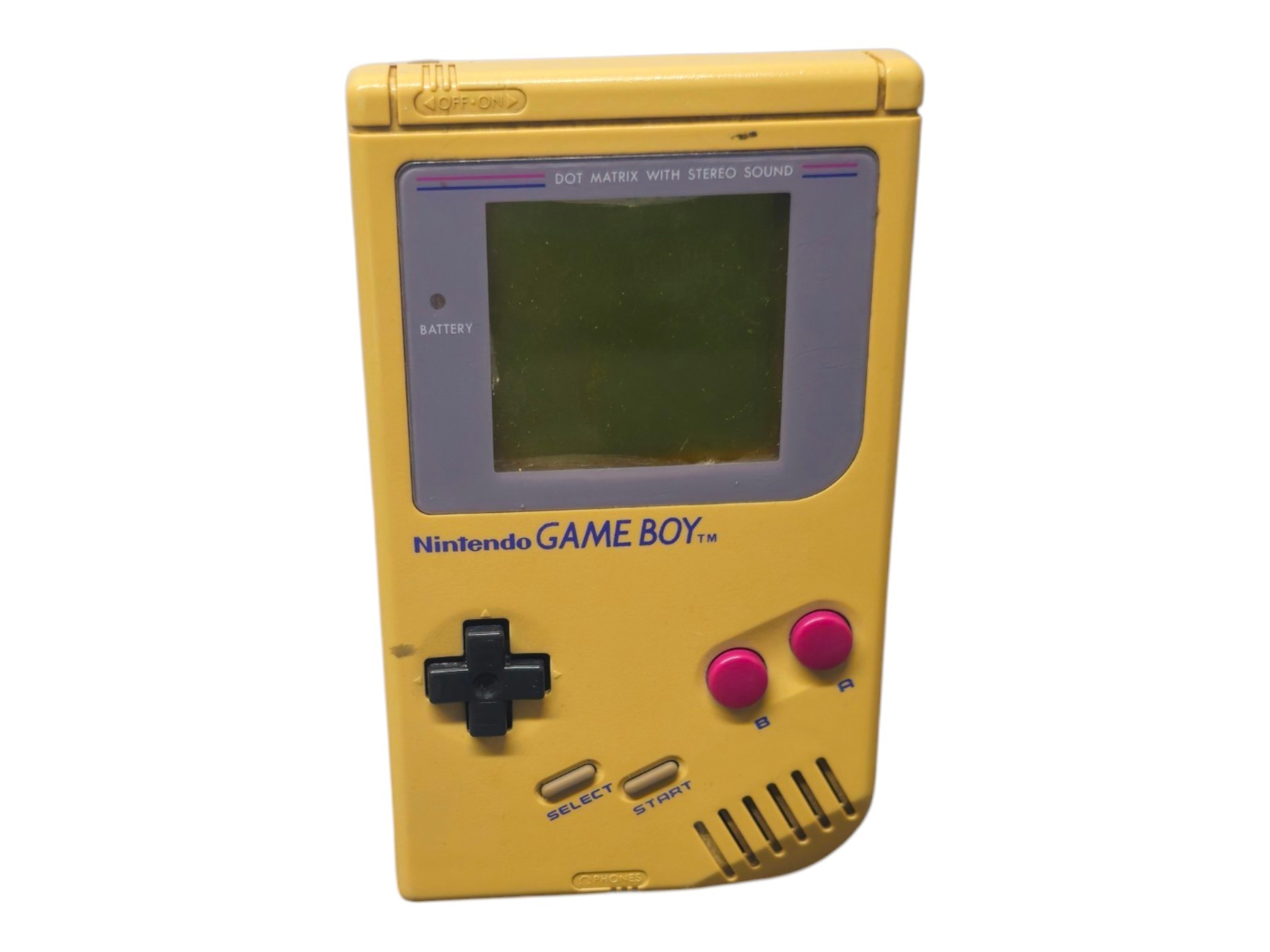
The Nintendo Game Boy is one of the most iconic, influential, and successful handheld video game consoles ever created. Released in 1989, it revolutionised portable gaming by combining affordable hardware, exceptional battery life, durable construction, and an extraordinary library of games into a compact, self-contained entertainment system.
With its distinctive grey enclosure, green-tinted monochrome display, and unforgettable games such as Tetris, Super Mario Land, The Legend of Zelda: Link’s Awakening, and Pokémon Red and Blue, the original Game Boy became a cultural phenomenon that transcended generations.
Although technologically modest compared with some of its competitors, the Game Boy demonstrated that excellent game design, portability, and reliability were more important than advanced specifications alone.
More than three decades after its introduction, the original Game Boy remains one of the most recognisable symbols of video game history and a cornerstone of Nintendo’s legacy.
📘 Introduction
The Nintendo Game Boy, officially designated DMG-01, was first released in Japan on April 21, 1989.
It reached North America on July 31, 1989, followed by European markets in 1990.
Developed by Nintendo’s Research & Development 1 division, the Game Boy represented an ambitious attempt to bring interchangeable-cartridge gaming into a genuinely portable format.
Nintendo had already achieved considerable success in handheld entertainment through its Game & Watch series, but the Game Boy introduced a fundamentally different concept.
Instead of purchasing a separate electronic device for each game, players could use a single console with interchangeable cartridges.
The machine combined several important features:
- Portable, battery-powered operation
- Interchangeable game cartridges
- A monochrome LCD display
- Familiar directional controls
- Integrated sound
- Multiplayer connectivity
- Exceptional battery efficiency
Its design prioritised functionality, durability, and affordability over graphical sophistication.
This philosophy proved enormously successful.
The Game Boy became one of the defining consumer electronics products of the 1990s and helped establish Nintendo as the dominant force in handheld gaming for many years.
🏭 The Birth of the Game Boy: Gunpei Yokoi’s Vision
The creation of the Game Boy is closely associated with Gunpei Yokoi, one of the most influential figures in Nintendo’s history.
Yokoi joined Nintendo in the 1960s and became involved in developing innovative electronic toys and entertainment devices.
He later played a central role in the creation of the Game & Watch series, which launched in 1980.
These small electronic devices introduced millions of people to portable gaming.
From Game & Watch to Game Boy
The Game & Watch series demonstrated several important principles:
- Portable entertainment could attract a large audience
- Simple controls were essential
- Low power consumption improved usability
- Durable construction increased reliability
- Affordable technology could support excellent gameplay
Nintendo applied these lessons to the Game Boy.
Instead of using the most powerful hardware available, the development team focused on achieving a balance between cost, battery life, portability, and game quality.
Lateral Thinking with Withered Technology
Gunpei Yokoi became associated with a design philosophy often described as Lateral Thinking with Withered Technology.
The concept involved using mature, inexpensive, and well-understood technologies in creative ways.
Rather than depending on expensive new components, Nintendo could use proven hardware to create innovative products.
The Game Boy became one of the clearest examples of this approach.
Its monochrome display and relatively modest processor were not technological accidents.
They were deliberate design decisions that helped create a practical and commercially successful handheld system.
🖥️ The Iconic Grey Brick Design
One of the most recognisable features of the original Game Boy is its distinctive grey plastic enclosure.
Its relatively large rectangular shape earned it the affectionate nickname “the brick” among retro gaming enthusiasts.
Although considerably bulkier than later handheld consoles, the design was practical, comfortable, and exceptionally durable.
Design Features
- Light grey plastic enclosure
- Distinctive vertical rectangular shape
- 2.6-inch monochrome LCD
- Black directional pad
- Burgundy-coloured A and B buttons
- Start and Select buttons
- Integrated mono speaker
- Headphone connection
- Adjustable screen contrast
- Adjustable volume
- Cartridge slot on the rear
- Removable battery compartment
- External power connector
- Multiplayer link port
The Game Boy measured approximately 148 × 90 × 32 mm and weighed around 220 grams without batteries.
Its large enclosure provided space for four AA batteries and a relatively substantial internal circuit board.
A Timeless Industrial Design
The console’s appearance became instantly recognisable.
Its grey body, dark screen border, and burgundy buttons established a visual identity that remains closely associated with Nintendo.
The original Game Boy design has since inspired countless products, artistic creations, accessories, and retro-themed electronics.
It remains one of the most recognisable examples of late-1980s consumer electronics design.
⚙️ Technical Specifications
Despite its modest appearance, the Game Boy featured a carefully designed hardware architecture optimised for portable gaming.
Hardware Overview
- Manufacturer: Nintendo
- Model: Game Boy DMG-01
- Release year: 1989
- European release: 1990
- Generation: Fourth-generation handheld console
- CPU: Custom Sharp 8-bit processor
- Processor architecture: Sharp SM83, with similarities to the Intel 8080 and Zilog Z80
- Clock speed: Approximately 4.19 MHz
- Main RAM: 8 KB
- Video RAM: 8 KB
- Display: Reflective STN LCD
- Screen size: Approximately 2.6 inches
- Resolution: 160×144 pixels
- Display: Four monochrome shades
- Hardware sprites: Up to 40
- Audio: Four-channel programmable sound hardware
- Speaker: Integrated mono speaker
- Headphone output: Stereo
- Storage medium: ROM cartridges
- Multiplayer: Serial Game Link port
- Power supply: Four AA batteries
- Battery life: Approximately 15–30 hours, depending on conditions
- Dimensions: 148 × 90 × 32 mm
The Game Boy’s technical specifications were significantly more modest than those of certain competing handheld consoles.
However, its architecture was exceptionally efficient.
The combination of low power consumption, straightforward graphics hardware, and highly optimised games allowed Nintendo to deliver an impressive portable gaming experience.
🧠 The Custom 8-Bit Processor
At the heart of the Game Boy was a custom 8-bit processor manufactured by Sharp.
The processor operated at approximately 4.194304 MHz.
Its instruction set shared characteristics with the Intel 8080 and Zilog Z80, although it was not a complete implementation of either processor.
Processor Capabilities
- 8-bit data processing
- Memory addressing and management
- Game logic execution
- Input handling
- Graphics coordination
- Audio control
- Serial communication
Although its operating frequency appears extremely low by modern standards, the processor was well suited to the console’s intended purpose.
The Game Boy was designed around a fixed display resolution, predictable hardware behaviour, and relatively simple input controls.
This allowed developers to optimise games very precisely.
Efficient Hardware Design
The limited processing resources encouraged programmers to develop efficient software.
Game developers relied on techniques such as:
- Tile-based graphics
- Hardware sprites
- Compact game data
- Efficient memory management
- Carefully optimised animation
- Reusable graphical elements
These techniques allowed developers to produce sophisticated gameplay despite the machine’s limited memory and processing power.
The Game Boy became an excellent example of how intelligent hardware design and software optimisation can overcome technical limitations.
🟩 The Famous Green-Tinted LCD Screen
Perhaps the most iconic feature of the original Game Boy is its green-tinted monochrome display.
Unlike modern handheld consoles with illuminated colour screens, the original Game Boy used a reflective liquid crystal display.
The screen depended on ambient light rather than an integrated backlight.
Display Specifications
- Technology: Reflective STN LCD
- Resolution: 160×144 pixels
- Screen size: Approximately 2.6 inches
- Display depth: Two bits per pixel
- Available shades: Four
- Backlight: None
- Contrast adjustment: Manual dial
Although frequently described as black and white, the original display produced a characteristic greenish appearance.
Its four shades created the illusion of depth, shadows, and movement.
Why Nintendo Chose Monochrome
During the late 1980s, colour LCD technology was available but relatively expensive and power-hungry.
Nintendo chose a simpler display because it offered several important advantages:
- Lower manufacturing costs
- Reduced power consumption
- Longer battery life
- Lower hardware complexity
- Greater affordability
These advantages proved more important to most consumers than colour graphics.
Screen Ghosting
One characteristic of the original LCD was noticeable motion blur, commonly called ghosting.
Because the screen’s pixels responded relatively slowly, fast-moving objects could leave visible trails.
This was particularly noticeable in action games.
Although later Game Boy models improved display response, the original screen’s characteristics remain an important part of the authentic DMG-01 experience.
Playing Without a Backlight
Because the original screen lacked internal illumination, players needed a suitable external light source.
Playing outdoors during daylight was often convenient, but using the Game Boy in dark environments could be difficult.
This limitation helped create a market for clip-on lights, magnifiers, and other accessories.
Today, modern IPS screen modifications provide an alternative for collectors who prefer improved visibility, although they change the original display experience.
🔋 Battery Life: Nintendo’s Greatest Advantage
One of the Game Boy’s most important competitive advantages was its remarkable battery efficiency.
The original console operated using four AA batteries, which could provide many hours of gameplay.
Under favourable conditions, battery life could approach 30 hours, although actual results depended on battery quality, volume, and other factors.
Why Battery Life Mattered
Portable gaming was particularly dependent on battery performance.
During the late 1980s and early 1990s, rechargeable consumer batteries were less convenient and less widespread than modern lithium-ion technology.
Frequent battery replacement could make a handheld console expensive to operate.
Nintendo’s efficient design helped reduce this problem.
The Game Boy’s advantages included:
- Relatively low power consumption
- Long playing sessions
- Widely available AA batteries
- Easy battery replacement
- No need for a charging station
- Reliable portable operation
The Battery Indicator
The original Game Boy featured a red power LED.
As the batteries became depleted, the indicator could become dimmer.
Players quickly learned to recognise when their batteries were approaching the end of their useful life.
For many children, the fading red indicator became an unforgettable warning that a gaming session might soon end.
🎵 Four-Channel Sound: The Classic Game Boy Audio
Although the original Game Boy featured only a small built-in speaker, its sound hardware was surprisingly capable.
The console used a four-channel programmable sound system.
Audio Channels
- Channel 1: Square wave with frequency sweep
- Channel 2: Square wave
- Channel 3: Programmable waveform channel
- Channel 4: Noise generator
These channels could be combined to create melodies, bass lines, percussion, and sound effects.
Stereo Through Headphones
The built-in speaker produced mono sound.
However, the Game Boy could deliver stereo audio through compatible headphones.
This was an impressive feature for an affordable handheld console released in 1989.
Legendary Game Boy Music
The platform produced some of the most memorable soundtracks in handheld gaming history.
Notable examples include:
- Tetris
- Super Mario Land
- The Legend of Zelda: Link’s Awakening
- Pokémon Red and Blue
- Kirby’s Dream Land
- Mega Man: Dr. Wily’s Revenge
- Castlevania II: Belmont’s Revenge
The distinctive sound of the Game Boy became closely associated with the emerging chiptune music scene.
Even today, musicians and electronic artists continue using original Game Boy hardware and compatible software to create music.
🎮 Games & Software Library
The original Game Boy developed one of the most important software libraries in handheld gaming history.
Its catalogue included platform adventures, puzzle games, action titles, role-playing games, sports simulations, and innovative original productions.
Some of the most celebrated Game Boy games include:
- Tetris
- Super Mario Land
- Super Mario Land 2: 6 Golden Coins
- Wario Land: Super Mario Land 3
- The Legend of Zelda: Link’s Awakening
- Pokémon Red
- Pokémon Blue
- Pokémon Yellow
- Kirby’s Dream Land
- Kirby’s Dream Land 2
- Metroid II: Return of Samus
- Donkey Kong (1994)
- Donkey Kong Land
- Dr. Mario
- Balloon Kid
- Alleyway
- SolarStriker
- Kid Icarus: Of Myths and Monsters
- Castlevania: The Adventure
- Castlevania II: Belmont’s Revenge
- Mega Man: Dr. Wily’s Revenge
- Mega Man II
- Final Fantasy Adventure
- Final Fantasy Legend
- Final Fantasy Legend II
- Gargoyle’s Quest
- DuckTales
- Teenage Mutant Ninja Turtles: Fall of the Foot Clan
- R-Type
- Contra: The Alien Wars (released as Contra: The Alien Wars on Game Boy in North America and Probotector 2 in Europe)
The Game Boy’s software library became one of its greatest strengths.
Many titles were designed specifically for portable play, featuring intuitive controls, clear graphics, and gameplay suitable for short or extended sessions.
The system also became home to several franchises that would later develop into major international entertainment brands.
🧩 Tetris: The Game That Changed Everything
Few video games have been as closely associated with a particular console as Tetris and the Nintendo Game Boy.
Originally created by Soviet programmer Alexey Pajitnov in 1984, Tetris became a worldwide phenomenon during the late 1980s.
Nintendo recognised that the puzzle game’s simple concept was perfectly suited to portable gaming.
A Historic Partnership
The Game Boy version of Tetris was included with the console in many international retail packages.
This decision proved enormously important.
Rather than positioning the system exclusively as a toy for children, Nintendo used Tetris to attract a much broader audience.
The game appealed to:
- Children
- Teenagers
- Adults
- Casual players
- Experienced gamers
- People unfamiliar with video games
Simple but Addictive Gameplay
Tetris required players to arrange falling geometric blocks into complete horizontal lines.
Its appeal came from:
- Simple controls
- Increasing difficulty
- Endless replayability
- Easy-to-understand objectives
- Short or extended playing sessions
- Memorable music
The game’s design was particularly suitable for the Game Boy’s small monochrome display.
Multiplayer Tetris
Using a Game Link Cable, two players could connect their Game Boy consoles and compete against each other.
Each player needed a compatible console and game cartridge.
This feature added another dimension to the experience.
The Perfect Game Boy Game
Tetris demonstrated the fundamental strength of Nintendo’s approach.
A technically simple game could become an extraordinary success when combined with the right hardware.
The partnership between Tetris and the Game Boy remains one of the most influential combinations in video game history.
🍄 Super Mario Land: Mario Goes Portable
Released in 1989, Super Mario Land brought Nintendo’s most famous character to the Game Boy.
Unlike earlier Mario games developed primarily for home consoles, Super Mario Land was designed specifically around the limitations of the handheld system.
The game featured:
- Side-scrolling platform gameplay
- Unique enemies and environments
- Compact level design
- Distinctive music
- Vehicle-based shooting sections
- A new setting called Sarasaland
A Different Mario Adventure
Super Mario Land introduced Princess Daisy and several new gameplay elements.
Its visual presentation was relatively simple, but its responsive controls and imaginative level design made it an important early Game Boy title.
Super Mario Land 2
The sequel, Super Mario Land 2: 6 Golden Coins, arrived in 1992.
It introduced:
- Larger character sprites
- More detailed environments
- Expanded exploration
- Improved graphical presentation
- Wario as the main antagonist
Super Mario Land 2 became one of the most celebrated platform games on the system.
Its success also helped establish Wario, who would later star in his own series.
⚡ Pokémon: The Game Boy’s Second Life
One of the most remarkable chapters in the Game Boy’s history began in 1996.
That year, Nintendo and Game Freak released Pocket Monsters Red and Green in Japan.
The games introduced players to a world populated by creatures that could be collected, trained, and exchanged.
The concept evolved into the global phenomenon known as Pokémon.
The Original Pokémon Experience
The first-generation Pokémon games featured:
- Creature collection
- Turn-based battles
- Exploration
- Character progression
- Trading
- Multiplayer battling
- An interconnected game world
The original games introduced 151 Pokémon.
Their design encouraged players to interact with other Game Boy owners.
The Importance of the Link Cable
One of Pokémon’s most innovative ideas was its use of the Game Link Cable.
Players could connect two consoles to:
- Trade Pokémon
- Battle other players
- Exchange version-exclusive creatures
- Complete their Pokédex collections
This transformed the Game Boy from an individual entertainment device into a social gaming platform.
A Global Phenomenon
Pokémon Red and Blue reached North America in 1998, followed by European releases in 1999.
Their success revitalised interest in the Game Boy platform years after its original introduction.
The franchise became one of the most successful entertainment properties in history.
For many players, the original Game Boy is inseparable from memories of collecting Pokémon, trading with friends, and exploring the Kanto region.
🔗 Game Link Cable: Multiplayer Before the Internet
One of the Game Boy’s most innovative features was its ability to connect with another handheld console.
The Game Link Cable allowed compatible games to exchange data through the console’s serial communication port.
Link Cable Applications
- Two-player multiplayer gaming
- Competitive Tetris matches
- Pokémon trading
- Pokémon battles
- Multiplayer sports games
- Data communication between compatible software
Some games and accessories supported more elaborate multiplayer arrangements.
A Social Gaming Revolution
Before widespread internet access and modern wireless gaming, the Game Link Cable provided a remarkably simple way to connect players.
Friends could meet in person, connect their consoles, and enjoy a shared gaming experience.
This was especially important for Pokémon.
Trading became an essential part of the game rather than merely an optional feature.
The Legacy of Local Connectivity
The Game Link Cable helped establish concepts that later became central to portable gaming.
These included:
- Local multiplayer
- Direct device communication
- Shared gaming experiences
- Trading between players
- Social interaction through games
Its influence can be seen in later Nintendo handheld systems and multiplayer gaming technologies.
🕹️ Controls & Gameplay Design
The Game Boy used a straightforward control layout inspired by Nintendo’s earlier console designs.
Its primary controls included:
- Directional pad
- A button
- B button
- Start button
- Select button
The simplicity of this arrangement made the console accessible to users of all ages.
The Nintendo D-Pad
Nintendo’s directional pad had already become a defining feature of the Game & Watch and Nintendo Entertainment System.
The Game Boy continued this design tradition.
The D-pad was particularly effective for platform games, puzzles, and role-playing games.
Two Action Buttons
Rather than adding numerous buttons, Nintendo retained a simple two-button layout.
This encouraged developers to create intuitive control schemes.
For example:
- One button could control jumping
- Another could control attacking
- Start could pause the game
- Select could manage additional functions
This approach helped make games easier to learn.
The Game Boy demonstrated that well-designed controls were more important than having a large number of buttons.
💾 Game Paks: The Cartridge-Based Experience
The Game Boy used removable ROM cartridges, officially referred to as Game Paks.
These small plastic cartridges contained game software and, in some cases, additional memory or electronic components.
Cartridge Features
- Compact plastic enclosure
- ROM-based game storage
- Direct cartridge connection
- Fast access to game data
- Durable solid-state construction
- Optional battery-backed save memory
- Specialised hardware in selected cartridges
Unlike floppy disks or cassette tapes, cartridges contained no moving parts.
This made them especially suitable for portable gaming.
Saving Game Progress
Some Game Boy cartridges included battery-backed SRAM.
A small internal battery allowed the cartridge to retain saved data when the console was switched off.
This was important for games such as:
- Pokémon Red and Blue
- The Legend of Zelda: Link’s Awakening
- Certain role-playing and adventure titles
Not every game required a save battery.
Some titles relied on passwords or did not offer persistent saves.
Cartridge Preservation
Today, original Game Boy cartridges are important collectible artefacts.
However, cartridges containing battery-backed save memory may require maintenance.
After several decades, internal batteries can become depleted.
Replacing a save battery can restore save functionality, but existing saved data may be lost if it is not backed up first.
For collectors, preserving original cartridges and their stored data is an important part of video game conservation.
📷 Game Boy Camera & Game Boy Printer
One of the most unusual developments in the Game Boy’s lifespan was the introduction of camera and printing accessories.
In 1998, Nintendo released the Game Boy Camera and Game Boy Printer.
These accessories expanded the console beyond conventional gaming.
Game Boy Camera
The Game Boy Camera was a cartridge featuring a small digital camera.
It allowed users to:
- Capture monochrome photographs
- Edit images
- Add stamps and effects
- Create animations
- Play simple camera-based games
- Save a limited collection of pictures
The camera produced extremely low-resolution images by modern standards.
However, its capabilities were remarkable for an affordable handheld accessory in 1998.
Game Boy Printer
The Game Boy Printer used thermal printing technology.
It could produce small monochrome prints from compatible games and applications.
Users could print photographs captured with the Game Boy Camera or selected images from supported software.
The printer required its own batteries and special thermal paper.
Appropriate link cables or adapters were also necessary, depending on the Game Boy model.
A Fascinating Historical Achievement
The Game Boy Camera and Printer anticipated several concepts that later became common in smartphones and portable digital devices.
These included:
- Digital photography
- Image editing
- Portable printing
- Creative multimedia applications
- Sharing personalised content
For collectors, these accessories demonstrate how Nintendo continued experimenting with the Game Boy hardware long after its original release.
💡 Accessories & Expansions
The Game Boy developed a large ecosystem of official and third-party accessories.
Some were designed to improve everyday usability, while others introduced completely new functionality.
Popular Accessories
- Game Link Cable
- Game Boy Camera
- Game Boy Printer
- Rechargeable battery packs
- External power adapters
- Carrying cases
- Protective cases
- Screen magnifiers
- Clip-on screen lights
- Headphones
- Cartridge storage cases
Screen Magnifiers & Lights
Because the original Game Boy lacked a backlight, accessories designed to improve screen visibility became particularly popular.
Some combined a magnifying lens with an external light source.
These products could make gaming more comfortable under poor lighting conditions.
Rechargeable Battery Packs
Rechargeable battery accessories provided an alternative to disposable AA batteries.
They offered convenience for users who played frequently.
Super Game Boy
In 1994, Nintendo introduced the Super Game Boy, an accessory for the Super Nintendo Entertainment System.
It allowed compatible Game Boy cartridges to be played on a television through the SNES.
The accessory also offered features such as:
- Colour palette selection
- Decorative screen borders
- Larger television display
- Additional enhancements in selected games
The Super Game Boy became an important bridge between portable and home console gaming.
🎨 Play It Loud! Edition & Colour Variations
The original Game Boy was initially associated with its classic grey enclosure.
However, Nintendo later introduced additional colour variations.
In 1995, the company launched the Play It Loud! series.
These systems retained the original Game Boy hardware architecture while offering colourful exterior designs.
Notable Colour Variations
- Classic Grey
- Black
- Red
- Yellow
- Green
- Blue
- White
- Transparent
Availability varied by region and production period.
Why the Colour Editions Matter
The Play It Loud! campaign helped refresh the Game Boy’s image during the mid-1990s.
It also demonstrated Nintendo’s ability to extend the lifespan of existing hardware through cosmetic redesigns.
For collectors, these variations provide an additional area of interest.
Complete boxed examples in unusual colours can be particularly desirable.
However, the original grey DMG-01 remains the most historically recognisable version of the console.
🥊 Game Boy vs. Sega Game Gear vs. Atari Lynx
The Game Boy entered a competitive handheld gaming market.
Its most notable rivals included the Atari Lynx and Sega Game Gear.
Both competitors offered more advanced colour displays.
However, Nintendo followed a different strategy.
Nintendo Game Boy (1989)
- Monochrome LCD
- 160×144 resolution
- Four AA batteries
- Excellent battery efficiency
- Affordable hardware
- Compact cartridges
- Strong Nintendo software library
Atari Lynx (1989)
- Backlit colour LCD
- More advanced graphical capabilities
- Hardware scaling and sprite effects
- Stereo audio
- Six AA batteries
- Larger enclosure
- Higher power consumption
Sega Game Gear (1990)
- Backlit colour LCD
- Colour graphics
- Hardware architecture related to the Sega Master System
- Six AA batteries
- Higher power consumption
- Strong arcade-style game library
Why Nintendo Won
The Game Boy’s success was not based on superior graphical capabilities.
Its main advantages were:
- Lower cost
- Longer battery life
- Greater portability
- Strong first-party software
- Reliable construction
- Excellent third-party support
Games such as Tetris, Super Mario Land, and Pokémon proved more commercially important than raw technical specifications.
The Game Boy demonstrated that hardware success depends on the complete user experience, not simply the capabilities of individual components.
🔄 Game Boy vs. Game Boy Pocket vs. Game Boy Color
The Game Boy family evolved through several important revisions.
For collectors, distinguishing between the different models is essential.
Nintendo Game Boy DMG-01 (1989)
- Original grey enclosure
- 8-bit processor
- 160×144 monochrome LCD
- Four shades
- Four AA batteries
- Large, durable construction
- Adjustable contrast
- No backlight
Nintendo Game Boy Pocket (1996)
- Smaller and lighter enclosure
- Improved monochrome LCD
- Two AAA batteries
- Reduced overall dimensions
- Similar core gaming performance
- Compatibility with original Game Boy games
The Pocket represented a substantial improvement in portability.
Its smaller enclosure made the system more convenient to carry.
Nintendo Game Boy Light (1998)
- Released exclusively in Japan
- Compact design based on the Pocket
- Electroluminescent backlight
- Two AA batteries
- Improved usability in dark environments
- Compatibility with original Game Boy software
The Game Boy Light became especially interesting to collectors because of its limited regional availability.
Nintendo Game Boy Color (1998)
- Colour TFT LCD
- 160×144 resolution
- Up to 56 simultaneous colours
- Faster processor operating mode
- Additional RAM
- Two AA batteries
- Compatible with original Game Boy games
- Support for new Game Boy Color software
The Game Boy Color represented a more substantial technological improvement.
It introduced colour graphics while preserving compatibility with the existing Game Boy library.
However, original DMG-01 systems cannot run Game Boy Color-exclusive cartridges.
Historical Significance
Each revision contributed to the evolution of Nintendo’s handheld systems.
The original DMG-01 remains particularly important because it established the architecture, design philosophy, and commercial success of the entire Game Boy family.
🌍 Worldwide Success & Cultural Impact
The Game Boy became one of the most successful consumer electronics products of its time.
Its popularity extended far beyond traditional video game audiences.
The system was used by:
- Children
- Teenagers
- Adults
- Casual gamers
- Travellers
- Commuters
- Gaming enthusiasts
The combined Game Boy and Game Boy Color family achieved approximately 118.69 million units sold worldwide.
This figure includes multiple Game Boy hardware revisions and should not be attributed solely to the original DMG-01.
The Game Boy Around the World
The Game Boy developed particularly strong communities in:
- Japan
- North America
- The United Kingdom
- Germany
- France
- Spain
- Italy
- Greece and Cyprus
- Australia
- Other international markets
Its enormous popularity helped establish portable video gaming as a major entertainment category.
The Game Boy in Greece
In Greece, the Game Boy became a familiar symbol of portable entertainment during the 1990s.
Its appearance coincided with the increasing popularity of dedicated video game consoles.
For many Greek children, the Game Boy offered a different experience from home computers such as the Amstrad CPC, ZX Spectrum, and Commodore Amiga.
Games could now be played:
- During holidays
- While travelling
- At friends’ houses
- Away from a television
- During everyday leisure time
Titles such as Tetris, Super Mario Land, and Pokémon became particularly memorable.
The Game Boy also helped introduce many players to Nintendo’s most famous franchises.
Its simple design and durable construction made it a lasting part of childhood memories for an entire generation.
🔧 Build Quality & Longevity
The Nintendo Game Boy DMG-01 is widely regarded as one of the most durable handheld consoles ever produced.
Its relatively simple internal construction and robust enclosure helped many units survive decades of use.
Nevertheless, original systems may require maintenance after more than 35 years.
Common Restoration Tasks
- Cleaning battery contacts
- Removing corrosion
- Cleaning the cartridge connector
- Inspecting the LCD
- Repairing missing vertical screen lines
- Checking button contacts
- Cleaning the speaker
- Inspecting the volume control
- Checking the contrast adjustment
- Cleaning the power switch
- Replacing damaged screen lenses
Battery Corrosion
One of the most common problems affecting original Game Boy consoles is battery leakage.
AA batteries left inside a console for many years can leak corrosive material.
This may damage:
- Battery terminals
- Metal contacts
- Internal wiring
- Circuit board connections
In severe cases, corrosion can prevent the system from powering on.
Collectors should remove batteries when storing consoles for extended periods.
LCD Vertical Lines
Another familiar problem involves missing vertical lines on the original LCD.
This can result from deterioration of the display’s electrical connections.
Certain cases can be repaired by specialists using appropriate equipment and techniques.
However, careless heating or pressure can permanently damage the display.
The Original Screen Lens
The transparent protective lens on the front of the Game Boy can become scratched or detached.
Replacement lenses are available, but collectors interested in originality may prefer preserving the factory-installed component whenever possible.
Cartridge Connector Maintenance
Dirty or oxidised cartridge contacts can cause unreliable game loading.
Careful cleaning using suitable electronics-maintenance materials can often restore functionality.
With proper care, many original Game Boy consoles remain fully operational decades after their manufacture.
🛠️ Modern IPS Screen Modifications
One of the most popular modern upgrades for the original Game Boy is the installation of an IPS display.
Unlike the original reflective monochrome LCD, an IPS screen uses modern display technology with integrated illumination.
Advantages of IPS Screens
- Bright, illuminated display
- Improved contrast
- Better viewing angles
- Reduced motion blur
- Adjustable brightness on many kits
- Optional colour palettes on selected models
- Improved visibility in dark environments
These upgrades make the original Game Boy considerably more convenient for everyday gaming.
Originality vs. Modern Convenience
For collectors, IPS modifications introduce an interesting choice.
An original DMG-01 preserves the authentic experience of 1989.
A modified Game Boy offers the convenience of modern display technology while retaining much of the original hardware and control layout.
However, IPS modifications may involve replacing components or modifying the enclosure, depending on the kit.
They can also change the console’s power consumption.
Museum Preservation
From a museum perspective, both configurations can be historically interesting.
An original Game Boy demonstrates the technological limitations and design philosophy of the late 1980s.
A modernised Game Boy demonstrates the continuing enthusiasm surrounding the platform and the ways modern technology can extend the usability of vintage hardware.
For historical preservation, original components should ideally be retained whenever modifications are performed.
⭐ Why the Game Boy Still Matters
The original Nintendo Game Boy remains one of the most important devices in gaming history for several reasons:
- It established interchangeable-cartridge handheld gaming as a mainstream market
- Its durable construction became legendary
- Its exceptional battery efficiency set a standard for portable entertainment
- Its simple controls made gaming accessible to a broad audience
- It helped transform Tetris into a global phenomenon
- It introduced portable adventures featuring Mario, Zelda, Kirby, and other characters
- It became the original home of Pokémon
- Its Game Link Cable encouraged social gaming
- It inspired an enormous ecosystem of accessories
- It established the foundations of Nintendo’s successful handheld console business
The Game Boy also demonstrates an important principle in technology history.
The most successful product is not always the one with the most powerful hardware.
Nintendo’s careful balance of cost, reliability, portability, software, and battery life proved more important than colour graphics or advanced processing capabilities.
Even today, the Game Boy continues to influence game designers, hardware enthusiasts, musicians, and collectors.
🏛️ Collectability & Retro Gaming Legacy
The original Nintendo Game Boy DMG-01 remains one of the most recognisable and desirable handheld systems among retro gaming collectors.
Its historical importance, distinctive design, and extensive software library make it an essential part of many video game collections.
Collectors often look for examples that retain:
- Original Nintendo Game Boy DMG-01 console
- Factory-installed monochrome LCD
- Original grey enclosure
- Original screen lens
- Original battery cover
- Original packaging
- Protective cardboard inserts
- Instruction manuals
- Original Game Link Cable
- Authentic Game Boy cartridges
- Official accessories
Complete Boxed Examples
Complete boxed consoles are particularly desirable.
Depending on the regional retail package, original contents may include:
- Console
- Batteries
- Headphones
- Game cartridge
- Link Cable
- Instruction documentation
- Promotional materials
Contents varied by market, production period, and bundle.
Collectors should therefore verify the exact original retail configuration before determining whether a particular example is complete.
Original vs. Modified Hardware
The condition and originality of the console can significantly influence collector interest.
Important details include:
- Original LCD condition
- Battery compartment condition
- Authentic Nintendo labels
- Unmodified motherboard
- Original shell colour
- Serial and regional markings
- Functional buttons
- Cartridge connector condition
Modified systems with IPS screens or replacement shells may be desirable for everyday gaming, but they represent a different collecting category from fully original hardware.
Preserving the Game Boy Legacy
The Game Boy’s legacy extends beyond the console itself.
It includes:
- Game cartridges
- Printed manuals
- Original packaging
- Accessories
- Advertising materials
- Promotional displays
- Technical documentation
- Hardware revisions
- Software development history
Together, these materials help document the extraordinary influence of Nintendo’s first interchangeable-cartridge handheld console.
The Game Boy remains a powerful reminder of a period when portable gaming was becoming an important part of everyday life.
📦 Items Included in This Collection Entry
🏁 Conclusion
The Nintendo Game Boy represents one of the greatest achievements in the history of portable electronic entertainment. By combining simple but effective hardware, exceptional battery efficiency, interchangeable cartridges, and an extraordinary software library, Nintendo created a device that fundamentally changed how and where people played video games.
Its monochrome display, distinctive grey enclosure, and familiar controls became symbols of an era.
From the timeless puzzle gameplay of Tetris to the portable adventures of Super Mario Land and the worldwide phenomenon of Pokémon, the Game Boy introduced millions of people to unforgettable gaming experiences.
Its success demonstrated that technological innovation does not always require the most advanced components.
Instead, thoughtful design, accessibility, reliability, and exceptional software can create a product whose influence lasts for generations.
More than three decades after its original release, the Game Boy continues to inspire collectors, developers, musicians, and gaming enthusiasts around the world.
A true handheld gaming legend, a masterpiece of practical industrial design, and one of the most important video game systems ever created.
