
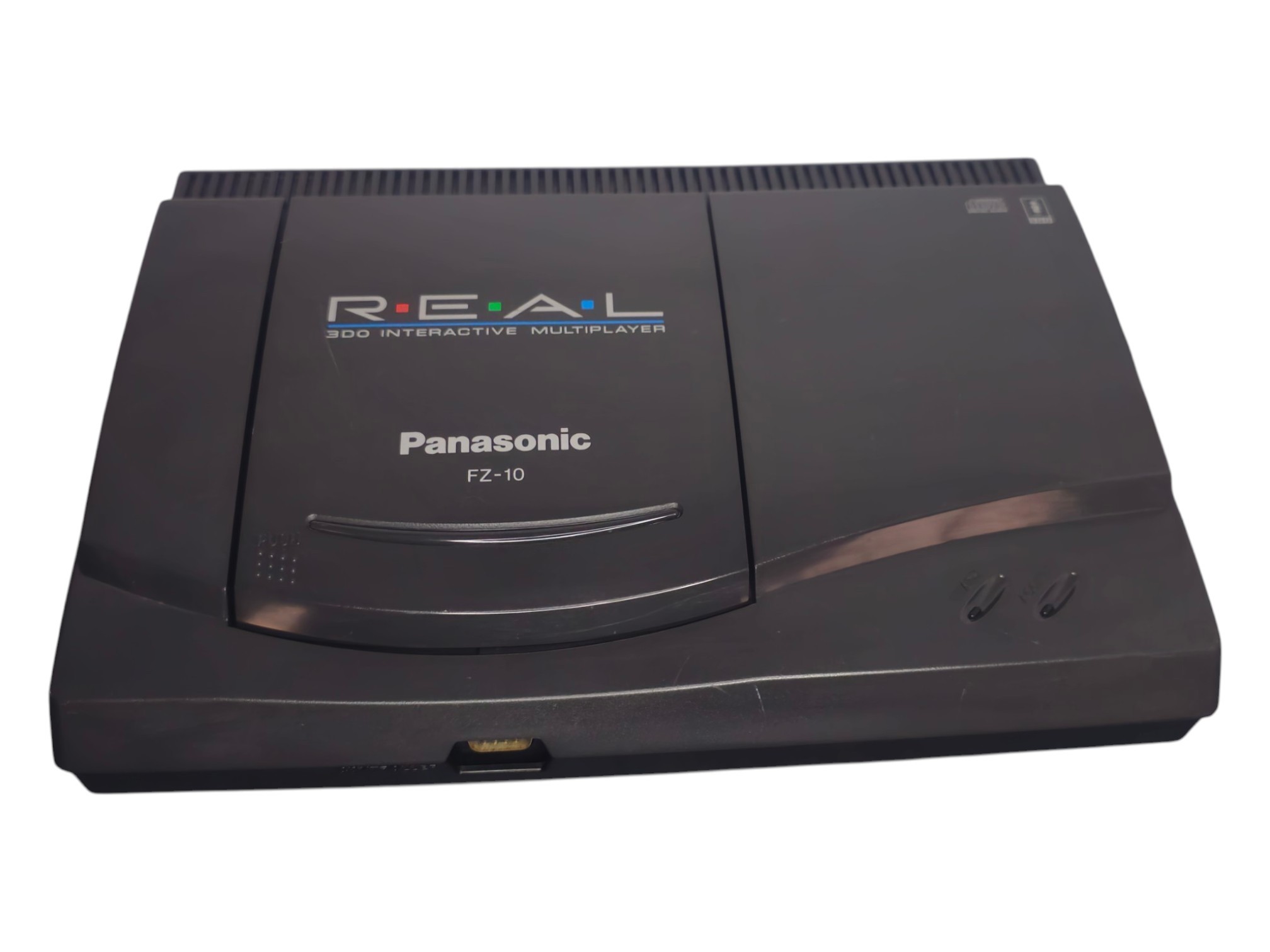
The Panasonic 3DO REAL FZ-10 is one of the most fascinating and technologically ambitious video game consoles of the 1990s. Combining a powerful 32-bit RISC processor, advanced multimedia capabilities, CD-ROM technology, and impressive graphics hardware, it represented an important experiment in the evolution of home entertainment.
Released in Japan in November 1994, the FZ-10 was a redesigned, more affordable version of Panasonic’s original 3DO REAL FZ-1. Its compact appearance, top-loading CD drive, and simplified construction made it one of the most recognisable implementations of the 3DO Interactive Multiplayer platform.
With memorable titles such as The Need for Speed, Road Rash, Gex, Return Fire, Star Control II, and Super Street Fighter II Turbo, the 3DO offered gaming experiences that demonstrated the potential of CD-based interactive entertainment.
Although the platform ultimately struggled against the Sony PlayStation and Sega Saturn, it remains a remarkable example of technological innovation, ambitious business strategy, and the rapidly changing video game industry of the 1990s.
📘 Introduction
The Panasonic 3DO REAL FZ-10 was introduced in Japan on November 11, 1994, as a redesigned version of the original Panasonic FZ-1.
The 3DO Interactive Multiplayer platform had first launched in North America in October 1993, developed around a hardware specification created by The 3DO Company.
Unlike traditional video game systems, the 3DO was not designed to be manufactured exclusively by one company.
Instead, its creators envisioned a common hardware standard that multiple electronics manufacturers could license and produce.
Panasonic became the first and most prominent manufacturer to adopt the technology, introducing the original FZ-1 under its REAL branding.
The FZ-10 represented the next stage of this ambitious project.
Its smaller enclosure, simplified disc mechanism, and reduced manufacturing costs were intended to make the advanced 3DO platform more accessible to consumers.
Despite its relatively short commercial lifespan, the FZ-10 remains an important part of fifth-generation console history.
🏭 The Birth of 3DO: Trip Hawkins’ Vision
The origins of the 3DO platform are closely connected to Trip Hawkins, the founder of Electronic Arts.
After establishing Electronic Arts as one of the most influential video game publishers of the 1980s, Hawkins became interested in creating an entirely new approach to the console business.
During the early 1990s, the video game industry was dominated by manufacturers such as Nintendo and Sega.
These companies controlled their hardware platforms, software licensing, and cartridge manufacturing arrangements.
Hawkins envisioned a different model.
A Universal Gaming Standard
Rather than developing a console that only one manufacturer could produce, The 3DO Company would create a standardised hardware architecture.
Other electronics manufacturers could then license this technology and manufacture compatible machines.
The concept was similar in principle to established consumer electronics formats, where different companies could produce devices using a common technical standard.
Participating Manufacturers
Companies associated with the 3DO hardware ecosystem included:
- Panasonic / Matsushita
- GoldStar, later known as LG
- Sanyo
- Creative Labs, through its PC expansion hardware
Other manufacturers explored or announced potential involvement, although not every proposed system reached commercial production.
An Ambitious Experiment
The 3DO licensing model offered several theoretical advantages:
- Multiple hardware manufacturers
- A shared software platform
- Competition between console producers
- Greater freedom for software developers
- A common technical standard
- Opportunities for hardware innovation
However, it also introduced financial challenges.
Traditional console manufacturers could subsidise hardware costs and generate revenue through software licensing.
The 3DO model made this more complicated because independent manufacturers needed to earn money from selling the hardware itself.
This problem would become one of the main reasons behind the platform’s commercial difficulties.
🖥️ The Panasonic FZ-10: A Completely Redesigned Console
The original Panasonic 3DO FZ-1 featured a large enclosure with a motorised, front-loading CD mechanism.
Its appearance reflected the premium multimedia equipment of the early 1990s.
The FZ-10 introduced a substantially different design.
Panasonic replaced the original enclosure with a smaller, more streamlined console that was easier and less expensive to manufacture.
Design Features
- Compact black enclosure
- Top-loading CD-ROM mechanism
- Manual disc lid
- Front controller connector
- Power and access indicators
- Integrated internal power supply
- Analogue audio and video connections
- Expansion interface
- Internal game-save memory
The revised appearance gave the FZ-10 a more conventional console identity.
Its smaller dimensions made it easier to place alongside televisions, VCRs, and other home entertainment equipment.
The Top-Loading CD Drive
One of the most noticeable improvements was the replacement of the original motorised CD tray with a manual top-loading mechanism.
This simplified the internal construction.
Advantages included:
- Fewer mechanical tray components
- Easier disc access
- Simplified manufacturing
- Reduced mechanical complexity
- More compact construction
The top-loading design became one of the FZ-10’s most recognisable characteristics.
It also distinguished the console from many contemporary CD-based systems that used motorised disc trays.
⚙️ Technical Specifications
The Panasonic FZ-10 retained the core architecture of the original 3DO Interactive Multiplayer.
Its hardware was advanced for the early 1990s, particularly compared with established 16-bit systems.
Hardware Overview
- Manufacturer: Panasonic / Matsushita Electric Industrial
- Model: 3DO REAL FZ-10
- Japanese release: November 11, 1994
- Generation: Fifth-generation video game console
- CPU: ARM60
- CPU architecture: 32-bit RISC
- CPU clock speed: 12.5 MHz
- Main RAM: 2 MB
- Video RAM: 1 MB
- System ROM: 1 MB
- Save memory: 32 KB battery-backed SRAM
- Graphics: Custom 3DO graphics hardware
- Graphics processors: MADAM and CLIO, or functionally integrated revisions
- Typical internal graphics resolution: 320×240 pixels (NTSC)
- Video processing: Scaling, rotation, and texture-mapped graphics
- Audio: 16-bit digital stereo capabilities
- Storage: CD-ROM
- Optical drive: Double-speed CD-ROM
- Controllers: One primary controller port with supported daisy-chain expansion
- Video connections: Composite video and S-Video on typical NTSC FZ-10 units
- Audio output: Analogue stereo
- Operating environment: 3DO Portfolio operating system
- Japanese video standard: NTSC
The FZ-10’s architecture was designed to provide advanced multimedia performance without relying entirely on its central processor.
Specialised graphics and audio hardware handled demanding operations, allowing developers to create experiences that were difficult to reproduce on earlier console generations.
🧠 The ARM60: A Powerful 32-Bit Processor
At the heart of the 3DO was an ARM60 processor running at 12.5 MHz.
The ARM60 belonged to the ARM family of Reduced Instruction Set Computer processors.
This architecture was designed around relatively simple, efficient instructions.
Processor Capabilities
- 32-bit processing
- Efficient instruction execution
- Memory management
- Game logic
- Mathematical calculations
- Multimedia coordination
- Input and peripheral management
- Communication with specialised hardware
The processor worked alongside dedicated graphics and audio components.
This allowed the console to distribute processing responsibilities between multiple hardware elements.
Why the ARM Architecture Matters
ARM technology would eventually become one of the most widely used processor architectures in the world.
Modern smartphones, tablets, embedded systems, and many portable devices rely on processors belonging to the ARM family.
The 3DO therefore represents an interesting early example of ARM technology being used in a sophisticated home entertainment system.
Beyond Clock Speed
Although 12.5 MHz appears extremely modest compared with modern processors, the 3DO was designed around specialised hardware acceleration.
The ARM60 did not need to perform every graphics or audio operation independently.
The system’s custom processors provided important capabilities that helped compensate for the relatively low CPU clock speed.
This combination made the 3DO an ambitious multimedia platform for its generation.
🧩 MADAM & CLIO: The 3DO Custom Chipset
One of the most important features of the 3DO architecture was its specialised chipset.
The original hardware design used two major custom components known as MADAM and CLIO.
These worked together with the ARM60 processor to manage graphics, memory, audio, and system operations.
MADAM: The Graphics and Memory Engine
MADAM was responsible for several important system functions.
Its capabilities included:
- Memory coordination
- Direct memory access
- Graphics acceleration
- Cel rendering
- Image transformations
- Mathematical operations
- Communication between processing components
The Cel Engine was particularly important.
It allowed graphical objects to be manipulated using hardware-supported operations.
These included:
- Scaling
- Rotation
- Distortion
- Texture mapping
- Image transformations
These capabilities were valuable for arcade-style gaming and multimedia presentations.
CLIO: Display, Audio & System Control
CLIO handled additional functions involving:
- Display generation
- Audio processing
- Digital signal processing
- System timing
- Input/output coordination
- Hardware interrupts
The combination of MADAM and CLIO contributed significantly to the 3DO’s multimedia capabilities.
Later Chipset Integration
Some later 3DO hardware revisions combined functions previously handled by separate chips into more highly integrated components.
These revisions reduced manufacturing complexity while retaining compatibility with the original platform architecture.
The evolution of the 3DO chipset illustrates how manufacturers attempted to make sophisticated hardware more affordable.
🎨 Graphics: A Leap Beyond the 16-Bit Era
The 3DO was designed to provide graphical capabilities substantially beyond those of traditional 16-bit consoles.
Its custom hardware could manipulate graphical objects using scaling, rotation, and texture-mapping operations.
These features were particularly attractive during the transition towards three-dimensional gaming.
Graphics Capabilities
- Hardware-accelerated graphical objects
- Image scaling
- Sprite and cel transformations
- Rotation effects
- Texture mapping
- Advanced colour processing
- Digital image display
- Video and animation playback
The 3DO commonly used a 320×240-pixel internal framebuffer in NTSC operation, with its display hardware capable of processing and interpolating images for television output.
The Transition to 3D Gaming
During the early 1990s, game developers were beginning to experiment with more sophisticated three-dimensional environments.
The 3DO offered capabilities suitable for:
- Driving games
- First-person shooters
- Flight simulations
- Interactive adventures
- Digitised video sequences
- Texture-mapped environments
Games such as The Need for Speed and Return Fire demonstrated how developers could use the system’s hardware to create experiences beyond conventional 16-bit gaming.
The Limitations
Despite its impressive architecture, the 3DO was not as powerful as the later PlayStation in every area.
Its hardware had been designed during an earlier phase of 3D console development.
As developers increasingly focused on complex polygon-based environments, the PlayStation and Saturn introduced different advantages.
Nevertheless, the 3DO remains an important milestone in the evolution from sprite-based gaming towards modern 3D graphics.
🎵 Digital Stereo Sound & CD Audio
Audio was one of the major strengths of the 3DO platform.
The console featured sophisticated digital sound capabilities that complemented its CD-ROM storage system.
Audio Features
- 16-bit digital audio capabilities
- Stereo output
- Digital sound processing
- Sample-based music
- Digitised speech
- Environmental sound effects
- High-quality soundtrack playback
- Support for compatible audio CD formats
The large storage capacity of CD-ROMs allowed developers to include considerably more audio content than was practical on many earlier cartridges.
A More Cinematic Experience
Games could feature:
- Recorded dialogue
- Digitised sound effects
- Atmospheric soundtracks
- Cinematic music
- Longer audio sequences
- High-quality samples
This made the 3DO particularly suitable for games designed around multimedia presentation.
Titles such as Road Rash and Wing Commander III demonstrated the growing importance of music, dialogue, and cinematic audio in home gaming.
The Sound of the CD-ROM Generation
The 3DO represented a period when game soundtracks were evolving rapidly.
Earlier consoles often relied primarily on programmable sound generators.
CD-based systems offered greater flexibility in storing and reproducing recorded audio.
This helped establish the importance of high-quality sound in modern video game production.
💿 CD-ROM: The Foundation of the 3DO Experience
One of the most important characteristics of the Panasonic FZ-10 was its use of CD-ROM technology.
During the early 1990s, many popular gaming systems still relied on cartridges.
Although cartridges offered fast access to game data, their storage capacity was limited and manufacturing costs could be relatively high.
CD-ROM technology provided a different approach.
Advantages of CD-ROM
- Hundreds of megabytes of storage
- Lower replication costs at scale
- High-quality digital audio
- Extensive voice acting
- Full-motion video
- Larger game assets
- Additional multimedia content
A conventional CD-ROM could store roughly 650 MB of data, depending on its format.
This represented a dramatic increase over many cartridges of the period.
The FZ-10 Optical Drive
The FZ-10 used a double-speed CD-ROM mechanism.
Although considerably slower than modern optical drives, it provided a practical solution for distributing large games and multimedia applications.
The Trade-Off: Loading Times
Unlike cartridges, CD-ROM drives required mechanical movement.
The laser assembly had to locate and read data from the spinning disc.
This introduced loading times.
Some 3DO games required players to wait between levels, menus, or video sequences.
Nevertheless, the enormous increase in storage capacity opened new possibilities for developers.
📀 More Than Games: Audio CDs & Photo CDs
The Panasonic FZ-10 was marketed as a multimedia entertainment system rather than simply a gaming console.
Its optical drive supported several forms of digital content.
Multimedia Capabilities
The system could be used with compatible:
- 3DO game discs
- Audio CDs
- CD+G discs
- Kodak Photo CDs
Audio CD Playback
The FZ-10 could function as a conventional audio CD player.
Users could listen to music through their television or connected audio equipment.
This helped justify the console’s position as a premium entertainment product.
CD+G
CD+G combined audio with simple graphical information.
Compatible discs could display graphics or text while music played.
Kodak Photo CD
Kodak Photo CD was a digital photography format introduced during the early 1990s.
It allowed photographs to be stored on optical discs.
Compatible 3DO systems could display Photo CD images through a television.
The Multimedia Vision
These functions reflected the industry’s belief that CD-ROM technology would create a new category of interactive household electronics.
During the 1990s, manufacturers increasingly experimented with devices combining:
- Gaming
- Music
- Photography
- Education
- Digital video
- Interactive software
The 3DO was one of the most ambitious examples of this approach.
🎮 Games & Software Library
The 3DO developed a distinctive software catalogue during its relatively short commercial lifespan.
Its library included racing games, shooters, fighting games, role-playing games, interactive movies, multimedia experiences, and arcade conversions.
Some of the most memorable 3DO titles include:
- The Need for Speed
- Road Rash
- Gex
- Return Fire
- Star Control II
- Super Street Fighter II Turbo
- Samurai Shodown
- Alone in the Dark
- Alone in the Dark 2
- D
- The Horde
- Wing Commander III: Heart of the Tiger
- Killing Time
- Total Eclipse
- Crash ‘n Burn
- FIFA International Soccer
- John Madden Football
- Myst
- Space Hulk: Vengeance of the Blood Angels
- Guardian War
- Doctor Hauzer
- Policenauts
- PO’ed
- Wolfenstein 3D
- Doom
- Dragon’s Lair
- Out of This World
- Flashback
- Jurassic Park Interactive
- Theme Park
- Cannon Fodder
- Syndicate
- BattleSport
The library reflected a period of experimentation.
Developers were exploring the possibilities of CD-ROM storage, digitised video, improved audio, and more sophisticated graphics.
Some titles became influential classics.
Others demonstrated the limitations of early multimedia game design.
Together, they provide an interesting picture of the industry’s transition into the fifth console generation.
🏎️ The Need for Speed: A Racing Legend Begins
One of the most historically important games associated with the 3DO is The Need for Speed.
Released in 1994, the original game was developed by EA Canada and published by Electronic Arts.
It introduced a racing franchise that would eventually become one of the most successful in gaming history.
A New Approach to Racing Games
The Need for Speed focused on exotic sports cars and a more realistic driving experience.
Its features included:
- Licensed high-performance vehicles
- Detailed car presentations
- Realistic driving characteristics
- Competitive racing
- Scenic environments
- Digitised multimedia content
The Importance of the 3DO Version
The original 3DO release is historically significant because it marked the beginning of the Need for Speed franchise.
Later versions appeared on additional platforms, but the 3DO was where the series began.
For collectors, the original 3DO edition represents an important milestone in racing game history.
🏍️ Road Rash: Arcade Racing Meets CD Multimedia
Another memorable 3DO title was Road Rash.
Originally developed by Electronic Arts, the series combined motorcycle racing with physical combat.
The 3DO version introduced substantial audiovisual improvements over earlier editions.
Gameplay Features
- Motorcycle racing
- Combat against rival riders
- Police encounters
- High-speed environments
- Vehicle upgrades
- Digitised video sequences
- Licensed music
The CD-ROM Advantage
The increased storage capacity of CD-ROM allowed the game to feature a more elaborate multimedia presentation.
This included music and video elements that contributed to its distinctive atmosphere.
A Defining 3DO Experience
Road Rash became one of the best-known games on the platform.
It demonstrated how established franchises could benefit from CD-based technology while retaining enjoyable gameplay.
Today, the 3DO version remains particularly interesting because of its distinctive presentation.
🦎 Gex: The Birth of a New Platforming Franchise
One of the most recognisable characters associated with the 3DO is Gex, the wisecracking gecko.
Developed by Crystal Dynamics, the original Gex was released for 3DO in 1995.
The game combined traditional side-scrolling platform gameplay with colourful graphics, animated environments, and a strong emphasis on humour.
Gameplay Features
- Side-scrolling platform action
- Colourful environments
- Animated characters
- Collectible items
- Hidden areas
- Distinctive level themes
- Humorous voice clips
Crystal Dynamics & the 3DO
The original Gex became one of the most important titles in Crystal Dynamics’ early history.
It demonstrated the studio’s ability to create polished, character-driven entertainment.
The character later appeared on other platforms, including the Sony PlayStation and Sega Saturn.
A 3DO Original
For collectors, Gex is especially important because the franchise originated on the 3DO.
Its success remains one of the most recognisable achievements of the platform’s software library.
🚁 Return Fire: Tactical Arcade Action
Released in 1995, Return Fire became one of the most highly regarded 3DO games.
Developed by Silent Software, it combined military-themed action with tactical gameplay.
Players controlled different vehicles while attempting to capture an enemy flag and return it to their base.
Available Vehicles
- Tank
- Helicopter
- Armoured support vehicle
- Jeep
Each vehicle offered different capabilities.
Gameplay Features
- Large scrolling battlefields
- Vehicle-based combat
- Strategic objectives
- Destructible targets
- Two-player gameplay
- Classical music soundtrack
Why Return Fire Stands Out
The game combined accessible arcade controls with tactical choices.
Players needed to select the appropriate vehicle for each task while avoiding enemy attacks.
Its distinctive gameplay and memorable presentation helped make it one of the 3DO’s most celebrated titles.
Return Fire remains an important example of the platform’s potential for original game design.
🚀 Star Control II: A Science-Fiction Classic
One of the most critically respected titles available on 3DO was Star Control II.
Originally released for computers in 1992, the game combined space exploration, storytelling, diplomacy, and combat.
The 3DO version introduced important multimedia enhancements.
Gameplay Features
- Open-ended space exploration
- Alien civilisations
- Dialogue and diplomacy
- Resource management
- Space combat
- Narrative choices
- Large interconnected game world
Enhanced Presentation
The 3DO version included additional voice acting and multimedia content.
This gave the game a more cinematic atmosphere.
An Influential Game
Star Control II became highly regarded for its writing, world-building, and imaginative alien species.
It influenced later games involving space exploration and interactive storytelling.
For modern collectors, the 3DO version represents one of the platform’s most historically significant releases.
🥋 Super Street Fighter II Turbo & Arcade Gaming
The 3DO also received a version of Super Street Fighter II Turbo, one of Capcom’s most influential fighting games.
The title demonstrated the platform’s ability to support demanding arcade conversions.
Gameplay Features
- Classic Street Fighter characters
- Competitive one-on-one combat
- Special moves
- Super Combo mechanics
- Colourful backgrounds
- Arcade-style gameplay
The Controller Challenge
The standard 3DO controller featured fewer face buttons than the six-button layout commonly associated with Street Fighter arcade games.
This made control mapping an important consideration.
Specialised controllers helped provide more convenient input options.
An Important Conversion
The 3DO version became one of the platform’s most recognisable fighting games.
Its soundtrack and audiovisual presentation also reflected the possibilities of CD-based entertainment.
Although other platforms later received their own versions, the 3DO conversion remains an important part of the game’s history.
🎬 D & the Rise of Interactive Horror
One of the most distinctive titles associated with the 3DO is D, developed by WARP and directed by Kenji Eno.
Released in 1995, the game represented the growing popularity of cinematic horror experiences.
A Different Kind of Game
D combined:
- Pre-rendered graphics
- Interactive exploration
- Horror storytelling
- Environmental puzzles
- Cinematic sequences
- Atmospheric sound design
Players explored a mysterious environment while uncovering a disturbing narrative.
The CD-ROM Era
The game’s presentation relied heavily on the increased storage capacity of CD-ROMs.
Its cinematic approach would have been difficult to reproduce on many earlier cartridge-based systems.
Historical Significance
D became an important example of experimental interactive storytelling.
It demonstrated how developers were beginning to explore the boundaries between film and video games.
Today, it remains an interesting part of the history of survival horror and multimedia entertainment.
🕹️ Controllers & the Unique Daisy-Chain System
One of the most unusual features of the 3DO platform was its controller arrangement.
Unlike most contemporary consoles, which provided two or more controller ports directly on the system, the FZ-10 featured one primary controller connector.
Additional controllers could be connected through compatible controller pass-through connections.
The Daisy-Chain Concept
A second controller could connect to the first controller.
Additional compatible controllers could then be connected in sequence.
This arrangement reduced the number of physical controller ports required on the console.
Controller Features
Typical 3DO controllers included:
- Directional pad
- A, B, and C action buttons
- Left and right shoulder buttons
- Play/Pause or Start-style control
- X and P function buttons
- Controller pass-through connection on supported designs
Multiplayer Gaming
The system supported multiplayer games using suitable controllers and compatible software.
However, the number of usable players depended on the game and connected hardware.
Controller Revisions
Panasonic produced different controller versions for its 3DO consoles.
The earlier FZ-1 controller included a headphone connection and volume adjustment.
The redesigned FZ-10 controller was smaller and lighter, with a simplified design.
For collectors, identifying the correct controller revision is an important part of documenting a complete original system.
💾 Internal Save Memory & Game Management
Unlike many earlier consoles that relied entirely on cartridges with integrated save batteries, the 3DO included internal memory for game data.
The Panasonic FZ-10 featured 32 KB of battery-backed SRAM for compatible saved games.
Save Memory Uses
Depending on the software, internal storage could be used for:
- Game progress
- Player profiles
- Configuration data
- High scores
- Other saved information
Built-In Memory Manager
The FZ-10 included memory-management functionality that allowed users to manage stored data.
This was particularly important because internal save storage was limited.
Users sometimes needed to remove older save files to create space for new ones.
Battery-Backed Storage
The internal memory depended on a lithium battery to retain its contents when the console was powered off.
After several decades, the original battery may become depleted.
This can result in lost game saves or an inability to retain new data reliably.
Preservation Considerations
For collectors, the condition of the backup battery is important.
Battery replacement may be necessary, but it should be performed carefully to avoid damaging the original circuit board.
Any irreplaceable save data should be backed up where a suitable method is available before servicing.
🇯🇵 The Japanese Panasonic FZ-10
The Japanese version of the Panasonic FZ-10 is particularly interesting because Japan played an important role in the 3DO platform’s commercial development.
Panasonic, operating under Matsushita Electric Industrial, was one of the country’s major consumer electronics manufacturers.
The company used the REAL branding for its 3DO systems.
Japanese Hardware Characteristics
The Japanese FZ-10 belongs to the NTSC family.
Its important regional characteristics include:
- Japanese-market identification
- NTSC video output
- Japanese firmware configuration
- Support for compatible Japanese 3DO software
- Compatibility with many North American 3DO games
- Japanese-market power requirements
Region-Free Software
One interesting feature of the 3DO platform is that it does not use the conventional system-wide regional lockout found on several competing consoles.
This means that many Japanese and North American games can run on hardware from either region.
However, compatibility is not universal.
Certain titles depend on specific video standards or firmware capabilities.
Japanese Character Support
Japanese 3DO systems include support for Japanese character data used by selected games.
Certain Japanese software titles require additional Kanji font resources that may not exist in non-Japanese systems.
This can make Japanese hardware particularly useful for collecting region-specific 3DO games.
The Importance of Original Regional Hardware
For a technology museum, a Japanese FZ-10 provides an opportunity to document the international variations of the 3DO platform.
It also illustrates the relationship between hardware manufacturing, regional software requirements, and local consumer markets.
📺 NTSC Video, S-Video & Modern Displays
The Panasonic FZ-10 was designed during a period when CRT televisions were the standard display technology.
Typical NTSC FZ-10 systems provided analogue video connections, including composite video and S-Video.
Video Connection Options
- Composite video
- S-Video
- Compatible analogue conversion equipment
- Original CRT television connections
Composite Video
Composite video combines picture information into a single analogue signal.
It was widely supported by televisions during the 1990s.
Although convenient, composite video can produce:
- Colour bleeding
- Reduced image sharpness
- Dot crawl
- Analogue interference
S-Video
S-Video separates brightness and colour information.
On compatible equipment, this can provide noticeably improved picture quality compared with composite video.
RGB Modifications
Some enthusiasts modify 3DO hardware to provide RGB video output.
However, RGB is not a standard factory output on typical Panasonic FZ-10 consoles.
A compatible hardware modification is required.
Modern HDMI Displays
The FZ-10 does not have native HDMI output.
To connect it to a modern television, users may require a suitable video scaler or analogue-to-digital converter.
For the most authentic experience, a compatible CRT television remains an excellent choice.
The 3DO’s original games were designed around the visual characteristics of analogue television technology.
🔄 Panasonic FZ-1 vs. Panasonic FZ-10
Although both consoles use the same underlying 3DO platform, their designs differ considerably.
Panasonic 3DO REAL FZ-1 (1993)
- Original Panasonic 3DO model
- Large premium enclosure
- Motorised front-loading CD tray
- Higher initial manufacturing cost
- Larger physical dimensions
- Early 3DO hardware configuration
- Original-style Panasonic controller
Panasonic 3DO REAL FZ-10 (1994)
- Redesigned compact enclosure
- Manual top-loading CD mechanism
- Simplified construction
- Lower manufacturing cost
- Revised internal hardware arrangements
- Smaller redesigned controller
- Built-in memory-management functionality
Same Gaming Platform
Both systems belong to the 3DO Interactive Multiplayer family.
They share the same basic software platform and core technical capabilities.
The FZ-10 did not introduce a new generation of gaming hardware.
Instead, it represented a more affordable and practical implementation of the existing 3DO standard.
Which Model Is More Interesting?
The FZ-1 is historically important because it represents Panasonic’s original implementation of the 3DO concept.
The FZ-10 demonstrates how the manufacturer attempted to refine the platform and make it commercially competitive.
For collectors, both models are important.
The choice often depends on historical preference, hardware condition, and interest in specific revisions.
🏢 Panasonic, GoldStar & Sanyo: Multiple 3DO Manufacturers
One of the most unusual aspects of the 3DO platform was the existence of several officially licensed hardware manufacturers.
Unlike Nintendo or Sega consoles, 3DO systems were not necessarily produced by a single company.
Panasonic
Panasonic introduced the best-known 3DO models:
These systems became the most recognisable representations of the platform.
GoldStar
GoldStar, later part of LG Electronics, produced its own licensed 3DO systems.
These featured different exterior designs while supporting the same general software platform.
Sanyo
Sanyo introduced the 3DO TRY, a distinct Japanese-market console.
Its design and relative rarity make it particularly interesting to collectors.
Creative Labs
Creative Labs developed the 3DO Blaster, an expansion system intended to allow compatible personal computers to run 3DO software.
This represented another unusual application of the licensed 3DO architecture.
Why This Was Revolutionary
The 3DO Company wanted multiple manufacturers to compete while maintaining software compatibility.
The idea resembled the way several companies could produce equipment based on common electronics standards.
Although the model was commercially unsuccessful, it remains one of the most ambitious experiments in console manufacturing history.
🥊 The Fifth-Generation Console Wars
The 3DO entered the market during a period of extraordinary technological competition.
The early 1990s marked the transition from 16-bit sprite-based gaming towards CD-ROM storage and increasingly sophisticated 3D graphics.
Several major platforms competed for consumer attention.
Panasonic 3DO
- Introduced in 1993
- 32-bit ARM-based architecture
- CD-ROM storage
- Advanced multimedia capabilities
- Multiple licensed manufacturers
- High initial price
Atari Jaguar
- Introduced in 1993
- Cartridge-based system
- Complex multi-processor architecture
- Strong emphasis on advanced graphics
- Smaller commercial software library
Sega Saturn
- Introduced in Japan in 1994
- CD-ROM storage
- Sophisticated multi-processor architecture
- Strong arcade conversion capabilities
- Extensive Japanese software support
Sony PlayStation
- Introduced in Japan in 1994
- CD-ROM storage
- Powerful polygon graphics
- Competitive pricing
- Strong third-party developer support
The Problem for 3DO
The 3DO initially offered advanced capabilities compared with established 16-bit systems.
However, the arrival of the PlayStation and Saturn changed consumer expectations.
Sony’s console offered strong 3D performance and quickly developed an extensive software library.
The 3DO’s high pricing and smaller installed user base made competition increasingly difficult.
By the middle of the decade, the platform was losing commercial momentum.
💰 The $699 Console: Why 3DO Struggled
One of the most frequently discussed aspects of 3DO history is its original launch price.
The Panasonic FZ-1 debuted in North America in 1993 at approximately $699.99.
This was an exceptionally high price for a consumer video game console.
Why Was It So Expensive?
Several factors contributed:
- Advanced hardware components
- Expensive early CD-ROM technology
- Complex custom chipsets
- Premium manufacturing
- High research and development costs
- The licensed hardware business model
The Licensing Problem
Traditional console manufacturers could sometimes sell hardware at very low margins or even at a loss.
They could then generate revenue through software royalties and other platform activities.
The 3DO Company licensed its technology to independent manufacturers.
These manufacturers needed to make the hardware commercially viable on its own.
This made aggressive price reductions more difficult.
The FZ-10 as a Response
Panasonic introduced the FZ-10 partly to reduce manufacturing costs and offer a more affordable system.
The redesign simplified several components without fundamentally changing the gaming platform.
However, the arrival of powerful competing consoles made the market increasingly difficult.
A Commercial Failure with Historical Importance
The 3DO did not achieve the sales required to become a dominant platform.
Nevertheless, its innovative technology and unusual business model remain historically significant.
Its failure also provides an important lesson about the relationship between technical performance, pricing, software availability, and consumer demand.
🚀 The 3DO M2: The Successor That Never Arrived
One of the most fascinating aspects of 3DO history is the planned successor known as M2.
The M2 was intended to provide a dramatic improvement over the original 3DO architecture.
Its development represented an attempt to compete with the rapidly advancing fifth-generation console market.
The M2 Concept
The proposed system included:
- More powerful processing hardware
- PowerPC-based architecture
- Advanced graphics capabilities
- Improved three-dimensional rendering
- Greater memory and system performance
Panasonic’s Involvement
Matsushita acquired the M2 technology from The 3DO Company in 1995.
The project was intended to support a new generation of multimedia hardware.
However, the planned consumer M2 console never received a conventional commercial release.
What Happened to M2?
Although the gaming console project was cancelled, elements of the technology were used in specialised equipment and other hardware applications.
Certain M2-related systems appeared in professional and arcade environments.
A Lost Console Generation
For collectors and gaming historians, the M2 remains one of the most interesting cancelled console projects of the 1990s.
It represents what the 3DO platform might have become if the original business model had achieved greater commercial success.
The project also illustrates the extraordinary pace of technological change during the decade.
🌍 Worldwide Popularity & Cultural Impact
The 3DO achieved a limited but meaningful presence in several international markets.
Its primary commercial activity was concentrated in Japan, North America, and selected European regions.
Major Markets
The platform appeared in markets including:
- Japan
- United States
- Canada
- United Kingdom
- France
- Germany
- Other selected European countries
A Premium Entertainment Product
Unlike more affordable systems aimed at mass-market gaming, the 3DO was initially positioned as a high-end multimedia device.
Its advanced specifications and CD-ROM capabilities appealed to technology enthusiasts interested in the future of digital entertainment.
The 3DO in Europe
In Europe, the platform faced competition from established home computers and popular video game consoles.
Systems such as the Amiga, Sega Mega Drive, Super Nintendo, and later PlayStation provided strong alternatives.
The 3DO’s high price limited its mainstream appeal.
The 3DO in Greece
The 3DO was far less common in Greece than major systems such as the Sega Mega Drive, Super Nintendo, and Sony PlayStation.
Its relatively limited distribution and premium price made it an unusual sight in ordinary gaming households.
Today, surviving 3DO hardware in Greece is particularly interesting because it represents a less familiar branch of 1990s console history.
For a technology collection, the Panasonic FZ-10 helps document the diversity of the fifth-generation gaming market.
🔧 Build Quality & Longevity
The Panasonic FZ-10 is generally regarded as a relatively robust implementation of the 3DO platform.
Its top-loading optical drive eliminated the motorised tray mechanism used in the earlier FZ-1.
However, the machine remains a complex piece of vintage electronics.
After more than three decades, some components may require maintenance.
Common Restoration Tasks
- Cleaning the optical pickup lens
- Inspecting the disc spindle motor
- Checking the disc lid mechanism
- Cleaning controller connections
- Inspecting the internal power supply
- Checking ageing capacitors
- Testing video and audio outputs
- Inspecting the internal save-memory battery
- Cleaning internal circuit boards
- Checking for corrosion
Optical Drive Wear
The FZ-10’s CD-ROM mechanism contains moving components.
Age-related issues can include:
- Difficulty recognising discs
- Extended loading times
- Intermittent reading errors
- Mechanical noise
- Laser deterioration
Careful diagnosis is important before replacing components.
Save Battery Maintenance
The console uses an internal battery to preserve save data.
An ageing battery can eventually fail or cause corrosion.
Inspection and replacement should be carried out using appropriate electronic servicing procedures.
Power Supply Considerations
Different regional FZ-10 versions were designed for different electrical standards.
Japanese domestic models normally require 100V AC power.
European mains electricity operates at approximately 230V.
An original Japanese 100V FZ-10 must not be connected directly to a 230V outlet.
A correctly specified step-down transformer is required unless the console has been professionally converted to a suitable power configuration.
The exact electrical requirements should always be confirmed from the unit’s original label.
🛠️ Modern Upgrades & Hardware Preservation
The Panasonic FZ-10 continues to attract interest from enthusiasts who maintain and restore original 3DO systems.
Modern modifications and replacement components can help preserve ageing hardware.
Popular Preservation Options
- Optical drive maintenance
- Replacement electronic components
- Internal battery replacement
- Video-output improvements
- RGB modifications
- Optical drive emulators
- Alternative digital storage solutions
- Controller repair and replacement
Optical Drive Emulators
One important development is the availability of optical drive emulation solutions for compatible 3DO hardware.
These devices can replace or supplement the function of an original CD-ROM drive.
Depending on the solution, games may be accessed through modern storage media.
This can reduce mechanical wear on the original optical drive.
Preserving Authentic Hardware
For museum collections, reversible modifications are often preferable.
They allow original hardware to remain as close as possible to its factory configuration.
When restoration or modernisation is necessary, documenting the work helps preserve the machine’s technical history.
Original components removed during repairs should ideally be retained and labelled whenever practical.
⭐ Why the Panasonic 3DO FZ-10 Still Matters
The Panasonic 3DO FZ-10 remains important in gaming history for several reasons:
- It represents an early attempt to establish a multi-manufacturer console standard
- It introduced advanced 32-bit gaming technology to consumers
- It used the influential ARM processor architecture
- Its CD-ROM system supported sophisticated multimedia applications
- It featured specialised graphics and audio hardware
- It helped introduce franchises such as The Need for Speed and Gex
- Its hardware redesign demonstrated early cost-reduction strategies
- It contributed to the transition from 16-bit to 32-bit gaming
- It played a role in the development of CD-based interactive entertainment
- Its commercial failure influenced discussions about future console business models
Innovation Beyond Commercial Success
The history of the 3DO demonstrates that technological ambition does not always guarantee market success.
Although the platform was unable to compete effectively with the PlayStation and Saturn, it introduced numerous interesting ideas.
Its legacy includes both successful technical innovations and important commercial lessons.
An Important Historical Experiment
The 3DO was an attempt to change how console hardware was manufactured, licensed, and distributed.
That alone makes it one of the most fascinating systems of the 1990s.
🏛️ Collectability & Retro Gaming Legacy
The Panasonic 3DO FZ-10 has become a desirable system among collectors interested in unusual fifth-generation gaming hardware.
Its distinctive design, relatively short commercial lifespan, and historic software library make it an interesting addition to a retro console collection.
What Collectors Look For
Important original components include:
- Panasonic 3DO REAL FZ-10 console
- Original Panasonic controller
- Original power cable
- Original AV cables
- Original packaging
- Protective inserts
- Instruction manuals
- Original 3DO game discs
- Promotional materials
- Regional documentation
Japanese Hardware
Japanese FZ-10 systems are particularly interesting because they represent Panasonic’s domestic market.
The original Japanese packaging, labels, and manuals can provide valuable historical information.
The system’s NTSC configuration and Japanese firmware are also important identifying characteristics.
Originality & Condition
Collectors commonly evaluate:
- Cosmetic condition
- Disc lid operation
- Optical drive functionality
- Controller condition
- Original labels
- Regional power specifications
- Functional save memory
- Motherboard revision
- Evidence of previous repairs
Preserving the 3DO Software Library
Original 3DO games are important historical artefacts.
Physical releases may contain:
- CD-ROM discs
- Printed manuals
- Cover artwork
- Longbox packaging
- Jewel cases
- Promotional inserts
- Regional documentation
The preservation of these materials helps document the commercial environment of the early CD-ROM gaming era.
A Distinctive Museum Exhibit
The FZ-10 provides an opportunity to explain one of the most unusual experiments in console history.
Its significance extends beyond its hardware specifications.
It represents an ambitious attempt to create an open, licensed consumer entertainment platform at a time when the video game industry was rapidly evolving.
📦 Items Included in This Collection Entry
🏁 Conclusion
The Panasonic 3DO REAL FZ-10 represents one of the most ambitious and fascinating chapters in the history of home video gaming. Combining a 32-bit ARM processor, sophisticated multimedia hardware, CD-ROM storage, and an unusual multi-manufacturer licensing model, the 3DO attempted to redefine the console industry during the early 1990s.
The FZ-10 refined the original Panasonic 3DO design with a smaller enclosure, a more practical top-loading disc mechanism, and simplified construction.
Its software library included influential titles such as The Need for Speed, Road Rash, Gex, Return Fire, and Star Control II, demonstrating the creative possibilities of early CD-based gaming.
Although the platform ultimately struggled against the commercial success of the Sony PlayStation and Sega Saturn, its technological achievements and experimental business model remain historically important.
The 3DO also played a role in the wider transition towards multimedia entertainment, helping establish the importance of optical storage, advanced graphics, digital audio, and interactive content.
More than three decades after its introduction, the Panasonic FZ-10 continues to fascinate collectors, hardware enthusiasts, and gaming historians.
Its story is a reminder that some of the most interesting technological innovations emerge from ambitious experiments that do not necessarily achieve lasting commercial success.
A remarkable 32-bit console, an extraordinary experiment in multimedia entertainment, and an essential part of any comprehensive collection of vintage video game hardware.
