

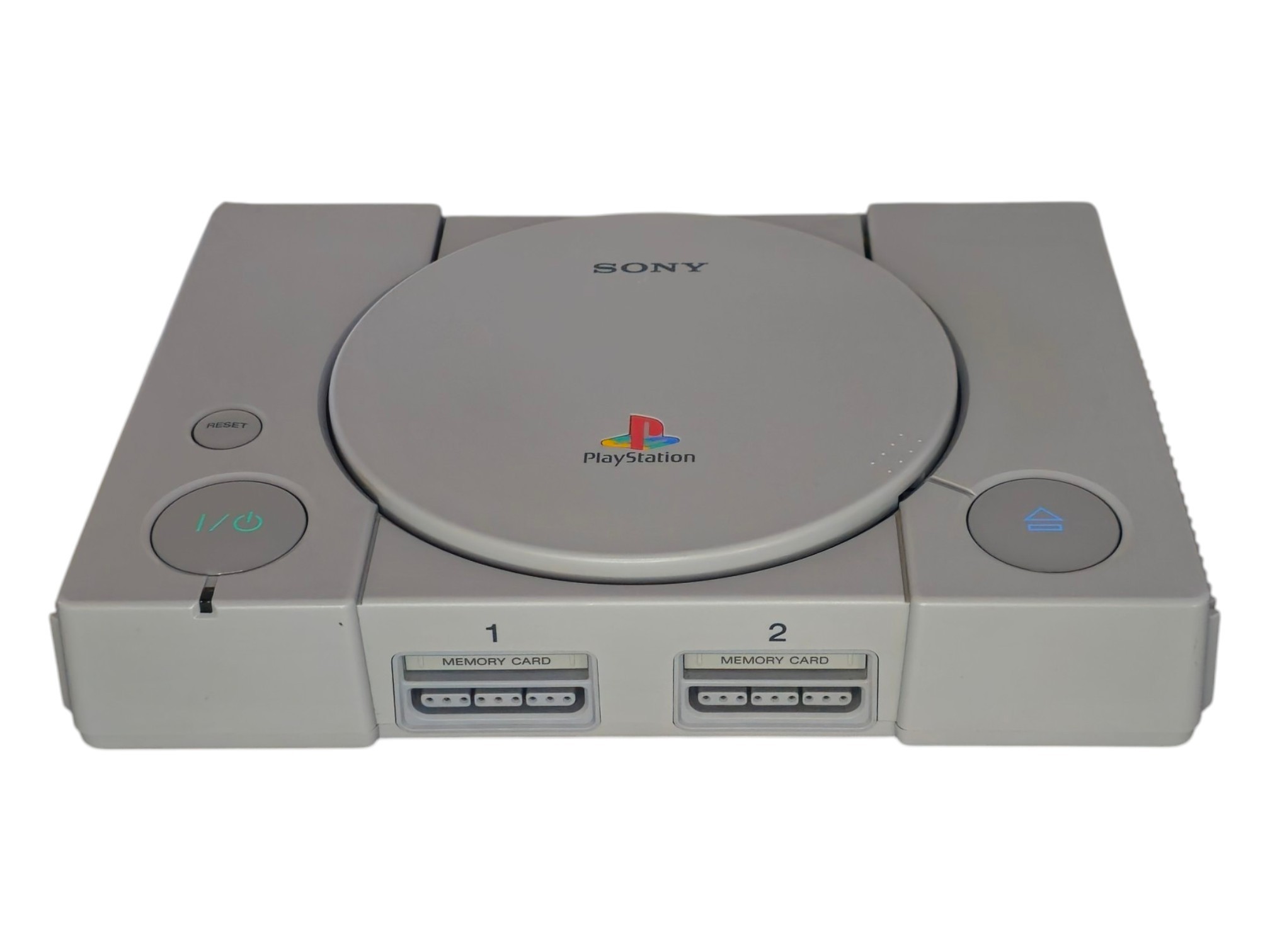
The Sony PlayStation SCPH-5502 is one of the most iconic home video game consoles of the 1990s and an important European revision of Sony’s original PlayStation hardware. Featuring the classic grey enclosure, a top-loading CD-ROM drive, a 32-bit MIPS processor, dedicated three-dimensional graphics hardware, and sophisticated digital audio capabilities, it represents the generation that transformed the global gaming industry.
Introduced as part of the original PlayStation family, the SCPH-5502 belongs to the revised European hardware series associated with 1997–1998 production, incorporating improvements to the optical drive and internal electronics compared with earlier launch models.
The PlayStation became the home of legendary franchises and influential games, including Crash Bandicoot, Gran Turismo, Metal Gear Solid, Resident Evil, Final Fantasy VII, Tekken 3, Tomb Raider, Spyro the Dragon, and Silent Hill.
Its CD-ROM technology helped establish a new era of cinematic storytelling, fully three-dimensional game environments, recorded soundtracks, and affordable software distribution.
More than three decades after the original PlayStation’s introduction, the SCPH-5502 remains a remarkable example of Sony’s early console engineering and an important artefact from one of gaming’s most transformative periods.
📘 Introduction
The original Sony PlayStation was launched in Japan on December 3, 1994, followed by North America on September 9, 1995, and Europe on September 29, 1995.
It was Sony Computer Entertainment’s first commercially released home video game console.
The PlayStation entered a market dominated by established companies such as Nintendo and Sega.
However, Sony approached the industry differently.
Instead of concentrating primarily on traditional cartridge-based gaming, the company adopted CD-ROM technology and created a hardware architecture designed for sophisticated real-time three-dimensional graphics.
The result was an extraordinary commercial and technological success.
The SCPH-5502 Revision
The SCPH-5502 was a revised PlayStation model distributed in PAL territories during the later 1990s.
It retained the original console’s appearance while introducing refinements to its internal hardware.
Its principal characteristics included:
- 32-bit MIPS R3000A-based processor
- Custom PlayStation graphics processor
- Dedicated Geometry Transformation Engine
- Double-speed CD-ROM drive
- 2 MB main RAM
- 1 MB video RAM
- 512 KB sound RAM
- 24-channel digital audio
- Two controller ports
- Two Memory Card slots
- Serial and parallel interfaces
- AV Multi Out connection
- European PAL configuration
The SCPH-5502 is particularly interesting because it belongs to the revised generation of original PlayStation hardware, developed after Sony gained experience with the earliest production models.
🏭 Sony, Nintendo & the Birth of PlayStation
The origins of the PlayStation can be traced to Sony’s earlier involvement with Nintendo.
During the late 1980s and early 1990s, Sony and Nintendo explored a collaboration involving CD-ROM technology.
Nintendo was developing its Super Nintendo Entertainment System, while Sony possessed considerable expertise in optical media and digital audio.
The Nintendo CD-ROM Project
The proposed collaboration involved a CD-based expansion for Nintendo’s hardware.
Sony also investigated a combined device capable of supporting Nintendo cartridge technology and optical media.
The project became associated with the name Play Station.
However, the partnership encountered commercial and contractual disagreements.
Nintendo ultimately pursued a different direction, and the collaboration did not result in a commercially released Nintendo-Sony console.
Ken Kutaragi
One of the most important figures in PlayStation history was Ken Kutaragi, a Sony engineer who strongly supported the company’s entry into interactive entertainment.
Kutaragi recognised the commercial potential of three-dimensional graphics and CD-ROM technology.
His work and leadership contributed significantly to the development of Sony’s independent gaming platform.
Sony Computer Entertainment
Sony established Sony Computer Entertainment in 1993.
The organisation became responsible for developing and marketing the new PlayStation platform.
A New Competitor
When the PlayStation launched in December 1994, Sony was entering the console industry as a major new competitor.
Its success would fundamentally change the balance of power within the gaming market.
🖥️ The Original Grey PlayStation Design
The SCPH-5502 features the familiar grey enclosure that became synonymous with the first PlayStation generation.
Unlike the later compact PS one, the original machine uses a relatively large, rectangular housing with rounded corners and a centrally positioned disc mechanism.
Exterior Features
- Classic grey plastic enclosure
- Circular top-loading disc lid
- Power button
- Reset button
- Open button
- Power indicator
- Two front controller ports
- Two Memory Card slots
- Rear AV Multi Out
- Rear Serial I/O
- Rear Parallel I/O
- Integrated internal power supply
The Circular Disc Lid
The top-mounted CD-ROM lid is one of the console’s most recognisable design elements.
A disc is placed directly onto the spindle mechanism.
The lid closes manually, and the drive reads the disc using an internal optical pickup.
The Four PlayStation Symbols
The PlayStation controller introduced four famous symbols:
- Triangle
- Circle
- Cross
- Square
These became central elements of Sony’s gaming identity.
A Defining Design
The grey exterior was simple, practical, and recognisable.
Together with the colourful PlayStation logo and distinctive controller, it established an industrial design language that remained influential throughout Sony’s gaming history.
⚙️ Technical Specifications
The SCPH-5502 belongs to the original 32-bit PlayStation hardware family.
Hardware Overview
- Manufacturer: Sony Computer Entertainment
- Console family: Sony PlayStation
- Model: SCPH-5502
- Original platform release: 1994
- Hardware revision period: 1997–1998
- Region: PAL / Europe
- Colour: Grey
- Generation: Fifth-generation home console
- CPU: Custom MIPS R3000A-based processor
- CPU architecture: 32-bit RISC
- CPU frequency: 33.8688 MHz
- Geometry processor: Geometry Transformation Engine (GTE)
- GPU: Sony PlayStation graphics processor
- Main RAM: 2 MB
- Video RAM: 1 MB
- Sound RAM: 512 KB
- System ROM: 512 KB
- Graphics: Hardware-accelerated 2D and 3D
- Colour capability: Up to approximately 16.7 million colours
- Audio: 24-channel, 16-bit digital sound architecture
- Storage medium: CD-ROM
- Optical drive: Double-speed CD-ROM
- Typical optical mechanism: Sony KSM-440ADM
- Controller ports: Two
- Memory Card slots: Two
- Video connection: AV Multi Out
- Additional connections: Serial I/O and Parallel I/O
- Power: 220–240V AC, 50 Hz
- Rated power consumption: Approximately 9W
- Dimensions: Approximately 270 × 60 × 188 mm
- Weight: Approximately 1.4 kg
SCPH-5502-Specific Characteristics
The SCPH-5502 belongs to the PU-18 motherboard generation.
It uses a revised optical drive system and retains important expansion connections that were removed from certain later PlayStation revisions.
Its commonly documented BIOS version is 3.0, dated January 6, 1997.
This is a firmware identification date, not necessarily the manufacturing date of an individual console.
🧠 The MIPS R3000A: Sony’s First PlayStation Processor
At the heart of the PlayStation is a custom processor based on the MIPS R3000A architecture.
Operating at approximately 33.8688 MHz, it provides the computational foundation for PlayStation software.
Processor Responsibilities
The CPU performs tasks involving:
- Game logic
- Artificial intelligence
- Character movement
- Physics calculations
- Software execution
- Input processing
- Memory coordination
- Communication with graphics hardware
32-Bit RISC Architecture
The processor belongs to the Reduced Instruction Set Computer family.
Its design emphasises efficient execution of relatively simple instructions.
A Significant Advance
Compared with the processors used in earlier 8-bit and 16-bit consoles, the PlayStation CPU offered substantially greater computational capability.
This made more sophisticated game environments practical.
The Importance of Dedicated Hardware
The main processor did not perform every graphics or audio operation independently.
Sony incorporated specialised processing hardware to accelerate demanding multimedia tasks.
This balanced architecture helped the PlayStation achieve impressive results despite its modest clock speed by modern standards.
📐 Geometry Transformation Engine: The Foundation of 3D
One of the PlayStation’s most important technical features is its Geometry Transformation Engine, commonly known as the GTE.
The GTE is a specialised mathematical coprocessor designed to accelerate operations associated with three-dimensional graphics.
GTE Functions
Its capabilities include:
- Coordinate transformations
- Perspective calculations
- Matrix and vector operations
- Lighting calculations
- Projection of 3D geometry onto a 2D display
Why It Was Important
Three-dimensional games require extensive mathematical calculations.
Objects must be positioned, rotated, and projected onto a screen according to the viewpoint of a virtual camera.
Performing all these calculations through the main CPU would reduce performance.
The GTE accelerates many of these operations.
A New Generation of Gaming
This technology helped make games such as Ridge Racer, Tekken, Tomb Raider, and Crash Bandicoot possible.
The Transition to Modern 3D
The PlayStation’s graphics architecture played an important role in establishing polygon-based environments as a standard feature of home gaming.
🎨 The PlayStation Graphics Processor
The PlayStation includes a dedicated GPU responsible for rendering graphical objects and producing the final video image.
Its architecture was designed for both two-dimensional and three-dimensional gaming.
Graphics Capabilities
- Polygon rendering
- Texture mapping
- Gouraud shading
- Flat shading
- Sprite rendering
- Colour blending
- Transparency effects
- 2D graphics operations
- Multiple display resolutions
Three-Dimensional Graphics
The GPU can render polygons used to construct:
- Characters
- Vehicles
- Buildings
- Landscapes
- Environments
- Animated objects
Texture Mapping
Textures are images applied to polygon surfaces.
They allow developers to add detail without creating additional geometry for every visual feature.
Gouraud Shading
Gouraud shading interpolates colour values across a polygon.
This provides smoother visual transitions than simple flat shading.
The Famous PlayStation Look
Original PlayStation games often exhibit distinctive graphical characteristics, including:
- Polygon wobbling
- Texture distortion
- Visible geometric edges
- Low-resolution textures
- Occasional clipping
- Sharp pixel boundaries
These effects result from limitations and design choices within the original hardware.
Rather than being merely defects, they have become recognisable characteristics of early PlayStation graphics.
🌈 Graphics Resolution & Colour
The PlayStation’s graphics hardware supports multiple display resolutions and colour modes.
Graphics Characteristics
- Up to approximately 16.7 million displayable colours
- 1 MB dedicated video RAM
- Multiple horizontal and vertical resolutions
- Interlaced and non-interlaced display options
- Texture mapping and transparency
- Hardware-assisted polygon rendering
Typical Game Resolutions
Many PlayStation games use relatively low resolutions suitable for standard-definition televisions.
Other applications and menus use higher-resolution modes.
The PAL Version
The SCPH-5502 is designed for PAL television operation.
Compared with NTSC configurations, PAL systems use different television timings.
This can affect:
- Vertical resolution
- Refresh rate
- Screen positioning
- Game speed
- Frame-rate behaviour
50 Hz & 60 Hz
PAL gaming was commonly associated with 50 Hz operation.
NTSC gaming was commonly associated with approximately 60 Hz.
Some PAL conversions were carefully optimised, while others displayed borders or operated more slowly than their original NTSC versions.
Historical Significance
These differences are important when comparing European PlayStation software with Japanese or North American releases.
For accurate museum demonstrations, original regional hardware and software provide useful evidence of how games were experienced in different markets.
💿 CD-ROM: The Technology That Changed Gaming
One of the most important decisions behind the PlayStation was Sony’s adoption of CD-ROM technology.
During the early 1990s, many established console platforms still relied on cartridges.
Sony chose optical discs as the primary game distribution format.
Advantages of CD-ROM
- Hundreds of megabytes of storage
- Lower replication costs at scale
- Digitised audio
- Extensive video sequences
- Larger game environments
- More detailed artwork
- Voice acting
- Cinematic storytelling
Storage Capacity
A conventional CD-ROM could store approximately 650 MB, depending on its format.
This was considerably more than most contemporary console cartridges.
Double-Speed Optical Drive
The PlayStation uses a double-speed CD-ROM drive.
This provided a practical balance between cost and performance for the period.
The Trade-Off
CD-ROMs introduced loading times.
Unlike cartridges, optical drives require mechanical movement and disc rotation to access data.
A Commercial Revolution
CD-based software was relatively economical to reproduce in large quantities.
This helped support a wide range of developers and publishers.
It also contributed to the enormous variety of PlayStation games released internationally.
🔧 The SCPH-5502 Optical Drive Improvements
The SCPH-5502 is particularly interesting because Sony revised the optical drive architecture compared with early PlayStation models.
Some earlier systems experienced difficulties related to the positioning and mechanical construction of the CD drive.
Early Optical Drive Problems
Early PlayStation models could experience:
- Disc reading errors
- Skipping full-motion video
- Interrupted audio playback
- Increased loading times
- Mechanical wear
The proximity of certain optical drive components to the internal power supply contributed to thermal and mechanical concerns.
The Revised SCPH-5502 Design
Sony introduced improvements involving:
- Revised optical pickup positioning
- Improved mechanical construction
- Updated optical tracking control
- Digital servo functionality
- Simplified internal adjustments
The KSM-440ADM
The SCPH-5502 is commonly associated with the KSM-440ADM optical drive assembly.
This was part of Sony’s evolving approach to improving disc-reading reliability.
Digital Servo Control
The revised electronics improved automatic optical focus and tracking behaviour.
This reduced dependence on some of the manual adjustments associated with earlier hardware.
Not Immune to Ageing
Although the SCPH-5502 represented an improvement, its optical drive can still deteriorate after decades of operation.
A well-preserved unit may function reliably, while another may require maintenance.
The actual optical drive installed in an individual console can also differ if it has previously been repaired.
🧩 The PU-18 Motherboard Revision
The SCPH-5502 belongs to the PlayStation hardware generation generally identified with the PU-18 motherboard.
The PU-18 was an important step in Sony’s hardware refinement process.
Main Improvements
- Smaller motherboard layout
- Updated optical drive control
- Reduced component complexity
- Revised power connections
- More integrated CD-ROM electronics
- Improved manufacturing efficiency
The Role of Hardware Revisions
Console manufacturers frequently revise their internal designs.
These changes may improve:
- Reliability
- Manufacturing cost
- Component availability
- Power consumption
- Mechanical construction
Same Gaming Platform
Despite the internal differences, the SCPH-5502 remains compatible with the established PlayStation software platform.
It is not a new console generation.
Preservation Importance
Identifying the motherboard revision is useful when restoring vintage hardware.
It helps technicians understand the expected electronic components and compatible replacement parts.
🔌 The SCPH-5502 Rear Connections
One of the most useful ways to distinguish PlayStation hardware revisions is to examine their rear connections.
The SCPH-5502 retains several interfaces that were removed from later models.
AV Multi Out
The primary audio/video connection.
It supports compatible cables for analogue television output.
Serial I/O
The Serial I/O connector can be used with compatible PlayStation communication accessories.
Selected games supported special link-cable functionality.
Parallel I/O
The console also includes a Parallel I/O expansion connector.
This was associated with specialised external accessories and development-related applications.
It should not be confused with a standard PC printer port.
AC Power Connection
The European SCPH-5502 contains an internal mains power supply.
It accepts the appropriate European AC power connection.
Removed Direct RCA Outputs
Earlier European PlayStation models, such as the SCPH-1002, included separate RCA audio/video outputs.
The SCPH-5502 removed these dedicated connectors.
Composite video and stereo audio remained available through suitable AV Multi Out cables.
A Distinctive Revision
The combination of AV Multi Out, Serial I/O, and Parallel I/O makes the SCPH-5502 particularly identifiable among original PlayStation models.
📺 PAL Video, RGB SCART & CRT Televisions
The European SCPH-5502 was designed for use with the PAL television standard.
Its AV Multi Out connection supports different analogue signal arrangements through suitable cables.
Composite Video
Composite combines colour and brightness information into one video signal.
It was widely supported by European televisions during the 1990s.
RGB Video
The PlayStation can provide RGB output through a compatible cable.
On suitable equipment, RGB offers a cleaner picture than composite.
SCART
SCART was extremely common on European televisions.
However, not every SCART cable carries RGB.
Some use composite video through the SCART connector.
The CRT Experience
The PlayStation was designed around CRT televisions.
These displays offered characteristics that complemented the console’s original graphical output.
Connecting to Modern Displays
Modern televisions may require:
- Analogue A/V inputs
- RGB-compatible equipment
- Retro gaming scalers
- Analogue-to-HDMI conversion
The SCPH-5502 does not have native HDMI output.
Preserving Original Video Characteristics
For a technology museum, demonstrating the PlayStation on a period-correct CRT can help recreate the original visual experience.
🎵 The PlayStation Sound Processing Unit
The PlayStation’s audio hardware was one of its greatest strengths.
It includes a specialised Sound Processing Unit, commonly known as the SPU.
Audio Capabilities
- 24 digital audio channels
- 16-bit sample processing
- 512 KB sound RAM
- Stereo output
- ADPCM sample playback
- Reverb effects
- Digital sound mixing
Sample-Based Audio
The PlayStation could reproduce digitised instrument samples and sound effects.
This enabled sophisticated music arrangements and atmospheric game audio.
CD Audio
CD-ROM storage also allowed developers to include high-quality recorded soundtracks.
Memorable PlayStation Music
Important examples include:
- Final Fantasy VII
- Final Fantasy VIII
- Castlevania: Symphony of the Night
- Metal Gear Solid
- Silent Hill
- Crash Bandicoot
- Spyro the Dragon
- Ridge Racer
- Gran Turismo
- Wipeout
A Major Advance
The PlayStation helped establish cinematic audio as an essential component of modern gaming.
Its combination of dedicated sound hardware and optical storage provided developers with considerable creative freedom.
🎬 Full-Motion Video & Cinematic Gaming
The PlayStation played an important role in popularising cinematic storytelling within video games.
Its CD-ROM format provided sufficient storage for extensive video sequences and recorded dialogue.
Full-Motion Video
Full-motion video, commonly abbreviated to FMV, refers to prerecorded moving-image sequences.
The PlayStation included hardware capabilities for decoding compressed image and video data.
Typical Applications
FMV could be used for:
- Opening sequences
- Story introductions
- Character cutscenes
- Ending sequences
- Cinematic transitions
- Multimedia presentations
The Role of MDEC
The PlayStation’s Motion Decoder, or MDEC, assisted with decoding compressed visual information.
Important Cinematic Games
Titles such as Final Fantasy VII, Resident Evil, and Metal Gear Solid demonstrated how cinematic presentation could contribute to storytelling.
A Defining Gaming Trend
During the 1990s, developers increasingly experimented with combining interactive environments and prerecorded video.
The PlayStation became one of the most important platforms for this transition.
🕹️ The Original PlayStation Controller
The first PlayStation introduced one of the most recognisable controller designs in gaming history.
The original controller used a conventional digital directional pad and a distinctive set of four symbol-based face buttons.
Controller Features
- Directional pad
- Triangle button
- Circle button
- Cross button
- Square button
- L1 and L2 buttons
- R1 and R2 buttons
- Start button
- Select button
The PlayStation Symbols
The symbols became one of Sony’s most enduring brand elements.
They distinguished the PlayStation from competing systems that commonly used lettered face buttons.
Four Shoulder Buttons
The PlayStation controller introduced an arrangement with four shoulder buttons.
This provided additional input possibilities for increasingly complex games.
A New Design Language
The controller’s overall layout influenced future PlayStation hardware.
Later Sony controllers retained the recognisable arrangement of the face buttons, directional pad, and shoulder controls.
The SCPH-5502 Era
The SCPH-5502 belongs to the period when the original digital PlayStation controller was still an important standard configuration.
Later analogue controllers expanded the platform’s control capabilities.
🎮 Dual Analog & DualShock Controllers
As three-dimensional gaming became more sophisticated, developers increasingly needed more precise movement controls.
Sony responded with new controller designs.
Dual Analog Controller
Introduced in 1997, the Dual Analog Controller featured two analogue sticks.
It represented an important step towards modern PlayStation controller design.
DualShock
Sony subsequently introduced the DualShock, combining:
- Two analogue sticks
- Vibration feedback
- Familiar PlayStation buttons
- Integrated controller design
DualShock Compatibility
The SCPH-5502 can use compatible DualShock controllers.
However, analogue control and vibration depend on software support.
Important DualShock Games
Examples include:
- Ape Escape
- Gran Turismo
- Metal Gear Solid
- Resident Evil 2
- Crash Bandicoot 3: Warped
Ape Escape
Released in 1999, Ape Escape became particularly famous because it required analogue-stick functionality.
The Controller Legacy
The DualShock established a design philosophy that influenced several later PlayStation generations.
💾 PlayStation Memory Cards
The original PlayStation used removable Memory Cards to save game progress.
Unlike many cartridge systems, the console did not normally store saves inside the game disc.
Memory Card Specifications
A standard original PlayStation Memory Card provides:
- 128 KB of flash storage
- 15 usable game-save blocks
- Non-volatile data retention
- Removable construction
- Compatibility with supported PlayStation games
The Two Memory Card Slots
The SCPH-5502 provides two front Memory Card slots.
These allow players to manage saves across multiple cards.
Save Data
Memory Cards could store information such as:
- Game progress
- Player profiles
- High scores
- Character information
- Configuration settings
Memory Management
The PlayStation includes a built-in Memory Card management interface.
When no game is running, users can access and manage stored game files.
An Important Gaming Tradition
Memory Cards became one of the defining accessories of the PlayStation era.
Their use established a new relationship between physical software and persistent player progress.
🎮 Games & Software Library
The original PlayStation developed one of the largest and most influential software libraries in console history.
Its games included platformers, racing simulations, role-playing games, survival horror, fighting games, sports titles, and cinematic adventures.
Notable PlayStation Games
- Crash Bandicoot
- Crash Bandicoot 2: Cortex Strikes Back
- Crash Bandicoot 3: Warped
- Crash Team Racing
- Spyro the Dragon
- Spyro 2: Gateway to Glimmer
- Spyro: Year of the Dragon
- Gran Turismo
- Gran Turismo 2
- Metal Gear Solid
- Resident Evil
- Resident Evil 2
- Resident Evil 3: Nemesis
- Final Fantasy VII
- Final Fantasy VIII
- Final Fantasy IX
- Tekken
- Tekken 2
- Tekken 3
- Tomb Raider
- Tomb Raider II
- Tomb Raider III
- Wipeout
- Wipeout 2097
- Wipeout 3
- Ridge Racer
- Ridge Racer Type 4
- Castlevania: Symphony of the Night
- Silent Hill
- MediEvil
- MediEvil 2
- Ape Escape
- Oddworld: Abe’s Oddysee
- Oddworld: Abe’s Exoddus
- Driver
- Driver 2
- Dino Crisis
- Dino Crisis 2
- Tony Hawk’s Pro Skater
- Tony Hawk’s Pro Skater 2
- Vagrant Story
- Legacy of Kain: Soul Reaver
- PaRappa the Rapper
- Rayman
- Klonoa: Door to Phantomile
- Syphon Filter
- Destruction Derby
- Colin McRae Rally
- Formula 1
- FIFA
- ISS Pro Evolution
The diversity of the software catalogue was one of the major reasons for the PlayStation’s success.
🍊 Crash Bandicoot: The Face of Early PlayStation Gaming
Released in 1996, Crash Bandicoot became one of the most recognisable games of the early PlayStation era.
Developed by Naughty Dog, the game introduced an energetic platforming character and colourful three-dimensional environments.
Gameplay Features
- Three-dimensional platforming
- Character animation
- Obstacles and enemies
- Collectible objects
- Boss encounters
- Varied level environments
The PlayStation Identity
Crash Bandicoot became closely associated with Sony’s new console.
Its personality and visual style helped establish the PlayStation as a platform with memorable character-driven games.
Technical Achievement
The developers used sophisticated optimisation techniques to create detailed environments within the system’s memory limitations.
A Lasting Franchise
Crash Bandicoot eventually became one of the most recognisable franchises originating during the first PlayStation generation.
🏎️ Gran Turismo: A Revolution in Racing Games
Released in Japan in December 1997, Gran Turismo transformed expectations for racing games.
Developed by Polyphony Digital under the direction of Kazunori Yamauchi, it emphasised realism, licensed vehicles, and detailed driving mechanics.
Gameplay Features
- Licensed production cars
- Driving physics
- Career progression
- Vehicle purchasing
- Performance upgrades
- Racing circuits
- Licence tests
A Different Approach
Unlike many earlier arcade racing games, Gran Turismo encouraged players to develop driving skills and understand vehicle performance.
Technical Presentation
The game demonstrated the PlayStation’s ability to render detailed cars and convincing racing environments.
A Major Commercial Success
Gran Turismo became one of the best-selling games on the original PlayStation.
It also established a franchise that remained closely associated with Sony hardware for decades.
🪖 Metal Gear Solid: Cinematic Stealth Gaming
Released in 1998, Metal Gear Solid became one of the most influential games in PlayStation history.
Directed by Hideo Kojima and developed by Konami, it combined stealth gameplay with cinematic storytelling.
Gameplay Features
- Tactical espionage
- Enemy detection
- Story-driven missions
- Voice acting
- Cinematic cutscenes
- Character development
- Unusual interactive mechanics
Solid Snake
Players controlled Solid Snake, an operative involved in a complex military mission.
The Importance of Presentation
Metal Gear Solid used the PlayStation’s CD-ROM capabilities to create an elaborate cinematic experience.
A New Standard
The game demonstrated how sophisticated narratives and gameplay systems could be combined within a home console experience.
It remains one of the most influential titles of the generation.
🧟 Resident Evil: The Birth of Modern Survival Horror
Released in 1996, Resident Evil became one of the defining games of the PlayStation era.
Developed by Capcom, it established conventions that would become central to survival horror.
Gameplay Features
- Exploration
- Limited ammunition
- Item management
- Environmental puzzles
- Suspense
- Dangerous enemies
- Cinematic camera angles
Pre-Rendered Backgrounds
Resident Evil combined polygonal characters with detailed pre-rendered backgrounds.
This allowed developers to create atmospheric environments while working within hardware limitations.
The Role of Sound
Audio design played an important part in creating tension.
Environmental sounds, music, and sudden effects contributed to the experience.
A Lasting Franchise
Resident Evil became one of the most successful survival horror series in gaming history.
⚔️ Final Fantasy VII: A Landmark in Role-Playing Games
Released in Japan in January 1997, Final Fantasy VII became one of the most important role-playing games ever created.
Developed by Square, it introduced many international players to Japanese RPGs.
Gameplay Features
- Turn-based combat
- Character development
- Large explorable environments
- Cinematic storytelling
- Extensive dialogue
- Summoning abilities
- Detailed fantasy and science-fiction setting
The CD-ROM Advantage
Final Fantasy VII used three CD-ROM discs.
The storage capacity allowed the developers to include extensive environments, music, and cinematic sequences.
A Major Industry Moment
Square’s decision to release the game on PlayStation reflected the advantages of CD-ROM technology.
International Success
Final Fantasy VII significantly expanded the popularity of Japanese role-playing games outside Japan.
Its influence continues throughout the gaming industry.
🥋 Tekken 3: Arcade Fighting Comes Home
Released for PlayStation in 1998, Tekken 3 became one of the platform’s most celebrated fighting games.
Developed by Namco, it brought sophisticated three-dimensional fighting gameplay to home entertainment.
Gameplay Features
- Large character roster
- Three-dimensional movement
- Combination attacks
- Detailed animation
- Competitive multiplayer
- Additional game modes
A Remarkable Conversion
The PlayStation version adapted the arcade experience to Sony’s consumer hardware.
The Importance of Local Multiplayer
Fighting games became a major part of the PlayStation’s social appeal.
Tekken 3 was especially popular because of its responsive controls and extensive selection of characters.
A PlayStation Classic
It remains one of the defining fighting games of the 1990s.
🦖 Tomb Raider: Three-Dimensional Exploration
Released in 1996, Tomb Raider became one of the most influential action-adventure games of the decade.
Developed by Core Design, it introduced Lara Croft as a major video game character.
Gameplay Features
- Three-dimensional exploration
- Environmental puzzles
- Platforming
- Combat
- Hidden areas
- Cinematic atmosphere
Lara Croft
Lara Croft became one of the most recognisable characters in video game history.
The Importance of 3D Worlds
Tomb Raider demonstrated how fully three-dimensional environments could support exploration and adventure gameplay.
A Major Franchise
The series became closely associated with the original PlayStation era, despite also appearing on other platforms.
🚗 Ridge Racer, Wipeout & the PlayStation Launch Era
Racing games played a major role in establishing the PlayStation’s early identity.
Ridge Racer
Developed by Namco, Ridge Racer was one of the important early PlayStation releases.
It demonstrated the console’s ability to reproduce fast-paced polygonal arcade racing.
Wipeout
Developed by Psygnosis, Wipeout became particularly influential in European gaming culture.
Its futuristic racing, electronic music, and distinctive visual presentation helped establish a modern image for PlayStation.
The Importance of Music
Wipeout became associated with contemporary electronic dance music and club culture.
A New Gaming Audience
The PlayStation appealed not only to traditional gaming enthusiasts but also to older teenagers and adults.
Its marketing and software presentation contributed to a change in how video games were perceived.
🔄 SCPH-1002 vs. SCPH-5502
The SCPH-5502 is an important revision of the original European PlayStation.
Sony PlayStation SCPH-1002
- Early European PlayStation model
- Introduced during the 1995 launch period
- Original grey enclosure
- Early motherboard architecture
- Separate RCA audio/video outputs
- AV Multi Out
- Serial I/O
- Parallel I/O
- Early CD-ROM mechanism
Sony PlayStation SCPH-5502
- Revised European hardware
- Associated with 1997–1998 production
- Same classic grey enclosure
- PU-18 motherboard generation
- Updated optical drive mechanism
- Digital servo improvements
- AV Multi Out
- Serial I/O
- Parallel I/O
- Dedicated RCA outputs removed
The Main Improvements
The SCPH-5502 introduced internal changes intended to improve reliability and reduce manufacturing complexity.
Same Software Platform
Both models play compatible original PlayStation software.
Collecting Significance
The SCPH-1002 represents early European launch hardware.
The SCPH-5502 represents Sony’s subsequent technical refinement of the same successful console.
🔄 SCPH-5502 vs. PS one
In 2000, Sony introduced the redesigned PS one, a smaller version of the original PlayStation.
PlayStation SCPH-5502
- Original large grey enclosure
- Internal AC power supply
- Top-loading CD-ROM drive
- Two controller ports
- Two Memory Card slots
- AV Multi Out
- Serial and parallel expansion interfaces
PS one
- Introduced in 2000
- Smaller white enclosure
- External power adapter
- Revised internal construction
- Two controller ports
- Two Memory Card slots
- AV Multi Out
- Reduced external expansion connectivity
A More Compact Design
The PS one was intended to provide a smaller and more affordable version of the established PlayStation platform.
The Historical Difference
The SCPH-5502 represents the original large PlayStation hardware generation.
The PS one represents Sony’s later compact redesign.
Both remain part of the same fundamental gaming platform.
🥊 PlayStation vs. Nintendo 64 vs. Sega Saturn
The fifth console generation was defined by competition between Sony, Nintendo, and Sega.
Sony PlayStation
- Released in 1994
- 32-bit MIPS processor
- CD-ROM storage
- Advanced polygon graphics
- Extensive third-party software support
- Two controller ports
Nintendo 64
- Released in 1996
- 64-bit MIPS processor
- ROM cartridge storage
- Advanced 3D rendering
- Analogue Control Stick
- Four controller ports
Sega Saturn
- Released in 1994
- Dual Hitachi SH-2 processors
- CD-ROM storage
- Sophisticated 2D graphics
- Complex internal architecture
- Strong arcade software library
Different Strategies
Sony emphasised CD-ROM technology, developer support, and a broad software library.
Nintendo concentrated on specialised 3D graphics hardware and cartridge-based gaming.
Sega pursued a powerful but complex architecture with important strengths in arcade-style games.
The Commercial Result
The PlayStation became the most commercially successful system of the generation.
Its success changed the competitive structure of the console industry.
🌍 Worldwide Success & Cultural Impact
The original PlayStation became an extraordinary global success.
Sony reports that the PlayStation family sold more than 102 million consoles worldwide during its commercial life.
Important Markets
The console achieved major popularity in:
- Japan
- North America
- United Kingdom
- France
- Germany
- Italy
- Spain
- Greece
- Other international markets
Reasons for Success
- CD-ROM software
- Competitive hardware
- Strong developer support
- Large games catalogue
- Aggressive marketing
- Memorable exclusive franchises
- Broad consumer appeal
A New Gaming Identity
The PlayStation helped change the public perception of video games.
Sony marketed the console towards teenagers, young adults, and more established gaming enthusiasts.
The PlayStation Brand
The success of the original console established one of the most influential entertainment brands in the world.
It created the foundation for the PlayStation 2, PlayStation 3, PlayStation 4, PlayStation 5, and Sony’s portable gaming systems.
🇬🇷 The Original PlayStation in Greece
The PlayStation arrived in Europe in September 1995 and became a major part of gaming culture during the second half of the decade.
In Greece, the system competed against established Sega and Nintendo hardware.
A New Generation
The PlayStation introduced many consumers to:
- Three-dimensional racing
- Cinematic adventure games
- Survival horror
- Advanced fighting games
- Japanese role-playing games
- CD-based multimedia entertainment
Popular Games in Greece
Particularly familiar franchises included:
- Crash Bandicoot
- Tekken
- FIFA
- ISS Pro Evolution
- Gran Turismo
- Tomb Raider
- Resident Evil
- Metal Gear Solid
- Driver
- Colin McRae Rally
PlayStation & Local Multiplayer
The console became associated with friends gathering around televisions for:
- Football matches
- Fighting games
- Racing competitions
- Party games
The Importance of the PAL Model
The SCPH-5502 represents the European hardware configuration available during the PlayStation’s established commercial period.
Its preservation helps document the actual hardware used in European homes during the late 1990s.
🔧 Maintenance & Long-Term Reliability
The SCPH-5502 is now a vintage gaming console.
After several decades, its original electronic and mechanical components may require inspection.
Common Maintenance Areas
- CD-ROM optical pickup
- Disc spindle motor
- Disc lid mechanism
- Lid detection switch
- Controller connectors
- Memory Card slots
- Power supply
- Internal capacitors
- AV Multi Out
- Serial and parallel connectors
Optical Drive Problems
Common symptoms include:
- Failure to recognise discs
- Skipping audio
- Interrupted video
- Slow loading
- Disc read errors
- Intermittent operation
The Optical Pickup
The laser assembly can deteriorate with age.
Dust and mechanical wear may also affect disc reading.
Cleaning & Diagnosis
Careful cleaning of accessible components can sometimes help.
However, disc-reading problems should be diagnosed before replacing parts or adjusting the laser.
Uncontrolled changes to laser power or focus settings can damage the mechanism and should be avoided.
Power Supply Safety
The European SCPH-5502 operates from mains electricity.
Its internal power supply contains potentially hazardous voltages.
Internal electrical servicing should be performed only by someone with appropriate experience.
A Durable Design
The revised optical system gives the SCPH-5502 advantages over certain earlier hardware configurations.
Nevertheless, long-term reliability depends on the condition of the individual unit.
🛠️ Modern Preservation & Hardware Modifications
The original PlayStation remains popular among electronics enthusiasts and collectors.
Modern repair methods and storage solutions can help preserve functioning hardware.
Popular Preservation Activities
- Optical drive maintenance
- Capacitor inspection
- Power supply servicing
- Connector cleaning
- Controller restoration
- Memory Card backup
- Video-output optimisation
- Compatible optical drive emulation
Optical Drive Emulators
Certain modern hardware projects allow compatible PlayStation revisions to use alternative storage interfaces instead of their original optical drives.
Compatibility depends on the motherboard and the specific product.
The SCPH-5502 Architecture
The PU-18 motherboard generation is supported by certain specialised modern preservation and storage modifications.
RGB & Modern Displays
Suitable RGB cables and high-quality video scalers can improve the display experience on modern televisions.
Preserving Original Components
For museum purposes, retaining the original optical drive and other removed parts is particularly valuable.
Reversible modifications are generally preferable when the goal is long-term historical preservation.
Software Preservation
Original PlayStation discs, manuals, and packaging remain important historical artefacts.
They document the development of CD-based console gaming and its international distribution.
🏛️ Collectability & Historical Preservation
The SCPH-5502 is a desirable example of the original PlayStation because it combines classic exterior styling with a revised internal architecture.
Important Collecting Factors
- Original Sony PlayStation SCPH-5502
- Grey factory enclosure
- Original manufacturer label
- Functional CD-ROM mechanism
- Correct AV Multi Out
- Serial I/O connector
- Parallel I/O connector
- Original controller
- Original Memory Card
- Original power cable
- Original packaging
- Instruction manual
- Original PlayStation game discs
Hardware Authenticity
The model code helps distinguish the SCPH-5502 from earlier and later versions.
Motherboard Identification
The original PU-18 hardware is an important identifying characteristic.
If the console has undergone repairs, the installed components should be checked before assuming complete factory originality.
Optical Drive Preservation
The KSM-440ADM drive is an important component associated with this revision.
A functioning original mechanism adds historical value.
Serial Number Documentation
The individual unit’s serial number can be retained in the museum’s internal inventory.
Public-facing historical articles do not generally need to reproduce the complete identifier.
A Landmark Exhibit
The SCPH-5502 provides an opportunity to explain:
- The transition from cartridges to optical media
- The development of 3D gaming
- MIPS processor architecture
- Sony’s early console engineering
- CD-ROM mechanics
- Digital audio and full-motion video
- Regional PAL hardware
- The rise of the PlayStation brand
⭐ Why the PlayStation SCPH-5502 Still Matters
The Sony PlayStation SCPH-5502 remains historically important for numerous reasons:
- It belongs to Sony’s first successful console generation
- It represents the revised European PlayStation hardware family
- It uses a 32-bit MIPS processor
- It features dedicated 3D graphics acceleration
- It incorporates specialised geometry-processing hardware
- It uses CD-ROM technology
- It supports sophisticated digital audio
- It retains serial and parallel expansion interfaces
- It introduced optical drive improvements over earlier revisions
- It supports one of the most influential software libraries in history
- It represents the foundation of the PlayStation brand
A Platform That Changed Gaming
The original PlayStation helped establish 3D games, cinematic storytelling, and optical media as defining elements of modern gaming.
A Technologically Important Revision
The SCPH-5502 illustrates how Sony refined its hardware during the PlayStation’s commercial life.
An Essential Piece of Console History
Its classic grey enclosure and distinctive startup experience remain instantly recognisable to millions of gaming enthusiasts.
📦 Items Included in This Collection Entry
- Sony PlayStation SCPH-5502 console unit — Original Grey / PAL edition
Hardware revision: SCPH-5502, associated with the PU-18 motherboard generation
Revision period: 1997–1998
🏁 Conclusion
The Sony PlayStation SCPH-5502 represents one of the most important hardware revisions of Sony’s original PlayStation console.
Building upon the revolutionary platform introduced in 1994, this European PAL model combined the classic grey enclosure with refined internal electronics, improved CD-ROM hardware, and the powerful multimedia architecture that made PlayStation a worldwide phenomenon.
Its 32-bit MIPS processor, Geometry Transformation Engine, dedicated graphics hardware, and sophisticated digital sound capabilities created the foundation for an extraordinary generation of video games.
The console became associated with legendary titles such as Crash Bandicoot, Gran Turismo, Final Fantasy VII, Metal Gear Solid, Resident Evil, Tekken 3, and Tomb Raider.
These games helped define modern three-dimensional gaming, cinematic storytelling, and interactive entertainment.
Sony’s decision to embrace CD-ROM technology transformed the economics and creative possibilities of console game development.
The PlayStation also played a central role in expanding gaming beyond its traditional audience, establishing Sony as one of the industry’s most influential manufacturers.
The SCPH-5502 is especially interesting because it demonstrates the hardware refinements introduced as Sony improved the original console’s design.
More than three decades after the PlayStation’s initial release, its combination of historic significance, technical innovation, and unforgettable software continues to fascinate collectors and gaming historians.
A true 32-bit gaming legend, a defining symbol of the CD-ROM revolution, and an essential piece of Sony PlayStation history.
