

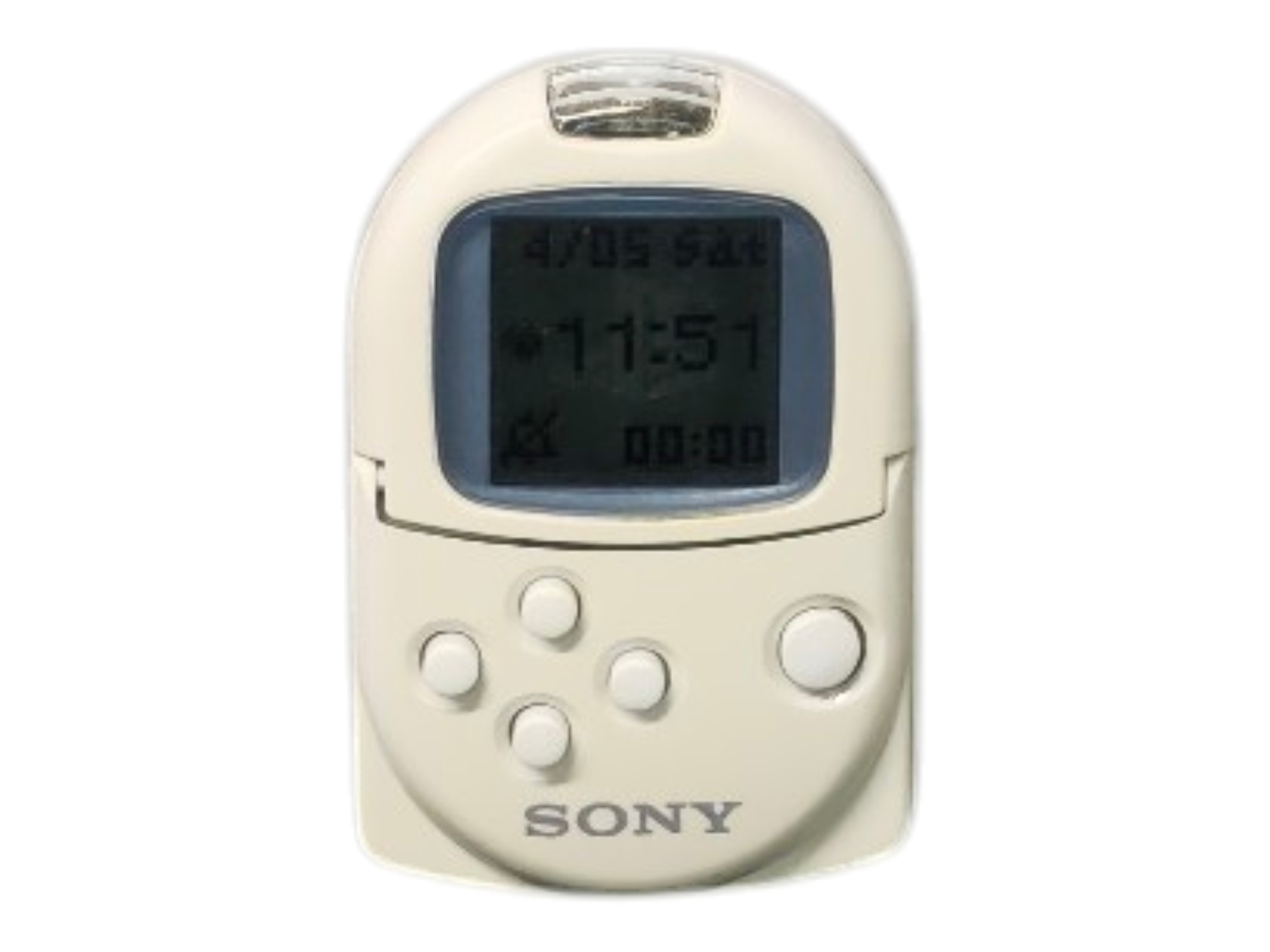
The Sony PocketStation SCPH-4000 White is one of the most unusual and innovative accessories created for the original PlayStation. Released exclusively in Japan in 1999, it combined the functionality of a conventional PlayStation Memory Card with a miniature handheld gaming system, a digital clock, and infrared communication capabilities.
Despite its extremely compact dimensions, the PocketStation featured a 32-bit ARM processor, a monochrome LCD screen, five control buttons, a miniature speaker, and its own battery-powered operating system.
Its ability to download compatible minigames from PlayStation titles and continue playing them independently made it an early example of connected console and portable gaming.
The original white SCPH-4000 represents the classic appearance of Sony’s remarkable miniature device and an important chapter in the history of the PlayStation ecosystem.
📘 Introduction
The Sony PocketStation was officially released in Japan on January 23, 1999, by Sony Computer Entertainment.
Its original Japanese retail price was approximately ¥3,000.
The device was developed as a companion accessory for the first-generation Sony PlayStation.
However, unlike an ordinary Memory Card, it contained its own processor, screen, buttons, and audio hardware.
This allowed it to operate independently after receiving compatible software from a PlayStation game.
The PocketStation was originally introduced in two standard colours:
- White — SCPH-4000
- Crystal — SCPH-4000C
Both versions shared the same fundamental hardware architecture.
The white version featured an opaque light-coloured enclosure consistent with the visual identity of many original PlayStation accessories.
The PocketStation became especially popular in Japan, where compatible games introduced new forms of interaction between home console gaming and portable entertainment.
Its most famous association was with Doko Demo Issyo, the game that introduced Toro Inoue, one of Sony’s best-known Japanese gaming characters.
🏭 The Birth of the PocketStation
During the late 1990s, Sony Computer Entertainment was enjoying extraordinary success with the original PlayStation.
Introduced in Japan in December 1994, the PlayStation had established itself as one of the leading home gaming platforms.
The rapidly expanding PlayStation software library also encouraged the development of new accessories.
Sony began exploring ways to extend the gaming experience beyond the television.
A New Kind of Memory Card
Conventional PlayStation Memory Cards allowed players to save progress and transfer data between compatible consoles.
The PocketStation expanded this concept considerably.
Instead of storing only saved data, it could also run small programs downloaded from compatible PlayStation games.
These programs could include:
- Minigames
- Virtual-pet activities
- Character interactions
- Portable challenges
- Supplementary game functions
Gaming Beyond the Television
The central idea was simple but innovative.
Players could start an experience on their PlayStation, transfer compatible content to the PocketStation, and continue interacting with it away from the console.
Some games allowed information or results to be transferred back to the main game.
This created a connection between two different forms of gaming.
A Japanese Exclusive
Although Sony explored the possibility of international distribution, the PocketStation was commercially released only in Japan.
Its popularity and limited early availability contributed to strong domestic demand.
The device subsequently became an attractive import for PlayStation enthusiasts in other countries.
⚪ The Original White Design
The SCPH-4000 White features a small opaque plastic enclosure with a distinctive miniature electronic-device appearance.
Unlike the Crystal version, which reveals portions of its internal construction through transparent plastic, the White edition presents a cleaner and more traditional exterior.
Design Features
- Opaque white plastic body
- Small monochrome LCD
- Five front control buttons
- PlayStation branding
- Hinged protective connector cover
- Integrated speaker
- Infrared communication window
- Red indicator LED
- Internal coin-cell battery compartment
- Strap attachment point
Its tiny dimensions made it suitable for carrying on a keychain, strap, or inside a pocket.
A Miniature PlayStation Companion
The white finish complemented the light-grey appearance of the original Japanese PlayStation and several official PlayStation accessories.
Its design communicated that the PocketStation belonged to the same product family.
A Distinctive Form Factor
The PocketStation was not designed to resemble a full-size handheld console.
Instead, it looked like an advanced Memory Card with a small display.
That appearance was central to its appeal.
It was simultaneously a console accessory, personal electronic gadget, and miniature gaming device.
⚙️ Technical Specifications
Despite its small size, the PocketStation contained a surprisingly capable hardware architecture.
Hardware Overview
- Manufacturer: Sony Computer Entertainment
- Product: PocketStation
- Model: SCPH-4000
- Official colour: White
- Release date: January 23, 1999
- Region: Japan
- Original retail price: Approximately ¥3,000
- CPU: ARM7T-family 32-bit RISC processor
- Processor frequency: Variable, up to approximately 7.995 MHz
- System RAM: 2 KB SRAM
- Flash memory: 128 KB
- Display: Monochrome LCD
- Screen resolution: 32×32 pixels
- Audio: Miniature PCM speaker
- Input: Five buttons
- Additional control: Reset button
- Communication: Bidirectional infrared
- Console connection: PlayStation Memory Card interface
- Power: One CR2032 3V lithium coin cell
- Additional functions: Clock, calendar, alarm, identification system
- Dimensions: Approximately 64 × 42 × 13.5 mm
- Weight: Approximately 30 g including battery
These characteristics made the PocketStation more sophisticated than a conventional memory storage accessory.
It contained most of the essential components of an independent miniature computer.
🧠 ARM7: A Complete Computer Inside a Memory Card
At the heart of the PocketStation was a 32-bit processor based on the ARM7 architecture.
ARM processors were designed to deliver efficient computing performance with relatively low power requirements.
These qualities made them suitable for compact, battery-powered electronic devices.
Processor Responsibilities
The PocketStation’s CPU handled:
- Executing downloaded software
- Reading button inputs
- Updating the LCD
- Producing sound
- Maintaining application logic
- Processing communication data
- Coordinating time-related functions
Why ARM Was Important
ARM technology would subsequently become central to smartphones, tablets, embedded computers, and many other portable electronic products.
The PocketStation represents an early example of a gaming accessory using an architecture that would become enormously influential.
Efficient Rather Than Powerful
The processor was not designed for complex 3D graphics or large game environments.
Its purpose was to execute small applications efficiently.
This reflected Sony’s goal of creating a miniature computing device that could operate from a single coin-cell battery.
🖥️ The 32×32 Monochrome Display
One of the PocketStation’s most recognisable features was its tiny LCD screen.
With a resolution of only 32×32 pixels, the display contained just 1,024 individual picture elements.
Display Characteristics
- Monochrome liquid crystal display
- 32×32 resolution
- No colour graphics
- No conventional backlight
- Compact low-power construction
- Suitable for simple animation and text
Designing Games for 1,024 Pixels
The extremely limited display required creative software design.
Developers used:
- Simple character sprites
- Minimalist animation
- Small symbols
- Compact numerical information
- Scrolling text
- Easily recognisable silhouettes
Expressive Characters
Even with such low resolution, developers could create memorable animated characters.
This was especially evident in virtual-pet and character-based applications.
A Distinctive Visual Identity
The monochrome screen became part of the PocketStation’s charm.
Its pixelated appearance connected it to earlier handheld electronic games while its software integration represented a much more advanced concept.
💾 Memory Card & Miniature Gaming System
The PocketStation’s most important function was its ability to operate as a PlayStation Memory Card.
The original PlayStation used removable memory cards to preserve game progress.
A standard card offered approximately 128 KB of flash storage, commonly organised into 15 usable save blocks.
The PocketStation used compatible flash memory technology while adding independent processing capabilities.
Memory Card Functions
When connected to a compatible PlayStation, the PocketStation could:
- Store saved game data
- Transfer saved information
- Receive compatible PocketStation applications
- Exchange information with supported games
- Manage memory usage
Shared Storage Capacity
The PocketStation’s flash memory was shared between downloaded applications and saved game data.
This meant that installing a minigame could reduce the space available for ordinary PlayStation saves.
A Two-Part Experience
A compatible game could transfer PocketStation software through the PlayStation Memory Card slot.
The player could then disconnect the device and use the downloaded application independently.
Depending on the game, data could later be transferred back.
Why This Was Revolutionary
The concept anticipated later systems in which portable devices and home consoles share game-related content.
Sony was experimenting with connected gaming years before modern companion apps and cloud-based gaming ecosystems became common.
🎮 Compatible Games & Software
The PocketStation was supported by a selection of PlayStation games, especially Japanese releases.
Its software library included standalone minigames, character applications, and supplementary features connected to larger PlayStation titles.
Notable associated games and applications included:
- Doko Demo Issyo
- Final Fantasy VIII – Chocobo World
- Pocket MuuMuu
- Pocket Dungeon
- SaGa Frontier 2
- Legend of Mana
- Tokimeki Memorial 2
- Metal Gear Solid: Integral
Support and available functions varied by individual software version and region.
More Than Conventional Games
Not every PocketStation application functioned as a complete independent game.
Some were designed to:
- Extend an existing PlayStation title
- Provide short portable activities
- Develop characters
- Transfer selected data
- Offer virtual-pet interaction
The Importance of Japanese Software
Because the PocketStation was officially released only in Japan, much of its software support was concentrated in Japanese games.
For collectors outside Japan, identifying compatible original software is an important part of experiencing the device authentically.
🐈 Doko Demo Issyo & the Birth of Toro Inoue
One of the most important games associated with the PocketStation is Doko Demo Issyo, released in Japan in 1999.
The game’s title can be translated approximately as Together Everywhere.
It introduced Toro Inoue, a white cat who became one of Sony’s most recognisable characters in Japan.
A Virtual Companion
Doko Demo Issyo focused on interacting with virtual characters.
The experience involved communication, personality, and simple daily activities.
PocketStation Integration
The PocketStation allowed elements of the experience to continue away from the PlayStation console.
This was particularly appropriate for a game based on companionship.
The Cultural Impact of Toro
Toro became a significant PlayStation character, appearing in later games, promotional campaigns, and merchandise.
The original PocketStation is therefore closely connected to an important part of Sony’s Japanese gaming culture.
Historical Importance
Doko Demo Issyo demonstrated that the PocketStation could support experiences based on interaction and emotional engagement rather than conventional action gameplay.
It remains one of the most historically significant PocketStation-compatible titles.
🐤 Final Fantasy VIII & Chocobo World
Another famous PocketStation application was Chocobo World, associated with Square’s Final Fantasy VIII.
The PlayStation game was released in 1999 and became one of the defining role-playing games of the era.
A Portable Final Fantasy Adventure
Chocobo World was a small companion game featuring a young Chocobo named Boko.
Players could explore a simplified world and participate in small activities.
PocketStation Features
The experience included:
- Portable exploration
- Automatic and interactive encounters
- Character progression
- Simple combat
- Item-related rewards
- Connections with the main PlayStation game
The Link to Final Fantasy VIII
Compatible game functionality allowed selected rewards or data to be transferred between the PocketStation and the main PlayStation game.
This created an additional gameplay dimension.
International Significance
Final Fantasy VIII helped introduce the PocketStation concept to audiences outside Japan, even though Sony did not officially launch the accessory internationally.
The PC version of Final Fantasy VIII also included a version of Chocobo World that could operate without the physical PocketStation.
An Important Collecting Connection
For PlayStation collectors, Chocobo World remains one of the best-known examples of the PocketStation’s unique functionality.
🔴 Infrared Communication
One of the PocketStation’s most unusual capabilities was its bidirectional infrared communication system.
Infrared technology allowed compatible devices to exchange information using light rather than a physical cable.
Infrared Capabilities
- Short-range communication
- Device-to-device data exchange
- Support for compatible applications
- Red LED activity indicator
- Communication between supported PocketStation software
The Importance of Physical Interaction
Infrared communication encouraged users to bring compatible devices together.
This created opportunities for local social interaction.
A Pre-Wireless Era
During the late 1990s, Bluetooth and Wi-Fi had not yet become standard features of consumer handheld gaming devices.
Infrared communication offered a comparatively inexpensive and efficient alternative.
Limitations
Infrared generally required the devices to be close together with suitable alignment.
It was not equivalent to modern wireless internet connectivity.
Nevertheless, the technology added a remarkable feature to such a small accessory.
🕹️ The Five-Button Control System
The PocketStation included five primary input buttons.
These consisted of:
- Up
- Down
- Left
- Right
- Select
A separate reset button was also provided.
Simple Controls
The arrangement was appropriate for the device’s small screen and compact software.
Rather than attempting to reproduce a full PlayStation controller, Sony chose a minimalist interface.
Portable Gaming Applications
The buttons could be used for:
- Navigating menus
- Moving characters
- Selecting commands
- Confirming actions
- Controlling minigames
A Different Gaming Philosophy
The PocketStation was not intended to reproduce full PlayStation games.
Its limited controls encouraged short, simple, and accessible experiences.
This made it particularly suitable for virtual pets, simple adventures, and companion applications.
🕒 Clock, Calendar & Alarm Functions
The PocketStation also functioned as a miniature personal electronic organiser.
Its integrated real-time clock provided basic time-related features independently of the PlayStation.
Built-In Functions
- Digital clock
- Calendar
- Alarm
- Date and time settings
- Time-based software functions
The Role of the Battery
The CR2032 battery powered the device when disconnected from the PlayStation.
This allowed the clock and compatible applications to continue operating.
A Miniature Personal Digital Assistant
Sony positioned the PocketStation as more than a gaming accessory.
Its clock, calendar, and communication capabilities gave it some characteristics associated with small personal digital assistants.
Why This Matters
During the 1990s, digital organisers and electronic keychain devices were increasingly popular.
The PocketStation combined that tradition with the PlayStation gaming ecosystem.
🔋 CR2032 Battery & Power Management
The PocketStation used a single CR2032 3V lithium coin-cell battery.
This small battery made independent portable operation possible.
Battery Characteristics
- CR2032 battery
- Nominal voltage of 3V
- Replaceable design
- Compact installation
- Suitable for low-power electronics
Battery Operation
The battery supported the clock, display, processor, and other functions when the device was disconnected from the PlayStation.
When inserted into a powered PlayStation, the PocketStation could receive power through the console connection.
Flash Memory Retention
The device’s flash storage did not require continuous battery power to preserve ordinary saved data.
This was an important distinction.
Removing an exhausted battery did not inherently erase the device’s flash memory contents.
However, time settings or temporary information could require resetting, and actively running software could be affected.
Long-Term Preservation
Collectors should inspect battery contacts and avoid leaving damaged cells inside the device.
The CR2032 should be replaced with a suitable equivalent when necessary.
🔄 PocketStation vs. Sega Dreamcast VMU
One of the PocketStation’s most interesting contemporary comparisons is the Sega Dreamcast Visual Memory Unit (VMU).
The Dreamcast launched in Japan in November 1998, shortly before the PocketStation’s commercial release.
Both products combined memory storage with miniature standalone gaming capabilities.
Sony PocketStation
- Released in January 1999
- 32×32 monochrome display
- ARM-based processor
- One CR2032 battery
- Infrared communication
- PlayStation Memory Card interface
- Five-button control layout
- Clock and calendar functions
Sega Dreamcast VMU
- Released with the Dreamcast in 1998
- 48×32 monochrome display
- Independent microcontroller
- Two CR2032 batteries
- Direct VMU-to-VMU connection
- Dreamcast controller integration
- Miniature games and display functions
Different Designs
The VMU was designed to fit into the Dreamcast controller.
The PocketStation connected through the PlayStation Memory Card slot.
A Shared Vision
Both devices anticipated a future in which a game could extend beyond the main console.
They remain among the most innovative gaming accessories of their generation.
🌍 Japanese Success & International Recognition
The PocketStation became an important commercial success in Japan.
It benefited from the enormous popularity of the original PlayStation and the country’s strong interest in portable electronics.
Launch Demand
The initial production allocation was limited relative to demand.
The device quickly attracted consumer interest.
A Japan-Only Product
Although international release plans were considered, the PocketStation was never officially introduced into European or North American retail markets.
Imported units nevertheless reached collectors and enthusiasts abroad.
Commercial Performance
Approximately 4.9 million PocketStation units were shipped in Japan before the product’s discontinuation in July 2002.
This figure covers the PocketStation family rather than the White edition alone.
An Important PlayStation Accessory
Its success demonstrated that consumers were interested in smaller, portable experiences connected to their home gaming systems.
The PocketStation became an unusual but memorable component of PlayStation history.
🛠️ Maintenance & Long-Term Reliability
The PocketStation is now a vintage electronic accessory.
Despite its relatively simple construction, several components may require inspection.
Common Maintenance Areas
- CR2032 battery contacts
- LCD screen
- Control buttons
- Protective connector cover
- PlayStation Memory Card contacts
- Infrared communication components
- Internal flash memory
- Speaker
- Enclosure and attachment point
Display Problems
Age-related LCD problems may include:
- Missing pixels or lines
- Reduced contrast
- Damaged display connections
- Physical screen damage
Connector Maintenance
The PlayStation connector is essential for transferring software and accessing saved data.
Dirty or damaged contacts may prevent reliable communication.
Battery Compartment
The battery compartment should be checked for corrosion or damaged contacts.
Protecting the White Enclosure
The opaque white plastic can develop:
- Scratches
- Discolouration
- Surface dirt
- Yellowing from age and environmental exposure
Gentle cleaning and protection from prolonged sunlight can help preserve its original appearance.
🏛️ Collectability & Historical Preservation
The white SCPH-4000 is an important collectible accessory from the original PlayStation generation.
It represents one of Sony’s earliest experiments in combining a home console with a miniature portable gaming device.
Important Collecting Details
- Original Sony PocketStation SCPH-4000
- White factory enclosure
- Functional monochrome LCD
- Original buttons
- Original connector cover
- Working Memory Card interface
- Functional infrared hardware
- Original packaging
- Instruction manual
- Original strap, when present
- Battery compartment condition
Originality
The White version should be documented under its correct model code, SCPH-4000.
It should not be confused with the Crystal SCPH-4000C.
Although the internal hardware is substantially identical, the separate model designations identify different factory colour variants.
Hardware Identification
PocketStation devices include an identification system.
Any visible device identification or serial information should be recorded separately from the official model number.
This can help document an individual museum unit.
Software Preservation
The PocketStation is especially interesting because its software was commonly obtained from compatible PlayStation game discs.
Preserving the original games, instructions, and downloaded applications helps explain how the accessory was intended to function.
⭐ Why the PocketStation SCPH-4000 Still Matters
The Sony PocketStation SCPH-4000 remains historically significant for several reasons:
- It combined a Memory Card with a miniature handheld computer
- It featured a 32-bit ARM processor
- It supported downloadable minigames
- It provided infrared communication
- It included a real-time clock and calendar
- It extended compatible PlayStation games beyond the television
- It helped introduce Toro Inoue through Doko Demo Issyo
- It represented Sony’s experimentation with portable gaming
- It anticipated connected gaming accessories and companion experiences
- It became a distinctive Japan-exclusive PlayStation product
The PocketStation demonstrates that technological innovation does not always require a large or powerful device.
Sometimes, the most memorable ideas emerge from compact products designed around a specific purpose.
📦 Items Included in This Collection Entry
- Sony PocketStation SCPH-4000 — White edition (Japan, 1999)
🏁 Conclusion
The Sony PocketStation SCPH-4000 White represents one of the most creative accessories developed for the original PlayStation.
By combining conventional Memory Card storage with independent processing, a monochrome display, downloadable minigames, infrared communication, and time-management features, Sony created a device that challenged the boundaries between console accessories and portable gaming systems.
Its connection to memorable titles such as Doko Demo Issyo and Final Fantasy VIII made it an important part of Japanese PlayStation culture.
The original white enclosure remains a recognisable example of Sony’s late-1990s industrial design, while its ARM-based architecture demonstrates how sophisticated computing technology could be incorporated into extraordinarily small consumer devices.
More than a quarter of a century after its introduction, the PocketStation continues to fascinate collectors and gaming historians.
A miniature PlayStation companion, a remarkable early connected-gaming device, and an essential piece of Sony’s portable entertainment history.
