

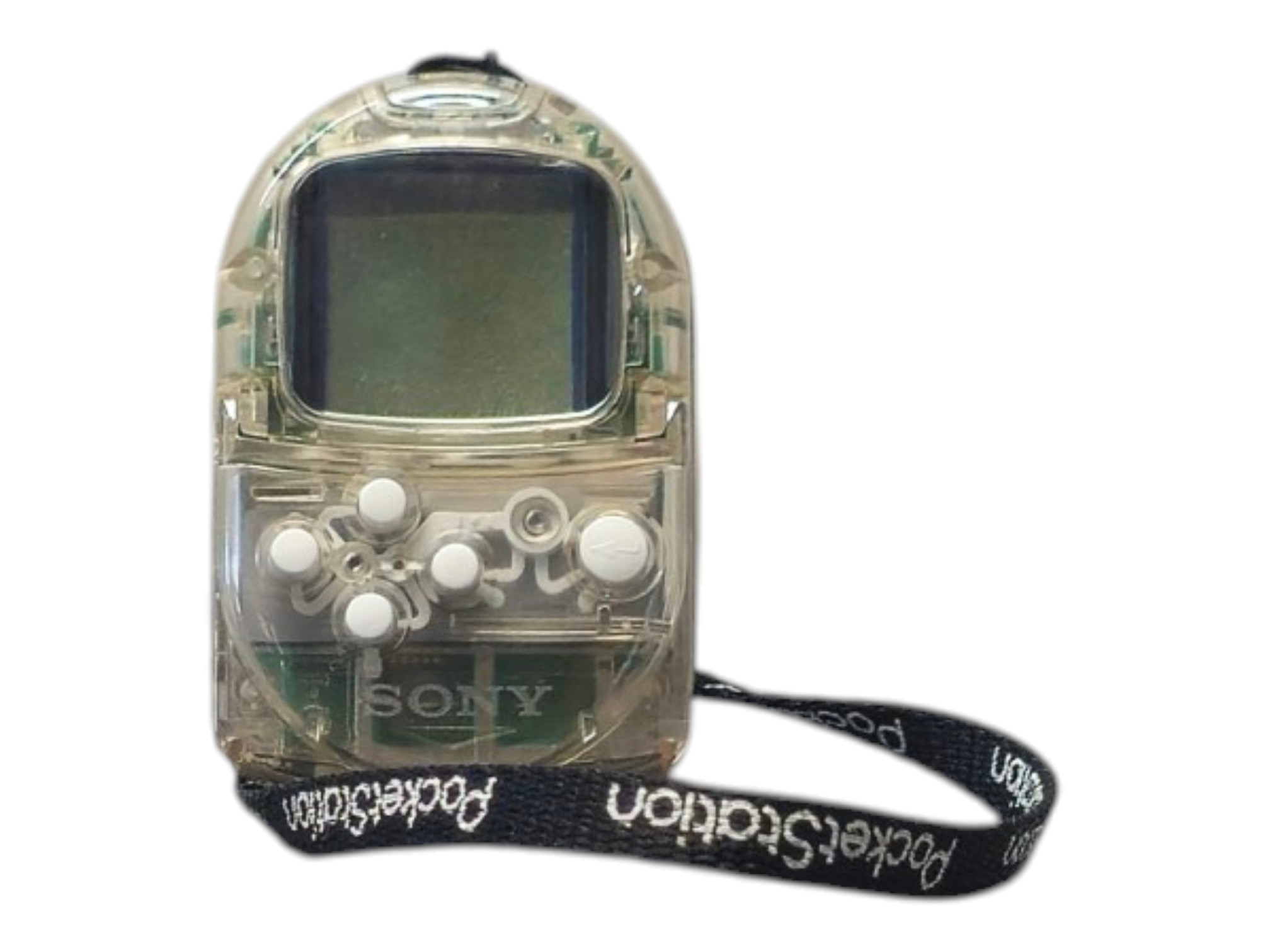
The Sony PocketStation SCPH-4000C Crystal is one of the most distinctive accessories of the original PlayStation era. Released in Japan on January 23, 1999, alongside the standard white edition, it combined the capabilities of a PlayStation Memory Card with a miniature handheld gaming system inside a striking transparent enclosure.
Its official Crystal finish reflects one of the most recognisable consumer electronics design trends of the late 1990s: transparent plastic products that allowed users to see the technology inside.
Featuring a 32-bit ARM processor, 32×32 monochrome LCD, 128 KB flash memory, infrared communication, and downloadable minigames, the PocketStation was far more sophisticated than an ordinary PlayStation storage accessory.
The Crystal SCPH-4000C preserved all the functionality of the original PocketStation while adding a distinctive visual identity.
Today, it remains an appealing collectible that represents both Sony’s experimentation with connected gaming and the transparent electronics aesthetic of the 1990s.
📘 Introduction
The Sony PocketStation SCPH-4000C was introduced by Sony Computer Entertainment on January 23, 1999, exclusively for the Japanese market.
It was one of the two standard PocketStation colour variations available at launch.
These were:
- SCPH-4000 — White
- SCPH-4000C — Crystal
The Crystal designation refers to the console’s transparent plastic enclosure.
Unlike the opaque white version, the Crystal model allows parts of the internal electronic construction to remain visible.
Both systems use the same underlying hardware architecture and support the same PocketStation software ecosystem.
An Innovative PlayStation Accessory
The PocketStation was developed to expand the capabilities of the original Sony PlayStation.
Its fundamental concept was to combine:
- Memory Card storage
- Independent handheld gaming
- Downloadable software
- Infrared communication
- Clock and calendar functionality
Compatible PlayStation games could transfer small applications to the device.
These applications could then be used away from the main console.
A Distinctive Collector’s Edition
Although the Crystal version was a standard commercial colour rather than a special limited edition, its transparent appearance gives it a distinctive identity.
It is particularly appealing to collectors interested in original manufacturer-produced transparent electronics.
🏭 The Origins of the PocketStation
During the late 1990s, the PlayStation had become one of the most successful gaming systems in history.
Sony Computer Entertainment was exploring ways to expand the platform beyond conventional controllers and Memory Cards.
The PocketStation emerged from this period of experimentation.
From Storage to Portable Gaming
A conventional PlayStation Memory Card was designed primarily to preserve saved game data.
The PocketStation expanded this function by adding independent computing hardware.
It could execute compatible applications without remaining connected to the main console.
A New Relationship Between Devices
Players could transfer a compatible application from a PlayStation game to the PocketStation.
Once disconnected, the handheld device could continue running that application.
In supported games, portable progress or rewards could later be transferred back.
The Idea Behind Connected Gaming
This approach anticipated several later developments, including:
- Portable companion games
- Connected console accessories
- Game-data transfer between devices
- Supplementary minigames
- Personalised virtual characters
- Cross-device entertainment
The PocketStation was particularly innovative because it achieved these functions using extremely limited hardware.
💎 The Crystal Design: Transparent Technology
The defining characteristic of the SCPH-4000C is its transparent Crystal enclosure.
Unlike the standard opaque white version, the Crystal model reveals elements of its internal structure.
Design Characteristics
- Transparent plastic enclosure
- Visible internal components
- Compact monochrome LCD
- Five control buttons
- Protective connector cover
- Infrared communication window
- Red LED indicator
- Miniature speaker
- Coin-cell battery compartment
- Strap attachment point
The Appeal of Transparent Electronics
Transparent electronics became particularly fashionable during the late 1990s.
Consumers were increasingly interested in products that displayed their internal components rather than concealing them.
This approach appeared in:
- Video game controllers
- Handheld consoles
- Computer peripherals
- Personal computers
- Portable electronic accessories
A Different Visual Identity
The Crystal PocketStation looks more technological than the standard white version because its internal construction forms part of the exterior appearance.
This does not provide additional processing power or gaming capabilities.
Instead, it changes how the device is perceived.
The transparent enclosure creates an immediate visual connection between the user and the electronic components inside.
🎨 The Transparent Electronics Trend of the 1990s
The Crystal PocketStation belongs to a broader design movement that became particularly visible during the late 1990s.
Manufacturers increasingly experimented with translucent and transparent plastic enclosures.
The Rise of Transparent Consumer Electronics
Important examples of this aesthetic included:
- Apple’s original iMac G3
- Transparent Nintendo Game Boy variations
- Clear PlayStation controllers
- Translucent computer accessories
- Limited-edition transparent gaming hardware
Technology as Part of the Design
Earlier electronics frequently concealed their internal components within opaque plastic or metal enclosures.
Transparent designs reversed this approach.
The internal electronics became part of the product’s visual character.
Why the Trend Became Popular
Transparent products communicated:
- Modernity
- Technological sophistication
- Playful industrial design
- Individuality
- Distinctive branding
The Crystal PocketStation’s Place in This Trend
The PocketStation’s miniature dimensions made the transparent design particularly effective.
Because the entire device was so small, the enclosure and internal circuit board formed a compact, visually interesting object.
For a technology museum, the Crystal edition provides an opportunity to explain how electronic design trends evolved during the late 1990s.
⚙️ Technical Specifications
The SCPH-4000C uses the same underlying technical architecture as the original white PocketStation.
Hardware Overview
- Manufacturer: Sony Computer Entertainment
- Product: PocketStation
- Model: SCPH-4000C
- Official colour: Crystal / Transparent
- Release date: January 23, 1999
- Region: Japan
- CPU: ARM7T-family 32-bit RISC processor
- Maximum CPU frequency: Approximately 7.995 MHz
- System memory: 2 KB SRAM
- Flash memory: 128 KB
- Display: Monochrome LCD
- Resolution: 32×32 pixels
- Audio: Miniature PCM speaker
- Controls: Five input buttons
- Reset: Dedicated reset button
- Communication: Bidirectional infrared
- LED: Red indicator
- Power: One CR2032 3V lithium coin-cell battery
- Console interface: PlayStation Memory Card connector
- Other features: Clock, calendar, alarm, identification system
- Dimensions: Approximately 64 × 42 × 13.5 mm
- Weight: Approximately 30 g including battery
Same Technology, Different Appearance
The Crystal edition does not provide a more advanced processor, larger display, or increased memory capacity.
Its distinction is primarily cosmetic.
This is important when documenting the two versions as separate museum exhibits.
They represent two original factory finishes of the same innovative hardware platform.
🧠 ARM7 Processing in a Miniature Device
The PocketStation contained a processor based on the ARM7 architecture.
This was a remarkable choice for such a compact gaming accessory.
The Role of the Processor
The ARM processor handled:
- Program execution
- LCD updates
- Button input
- Audio functions
- Communication
- Time-related functions
- Application data processing
Low-Power Computing
The processor was designed to operate efficiently in a battery-powered environment.
This helped make it practical to run small applications using a single coin-cell battery.
A Connection to Modern Technology
ARM architecture would later become extraordinarily influential.
Processors based on ARM technology are now widespread in smartphones, tablets, embedded computers, and numerous consumer electronics products.
The PocketStation is therefore an interesting early gaming-related example of the architecture’s wider potential.
Hardware Beyond Its Appearance
Although the PocketStation looks like a small electronic accessory, its internal architecture makes it a genuine miniature programmable computing system.
That distinction is central to its historical importance.
🖥️ The 32×32 Pixel Display
The Crystal PocketStation includes a compact 32×32-pixel monochrome LCD.
Its extremely limited resolution required software developers to work with small, carefully designed graphical elements.
Display Characteristics
- 1,024 pixels
- Monochrome graphics
- Compact physical dimensions
- Low-power operation
- Simple text and icon display
- Small animated characters
Why the Screen Was So Small
The PocketStation was not intended to reproduce the complete PlayStation gaming experience.
Its applications were designed around the capabilities of a keychain-sized device.
Creating Character from a Few Pixels
The limited display encouraged developers to create expressive sprites using very little graphical information.
Small facial expressions, character movements, and icons became important communication tools.
A Historical Computing Challenge
The PocketStation demonstrates how software design can overcome severe graphical restrictions.
Creating enjoyable interactive experiences within 32×32 pixels required a very different approach from developing games for television displays.
💾 PlayStation Memory Card Functionality
The PocketStation was designed to operate as a conventional PlayStation Memory Card while adding portable computing capabilities.
Flash Storage
The device contained approximately 128 KB of flash memory.
This was organised around the original PlayStation Memory Card system.
Save Blocks
Standard PlayStation Memory Cards provided 15 usable save blocks.
The PocketStation used compatible storage organisation.
Shared Application Storage
Downloaded PocketStation programs also occupied the available memory.
Consequently, installing portable applications could reduce the space available for ordinary saved games.
Connecting to a PlayStation
The PocketStation could be inserted into the original PlayStation Memory Card slot.
The protective connector cover opened to expose the connection.
Transferring Software
Compatible games could send applications and data to the device.
After transferring the application, the player could remove the PocketStation and use it independently.
Preserving Saved Data
Saved data in flash memory was non-volatile.
This meant that ordinary stored data did not automatically disappear when the device’s CR2032 battery was removed or exhausted.
For collectors, this is particularly important when replacing old batteries.
🎮 PocketStation Games & Software
The Crystal edition supports the same PocketStation-compatible software as the White edition.
There was no separate Crystal-exclusive game library associated with the standard SCPH-4000C hardware.
Notable compatible games and applications included:
- Doko Demo Issyo
- Final Fantasy VIII – Chocobo World
- Pocket MuuMuu
- Pocket Dungeon
- SaGa Frontier 2
- Legend of Mana
- Tokimeki Memorial 2
- Metal Gear Solid: Integral
The Software Distribution Model
PocketStation applications were generally distributed through compatible PlayStation games.
A user would load the PlayStation game and transfer the appropriate portable application.
Different Types of Content
PocketStation software could include:
- Small adventures
- Virtual-pet simulations
- Character interactions
- Portable rewards
- Supplemental game activities
- Simple minigames
No Built-In Catalogue of Major Games
The PocketStation was not a conventional standalone console with a large library permanently installed at the factory.
Most of its gaming appeal came from compatible software transferred through the PlayStation.
Regional Considerations
Because the device was officially sold only in Japan, Japanese PlayStation software provided the strongest support.
Some international PlayStation releases retained PocketStation-related functionality, but compatibility varied.
🐈 Doko Demo Issyo & Toro Inoue
One of the most important games in PocketStation history is Doko Demo Issyo.
Released in Japan in 1999, it introduced Toro Inoue, a small white cat who later became one of Sony’s best-known Japanese characters.
A New Kind of Entertainment
Rather than focusing on fast action, the game emphasised interaction with virtual characters.
The experience involved:
- Communication
- Personalisation
- Character development
- Everyday activities
- Portable interaction
The PocketStation Connection
The PocketStation allowed elements of the experience to continue away from the television.
This reinforced the game’s theme of companionship.
Why Toro Became Important
Toro developed into a recognisable character associated with PlayStation culture in Japan.
The character appeared in later games, promotional activities, and merchandise.
The Crystal Edition
The SCPH-4000C offered exactly the same Doko Demo Issyo compatibility as the White version.
For collectors, the transparent enclosure provides an alternative visual presentation of the original hardware used with the game.
🐤 Final Fantasy VIII: Chocobo World
One of the most internationally recognisable PocketStation features was Chocobo World, connected to Final Fantasy VIII.
The original Final Fantasy VIII was released for PlayStation in 1999.
Its PocketStation functionality allowed players to experience a small independent adventure.
The Chocobo World Concept
The minigame featured Boko, a young Chocobo.
The portable adventure included simplified gameplay designed for the PocketStation’s tiny display.
Gameplay Features
- Character movement
- Encounters
- Exploration
- Progression
- Rewards
- Data exchange with the main game
A Connected Gameplay Experience
The PocketStation could receive game-related information from Final Fantasy VIII.
Compatible data could later be returned to the main PlayStation game.
A Remarkable Innovation
The concept anticipated later cross-platform features that allow players to continue interacting with a game through a secondary device.
International Awareness
Although the PocketStation remained a Japan-only product, Final Fantasy VIII helped make the device familiar to gamers around the world.
Chocobo World remains one of the clearest demonstrations of the PocketStation’s original purpose.
🔴 Infrared Communication
The SCPH-4000C includes a bidirectional infrared communication system.
This technology allows compatible devices to exchange information using infrared light.
Infrared Features
- Short-range communication
- Device-to-device interaction
- Compatible software data exchange
- Red LED activity indication
- Communication without a physical cable
A Social Feature
Infrared communication could support interaction between users of compatible devices and applications.
This encouraged local physical interaction.
Before Bluetooth Became Universal
During the late 1990s, modern wireless networking technologies had not yet become standard features in portable consumer electronics.
Infrared provided a practical alternative for short-range data exchange.
Limitations
Infrared communication required suitable proximity and orientation.
It was not a general-purpose internet connection.
Preservation Importance
For a complete hardware inspection, the infrared transmitter and receiver should be checked where compatible test software is available.
The transparent enclosure does not change the device’s infrared communication specifications.
🕹️ The Five-Button Control System
The Crystal PocketStation uses five primary input buttons.
These include:
- Up
- Down
- Left
- Right
- Select
A separate reset button is also present.
Why Only Five Buttons?
The PocketStation was intended to run compact software rather than full PlayStation games.
Its simplified controls were appropriate for:
- Menu navigation
- Small character movement
- Confirming commands
- Selecting game options
- Navigating digital clock functions
Compact Ergonomics
The extremely small enclosure required the controls to be arranged carefully.
The device was designed for short interactions rather than prolonged action gaming sessions.
A Personal Electronic Gadget
The resulting form factor was closer to a miniature digital organiser than a conventional handheld console.
This was part of the PocketStation’s distinctive identity.
🕒 Clock, Calendar & Personal Functions
The PocketStation included a real-time clock.
This allowed the system to offer basic personal electronic functions.
Available Features
- Digital clock
- Date display
- Calendar
- Alarm settings
- Time-related software functions
- Device identification information
An Early Digital Companion
These features reflected Sony’s ambition to make the device useful beyond ordinary game-save storage.
Time-Based Activities
Certain compatible applications could use time-related information as part of their behaviour.
The PDA Connection
Sony described the PocketStation as a combination of Memory Card and miniature personal digital assistant.
The inclusion of clock and calendar functions reinforced this positioning.
The device was an early experiment in merging entertainment with everyday electronic functions.
🔋 Battery Operation & Data Preservation
The SCPH-4000C uses one CR2032 3V lithium coin-cell battery.
The battery powers the device when it is disconnected from the PlayStation.
Battery Functions
- Processor operation
- LCD display
- Audio functions
- Real-time clock
- Infrared communication
- Portable applications
Independent Operation
With a suitable battery installed, the PocketStation can operate as a miniature handheld electronic device.
Non-Volatile Storage
Ordinary flash memory contents do not depend on the CR2032 battery to remain stored.
This helps preserve saved data during battery replacement.
However, clock settings and temporary running information may require attention after battery removal.
Preservation Considerations
The battery compartment should be inspected for:
- Corrosion
- Damaged contacts
- Broken cover components
- Incorrect battery installation
Coin-Cell Safety
CR2032 batteries must be handled carefully.
They present a serious ingestion hazard to children and should be stored securely away from them.
For museum displays, the battery compartment should remain closed and inaccessible to visitors.
🔄 SCPH-4000C Crystal vs. SCPH-4000 White
The two standard PocketStation editions were introduced together in 1999.
They share almost identical technical specifications.
Sony PocketStation SCPH-4000 White
- Opaque white enclosure
- Japanese-market release
- Original 1999 hardware
- ARM7-based processor
- 32×32 monochrome LCD
- 128 KB flash memory
- Infrared communication
- CR2032 battery
- PlayStation Memory Card compatibility
Sony PocketStation SCPH-4000C Crystal
- Transparent Crystal enclosure
- Japanese-market release
- Original 1999 hardware
- ARM7-based processor
- 32×32 monochrome LCD
- 128 KB flash memory
- Infrared communication
- CR2032 battery
- PlayStation Memory Card compatibility
The Main Difference
The principal distinction is the factory enclosure colour and material appearance.
The White model conceals the internal electronics behind opaque plastic.
The Crystal model makes parts of the hardware visible.
No Performance Advantage
The Crystal edition does not inherently offer:
- Faster processing
- More memory
- Higher-resolution graphics
- Better battery life
- Additional infrared functionality
- Exclusive software compatibility
Why Both Versions Are Important
The two versions reflect Sony’s decision to offer different visual identities for the same innovative device.
For collectors, owning both provides a more complete representation of the original standard PocketStation product range.
🌀 PocketStation vs. Sega Dreamcast VMU
The PocketStation is frequently compared with Sega’s Dreamcast Visual Memory Unit, commonly known as the VMU.
Both devices emerged during the late 1990s and combined memory storage with miniature independent gaming functionality.
PocketStation
- PlayStation accessory
- Released in 1999
- 32×32 monochrome screen
- ARM-based processor
- One CR2032 battery
- Infrared communication
- Direct PlayStation Memory Card connection
Dreamcast VMU
- Dreamcast accessory
- Released in 1998
- 48×32 monochrome screen
- Independent processing hardware
- Two CR2032 batteries
- Direct device-to-device connection
- Integration with the Dreamcast controller
Different Approaches
Sega designed the VMU to operate both inside the Dreamcast controller and independently.
Sony developed the PocketStation around the existing PlayStation Memory Card system.
A Shared Historical Vision
Both companies were exploring how home console experiences could extend into portable accessories.
The devices remain important examples of creative hardware experimentation during the late 1990s.
🌏 Japanese Popularity & Commercial History
The PocketStation was commercially released only in Japan.
Its launch followed the enormous success of Sony’s first PlayStation.
Strong Demand
Initial supplies were limited, and the device quickly attracted attention.
Its popularity was supported by compatible games and the broader PlayStation software ecosystem.
A Japan-Exclusive Accessory
Sony considered releasing the PocketStation internationally.
However, official distribution remained limited to Japan.
Worldwide Recognition
Despite its domestic release, the device became familiar to international gaming enthusiasts through:
- Japanese game imports
- Gaming magazines
- PlayStation fan communities
- Final Fantasy VIII
- Online collector communities
Commercial Results
Approximately 4.9 million PocketStation units were shipped in Japan before production ended in July 2002.
This total covers the broader PocketStation family, not the Crystal colour individually.
A Lasting Japanese Gaming Icon
The PocketStation retains a distinctive place in Japanese PlayStation history.
Its popularity demonstrated the appeal of miniature digital companions and connected game experiences.
🛠️ Build Quality & Longevity
The Crystal edition requires many of the same maintenance considerations as the standard white version.
However, its transparent enclosure creates additional cosmetic preservation challenges.
Important Maintenance Areas
- LCD display
- Control buttons
- Connector contacts
- Battery compartment
- Infrared communication components
- Speaker
- Internal flash memory
- Protective connector cover
- Strap attachment point
Transparent Plastic Ageing
Clear plastic can change appearance over time.
Possible problems include:
- Yellowing
- Surface scratching
- Cloudiness
- Cracks
- Discolouration
- Damage from sunlight exposure
Preserving Transparency
The Crystal enclosure is one of the device’s most important identifying characteristics.
Collectors should avoid harsh solvents, abrasive cleaning products, and prolonged direct sunlight.
Internal Dust & Debris
Because the enclosure is transparent, dust and small particles inside the device may be more visible.
This can affect its cosmetic appearance without necessarily affecting functionality.
Display Condition
The LCD should be inspected for missing pixels, damaged connections, or reduced contrast.
Connector Cover
The protective cover is a distinctive mechanical feature of the PocketStation.
A missing or damaged cover can affect both appearance and usability.
For collectors, an intact original cover is an important part of a well-preserved example.
🔍 Identifying an Authentic SCPH-4000C
The most important identification detail of the Crystal version is its official model designation.
SCPH-4000C identifies the standard transparent Crystal PocketStation.
Important Identification Details
- Sony branding
- PocketStation product identity
- SCPH-4000C model designation
- Transparent enclosure
- Original control layout
- 32×32 LCD
- PlayStation Memory Card connection
- Japanese-market hardware
Different from Other Transparent Variants
Sony also released or supported other PocketStation-related colours and special variations.
Collectors should not confuse the standard Crystal version with later or special-colour products.
The original SCPH-4000C is the standard clear model released alongside the White edition.
The Importance of Model Numbers
Accurate model identification helps distinguish:
- Official factory variations
- Replacement shells
- Later special editions
- Modified units
- Incorrectly described products
Individual Identification
The PocketStation also includes an identification system.
If an identification number is visible on the device or through its software, it should be recorded separately from the official SCPH model number.
For museum documentation, this helps distinguish individual physical units.
🏛️ Collectability & Historical Preservation
The Crystal SCPH-4000C is an appealing collectible because it combines innovative hardware with a distinctive transparent design.
It represents two important aspects of late-1990s consumer electronics:
- The development of connected gaming accessories
- The popularity of transparent industrial design
Important Collecting Factors
- Original SCPH-4000C unit
- Clear factory enclosure
- Original buttons
- Original LCD
- Functional Memory Card connector
- Protective connector cover
- Working infrared system
- Battery compartment condition
- Original packaging
- Instruction documentation
- Original strap, if present
Condition of the Transparent Shell
The plastic enclosure is particularly important when evaluating a Crystal edition.
Clear, undamaged plastic preserves the original visual character.
Yellowing, cracks, and deep scratches can significantly change its appearance.
Original vs. Replacement Parts
Replacement enclosures or repaired components can help maintain functionality.
However, original factory components are important for historical authenticity.
Software Preservation
The PocketStation’s gaming functions depend heavily on compatible software.
Preserving original PlayStation games and their associated PocketStation applications is essential to understanding the complete experience.
A Valuable Museum Comparison
Displaying the Crystal version alongside the White SCPH-4000 allows visitors to compare two original commercial finishes of the same hardware.
This demonstrates how industrial design can create substantially different visual impressions without changing the underlying technology.
⭐ Why the PocketStation SCPH-4000C Still Matters
The Crystal PocketStation remains important for several reasons:
- It preserves the hardware innovation of the original PocketStation
- It represents an authentic 1999 factory colour variation
- Its transparent enclosure reflects a major design trend of the era
- It combines PlayStation storage with portable gaming
- It uses a 32-bit ARM processor
- It supports downloadable minigames
- It includes infrared communication
- It preserves a unique Japanese PlayStation experience
- It connects to important games such as Doko Demo Issyo and Final Fantasy VIII
- It represents Sony’s early experiments with connected portable entertainment
Technology & Design Together
The Crystal edition demonstrates that hardware design is not only about technical specifications.
Appearance can become an important part of a product’s identity and historical legacy.
A Window into 1990s Electronics
Its transparent enclosure makes the device particularly suitable for explaining the construction of miniature consumer electronics.
A Distinctive PlayStation Collectible
As one of the two original standard PocketStation colours, the Crystal edition occupies a clear position within Sony’s hardware history.
It is both a gaming accessory and a memorable example of late-1990s product design.
📦 Items Included in This Collection Entry
- Sony PocketStation SCPH-4000C — Crystal / Clear edition (Japan, 1999)
🏁 Conclusion
The Sony PocketStation SCPH-4000C Crystal represents an unusual combination of technological innovation and distinctive industrial design.
Released in Japan in 1999, it brought the capabilities of a PlayStation Memory Card, miniature handheld computer, and portable gaming accessory together inside a transparent plastic enclosure.
Its ARM-based processor, small monochrome LCD, infrared communication system, and compatibility with downloadable PlayStation minigames made it a remarkable product for its time.
The Crystal enclosure added a memorable visual identity, reflecting the transparent electronics trend that became popular during the late 1990s.
Although its hardware capabilities were identical to those of the standard White edition, its appearance made it an equally important part of the original PocketStation range.
Through games such as Doko Demo Issyo and Final Fantasy VIII, the device also demonstrated how home console entertainment could extend into portable experiences.
More than a quarter of a century after its release, the Crystal PocketStation remains a fascinating reminder of Sony’s willingness to experiment with unconventional gaming hardware.
A transparent miniature PlayStation companion, a remarkable piece of late-1990s industrial design, and an essential collectible from Sony’s experimental portable gaming era.
