

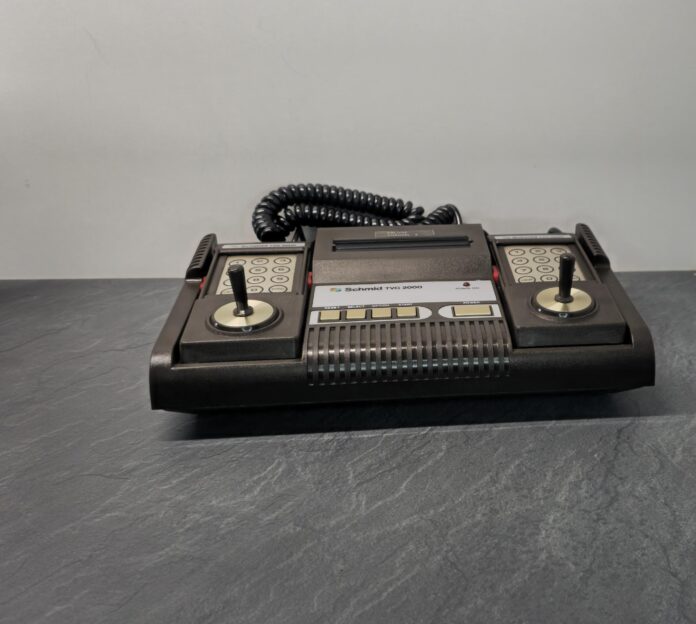

The Schmid TVG 2000 is a vintage Pong-style home console manufactured in Germany during the late 1970s, at the height of the European first-generation gaming boom. Produced by Schmid, a company known for electronic toys and educational devices, the TVG 2000 stands out as one of the more uncommon and distinctive European Pong systems. Its clean industrial design, multiple game variations, and reliable build quality made it a compelling alternative to better-known consoles from Interton, Universum, or Hanimex.
Today, the Schmid TVG 2000 is a rare and highly collectible system, appreciated by retro enthusiasts for its scarcity, unique styling, and place in Germany’s early video game history.
📘 Introduction
The late 1970s saw a surge in dedicated Pong consoles across Europe. Hundreds of manufacturers released systems powered by the same family of General Instrument AY-3-8500 chips, each offering their own styling and slight variations in game selection.
The Schmid TVG 2000 belongs to this era and offers:
-
Multiple built-in Pong variants
-
Hardwired paddle controls
-
High-quality German construction
-
Simple plug-and-play functionality
-
Classic CRT RF output
Although not as widely distributed as consoles from bigger electronics brands, the TVG 2000 is admired for its durability and minimalist design.
🎨 Classic Late-’70s German Design
The Schmid TVG 2000 features:
-
A sturdy plastic chassis, often in silver/grey and black tones
-
Two integrated paddle controllers with smooth rotary knobs
-
Control switches and reset options on the top panel
-
Large on/off and game selection toggles
-
Clear “TVG 2000” branding
The design strikes a balance between functional simplicity and the retro aesthetic typical of German consumer electronics from the time.
🎮 Built-In Pong Variants
As with most AY-3-8500–based systems, the TVG 2000 includes a collection of classic sports games — each a twist on the foundational Pong mechanics.
Common Built-In Games
-
Tennis — the standard Pong match
-
Football / Soccer — multiple paddles per team
-
Squash — ball bouncing off a side wall
-
Practice / Solo mode
-
Target shooting (if light gun model exists; varies by revision)
Models without a light gun stick strictly to paddle-based sports modes.
⚙️ Hardware & Controls
The Schmid TVG 2000 is straightforward to operate, featuring:
Key Features
-
Two built-in analogue paddle controls
-
Rotary potentiometers for smooth movement
-
Game selection switches
-
Adjustable ball speed or paddle size (depending on model)
-
Reset / Start / Serve buttons
-
RF output for PAL CRT televisions
-
Battery or external AC adapter power
The hardware design emphasizes reliability and minimalism.
📺 Video Output
The console outputs classic first-generation visuals:
-
Black-and-white graphics
-
RF signal (PAL) tuned on old TVs
-
Crisp, minimal visuals with the characteristic Pong grid
Collectors often pair it with vintage German or European CRT televisions for the most authentic display.
🛠️ Reliability & Common Issues
Despite being over four decades old, many TVG 2000 units still function, as the internal circuitry is extremely simple.
Common age-related issues include:
-
Dirty or jittery paddle potentiometers
-
Corroded battery terminals
-
Oxidised switch contacts
-
Loose RF cable
-
Slight discoloration/yellowing of casing
-
Sound output crackling (chip or speaker aging)
Most problems are easy to repair with basic tools and contact cleaner.
🌍 Cultural & Historical Significance
The Schmid TVG 2000 holds a place in European gaming history as:
-
A representative of Germany’s domestic electronics scene
-
A member of the large family of AY-3-8500–based consoles
-
A precursor to the programmable systems that followed (Interton VC 4000, Philips Videopac, Atari 2600)
-
A symbol of the era when video games first entered European homes
-
A collectible today due to its relative scarcity outside Germany
It’s an important reminder of how widespread and diverse first-generation gaming truly was.
📦 Items Included in This Collection Entry
-
Built-in paddle controllers
-
RF cable
-
Power adapterOriginal box
-
Instruction manual
📜 Conclusion
The Schmid TVG 2000 is a wonderfully preserved piece of early video game history. With its classic German styling, reliable AY-3-8500 chipset, and family-friendly Pong games, it remains a delightful and collectible example of the first generation of home consoles.
For any retro collector — especially those focused on European gaming history — the TVG 2000 is a rare and valuable addition.