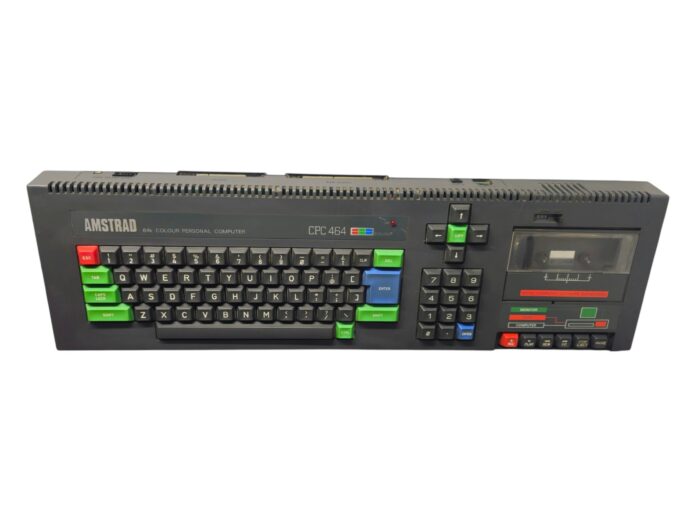
The Amstrad CPC 464 is one of the most iconic home computers of the 1980s. Affordable, reliable, and beautifully integrated, it brought colour graphics, quality sound, and easy programming into millions of homes across Europe. As the first model of the CPC line, the 464 became a cultural touchstone for gamers, students, and early computer enthusiasts.
📘 Introduction
Released in 1984, the Amstrad CPC 464 was designed as a complete, user-friendly system that could compete with the ZX Spectrum, Commodore 64, and other major 8-bit platforms of the time. Its philosophy was simple: offer everything a user needs in one package.
In an era of messy wiring and external tape decks, Amstrad created a clean, streamlined machine that felt truly modern.
🎮 A Fully Integrated Home Computer
The CPC 464’s biggest innovation was its all-in-one design. Amstrad bundled:
- The computer with a full-size keyboard
- A built-in cassette tape deck
- A dedicated colour or green monitor
- Power supplied directly through the monitor
This meant no external tape players, no loose wires, and no complicated setup — just plug it in and start computing.
The simplicity and strong build quality helped the CPC 464 become one of the top-selling European computers of the decade.
📼 Cassette Deck: Slow, Charming, Essential
Unlike later models, the 464 used a built-in cassette deck for loading programs and games. Though slower than floppy disks, cassettes were cheap, widely available, and massively supported by publishers.
Advantages included:
- Affordable software
- Convenient built-in controls (play, stop, fast-forward, rewind)
- No need for an external tape recorder
- High compatibility across Europe
Loading screens, iconic sounds, and the suspense of “will it load?” shaped the childhood of millions.
🎨 Graphics & Sound
Powered by the Zilog Z80A running at 4 MHz, the CPC 464 offered strong 8-bit performance with excellent video and audio capabilities for its time.
Graphics Modes
- Mode 0: 160×200, 16 colours
- Mode 1: 320×200, 4 colours
- Mode 2: 640×200, 2 colours
Sound
- 3-channel AY-3-8912 sound chip
- Capable of melodic chiptunes and rich audio effects
The CPC’s colourful palette and crisp display stood out in the crowded 8-bit home computing market.
🎮 Games & Software Library
The CPC 464 enjoyed a massive library of software, including hundreds of games optimized specifically for tape. Popular titles include:
- Harrier Attack
- Roland in Time / Roland in Space
- Bomb Jack
- Bruce Lee
- Sorcery
- Barbarian
- Gauntlet
- The Sentinel
The system also supported educational programs, creative tools, and early productivity software.
⌨️ Programming & Learning
Like the 6128, the 464 used Locomotive BASIC, widely regarded as one of the most powerful and user-friendly BASIC dialects of its generation. It allowed easy access to:
- Graphics commands
- Sound programming
- Memory management
- File handling on tape
For many young users, the CPC 464 was their first introduction to real programming.
🛠️ Build Quality & Longevity
The Amstrad CPC 464 is famous for its durability. Even after decades, many units still work flawlessly with minimal maintenance. The built-in tape deck often requires only:
- Belt replacement
- Head cleaning
- Manual alignment
Compared to other systems of the era, the CPC hardware aged remarkably well.
🌍 Popularity Across Europe
The 464 was a massive success, especially in:
- The UK
- France (where Amstrad dominated the market)
- Spain
- Germany
- Greece and Cyprus
- Australia and New Zealand
It became a household favourite and shaped a generation of home computing culture.
🧩 Why the CPC 464 Still Matters
Collectors and retro fans continue to love the 464 because:
- It represents the beginning of the CPC line
- Its design is iconic and instantly recognisable
- Tape-based gaming carries unique nostalgic charm
- It has a large, active fan community
- Hardware, mods, and modern expansions remain readily available
Whether you’re gaming on original cassette or using modern SD adapters, the CPC 464 remains a joy to use.
📦 Items Included in This Collection Entry
- Amstrad CPC 464 unit (PAL)
- Original monitor
📜 Conclusion
The Amstrad CPC 464 is more than just an 8-bit home computer — it’s a symbol of an era. Its colourful display, built-in cassette deck, and user-friendly design introduced millions of people to gaming, creativity, and programming.
Nearly 40 years later, its charm and cultural impact remain stronger than ever.
A true classic, and an essential part of any retro computing collection.