

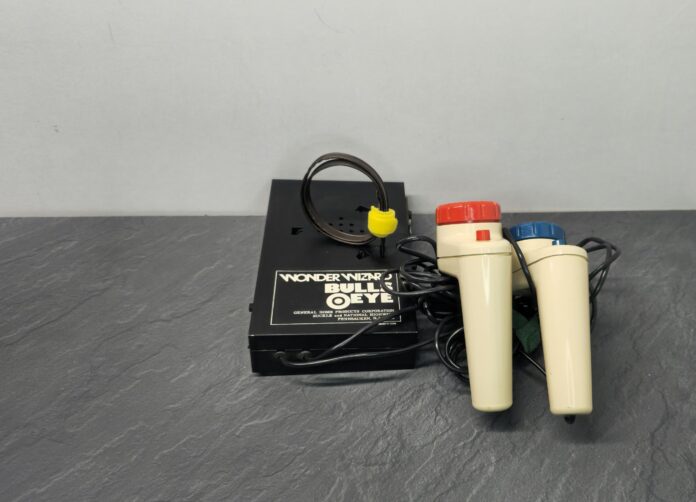

The Magnavox Wonder Wizard Bull’s Eye, released in the mid-1970s, is part of the historic Wonder Wizard line — a series of licensed Pong consoles produced by General Home Products (GHP) in collaboration with Magnavox, the company credited with inventing the very first home video game console: the Odyssey (1972).
The Bull’s Eye edition is one of the most iconic and collectible variants, offering multi-game Pong action in a stylish, woodgrain-finished shell that reflects the design sensibilities of the era. For collectors, this system represents a direct connection to the birth of home gaming.
📘 Introduction
The Wonder Wizard line capitalized on the massive success of Pong and Magnavox’s early home consoles. At a time when video games were still a novelty, Magnavox partnered with GHP to offer a range of models that were:
-
affordable
-
easy to use
-
designed for mainstream families
-
compatible with the growing craze of TV-based games
The Bull’s Eye model stood out thanks to its clean layout, its balanced selection of Pong game variations, and its striking visual style.
🎨 Retro Woodgrain Design
The Wonder Wizard Bull’s Eye features the classic 1970s aesthetic:
-
Woodgrain veneer across the top
-
Cream/beige-colored plastic body
-
Two silver paddle dials embedded on the console
-
Clearly labeled game selection switches
-
Bold “Wonder Wizard Bull’s Eye” branding
Its design is both nostalgic and unmistakably vintage, making it a perfect display piece for retro collections.
🎮 Built-In Pong Variants
Like many Pong consoles of its time, the Bull’s Eye includes several ball-and-paddle game modes, typically powered by a General Instrument AY-3-8500 chipset.
Common Games Include:
-
Tennis (Pong)
-
Hockey (two paddles per side)
-
Squash (one-player rebound game)
-
Practice / Solo mode
These games — simple but endlessly playable — defined the first generation of home video entertainment.
⚙️ Hardware & Controls
The Bull’s Eye integrates everything into a single unit:
Key Features
-
Two built-in paddle controllers
-
Rotary knobs for smooth analog movement
-
Game selection switches for mode and difficulty
-
On-screen scoring
-
Channel 3/4 RF output
-
Battery power or AC adapter (varies by version)
The analog paddles are very responsive, offering a surprisingly precise gameplay experience even decades later.
🔊 Audio & Video Output
The console outputs:
-
Black-and-white video (typical of Pong-era systems)
-
Simple bleeps and click sounds generated by the chipset
-
RF output requiring CRT tuning
When paired with a vintage CRT television, the experience feels authentically 1970s.
🛠️ Reliability & Common Issues
The Wonder Wizard Bull’s Eye is generally robust, but may experience:
-
Oxidized paddle potentiometers
-
Static or interference in RF output
-
Battery compartment corrosion
-
Yellowing of plastic surfaces
-
Internal wiring fatigue from age
Fortunately, repairs are straightforward thanks to simple circuitry.
🌍 Cultural & Historical Significance
The Wonder Wizard line holds an important place in gaming history:
-
Produced under license from Magnavox, pioneers of home gaming
-
Part of the post-Odyssey explosion of Pong systems
-
Helped bring video games into mainstream American households
-
Represents early commercial experimentation in TV gaming
-
A highly collectible artifact from the pre–Atari 2600 era
The Bull’s Eye variant, in particular, is one of the more sought-after models due to its striking design and direct Magnavox lineage.
📦 Items Included in This Collection Entry
📜 Conclusion
The Magnavox Wonder Wizard Bull’s Eye is a beautiful and historically significant Pong console from one of the founding companies of home video gaming. With its classic woodgrain design, built-in paddles, and iconic game modes, it offers a nostalgic window into the earliest days of gaming — long before cartridges, discs, and downloads.
A must-have collectible for enthusiasts of pre-crash and first-generation gaming history.