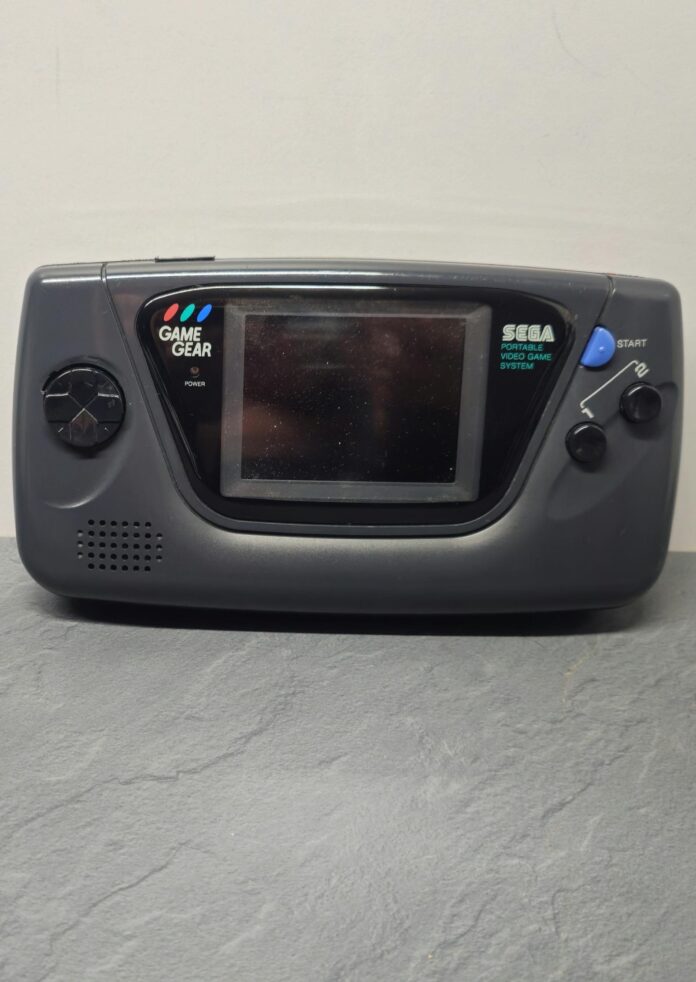
The Sega Game Gear, released in 1990 (Japan) and 1991 (worldwide), was Sega’s bold attempt to bring full-colour, TV-like gaming to the handheld market. With its bright backlit screen, impressive 8-bit performance, and library of arcade-quality titles, the Game Gear stood as the most technologically advanced handheld of its era — a vibrant alternative to Nintendo’s monochrome Game Boy.
Although it never matched the Game Boy in sales, it built a passionate fanbase and remains one of the most iconic portable systems of the 16-bit generation.
📘 Introduction
During the early ’90s handheld wars, Sega sought to stand out with power and visual impact. The Game Gear delivered:
- A full-colour, backlit screen
- Landscape orientation (similar to modern handhelds)
- A strong 8-bit architecture based on the Master System
- TV tuner and accessories
It was, in many ways, ahead of its time — but at the cost of battery life.
Today, it’s a beloved collectible and an important piece of Sega history.
🎨 Full-Colour Backlit Display
The Game Gear’s biggest advantage was its vibrant screen:
- 3.2-inch active matrix LCD
- Full colour
- Backlit for play in any lighting
- Perfect for arcade-style games
In an era dominated by monochrome handhelds, the Game Gear display felt revolutionary.
⚙️ 8-Bit Power Based on the Master System
Internally, the Game Gear shared much of its architecture with the Sega Master System, including:
- Zilog Z80 CPU @ 3.58 MHz
- Strong 2D sprite and scrolling capabilities
- High-quality FM-style audio (via PSG sound chip)
This allowed for:
- Smooth action games
- Large sprites
- Accurate ports of Master System classics
- Impressive arcade conversions
Some games were direct Master System ports, while others were tailored to the smaller screen.
🔥 Strong Game Library
The Game Gear library includes a mix of original titles, Master System adaptations, and arcade conversions.
Sega First-Party Highlights
- Sonic the Hedgehog (1, 2, Triple Trouble)
- Shining Force: The Sword of Hajya
- Columns
- OutRun
- Streets of Rage
Third-Party & Licensed Titles
- Mortal Kombat
- Disney platformers (Aladdin, Lion King)
- Ninja Gaiden
- Castle of Illusion & Land of Illusion
Unique & Underrated Gems
- GG Shinobi
- Defenders of Oasis
- Ax Battler
- Ristar
Despite a smaller library compared to the Game Boy, the Game Gear delivered many memorable experiences.
📺 Accessories & Expansion Options
The Game Gear had several innovative add-ons:
- TV Tuner — watch live TV on your handheld
- Master Gear Converter — play Sega Master System cartridges
- Rechargeable battery packs
- Car adapters and AC adapters
The Master Gear Converter, in particular, dramatically expanded the console’s library.
🔋 Battery Life — The Famous Weakness
With great power came great battery consumption:
- Requires 6 AA batteries
- Typically lasts 3–5 hours
Players relied heavily on:
- AC adapters
- Car adapters
- Rechargeable battery packs
Despite the short life, the trade-off was a bright, colourful, backlit screen decades before Nintendo adopted the same feature.
🛠️ Build Quality & Common Issues
The Game Gear is famously known for capacitor-related failures due to aging components.
Common issues include:
- No sound or distorted audio
- Dim or dead screen
- Power issues
- Faint image / washed out colours
Almost all units today benefit from:
- Full capacitor recap
- LCD screen mod (IPS upgrade) for modern brightness and clarity
- Sound board repair
Once restored, the Game Gear becomes significantly more enjoyable and reliable.
🌍 Cultural Impact
The Game Gear remains adored for:
- Its bold approach to handheld gaming
- Bringing full-colour action to the portable world
- Strong Sega brand identity
- Memorable Sonic titles
- Unique accessories and TV tuner “wow factor”
It represents a time when Sega pushed boundaries and prioritised innovation over compromise.
📦 Items Included in This Collection Entry
📜 Conclusion
The Sega Game Gear is a colourful icon of the 1990s — ambitious, stylish, and technologically impressive. While it couldn’t outlast the Game Boy in sales or battery life, it carved out a unique place in gaming history with its vibrant display, Master System power, and Sega’s unmistakable charm.
Today, the Game Gear is a collector favourite, especially when restored with modern screen mods.
A bold portable pioneer — and an essential part of any Sega or retro handheld collection.