
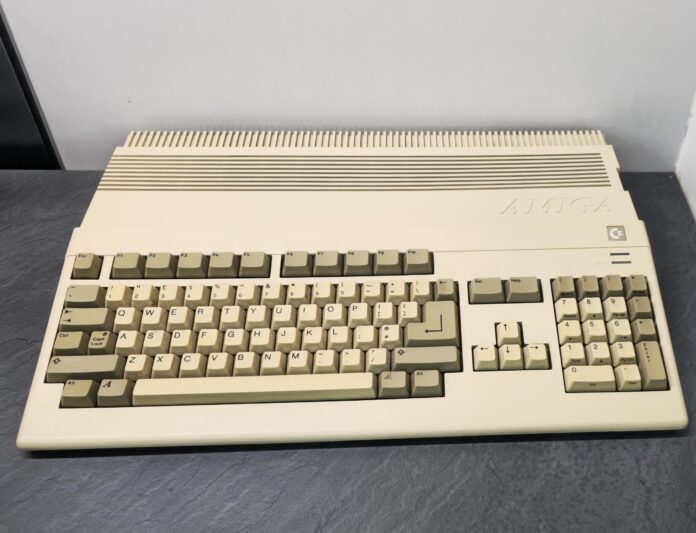

The Commodore Amiga 500 is one of the most iconic home computers ever made. Launched in 1987, it brought unprecedented graphics, sound, and multitasking capabilities to the mainstream market — setting new standards for gaming, creativity, and productivity. For many users around the world, the Amiga 500 became the heart of their childhood and a symbol of the golden age of home computing.
📘 Introduction
The Amiga 500 was the first mass-market model of the Amiga line, designed to offer cutting-edge performance at an affordable price. While the earlier Amiga 1000 targeted professionals and enthusiasts, the A500 aimed directly at the home user — and it became a runaway success.
With its advanced custom chipset, huge software library, and sleek, compact design, the Amiga 500 quickly grew into a global phenomenon and one of the best-selling 16-bit systems in history.
🎨 Advanced 16-Bit Graphics
What made the Amiga 500 revolutionary was its powerful custom chip architecture:
-
Agnus – handles graphics, blitter operations, and DMA
-
Denise – manages the display and colour output
-
Paula – delivers audio and manages disk I/O
These chips allowed the Amiga to produce visual effects far beyond typical home computers of the era.
Graphics Capabilities
-
Up to 4096 colours (HAM mode)
-
Hardware sprites
-
Smooth scrolling
-
Blitter-accelerated graphics
-
Advanced screen modes for animation and gaming
This enabled rich, arcade-quality visuals unmatched by most competitors.
🎧 Iconic 4-Channel Stereo Sound
The Amiga’s audio performance was equally impressive:
-
4-channel PCM stereo sound
-
Up to 28 kHz sample playback
-
Digitized speech, realistic effects, and music
For many musicians, composers, and demoscene creators, the Amiga became a dream machine.
🎮 A Gaming Powerhouse
The Amiga 500 dominated European gaming in the late ’80s and early ’90s. Its combination of fast CPU, custom chips, and disk-based software made it the perfect gaming platform.
Some legendary titles include:
-
Shadow of the Beast
-
The Secret of Monkey Island
-
Sensible World of Soccer
-
Turrican II
-
Lemmings
-
Lotus Esprit Turbo Challenge
-
Worms
-
Another World
-
Cannon Fodder
-
Pinball Dreams / Pinball Fantasies
These games defined the Amiga’s legacy and remain classics to this day.
⌨️ Workbench: A True OS Ahead of Its Time
The Amiga 500 ran AmigaOS, a combination of:
-
Kickstart ROM
-
Workbench GUI
-
Multitasking kernel
Decades ahead of its competition, AmigaOS offered:
-
True pre-emptive multitasking
-
Windows, icons, menus
-
Robust file management
-
Fast booting from Kickstart
For many users, this was their first experience with a modern graphical operating system.
💾 Storage & Memory
The A500 came with:
-
512 KB RAM (expandable to 1 MB or more via trapdoor)
-
Internal 3.5″ floppy drive
-
External floppy support
-
Hard-drive expansions through sidecar expansion port
The 512 KB “trapdoor RAM” upgrade became one of the most popular add-ons of the 1990s.
🛠️ Build Quality & Expandability
The Amiga 500 is famous for its sturdy case, reliable hardware, and strong expandability options:
-
Side expansion port for hard drives & accelerators
-
Trapdoor slot for RAM and clock modules
-
External floppy drive port
-
RGB, Composite, and RF video outputs
-
Joystick & mouse ports
Even today, the A500 supports modern enhancements like SD-based storage, OCS/ ECS upgrades, HDMI adapters, and accelerator boards.
🌍 Cultural Impact
The Amiga 500 became a cultural icon, especially in:
-
UK
-
Germany
-
Greece & Cyprus
-
Italy
-
France
-
Scandinavia
-
Australia
The demoscene, a creative community producing real-time art and music demonstrations, flourished on the Amiga and still thrives today.
The machine influenced:
-
Game development
-
Digital art
-
Early computer music
-
Animation (even used in TV production)
-
Productivity computing
It wasn’t just a home computer — it was a creative platform.
🧩 Why the Amiga 500 Still Matters
Today, the Amiga 500 is beloved because:
-
It offers some of the best retro gaming experiences ever made
-
Its demos and music still amaze audiences
-
The community remains extremely active
-
Hardware and software expansions continue to release
-
It represents the peak of 16-bit home computing
For collectors and enthusiasts, it remains a must-have system.
📦 Items Included in This Collection Entry
-
Commodore Amiga 500 (PAL)
-
Official PSU
📜 Conclusion
The Commodore Amiga 500 is a timeless legend — a machine that combined power, creativity, and fun like no other system of its era. With stunning graphics, superior sound, and a vast software library, it became the centerpiece of home computing for millions.
More than 35 years later, the A500 remains one of the most important and beloved retro computers ever made.
A treasure for collectors — and an unforgettable part of computing history.