

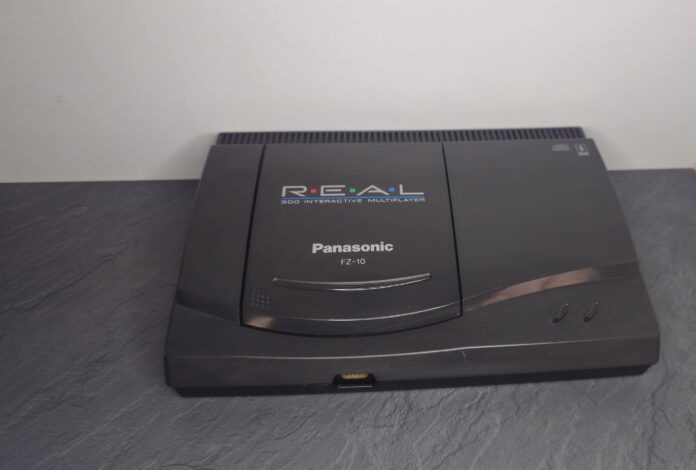

The Panasonic 3DO FZ-10, released in 1993 (with the top-loading FZ-10 revision arriving in 1994), is one of the most unique and forward-thinking consoles of the early 1990s. Part of the ambitious 3DO Interactive Multiplayer platform, the FZ-10 combined multimedia capabilities, CD-based storage, and advanced 32-bit graphics years before PlayStation and Saturn dominated the market. Though not commercially successful, the 3DO remains a fascinating piece of gaming history — bold, experimental, and packed with standout titles.
📘 Introduction
The 3DO was conceived by The 3DO Company, founded by Electronic Arts co-founder Trip Hawkins. Unlike traditional consoles, the 3DO was not tied to a single manufacturer — any company could licence the hardware and release its own version. Panasonic produced the most successful models, including the original FZ-1 and the later FZ-10.
The Panasonic 3DO FZ-10 is a sleeker, more affordable, top-loading redesign of the platform, fixing several issues from the original while offering the same multimedia experience.
🛠️ Sleek Top-Loading Redesign
The FZ-10 introduced improvements that made the system more user-friendly:
-
Top-loading CD drive (more reliable than FZ-1’s motorized tray)
-
Slimmer, more compact shell
-
Simplified front layout
-
Built-in memory manager
-
Quieter operation
Its durability and clean design make it the preferred 3DO model among collectors.
⚙️ 32-Bit Multimedia Power
The 3DO FZ-10 was a powerhouse in 1993, offering:
-
32-bit ARM60 RISC CPU @ 12.5 MHz
-
Custom graphics processors for texture mapping & scaling
-
CD-ROM storage for large, multimedia-rich games
-
Full-motion video (FMV) playback
-
High-quality stereo sound
Although technologically advanced, its high launch price limited consumer adoption.
🎮 Innovative Controller Design
The 3DO controllers featured:
-
Daisy-chaining support (plug controllers into each other)
-
Directional pad
-
A/B/C buttons
-
Shoulder buttons
-
Long cable for living-room play
The daisy-chain system removed the need for multiple front ports.
🔥 A Library of Cult Classics
The 3DO library is smaller than mainstream consoles but contains several standout titles that pushed the limits of early CD gaming.
Must-Play Games
-
Gex
-
The Horde
-
Road Rash
-
Star Control II
-
Super Street Fighter II Turbo
-
Shock Wave / Shock Wave 2
-
Killing Time
FMV & Experimental Titles
-
Mad Dog McCree
-
Night Trap
-
The Daedalus Encounter
-
Jurassic Park Interactive
The 3DO became a playground for early 3D graphics and cinematic storytelling.
🎥 Full-Motion Video (FMV) Era
The 3DO embraced FMV content more than most consoles of its time:
-
Interactive movies
-
Live-action cutscenes
-
Digitized actors
-
High-quality video playback compared to Sega CD/PC-FX
This became a signature characteristic of the platform — dated today, but revolutionary in the early ’90s.
🎵 Audio Quality
The 3DO boasted impressive sound capabilities:
-
16-bit, 44.1 kHz stereo audio (CD quality)
-
Support for Red Book audio tracks
-
Highly immersive sound in games like The Horde and Road Rash
🧩 Common Issues & Reliability
The FZ-10 is generally more reliable than the FZ-1 thanks to the top-loading mechanism.
Typical age-related issues include:
-
Laser misalignment
-
Sticky lid mechanism
-
Capacitors aging (moderate risk)
Overall, the FZ-10 is one of the most durable early CD consoles.
🌍 Cultural & Historical Impact
The 3DO FZ-10 is remembered for:
-
Introducing bold multimedia concepts
-
Being one of the first true 32-bit consoles
-
Showcasing early 3D gaming before PlayStation/Saturn
-
Serving as an experimental bridge between 16-bit and 32-bit eras
Though commercially unsuccessful, it influenced future console design and CD-based gaming evolution.
📦 Items Included in This Collection Entry
-
Panasonic 3DO FZ-10 (Japanese)
-
3DO controller
📜 Conclusion
The Panasonic 3DO FZ-10 is a fascinating artifact of gaming history — a console built on vision, ambition, and early multimedia innovation. With its sleek design, top-loading reliability, and unique game library, it remains a beloved collector’s piece and an important milestone in the evolution of CD-based gaming.
A distinctive, stylish console that continues to capture the imagination of retro enthusiasts.