
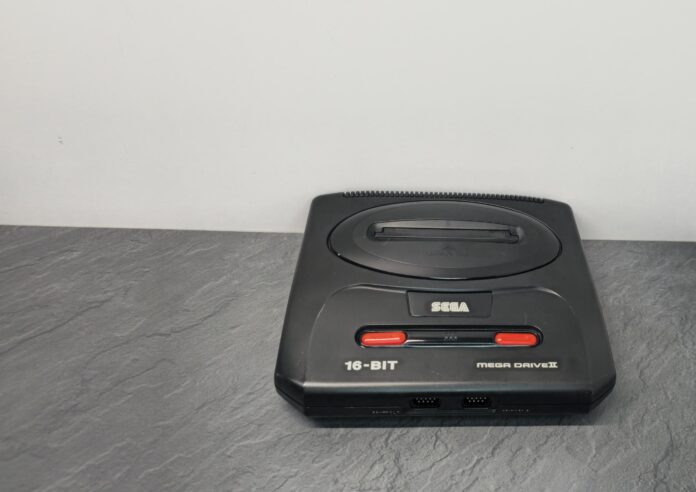

The Sega Mega Drive II, released in 1993, is the streamlined and modernised successor to Sega’s original 16-bit console. Slimmer, more affordable, and paired with a redesigned AV system, the Mega Drive II continued Sega’s dominance in the European and South American markets while bringing classics like Sonic 2, Streets of Rage 2, and Aladdin to millions of homes.
While the original Mega Drive is known for its bold, futuristic aesthetic, the Mega Drive II became the iconic version for an entire generation — especially in Europe.
📘 Introduction
By the early 1990s, Sega wanted a cost-reduced, simplified version of the Mega Drive to:
-
compete with the rising popularity of the Super Nintendo
-
reduce manufacturing costs
-
create a smaller, more modern-looking console
-
bundle with new hit titles
The result was the Mega Drive II — a more compact, consumer-friendly system that continued Sega’s 16-bit legacy deep into the mid-1990s.
🎨 Compact, Minimalist Redesign
The Mega Drive II sports a sleek, refined look:
-
Slim, rectangular shape
-
Central cartridge slot
-
New “SEGA” and “16-BIT” branding
-
Simple Power & Reset buttons
-
No more front headphone jack
-
Relocated AV and power ports at the back
It maintained Sega’s characteristic black colour, but with a cleaner, more minimal appearance than the original model.
⚙️ Refined 16-Bit Hardware
Although the internal architecture remained largely the same, some components were redesigned or consolidated:
-
Motorola 68000 CPU @ 7.67 MHz
-
Zilog Z80 @ 3.58 MHz (sound / backward compatibility)
-
Similar graphics capabilities to Model 1
-
Customised AV encoder (often Yamaha or ASIC variants)
-
Single expansion port for Mega-CD II
The video output varies by revision — some Mega Drive II units produce exceptionally clean RGB, while others use cost-reduced encoders that slightly soften the image.
🎧 Sound Differences
Compared to the original Mega Drive 1:
-
The YM2612 FM sound chip is still present
-
Audio output is mixed differently
-
Some revisions sound cleaner, others more compressed
For many fans, the Model 1 remains the “audiophile” Mega Drive, but the Model II still delivers the signature FM sound Sega is famous for.
🔥 A Golden Era of 16-Bit Classics
The Mega Drive II era saw the release of Sega’s strongest first-party library.
Legendary Games
-
Sonic the Hedgehog 2 (often bundled with the console)
-
Sonic 3 & Sonic & Knuckles
-
Streets of Rage 2 & 3
-
Golden Axe II
-
Shining Force II
-
Gunstar Heroes
-
Ecco: The Tides of Time
-
Comix Zone
Arcade Ports
-
Mortal Kombat (uncensored on Sega!)
-
Street Fighter II’: Special Champion Edition
-
OutRun 2019
-
Virtua Racing (SVP chip)
Europe & Brazil Standouts
Because the Mega Drive II thrived in PAL regions, many late releases and TecToy variations kept the platform alive for years.
🎮 Controllers & Accessories
The Mega Drive II shipped with the classic 3-button controller, but Sega soon standardised the:
-
6-button controller — essential for fighting games
-
Mega-CD II — redesigned to match the smaller console
-
32X — Sega’s add-on for pseudo-32-bit gaming
All Model 1 accessories remain compatible.
📺 Video Output
The Mega Drive II offers:
-
RGB SCART (PAL models) — excellent quality
-
Composite video
-
Mono audio
Because there is no headphone jack, stereo audio requires the AV out or SCART cable.
Image quality depends on board revision, but most PAL Mega Drive II units produce sharp, colourful video.
🛠️ Build Quality & Reliability
The Mega Drive II is highly reliable:
-
Durable plastic shell
-
Simple internal layout
-
Long-lasting capacitors
-
Cartridge slot rarely fails
Common minor issues:
-
Slightly lower audio fidelity on some revisions
-
Power port wear
-
32X and Mega-CD connection alignment (if used)
Overall, it is one of the most reliable 16-bit consoles ever produced.
🌍 Cultural Impact
The Mega Drive II is the version that defined Sega for millions of players:
-
Dominant in Europe, Australia, Greece, and Brazil
-
More widely distributed than the original Model 1
-
Became a cultural symbol of the early–mid 1990s
-
Still beloved in Brazil thanks to TecToy production
For many, the Mega Drive II is the Mega Drive — the model they grew up with.
📦 Items Included in This Collection Entry
📜 Conclusion
The Sega Mega Drive II is a sleek and accessible redesign of Sega’s iconic 16-bit console. Compact, reliable, and bundled with some of the best games of the era, it represents the golden age of Sega for millions of fans around the world.
Today, it remains a highly collectible piece of gaming history — a timeless reminder of the console wars, the rise of Sonic, and the power of 16-bit gaming.